
What Does “Another Way to Say Hit the Ground Running” Mean?

The phrase “hit the ground running” is an idiom that means to begin a task, job, project, or activity with energy and purpose. It often suggests that someone starts making progress immediately instead of spending a long time getting prepared.
For example, a manager might say, “We need someone who can hit the ground running.” This means the company wants a person who can begin contributing quickly with little training or adjustment.
The expression is common in American workplace English, resumes, interviews, business conversations, and project discussions. However, because it is an idiom, you may want a clearer or more professional alternative in formal writing.
Why Use Other Ways to Say “Hit the Ground Running”?
Using another expression can make your writing more precise and appropriate for the situation. Although “hit the ground running” is natural, it can sound somewhat informal or repetitive when used too often.
Consider an alternative when you want to:
- Make your writing more professional.
- Avoid repeating the same workplace idiom.
- Emphasize quick action or immediate progress.
- Describe strong performance from the beginning.
- Make a resume statement more direct.
- Use clearer language in formal business writing.
- Match your wording to an interview or workplace setting.
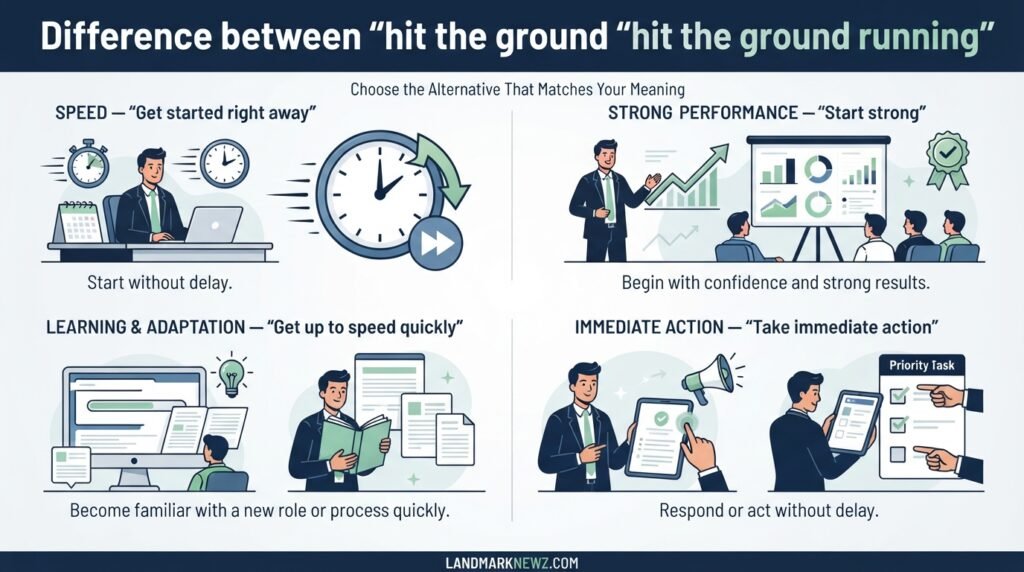
The key is to choose an expression that preserves the meaning you actually want. Some alternatives focus on speed, while others emphasize confidence, preparation, or early results.
10 Best Other Ways to Say “Hit the Ground Running”

1. Start Strong
Meaning
“Start strong” means beginning a task, role, or project with confidence, energy, and a good level of performance. It is shorter and more direct than “hit the ground running.”
Best For
- Professional
- Formal
- Friendly
Example 1
The new marketing team started strong and exceeded its first-month goals.
Example 2
I want to start strong in my new role by building good relationships with the team.
Quick Tip
Use “start strong” when you want to emphasize a successful beginning rather than simply speed.
2. Get Started Right Away
Meaning
“Get started right away” focuses on beginning without unnecessary delay. It is one of the clearest alternatives because almost any reader can understand it immediately.
Best For
- Professional
- Casual
- Friendly
Example 1
Once the materials arrive, we can get started right away.
Example 2
She reviewed the project brief and got started right away.
Quick Tip
Choose this phrase when immediate action is more important than describing high performance.
3. Get Off to a Fast Start
Meaning
“Get off to a fast start” describes beginning an activity quickly and making early progress. It works especially well when discussing projects, campaigns, sales, or other measurable efforts.
Best For
- Professional
- Casual
- Friendly
Example 1
The sales team got off to a fast start during the first quarter.
Example 2
Our new campaign got off to a fast start after the launch.
Quick Tip
Use this phrase when you want to highlight strong early momentum.
4. Jump Right In
Meaning
“Jump right in” means starting a task immediately and becoming actively involved. It has an energetic, conversational feel and often suggests enthusiasm.
Best For
- Casual
- Friendly
- Professional
Example 1
After a brief introduction, Maria jumped right in and helped the team organize the event.
Example 2
I was excited to jump right in and begin working on the new design.
Quick Tip
This phrase is natural in conversations and workplace messages but may be too casual for a highly formal report.
5. Get Up to Speed Quickly
Meaning
“Get up to speed quickly” means learning the information, skills, or processes needed to perform effectively. Unlike “hit the ground running,” it specifically emphasizes becoming familiar with a new situation.
Best For
- Professional
- Formal
- Friendly
Example 1
The training program helped me get up to speed quickly in my new position.
Example 2
She got up to speed quickly and soon handled customer requests independently.
Quick Tip
Use this option when the original phrase refers to learning a new role, system, or process.
6. Take Immediate Action
Meaning
“Take immediate action” emphasizes responding or doing something without delay. It sounds more formal and serious than “hit the ground running.”
Best For
- Professional
- Formal
Example 1
The operations team took immediate action when the system detected an issue.
Example 2
Managers should take immediate action when customer concerns require urgent attention.
Quick Tip
Use this phrase for situations involving urgency, decisions, problems, or responsibilities rather than ordinary onboarding.
7. Make an Immediate Start
Meaning
“Make an immediate start” means beginning a task or activity promptly. It has a formal tone and can work well when describing plans, schedules, or professional responsibilities.
Best For
- Professional
- Formal
Example 1
The consultant was ready to make an immediate start on the project.
Example 2
Our team can make an immediate start once the client approves the proposal.
Quick Tip
This option is useful in formal business writing when you want to avoid an idiomatic expression.
8. Get Things Moving Quickly
Meaning
“Get things moving quickly” means beginning work and creating progress without unnecessary delays. It focuses on momentum and action rather than individual performance.
Best For
- Professional
- Casual
- Friendly
Example 1
The project manager helped get things moving quickly after the kickoff meeting.
Example 2
We need a clear plan to get things moving quickly and meet the deadline.
Quick Tip
Use this phrase when talking about a team, project, or process rather than describing one person’s ability.
9. Start Making Progress Immediately
Meaning
“Start making progress immediately” clearly communicates that someone begins producing results soon after starting. It is especially useful when you want a professional alternative with no idiomatic meaning.
Best For
- Professional
- Formal
Example 1
The new employee started making progress immediately after completing the initial training.
Example 2
Our development team started making progress immediately once the requirements were finalized.
Quick Tip
This is a strong choice for resumes, reports, and business documents because it directly emphasizes results.
10. Get the Ball Rolling
Meaning
“Get the ball rolling” means starting an activity, conversation, project, or process. It emphasizes initiating something rather than necessarily performing at a high level from the beginning.
Best For
- Casual
- Friendly
- Professional
Example 1
Let’s get the ball rolling by reviewing the project timeline.
Example 2
The kickoff meeting helped get the ball rolling on our new community program.
Quick Tip
Use this expression when you mean “start the process,” not necessarily “perform effectively from day one.”
Comparison Table
| Alternative | Best Used In | Tone |
| Start strong | Work, resumes, interviews | Professional |
| Get started right away | Everyday and workplace communication | Clear |
| Get off to a fast start | Projects, sales, campaigns | Energetic |
| Jump right in | Conversations and team settings | Casual |
| Get up to speed quickly | New jobs and processes | Professional |
| Take immediate action | Urgent or formal situations | Formal |
| Make an immediate start | Business writing and plans | Formal |
| Get things moving quickly | Projects and teamwork | Practical |
| Start making progress immediately | Resumes and professional writing | Direct |
| Get the ball rolling | Meetings and projects | Casual |
Common Mistakes

1. Using “hit the ground running” in every professional situation
The idiom sounds natural, but repeating it can make workplace writing feel predictable. Choose a direct alternative when you need greater variety or precision.
2. Using a casual expression in formal writing
“Jump right in” and “get the ball rolling” are conversational. For a formal report, consider “take immediate action” or “make an immediate start.”
3. Confusing speed with performance
Not every alternative means exactly the same thing. “Get started right away” emphasizes speed, while “start strong” suggests a capable or successful beginning.
4. Using “get up to speed” when no learning is involved
“Get up to speed quickly” usually relates to gaining knowledge or becoming familiar with a role or process. It may not be the right choice when you simply mean starting a task.
5. Using an idiom when clarity matters more
Idioms can make writing engaging, but direct wording often works better in resumes, formal reports, and business documents. Say exactly what the person did when the specific action matters.
Frequently Asked Questions
What is another way to say “hit the ground running” professionally?
Professional alternatives include “start strong,” “start making progress immediately,” “get up to speed quickly,” and “make an immediate start.” The best choice depends on your intended meaning. For a resume, “start making progress immediately” clearly communicates early results, while “get up to speed quickly” works well for adapting to a new role.
What does “hit the ground running” mean at work?
At work, “hit the ground running” means starting a new job, project, or responsibility with energy and making progress quickly. It can also suggest that someone needs little time to adjust before contributing. Employers often use the phrase when describing candidates who can become productive soon after joining a team.
What is a good alternative to “hit the ground running” on a resume?
“Start making progress immediately” is a strong resume-friendly alternative because it focuses on results rather than an idiom. You can also use phrases such as “contribute immediately,” “deliver results quickly,” or “make an immediate impact” when those statements accurately describe your experience and achievements.
Is “start strong” the same as “hit the ground running”?
The two phrases have similar meanings, but they are not identical. “Hit the ground running” emphasizes starting quickly and becoming productive with little delay. “Start strong” focuses more on beginning with confidence or strong performance. Choose “start strong” when early quality matters more than speed alone.
Is “jump right in” professional?
“Jump right in” can be professional in casual workplace communication, team conversations, and friendly emails. However, it has a conversational tone and may not suit a formal report or application. In those settings, alternatives such as “begin immediately” or “start making progress immediately” provide a more polished option.
What is a formal way to say “hit the ground running”?
Formal alternatives include “make an immediate start,” “take immediate action,” and “begin making progress immediately.” These phrases avoid the informal nature of the original idiom while keeping the general idea of prompt action. Choose the wording that matches the exact situation rather than replacing the idiom mechanically.
Can I use “get up to speed quickly” in a job interview?
Yes. “Get up to speed quickly” is a natural workplace expression for describing how you adapt to a new position, system, or process. For example, you could explain that your previous experience helped you learn new software quickly. It works particularly well when discussing adaptability and learning ability.
What is the best simple replacement for “hit the ground running”?
“Start strong” is one of the simplest replacements because it is short, natural, and widely understood. If you specifically want to emphasize immediate action, use “get started right away.” If you want to highlight early results, “start making progress immediately” is more precise.
Conclusion
There are several natural ways to replace “hit the ground running,” and the best option depends on the meaning and setting. “Start strong” is a versatile choice when you want to emphasize a confident beginning, while “get started right away” focuses on taking action without delay.
For workplace and resume writing, “start making progress immediately” provides a clear, professional alternative. If someone needs to learn a new system or role quickly, “get up to speed quickly” is more precise.
For casual conversations, expressions such as “jump right in” and “get the ball rolling” sound natural and energetic. The key is to avoid treating every synonym as interchangeable. Choose the phrase that accurately communicates whether you mean speed, performance, initiative, or quick adaptation. For workplace communication, using clear and professional language can also help you express your intentions effectively.

The Landmark Newz Editorial Team writes and reviews every guide on this site. We check each alternative phrase against standard dictionaries and real usage, explain when it fits, and update articles when readers point out errors.