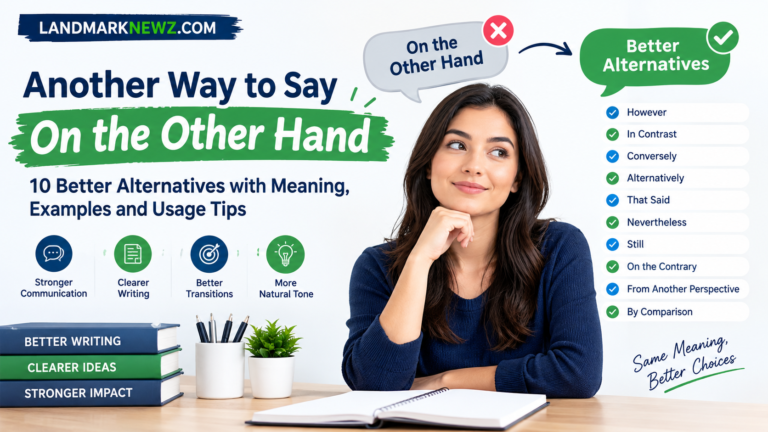

The phrase “on the other hand” introduces a contrasting idea, viewpoint, fact, or possibility. It is often used when you want to show that two sides of an issue are different.
For example, you might write, “The apartment is affordable. On the other hand, it is far from downtown.” The phrase tells the reader that the second sentence presents an important contrast to the first.
You can replace it with words and phrases such as however, in contrast, conversely, alternatively, that said, and from another perspective. The right choice depends on whether you are comparing ideas, changing direction, or presenting another option.
The expression commonly appears in essays, business writing, emails, reports, articles, reviews, and everyday conversations.

Why Use Other Ways to Say “On the Other Hand”?

Using different expressions for contrast can make your writing smoother and more precise. Repeating “on the other hand” too often may make an article, essay, or report sound predictable.
Other alternatives can also help you show the exact relationship between two ideas.
- Avoid repetition when making several comparisons.
- Sound more natural in everyday conversations.
- Improve professional writing by choosing precise transition words.
- Create stronger comparisons between two viewpoints.
- Match the tone of an academic, professional, or casual sentence.
- Introduce another perspective without making the contrast sound too strong.
10 Best Other Ways to Say “On the Other Hand”
1. However
Meaning
However introduces an idea that contrasts with something stated earlier. It is one of the most flexible alternatives to “on the other hand” and works naturally in both professional and everyday writing.
Best For
- Professional
- Formal
- Polite
Example 1
The position offers excellent benefits; however, the commute is quite long.
Example 2
The restaurant has received positive reviews. However, the wait times can be unpredictable.
Quick Tip
Use however when you need a simple, clear transition between contrasting ideas.
2. In Contrast
Meaning
In contrast clearly signals a difference between two people, things, situations, or ideas. It works especially well when the purpose of the sentence is direct comparison.
Best For
- Professional
- Formal
Example 1
The first proposal focuses on short-term savings. In contrast, the second emphasizes long-term growth.
Example 2
City apartments tend to be expensive. In contrast, homes in smaller towns may offer more space.
Quick Tip
Choose in contrast when you want the reader to notice a clear difference.
3. Conversely
Meaning
Conversely introduces a statement that presents the opposite or reverse relationship of the previous point. It is more formal than “on the other hand” and often appears in academic, technical, and analytical writing.
Best For
- Professional
- Formal
Example 1
Higher prices may discourage some buyers. Conversely, lower prices can increase demand.
Example 2
Some employees prefer working independently. Conversely, others perform better in collaborative teams.
Quick Tip
Use conversely when the second idea closely reverses or contrasts with the first.
4. Alternatively
Meaning
Alternatively introduces another possibility, method, or choice rather than simply showing an opposing idea. It is useful when you want to give readers a different option.
Best For
- Professional
- Formal
- Polite
Example 1
You can submit the application online. Alternatively, you can mail a printed copy.
Example 2
We could meet at the office. Alternatively, we could schedule a video call.
Quick Tip
Use alternatively when you are presenting another option, not just a contrasting fact.
5. That Said
Meaning
That said introduces a point that qualifies, balances, or contrasts with something previously mentioned. It sounds more conversational than “however” and can make disagreement feel less abrupt.
Best For
- Casual
- Friendly
- Professional
- Polite
Example 1
The software takes some time to learn. That said, it becomes much easier after a few practice sessions.
Example 2
The hotel is outside the city center. That said, the train station is only a short walk away.
Quick Tip
Use that said when you want to acknowledge the first point before offering a different perspective.
6. Nevertheless
Meaning
Nevertheless introduces a statement that remains true despite the previous point. It often creates a stronger contrast than a simple conversational transition.
Best For
- Formal
- Professional
- Polite
Example 1
The project faced several delays. Nevertheless, the team completed the main objectives.
Example 2
The instructions may seem complicated at first. Nevertheless, most users can learn the process quickly.
Quick Tip
Use nevertheless when the second point continues to stand despite a problem or limitation.
7. Still
Meaning
Still can introduce a contrasting or balancing thought in a natural, conversational way. It is shorter and less formal than “nevertheless,” making it useful for everyday communication.
Best For
- Casual
- Friendly
- Polite
Example 1
The jacket costs more than I expected. Still, the quality is impressive.
Example 2
The drive took nearly three hours. Still, the trip was worth it.
Quick Tip
Choose still when you want a relaxed alternative that does not sound overly formal.
8. On the Contrary
Meaning
On the contrary presents an idea that directly contradicts or corrects a previous statement. It is stronger than “on the other hand,” so it should only be used when the second idea actually opposes the first.
Best For
- Formal
- Professional
Example 1
The manager did not ignore the complaint. On the contrary, she responded to it immediately.
Example 2
The new policy has not reduced customer satisfaction. On the contrary, recent feedback has been highly positive.
Quick Tip
Do not use on the contrary for every contrast. Save it for situations involving a genuine contradiction.
9. From Another Perspective
Meaning
From another perspective introduces a different way of looking at the same issue. Rather than directly opposing the first idea, it encourages the reader to consider another viewpoint.
Best For
- Professional
- Formal
- Polite
Example 1
The expansion could increase operating costs. From another perspective, it may create valuable new revenue opportunities.
Example 2
The change may seem inconvenient to some employees. From another perspective, it could make the workflow more efficient.
Quick Tip
Use this phrase when you want to shift viewpoints without suggesting that the first idea is wrong.
10. By Comparison
Meaning
By comparison highlights how one subject differs from another. It is particularly useful when discussing measurable differences in quality, size, cost, performance, or other characteristics.
Best For
- Professional
- Formal
Example 1
The downtown location is compact and busy. By comparison, the suburban branch has a larger, quieter space.
Example 2
The older model uses more energy. By comparison, the newer version operates much more efficiently.
Quick Tip
Use by comparison when two subjects have already been introduced and you want to emphasize their differences.
Comparison Table

| Alternative | Best Used In | Tone |
| However | Essays, emails, general writing | Neutral |
| In Contrast | Comparisons and reports | Formal |
| Conversely | Academic and analytical writing | Formal |
| Alternatively | Choices and options | Professional |
| That Said | Conversations and balanced opinions | Conversational |
| Nevertheless | Formal writing and arguments | Formal |
| Still | Everyday writing and speech | Casual |
| On the Contrary | Direct contradictions | Strong/Formal |
| From Another Perspective | Viewpoints and discussions | Professional |
| By Comparison | Direct comparisons | Formal |
Common Mistakes

1. Using “On the Contrary” for a Simple Contrast
“On the contrary” usually signals a direct contradiction. If you are simply presenting another side of an issue, however or in contrast is usually more accurate.
2. Using “Alternatively” When There Is No Choice
“Alternatively” suggests another option or course of action. It may sound incorrect when you are only comparing two facts.
3. Making Every Sentence Sound Formal
Words such as conversely and nevertheless can make writing sound formal. In casual emails or conversations, still or that said may sound more natural.
4. Ignoring the Relationship Between Ideas
Not every contrasting phrase means exactly the same thing. Before choosing an alternative, decide whether you are showing a difference, contradiction, qualification, or alternative choice.
5. Repeating One Transition Too Often
Using “however” in every paragraph can become repetitive. Varying your transitions improves flow while allowing each phrase to serve its proper purpose.
Frequently Asked Questions
What is the best replacement for “on the other hand”?
However is one of the best general replacements because it works in many types of writing. For direct comparisons, in contrast may be better. If you are presenting another choice, use alternatively. For a more conversational tone, that said or still can sound more natural.
Is “however” the same as “on the other hand”?
The two expressions often perform a similar function, but they are not always interchangeable. “On the other hand” commonly introduces another side or perspective, while “however” usually signals a contrast or qualification. In many sentences, though, either expression can work without changing the main meaning.
What is a formal way to say “on the other hand”?
Formal alternatives include in contrast, conversely, nevertheless, and by comparison. The best choice depends on the relationship between your ideas. “Conversely” works well for reversed relationships, while “in contrast” is especially useful for direct comparisons.
What is a casual way to say “on the other hand”?
For casual communication, still and that said are good choices. They sound natural in conversations, texts, personal emails, and informal writing. “That said” is particularly useful when you want to acknowledge one point before introducing another perspective.
Can I use “on the contrary” instead of “on the other hand”?
Not in every situation. “On the contrary” normally introduces a direct contradiction or correction. “On the other hand” is broader and can simply introduce a different viewpoint. Using “on the contrary” for a mild contrast can make the sentence sound inaccurate or unnecessarily strong.
Is “conversely” a good alternative for essays?
Yes. Conversely can be an effective choice in academic and analytical writing when the second idea reverses or contrasts with the first. However, it should not be used simply because it sounds sophisticated. Make sure the relationship between the two statements genuinely supports the word.
How can I avoid repeating “on the other hand” in an essay?
First, identify what relationship you want to express. Use however for general contrast, in contrast for comparison, conversely for a reversed relationship, and from another perspective when introducing a different viewpoint. This creates variety without sacrificing clarity.
What is the best alternative for professional emails?
However, that said, and in contrast are useful choices in professional emails. “However” is the safest general option, while “that said” creates a slightly warmer tone. If you are directly comparing two situations, “in contrast” may communicate the relationship more clearly.
Conclusion
There are many effective ways to replace “on the other hand,” but the best choice depends on what you want to communicate. However is the most flexible option, while in contrast works well for direct comparisons. Choose conversely for a formal reversed relationship and alternatively when presenting another option.
For a conversational tone, that said and still sound natural and approachable. If you need to introduce a different viewpoint, from another perspective is a strong choice. Remember that on the contrary should be reserved for genuine contradictions.
The key is not simply to replace one phrase with another. Choose the transition that accurately explains the relationship between your ideas, and your writing will sound clearer, more natural, and more purposeful. For additional guidance, explore choosing transition words that connect ideas clearly to make your writing easier to follow.

The Landmark Newz Editorial Team writes and reviews every guide on this site. We check each alternative phrase against standard dictionaries and real usage, explain when it fits, and update articles when readers point out errors.