
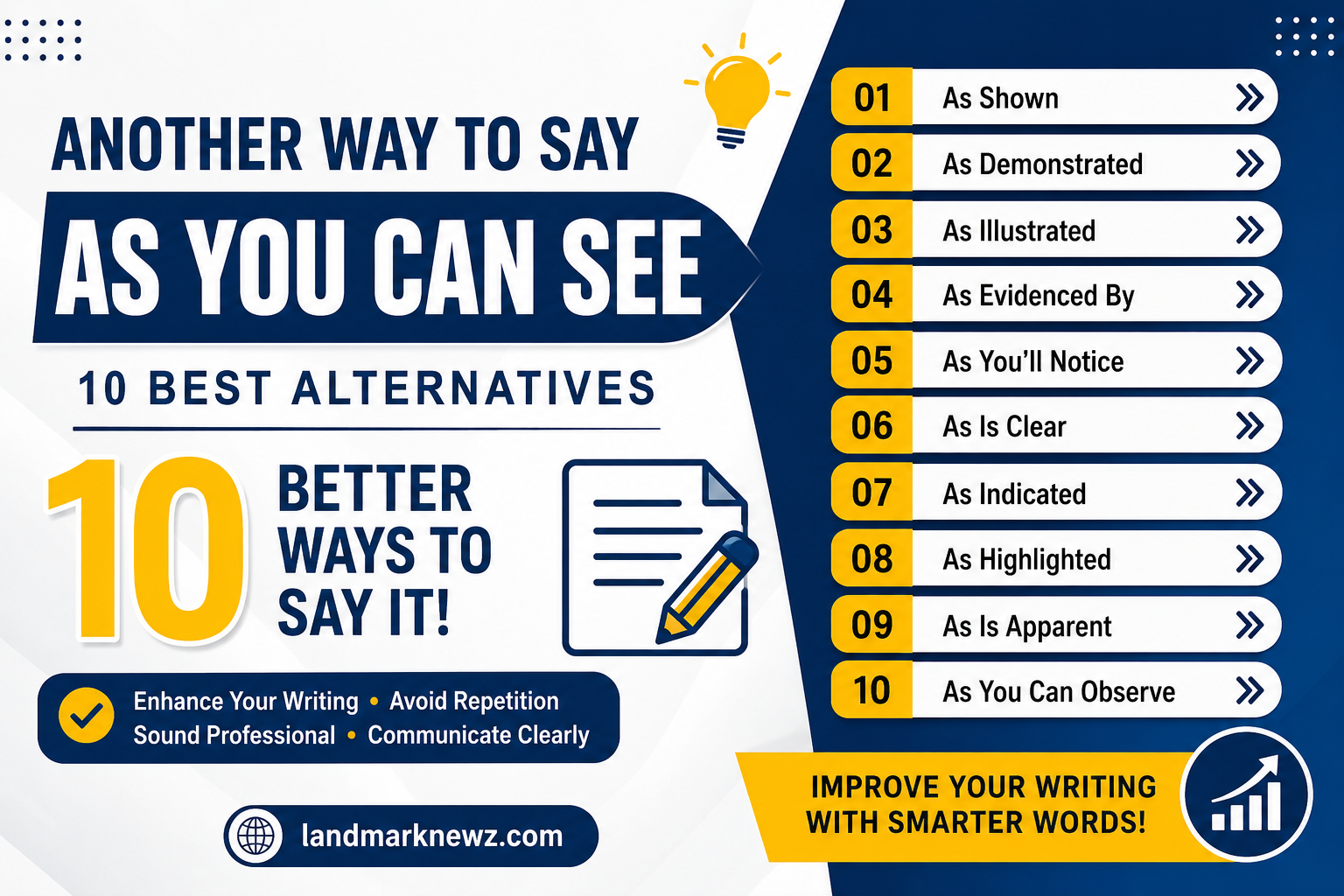
“As you can see” is a common phrase used to point someone’s attention toward something visible, noticeable, or supported by evidence. While it is perfectly correct, repeating it too often can make your writing sound predictable.
Fortunately, you have several natural alternatives. The right phrase can make an email more professional, a report more precise, or a presentation more conversational.
What Does “Another Way to Say As You Can See” Mean?
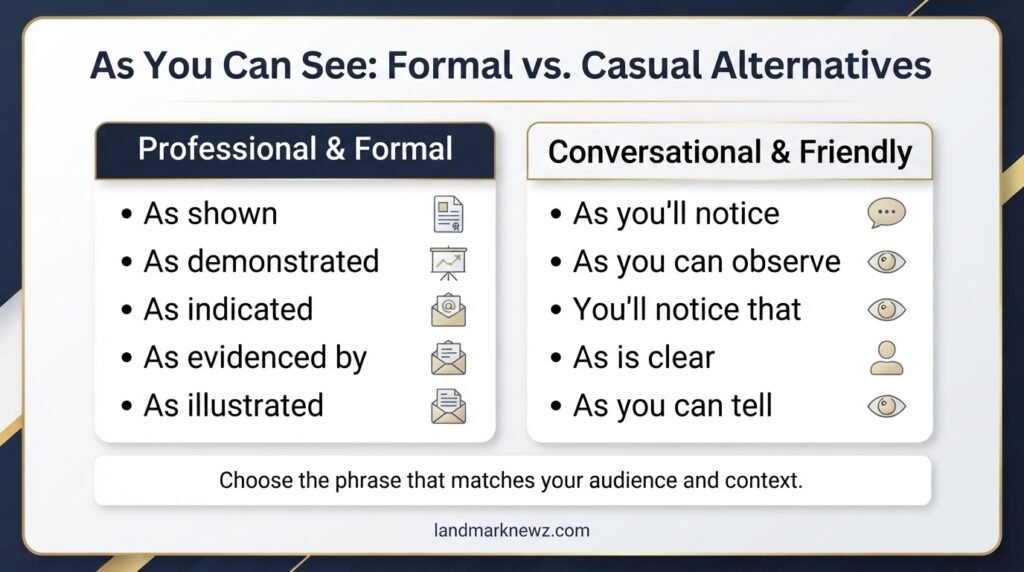
The phrase “another way to say as you can see” refers to alternative expressions that communicate the same general idea as “as you can see.” These expressions direct the reader or listener toward something that supports the point being made.
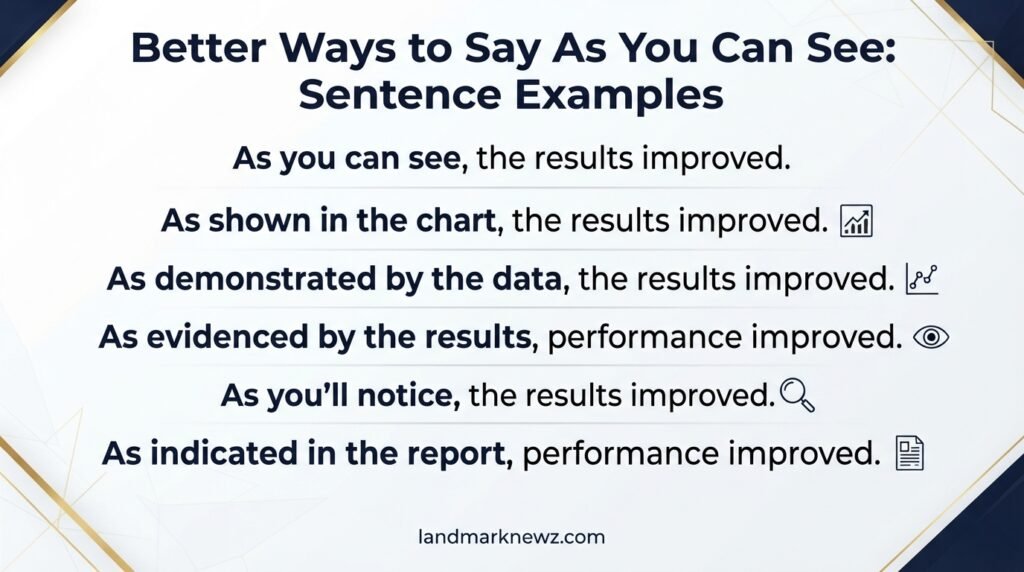
For example, instead of writing, “As you can see, sales increased this year,” you could write, “As shown in the chart, sales increased this year.”
People often look for alternatives when writing business emails, reports, presentations, essays, articles, and other professional content.
Why Use Other Ways to Say “As You Can See”?
Using different expressions can make your communication clearer and more engaging. It also lets you match your wording to the situation instead of relying on the same phrase repeatedly.
Other benefits include:
- Avoiding repetition in longer documents.
- Sounding more professional in business and academic writing.
- Making evidence clearer when referring to charts, data, or results.
- Creating a conversational tone when speaking to an audience.
- Improving precision by explaining exactly what the reader should notice.
10 Best Other Ways to Say “As You Can See”
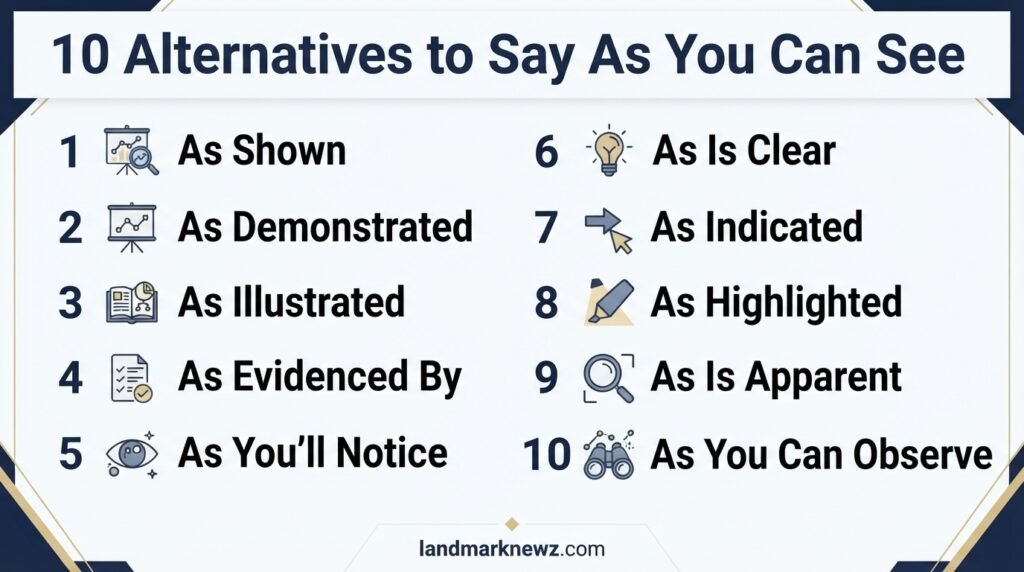
1. As Shown
Meaning
“As shown” points to information that has already been presented visually or in writing. It is especially useful when referring to charts, graphs, tables, examples, or results.
Best For
- Professional
- Formal
Example 1
As shown in the report, customer satisfaction improved during the final quarter.
Example 2
As shown in the chart, online sales increased significantly in July.
Quick Tip
Use “as shown” when the information is displayed clearly somewhere nearby.
2. As Demonstrated
Meaning
“As demonstrated” suggests that something has been proven or made clear through evidence, an example, or a practical result. It sounds more formal than “as you can see.”
Best For
- Professional
- Formal
Example 1
As demonstrated by the test results, the updated system performs more efficiently.
Example 2
As demonstrated during the presentation, the new process reduces processing time.
Quick Tip
Choose this phrase when you want to emphasize evidence or proof rather than simple visibility.
3. As Illustrated
Meaning
“As illustrated” directs attention to something explained or represented through an image, example, diagram, or other visual aid. It works particularly well in reports and educational content.
Best For
- Formal
- Professional
Example 1
As illustrated in Figure 2, the two methods produce similar results.
Example 2
As illustrated by the example above, small changes can improve the overall process.
Quick Tip
Use “as illustrated” when a visual, example, or diagram helps explain your point.
4. As Evidenced By
Meaning
“As evidenced by” means that something is supported or demonstrated by available evidence. It is useful when discussing facts, results, behavior, or measurable changes.
Best For
- Formal
- Professional
Example 1
As evidenced by the latest survey, employees prefer flexible scheduling.
Example 2
As evidenced by the decline in complaints, the updated policy has been effective.
Quick Tip
Use this phrase when you are pointing to evidence rather than something that is simply visible.
5. As You’ll Notice
Meaning
“As you’ll notice” is a friendly and natural way to direct someone’s attention to something they are likely to observe. It feels less formal and more conversational.
Best For
- Casual
- Friendly
- Polite
Example 1
As you’ll notice, the revised design has a much simpler layout.
Example 2
As you’ll notice during the tour, each room has a different purpose.
Quick Tip
This is a good choice for presentations, conversations, and reader-friendly content.
6. As Is Clear
Meaning
“As is clear” emphasizes that something should be easy to understand from the information provided. It can sound confident and direct.
Best For
- Professional
- Formal
Example 1
As is clear from the data, the project is moving ahead of schedule.
Example 2
As is clear from her response, she understands the main concern.
Quick Tip
Use this expression carefully because it can sound overly confident if the evidence is open to interpretation.
7. As Indicated
Meaning
“As indicated” refers to information that has been pointed out, recorded, or presented. It is common in formal reports, instructions, and business communication.
Best For
- Professional
- Formal
Example 1
As indicated in the attached document, the deadline has been extended.
Example 2
As indicated by the survey responses, most participants support the proposal.
Quick Tip
“As indicated” is especially useful when referring to documents, data, instructions, or previous statements.
8. As Highlighted
Meaning
“As highlighted” draws attention to a particular fact, detail, or issue that deserves special notice. It works well when something has already been emphasized.
Best For
- Professional
- Formal
Example 1
As highlighted in the report, customer retention remains a key priority.
Example 2
As highlighted during yesterday’s meeting, the deadline cannot be moved again.
Quick Tip
Use it when the information has been specifically emphasized rather than merely presented.
9. As Is Apparent
Meaning
“As is apparent” means that something is clearly noticeable or understandable from the available information. It has a formal tone and is more common in professional or academic writing.
Best For
- Formal
- Professional
Example 1
As is apparent from the results, the revised strategy produced better outcomes.
Example 2
As is apparent from the discussion, both teams share the same goal.
Quick Tip
Reserve this phrase for situations where the conclusion is genuinely clear.
10. As You Can Observe
Meaning
“As you can observe” directly invites someone to notice something for themselves. It is similar to “as you can see,” but it sounds slightly more formal.
Best For
- Professional
- Formal
- Polite
Example 1
As you can observe, the machine operates smoothly after the adjustment.
Example 2
As you can observe from the diagram, the two components connect at the center.
Quick Tip
Use it when speaking to an audience or explaining something that can be directly observed.
Comparison Table
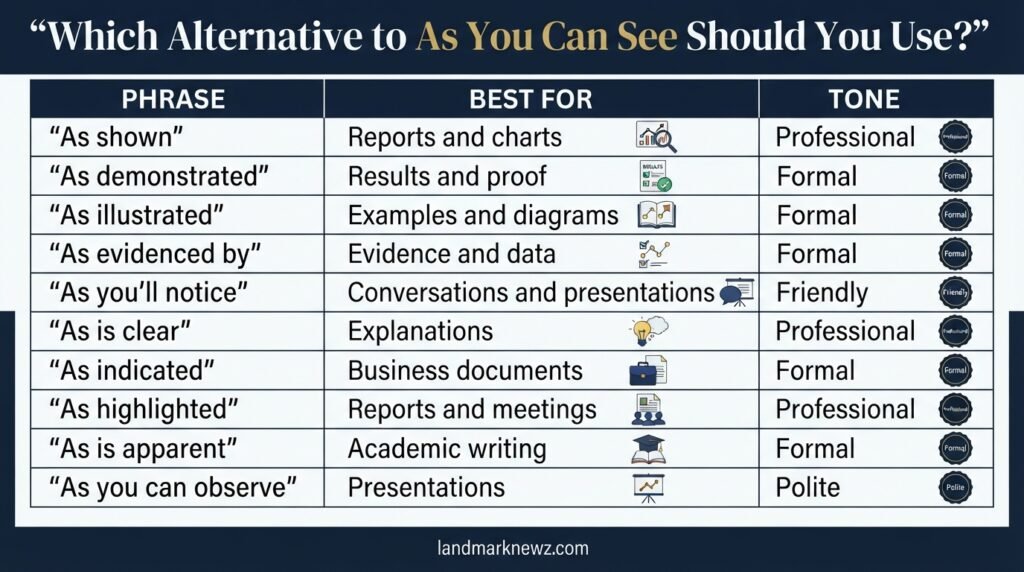
| Alternative | Best Used In | Tone |
| As shown | Reports, presentations | Professional |
| As demonstrated | Research, business writing | Formal |
| As illustrated | Reports, educational writing | Formal |
| As evidenced by | Analytical writing | Formal |
| As you’ll notice | Presentations, conversations | Friendly |
| As is clear | Reports, explanations | Professional |
| As indicated | Business documents | Formal |
| As highlighted | Reports, meetings | Professional |
| As is apparent | Academic and professional writing | Formal |
| As you can observe | Presentations, explanations | Polite |
Common Mistakes
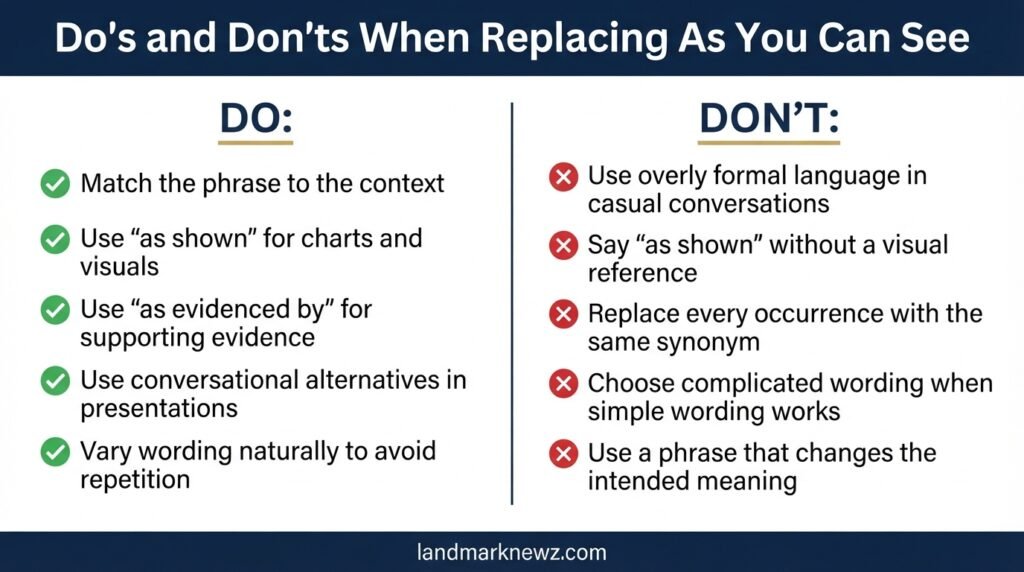
1. Using a formal phrase in a casual conversation
Phrases such as “as evidenced by” can sound stiff when talking with friends or coworkers informally. Choose “as you’ll notice” or simply “you’ll notice” for a more natural tone.
2. Using “as shown” without something to show
“As shown” works best when a chart, table, image, example, or other source actually supports the statement. Without that reference, the phrase can feel incomplete.
3. Choosing overly complicated wording
You do not need a sophisticated expression every time you replace “as you can see.” Simple language is often clearer, especially for general audiences.
4. Repeating the same alternative
Replacing “as you can see” with “as shown” throughout an entire report does not solve repetition. Vary your wording when the context genuinely changes.
5. Assuming every alternative has the same meaning
These expressions are related, but they are not always interchangeable. “As evidenced by” focuses on evidence, while “as you’ll notice” focuses on something the reader or listener can observe.
Frequently Asked Questions
What is a professional way to say “as you can see”?
“As shown,” “as indicated,” “as demonstrated,” and “as highlighted” are strong professional alternatives. For example, “As shown in the attached report, revenue increased this quarter” sounds concise and appropriate for business communication.
What is a formal way to say “as you can see”?
For formal writing, consider “as demonstrated,” “as illustrated,” “as evidenced by,” or “as is apparent.” The best choice depends on what follows the phrase. Use “as evidenced by” for supporting proof and “as illustrated” for examples or visual information.
What can I say instead of “as you can see” in an email?
In a professional email, “as shown,” “as indicated,” or “as highlighted” usually works well. For example, instead of saying, “As you can see in the attached file,” you can write, “As indicated in the attached file.”
Is “as you can see” professional?
Yes. “As you can see” is grammatically correct and can be professional when used naturally. However, in formal reports or repeated business communication, alternatives such as “as shown” or “as indicated” may sound more concise and precise.
What is a better phrase for “as you can see” in a presentation?
“As you’ll notice” and “as you can observe” work well in presentations. If you are showing a chart or slide, “as shown here” is often even more natural because it directly connects your words to the visual material.
Can I use “as evidenced by” instead of “as you can see”?
Yes, but only when you are referring to evidence that supports your statement. “As evidenced by the survey results” means the survey provides evidence, while “as you can see” can simply point someone’s attention toward something visible.
What is a simple alternative to “as you can see”?
“As shown” is one of the simplest alternatives. Other easy options include “as indicated,” “as illustrated,” and “as you’ll notice.” Choose the simplest expression that accurately describes what you want your reader to notice.
Which alternative sounds the most natural?
The most natural choice depends on the setting. “As shown” is highly natural for charts and documents, “as you’ll notice” works well in conversation, and “as demonstrated” fits situations involving evidence, results, or a practical example.
Conclusion
There are many useful alternatives to “as you can see,” and the best one depends on your purpose and audience. For professional reports, “as shown,” “as indicated,” and “as highlighted” are concise and polished. For formal or analytical writing, “as demonstrated,” “as illustrated,” and “as evidenced by” provide greater precision.
If you’re speaking to an audience or writing conversational content, “as you’ll notice” feels more natural and approachable. Meanwhile, “as is apparent” and “as is clear” work when the conclusion is genuinely easy to understand from the available information.
The key is not to replace every instance mechanically. Instead, choose the phrase that accurately describes the evidence, visual, example, or observation you want your reader to focus on. For more guidance on communicating clearly in professional documents, see this resource on writing clear and professional reports.

Professional Writing & Workplace Communication Expert
Marcus Hale is a business communication specialist with 11 years of experience in corporate training and professional writing. He has worked with mid-sized companies and remote teams to improve clarity in emails, reports, performance reviews, and client-facing messages.
Marcus focuses on polished, professional alternatives that help readers sound confident without sounding stiff. His guides cover workplace phrases, resume language, leadership communication, and formal-to-natural transitions. He holds a background in business administration and technical writing, and has led workshops on effective professional English.
At LandmarkNewz, Marcus creates practical synonym lists and phrasing tips that professionals can apply immediately in emails, meetings, and career documents.