What Does “Another Way to Say Either Way” Mean?
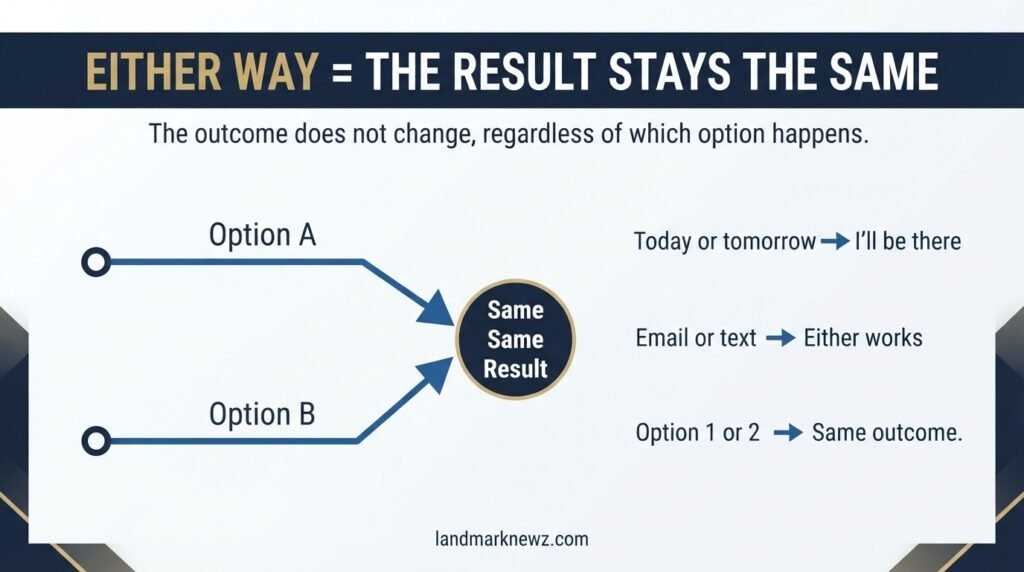
The phrase “another way to say either way” refers to alternative expressions that communicate the same basic idea as “either way.” The phrase “either way” usually means that the outcome will be the same regardless of which of two possibilities occurs.
For example, you might say, “We can meet today or tomorrow. Either way, I’ll be there.” Here, the speaker is saying that the specific choice does not change the final result.
“Either way” is common in everyday conversations, emails, workplace discussions, and informal writing. However, repeating it too often can make your writing sound predictable, so choosing a suitable alternative can make your communication more natural.
Why Use Other Ways to Say “Either Way”?
Although “either way” is correct and widely understood, another expression may fit your situation better.
Using alternatives can help you:
- Avoid repeating the same phrase.
- Make your writing sound more natural.
- Match formal and informal situations.
- Communicate choices more clearly.
- Sound more professional in emails and workplace writing.
- Add reassurance, flexibility, or emphasis when needed.
The key is not to replace “either way” automatically. Instead, choose a phrase that accurately reflects your intended meaning.
10 Best Other Ways to Say “Either Way”
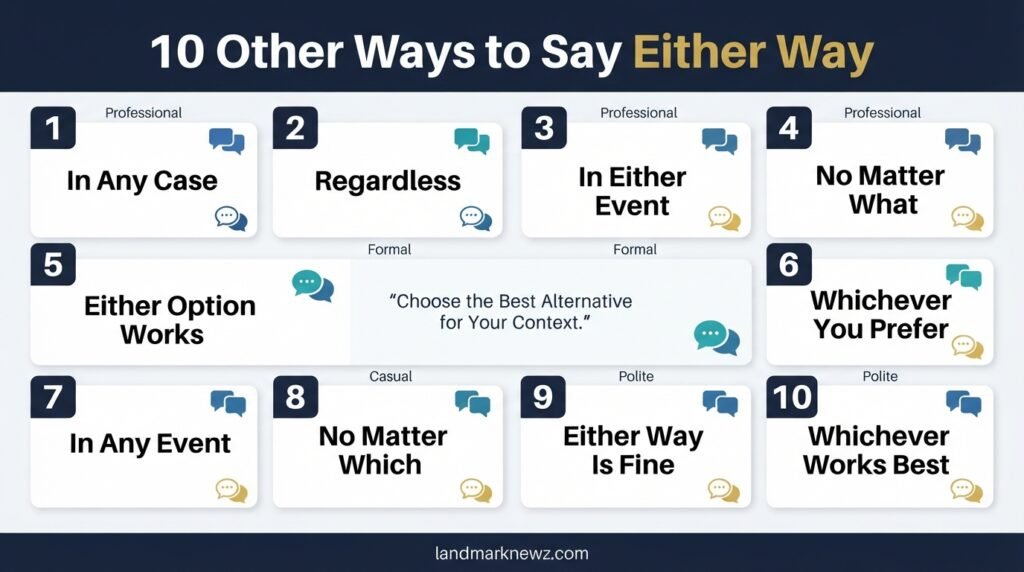
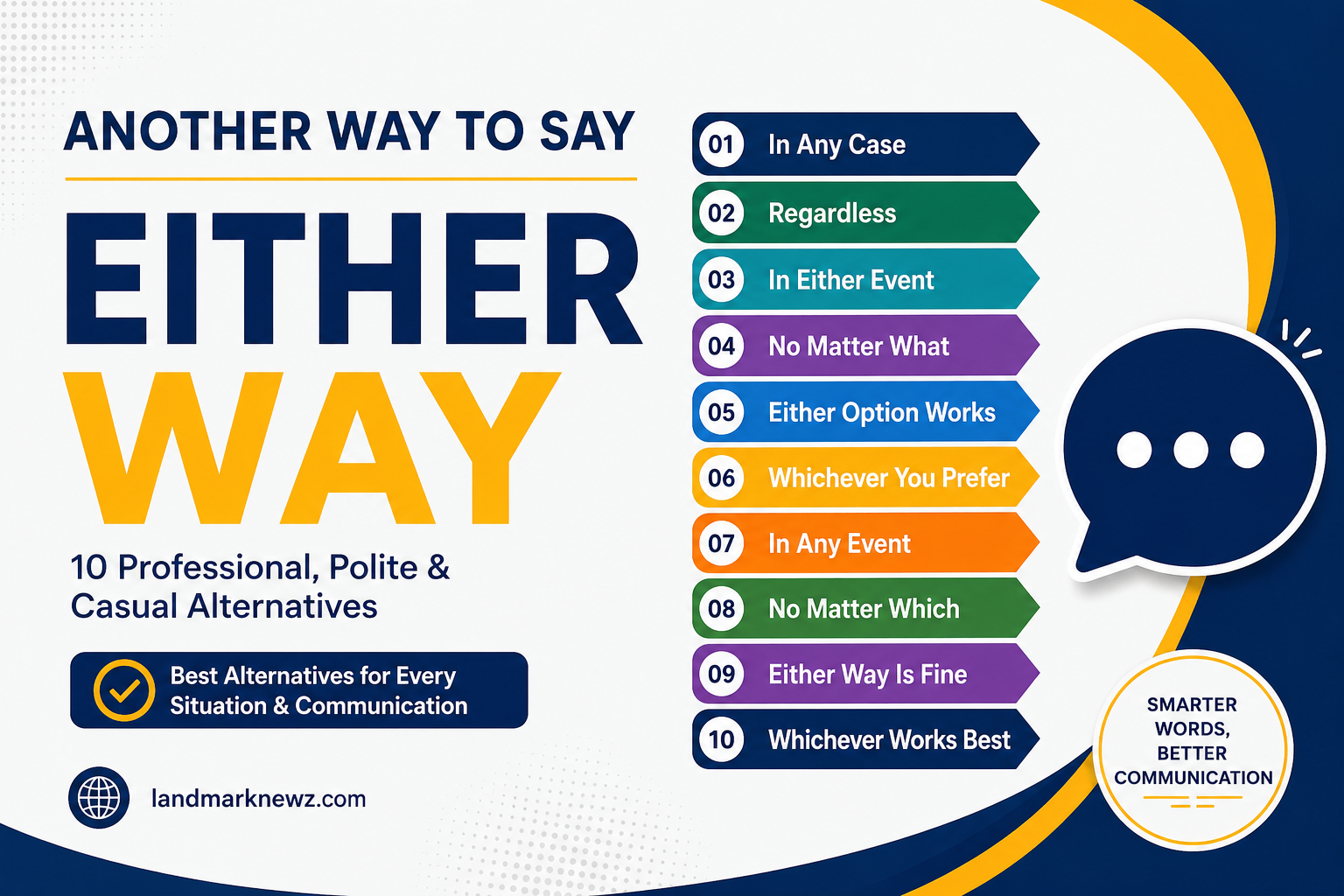
1. In Any Case
Meaning
In any case means that something remains true or relevant regardless of the circumstances. It can also be used to move a conversation forward after discussing different possibilities.
Best For
- Professional
- Formal
- Polite
Example 1
“In any case, we should have the final report ready by Friday.”
Example 2
“The weather may change, but in any case, the event will begin at noon.”
Quick Tip
Use in any case when you want a polished alternative to “either way,” especially in business writing.
2. Regardless
Meaning
Regardless means that something will happen or remain true despite different circumstances or outcomes. It is concise and works particularly well when you want to emphasize that a condition does not affect the final decision.
Best For
- Professional
- Formal
- Neutral
Example 1
“Regardless of which proposal we select, the project will require additional funding.”
Example 2
“Regardless, I appreciate you taking the time to review the document.”
Quick Tip
Use regardless of when followed by a noun or noun phrase, such as “regardless of the outcome.”
3. In Either Event
Meaning
In either event means that the same action or result applies to either of two possible situations. It has a more formal tone than “either way.”
Best For
- Formal
- Professional
Example 1
“We may receive approval today or Monday; in either event, the team will be ready to proceed.”
Example 2
“The client may accept the offer or request changes. In either event, we will respond promptly.”
Quick Tip
Choose in either event for formal documents, business correspondence, or situations involving two specific outcomes.
4. No Matter What
Meaning
No matter what means that something will remain true or happen regardless of what occurs. It sounds more conversational and can express confidence, commitment, or reassurance.
Best For
- Casual
- Friendly
- Warm
Example 1
“No matter what happens at the interview, you should be proud of how prepared you are.”
Example 2
“No matter what you decide, I’ll support your choice.”
Quick Tip
Use this phrase when you want your message to sound personal or reassuring rather than formal.
5. Either Option Works
Meaning
Either option works clearly tells someone that both available choices are acceptable. Unlike some alternatives, it focuses directly on the choices rather than the outcome.
Best For
- Professional
- Casual
- Polite
Example 1
“We can schedule the call for Tuesday or Wednesday; either option works for me.”
Example 2
“You can send the files as PDFs or Word documents. Either option works.”
Quick Tip
This is especially useful when someone asks which of two choices you prefer and you genuinely have no preference.
6. Whichever You Prefer
Meaning
Whichever you prefer means that the other person’s choice is acceptable to you. It is a polite way to give someone control over a decision.
Best For
- Polite
- Friendly
- Professional
Example 1
“We can meet over Zoom or Teams, whichever you prefer.”
Example 2
“You can submit the application today or tomorrow, whichever you prefer.”
Quick Tip
Use this phrase when you want to emphasize flexibility rather than simply saying that both choices produce the same result.
7. In Any Event
Meaning
In any event means that something remains true or will happen regardless of what happens beforehand. It is often used to transition from one point to another.
Best For
- Formal
- Professional
- Polite
Example 1
“The negotiations may take longer than expected. In any event, we will provide an update tomorrow.”
Example 2
“We have not received the final numbers yet. In any event, the presentation is ready.”
Quick Tip
In any event can sound more formal than “either way,” making it a strong option for business writing.
8. No Matter Which
Meaning
No matter which emphasizes that the specific choice does not change the situation. It is useful when discussing two or more clearly identified options.
Best For
- Neutral
- Casual
- Professional
Example 1
“No matter which route we take, we should arrive before sunset.”
Example 2
“No matter which design you choose, the final product will include the updated logo.”
Quick Tip
Use no matter which when you are directly referring to different choices, options, or alternatives.
9. Either Way Is Fine
Meaning
Either way is fine means that you are comfortable with either available option. It is simple, friendly, and common in everyday American English.
Best For
- Casual
- Friendly
- Polite
Example 1
“We can order pizza or make pasta tonight. Either way is fine with me.”
Example 2
“You can call me this afternoon or send me a message. Either way is fine.”
Quick Tip
This phrase works best when you want to show that you have no strong preference.
10. Whichever Works Best
Meaning
Whichever works best communicates flexibility and allows the other person to select the option that is most convenient. It sounds natural without being overly casual.
Best For
- Professional
- Friendly
- Polite
Example 1
“We can review the proposal Thursday or Friday, whichever works best for you.”
Example 2
“Feel free to send the information by email or through the shared folder, whichever works best.”
Quick Tip
Use this phrase when your main goal is to make a decision easier for the other person.
Comparison Table
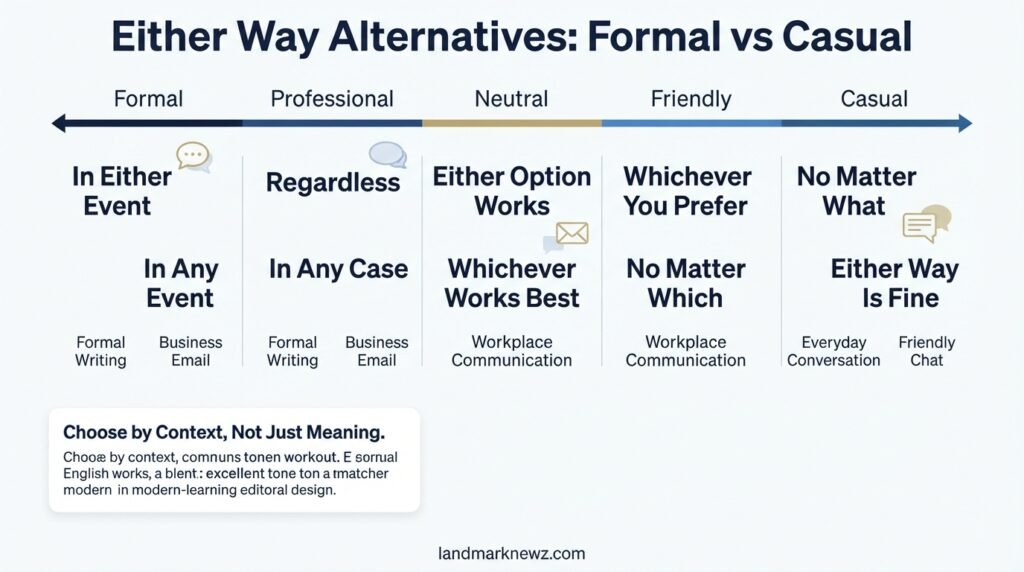
| Alternative | Best Used In | Tone |
| In any case | Emails, business writing | Professional |
| Regardless | Formal and professional communication | Neutral/Formal |
| In either event | Formal documents | Formal |
| No matter what | Personal conversations | Warm/Casual |
| Either option works | Decisions and workplace messages | Neutral |
| Whichever you prefer | Requests and choices | Polite |
| In any event | Professional writing | Formal |
| No matter which | Choices and alternatives | Neutral |
| Either way is fine | Everyday conversations | Casual/Friendly |
| Whichever works best | Workplace and personal communication | Polite/Friendly |
Common Mistakes
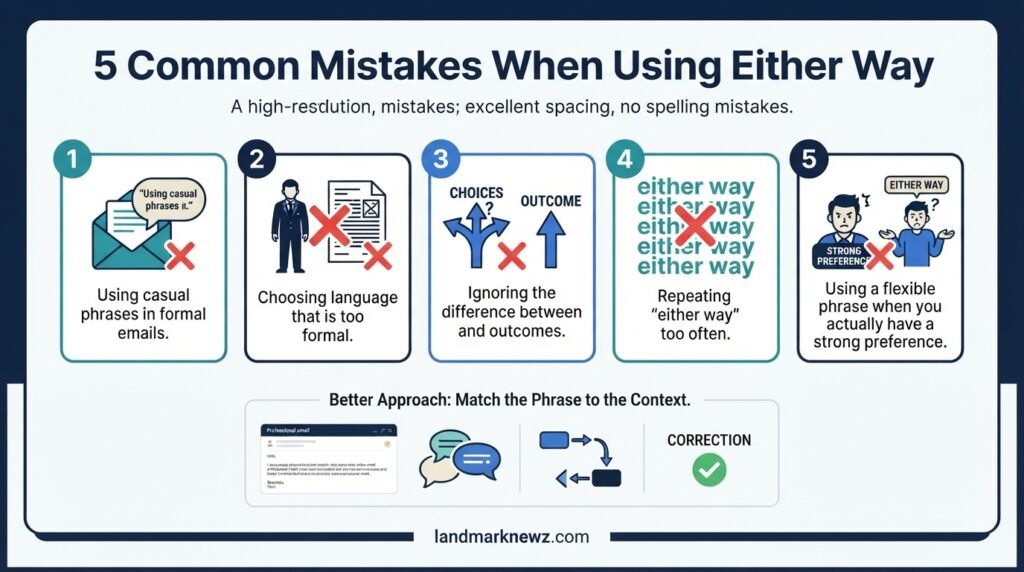
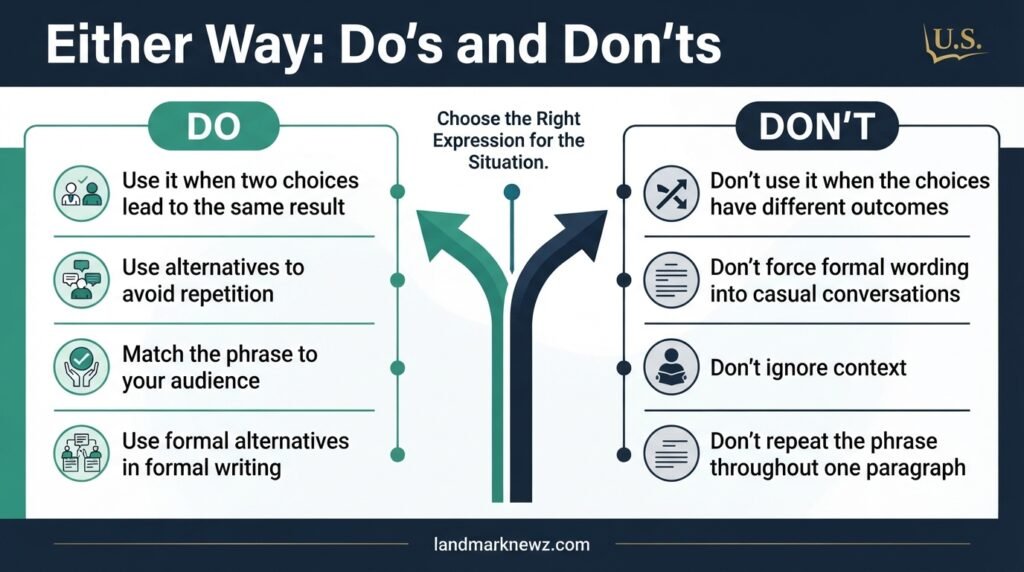
1. Using Casual Phrases in Professional Emails
Phrases such as “either way is fine” may sound too casual in some formal settings. Consider “in any case” or “regardless” when writing to clients, managers, or business partners.
2. Choosing Overly Formal Language
Not every message needs formal wording. Saying “in either event” to a close friend can sound stiff when “either way” would feel more natural.
3. Ignoring the Difference Between Choices and Outcomes
Some alternatives describe choices, while others emphasize an unchanged result. For example, “whichever you prefer” gives someone a choice, while “regardless” emphasizes that the outcome does not change.
4. Repeating the Same Expression
Using “either way” several times in one email or paragraph can make your writing repetitive. Rotate between suitable alternatives when the meaning remains accurate.
5. Sounding Insincere
Be careful with phrases that suggest flexibility. If you actually have a strong preference, saying “whichever works best” may create confusion. State your preference clearly when it matters.
Frequently Asked Questions
What is another way to say “either way”?
Common alternatives include in any case, regardless, in any event, no matter what, either option works, whichever you prefer, and whichever works best. The best choice depends on the context. For professional writing, “in any case” and “regardless” are especially useful.
What is a professional way to say “either way”?
In any case, regardless, and in any event are strong professional alternatives. For example, “In any case, we will send the revised proposal tomorrow” sounds polished and appropriate for workplace communication.
What is a casual way to say “either way”?
In casual conversations, you can say no matter what, either option works, or either way is fine. These expressions sound relaxed and natural when talking with friends, family, or coworkers in informal situations.
Is “regardless” the same as “either way”?
They can have similar meanings, but they are not always interchangeable. “Either way” usually refers to two possible choices or outcomes, while “regardless” emphasizes that something remains true despite circumstances or conditions.
How do you say “either way” politely?
You can use whichever you prefer or whichever works best when you want to sound polite. These phrases show that you are comfortable allowing another person to choose between available options.
What is a formal synonym for “either way”?
In either event and in any event are formal alternatives. They work well in professional correspondence, reports, formal announcements, and other situations where a more polished tone is appropriate.
Can I use “either way” in a professional email?
Yes. “Either way” is grammatically correct and acceptable in professional emails, especially when the tone is conversational. However, if the email is highly formal, “in any case,” “regardless,” or “in either event” may sound more appropriate.
What is the best alternative to “either way” when giving someone a choice?
Whichever you prefer or whichever works best is usually the best choice. Both expressions make it clear that the other person can select the option that suits them while keeping your tone flexible and polite.
Conclusion
Knowing another way to say either way can make your communication more precise, natural, and flexible. Although “either way” is perfectly acceptable, different situations call for different expressions.
For professional emails, in any case, regardless, and in any event provide a polished tone. When you want to give someone a choice, whichever you prefer or whichever works best is more appropriate. For casual or reassuring conversations, no matter what and either way is fine sound natural.
The most important step is to consider what you are trying to communicate. Are you emphasizing an unchanged outcome, offering two acceptable choices, or letting someone else decide? Once you identify that purpose, choosing the right alternative becomes much easier.
Use the phrase that fits both your meaning and your audience. For more guidance on choosing the right tone for your audience, consider Purdue OWL’s advice on tone in business writing.

Professional Writing & Workplace Communication Expert
Marcus Hale is a business communication specialist with 11 years of experience in corporate training and professional writing. He has worked with mid-sized companies and remote teams to improve clarity in emails, reports, performance reviews, and client-facing messages.
Marcus focuses on polished, professional alternatives that help readers sound confident without sounding stiff. His guides cover workplace phrases, resume language, leadership communication, and formal-to-natural transitions. He holds a background in business administration and technical writing, and has led workshops on effective professional English.
At LandmarkNewz, Marcus creates practical synonym lists and phrasing tips that professionals can apply immediately in emails, meetings, and career documents.