

“Food for thought” is an idiom used for an idea, fact, question, or comment that makes someone stop and think. It does not refer to actual food; instead, it describes information that encourages reflection or deeper consideration.
People commonly use the phrase in conversations, presentations, articles, emails, speeches, and discussions. For example, “Her comments gave me some food for thought” means her comments gave the speaker something important to consider.
If you want to avoid repeating this familiar expression, several alternatives can communicate the same idea with a more specific tone.
Why Use Other Ways to Say “Food for Thought”?
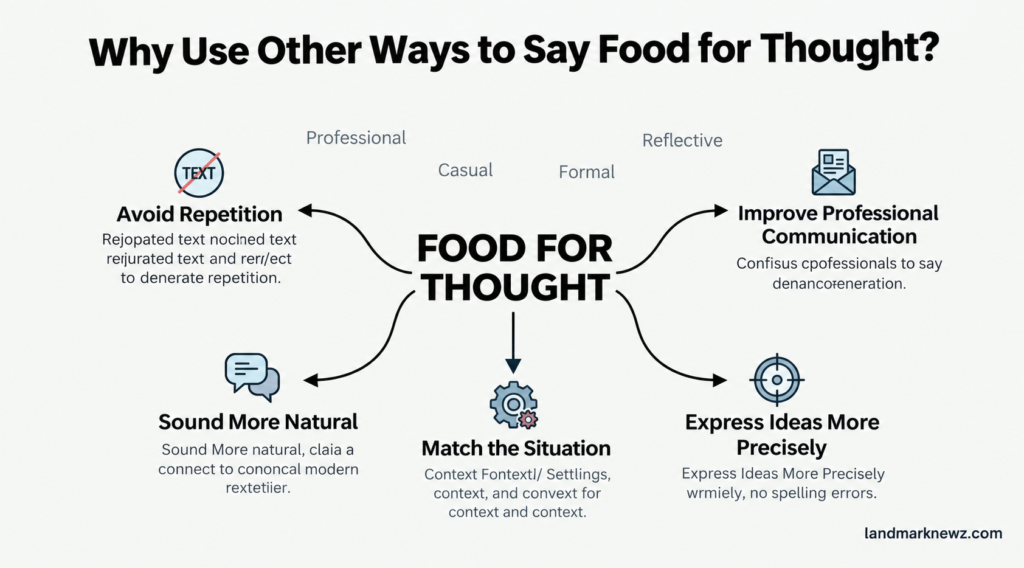
Using alternatives can make your writing more precise and natural. While “food for thought” is widely understood, another expression may fit your audience or situation better.
You might choose a different phrase to:
- Avoid repeating the same expression.
- Sound more professional in business writing.
- Make casual conversations feel more natural.
- Add a thoughtful or reflective tone.
- Clearly explain that an idea deserves consideration.
- Match the level of formality to your audience.
10 Best Other Ways to Say “Food for Thought”
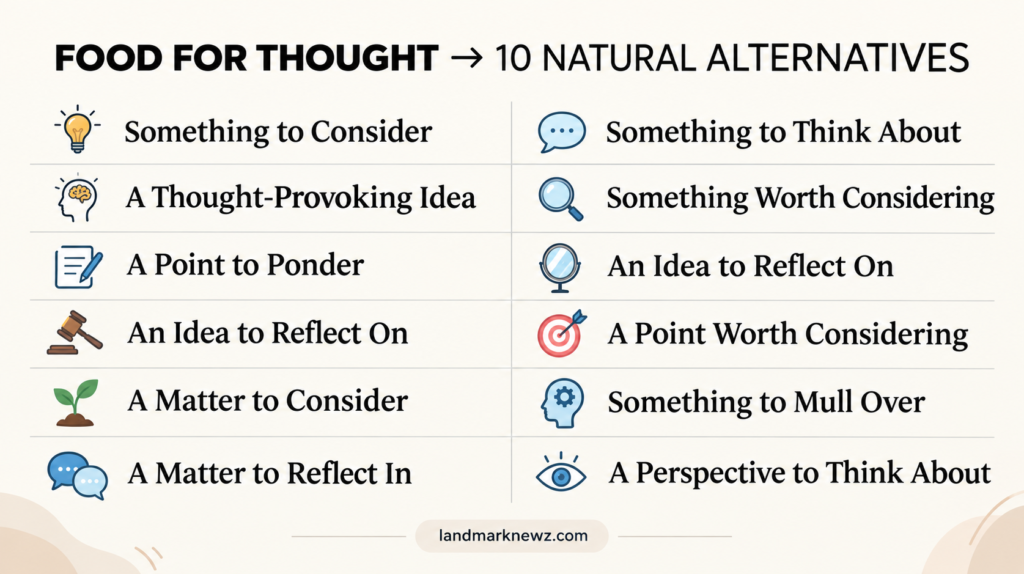
1. Something to Consider
Meaning
“Something to consider” is a clear and versatile alternative to “food for thought.” It suggests that a person should think carefully about an idea before making a decision or forming an opinion.
Best For
- Professional
- Formal
- Polite
Example 1
The lower operating cost is something to consider before we choose the new supplier.
Example 2
Your suggestion about changing the schedule is definitely something to consider.
Quick Tip
Use this phrase when you want to encourage thoughtful consideration without sounding overly dramatic or informal.
2. Something to Think About
Meaning
“Something to think about” is a natural, conversational expression that tells someone an idea deserves further attention. It works especially well in everyday American English.
Best For
- Casual
- Friendly
- Professional
Example 1
The manager’s comments about customer service gave us something to think about.
Example 2
Maybe taking a different approach is something to think about before we move forward.
Quick Tip
Choose this option when you want your language to sound relaxed and straightforward.
3. A Thought-Provoking Idea
Meaning
“A thought-provoking idea” describes an idea that stimulates deeper thinking or raises interesting questions. It is stronger than simply saying that something deserves consideration.
Best For
- Formal
- Professional
- Academic
Example 1
The speaker presented a thought-provoking idea about the future of remote education.
Example 2
Her proposal introduced a thought-provoking idea that challenged our usual assumptions.
Quick Tip
Use this phrase when you want to emphasize that an idea is intellectually interesting or challenging.
4. Something Worth Considering
Meaning
“Something worth considering” tells the reader or listener that an idea has enough value to deserve attention. It is particularly useful when discussing choices, proposals, or possible solutions.
Best For
- Professional
- Formal
- Polite
Example 1
Expanding into smaller cities is something worth considering as the company grows.
Example 2
The option of hiring additional staff is something worth considering before the busy season begins.
Quick Tip
This is a strong choice for workplace communication because it sounds measured and objective.
5. A Point to Ponder
Meaning
“A point to ponder” has a reflective tone and suggests that an idea deserves careful thought. It is somewhat more expressive than everyday alternatives such as “something to think about.”
Best For
- Formal
- Warm
- Reflective
Example 1
The author’s question about personal responsibility is a point to ponder after finishing the book.
Example 2
Whether convenience is worth the extra cost is certainly a point to ponder.
Quick Tip
Use it when you want to create a thoughtful or reflective mood rather than a strictly businesslike one.
6. A Matter to Consider
Meaning
“A matter to consider” refers to an issue or subject that should be carefully evaluated. It carries a formal tone and works particularly well when discussing decisions or responsibilities.
Best For
- Formal
- Professional
- Polite
Example 1
The long-term effect on employees is an important matter to consider.
Example 2
Budget flexibility will be a key matter to consider during the planning process.
Quick Tip
This phrase fits formal reports, workplace discussions, and serious decision-making situations.
7. An Idea to Reflect On
Meaning
“An idea to reflect on” suggests taking time to think deeply about a particular thought or perspective. It has a calm and introspective quality.
Best For
- Warm
- Formal
- Friendly
Example 1
The author’s view of success is an interesting idea to reflect on.
Example 2
Finding a healthier balance between work and personal time is an idea to reflect on.
Quick Tip
Use this expression when the purpose is personal reflection rather than immediate action.
8. A Point Worth Considering
Meaning
“A point worth considering” emphasizes that a particular observation or argument deserves attention. It is useful when acknowledging an idea without necessarily agreeing with it.
Best For
- Professional
- Formal
- Polite
Example 1
The consultant raised a point worth considering before we finalize the strategy.
Example 2
Her concern about delivery times is a point worth considering.
Quick Tip
This phrase is especially helpful in professional discussions because it recognizes an idea without automatically endorsing it.
9. Something to Mull Over
Meaning
“Something to mull over” means something that deserves time and careful thought. The expression is informal and conversational, making it a good choice for relaxed communication.
Best For
- Casual
- Friendly
Example 1
The possibility of moving closer to the office is something to mull over.
Example 2
His offer gives me something to mull over before I make a final decision.
Quick Tip
Keep this phrase for casual conversations, personal messages, and relaxed writing rather than formal business documents.
10. A Perspective to Think About
Meaning
“A perspective to think about” highlights a particular way of viewing an issue. It works well when someone has introduced a new viewpoint that may change how others understand a topic.
Best For
- Professional
- Friendly
- Formal
Example 1
Her experience provides a different perspective to think about when discussing workplace flexibility.
Example 2
The article offers a useful perspective to think about before forming an opinion on the issue.
Quick Tip
Use this expression when the important part of the message is a new viewpoint or way of understanding something.
Comparison Table
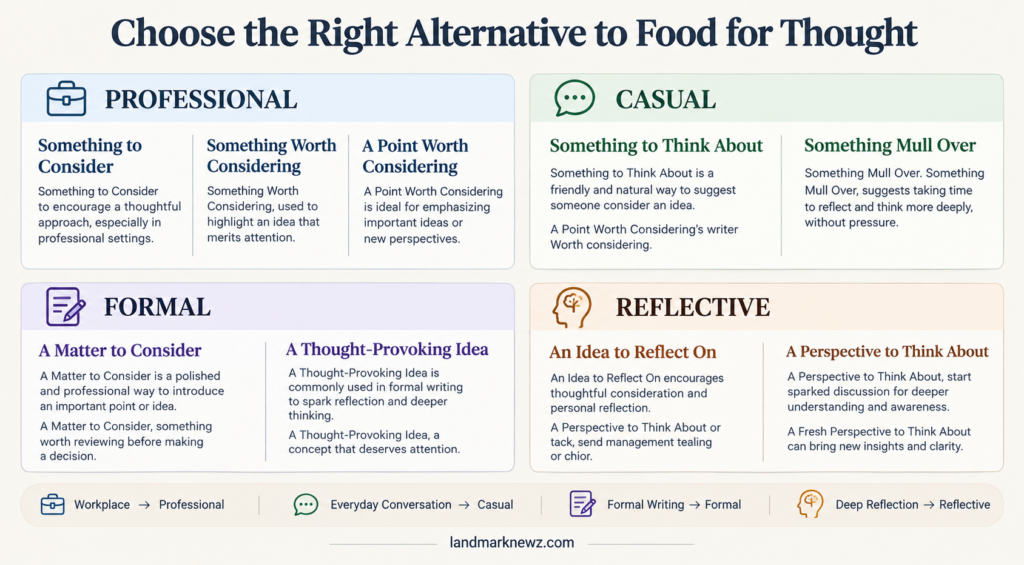
| Alternative | Best Used In | Tone |
| Something to Consider | Business, general writing | Professional |
| Something to Think About | Everyday conversation | Casual |
| A Thought-Provoking Idea | Articles, presentations | Intellectual |
| Something Worth Considering | Workplace, decisions | Professional |
| A Point to Ponder | Reflective writing | Thoughtful |
| A Matter to Consider | Reports, formal discussions | Formal |
| An Idea to Reflect On | Personal reflection | Warm |
| A Point Worth Considering | Meetings, discussions | Polite |
| Something to Mull Over | Casual conversation | Informal |
| A Perspective to Think About | Discussions, articles | Reflective |
Common Mistakes
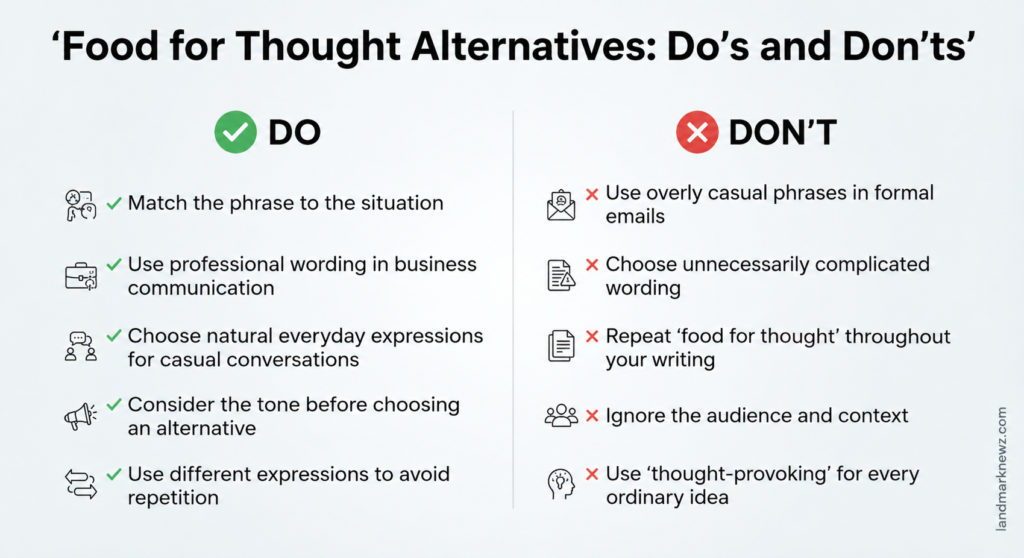
1. Using Casual Phrases in Professional Emails
Expressions such as “something to mull over” can sound too relaxed in formal workplace communication. “Something to consider” is usually a safer professional choice.
2. Choosing Overly Formal Language
Not every situation needs phrases such as “a matter to consider.” In a casual conversation, simpler language often sounds more natural.
3. Repeating the Same Phrase
Using “food for thought” several times in the same article or conversation can make your language feel repetitive. Rotate between suitable alternatives when the context allows it.
4. Forgetting Context
A phrase can have the right meaning but the wrong tone. For example, “a point to ponder” may sound unusual in a short business email where “something to consider” would be clearer.
5. Sounding Insincere
Do not call every minor observation “thought-provoking.” Strong descriptive language works best when the idea genuinely encourages deeper consideration.
Frequently Asked Questions
What is the best professional alternative to “food for thought”?
“Something to consider” is one of the best professional alternatives to “food for thought.” It is clear, neutral, and appropriate for emails, meetings, reports, presentations, and workplace conversations. “Something worth considering” is another excellent option when you want to emphasize that an idea has practical value.
What is a casual way to say “food for thought”?
“Something to think about” is one of the most natural casual alternatives. It sounds conversational and works well with friends, family, coworkers, and informal online communication. “Something to mull over” is also casual, although it suggests spending more time thinking about a decision or idea.
Is “something to consider” the same as “food for thought”?
The two expressions are very similar, but they are not identical in every context. “Something to consider” focuses more directly on evaluating an idea, option, or decision. “Food for thought” is broader and often emphasizes an interesting idea that encourages reflection.
How can I say “food for thought” in an email?
In a professional email, try “something to consider,” “something worth considering,” or “a point worth considering.” These expressions sound polished without being overly formal. For example, you could write, “I wanted to share one point worth considering before we finalize the proposal.”
What is a formal synonym for “food for thought”?
Formal alternatives include “a matter to consider,” “something worth considering,” and “a point worth considering.” The best choice depends on the sentence. “A matter to consider” works particularly well when discussing an issue, responsibility, or decision in a formal setting.
Can I use “thought-provoking idea” instead of “food for thought”?
Yes, but the meaning is slightly more specific. “Thought-provoking idea” emphasizes that an idea stimulates deeper or more interesting thinking. It is especially suitable for articles, presentations, books, speeches, and academic discussions where intellectual engagement is important.
What does “a point to ponder” mean?
“A point to ponder” means an idea, observation, or question that deserves careful thought. It has a reflective and slightly literary tone. It can replace “food for thought” when you want to make your writing sound thoughtful without simply repeating the original idiom.
Which alternative should I use on a resume?
For a resume, avoid using “food for thought” unless it is part of a specific achievement or statement. If you need to describe an idea or recommendation, use precise language such as “a valuable consideration,” “a key insight,” or “a strategic perspective,” depending on the context.
Conclusion
There are many natural ways to say “food for thought,” but the best alternative depends on your audience and purpose. For professional writing, “something to consider,” “something worth considering,” and “a point worth considering” are clear and polished choices. For casual conversations, “something to think about” and “something to mull over” sound more natural.
If you want a reflective tone, try “a point to ponder” or “an idea to reflect on.” For articles and presentations, “a thought-provoking idea” can highlight the intellectual value of a concept.
The key is to choose language that matches the situation rather than replacing every use of “food for thought” with the same synonym. The right phrase makes your writing clearer, more natural, and more purposeful.

Language & Everyday Communication Specialist
Elena Voss is a language enthusiast and communication coach with over 9 years of experience helping people express themselves more naturally in English. She previously worked as an ESL instructor and corporate language trainer, guiding professionals and students on clearer everyday conversations, polite alternatives, and natural phrasing.
Elena specializes in practical synonym guides and “another way to say…” content that feels conversational rather than textbook. Her writing focuses on real-life situations — emails to friends, casual workplace chat, social media, and daily interactions. She believes the best language advice is simple, useful, and easy to remember.
When she’s not creating content for LandmarkNewz, Elena enjoys analyzing modern slang trends and testing new phrases in real conversations.