

What Does “Another Way to Say Food Insecurity” Mean?

The phrase “another way to say food insecurity” refers to alternative expressions that describe a person or household having limited, uncertain, or inadequate access to enough food for an active and healthy life.
People often look for different wording when writing reports, essays, resumes, research papers, health materials, nonprofit content, or public-policy documents. The right alternative can make the meaning clearer without making the subject sound insensitive or overly complicated.
Food insecurity is a broad term, so no single synonym works perfectly in every sentence. Some alternatives emphasize affordability, while others focus on food access, availability, nutrition, or uncertainty.
Why Use Other Ways to Say “Food Insecurity”?
Using alternative wording can help you communicate the specific problem more accurately. It can also prevent repetition when discussing food access several times in the same article or report.
Other wording may help you:
- Avoid repeating “food insecurity.”
- Make complex ideas easier for general readers to understand.
- Emphasize affordability, access, or nutrition.
- Match academic, professional, or conversational contexts.
- Use more descriptive language when explaining a person’s circumstances.
- Make public-health or community information easier to understand.
The key is to choose a phrase that preserves the intended meaning rather than replacing the term simply for variety.
10 Best Other Ways to Say “Food Insecurity”

1. Lack of Access to Adequate Food
Meaning
This phrase describes a situation in which someone does not have dependable access to enough food to meet their needs. It is a clear and neutral alternative that works well when you want to explain food insecurity without using the original term.
Best For
- Professional
- Formal
- Academic
Example 1
Many families experience a lack of access to adequate food because of rising living costs.
Example 2
The program helps children affected by a lack of access to adequate food.
Quick Tip
Use this phrase when you want a direct, formal explanation of what food insecurity means.
2. Limited Access to Nutritious Food
Meaning
This expression focuses on whether people can obtain healthy, nutritious foods. It is especially useful when the discussion involves diet quality, health, or the availability of fresh foods.
Best For
- Professional
- Formal
- Public health
Example 1
Rural communities may face limited access to nutritious food because grocery stores are located far away.
Example 2
The initiative aims to improve limited access to nutritious food in underserved neighborhoods.
Quick Tip
Choose this wording when nutrition or healthy food options are central to your topic.
3. Food Hardship
Meaning
Food hardship is a concise expression for difficulty getting enough food or being able to afford food consistently. It often appears in discussions about household finances, poverty, community programs, and social conditions.
Best For
- Professional
- Formal
- Community
Example 1
The survey examined food hardship among low-income households.
Example 2
Local organizations provide assistance to families experiencing food hardship.
Quick Tip
Use “food hardship” when you need a short alternative that still communicates serious difficulty accessing food.
4. Difficulty Affording Food
Meaning
This phrase specifically highlights the financial side of the problem. It is useful when income, household expenses, inflation, or food prices make it difficult for someone to purchase enough food.
Best For
- Professional
- Casual
- Friendly
- General audiences
Example 1
Many households report difficulty affording food after paying for housing and utilities.
Example 2
The survey asked residents whether they had difficulty affording food during the previous month.
Quick Tip
Use this option when money is the main barrier rather than physical availability.
5. Insufficient Access to Food
Meaning
Insufficient access to food suggests that a person or household cannot obtain enough food to meet their needs. It has a formal tone and can fit naturally into reports, research, and policy discussions.
Best For
- Professional
- Formal
- Academic
Example 1
The study explored the effects of insufficient access to food on children’s well-being.
Example 2
Community programs can help address insufficient access to food among vulnerable households.
Quick Tip
This is a good choice when you want concise, formal wording without focusing on a single cause.
6. Lack of Reliable Access to Food
Meaning
This alternative emphasizes reliability and consistency. It communicates that someone may have food at certain times but cannot depend on having enough food regularly.
Best For
- Professional
- Formal
- Public health
Example 1
Families with a lack of reliable access to food may struggle to plan regular meals.
Example 2
The nonprofit supports households facing a lack of reliable access to food.
Quick Tip
Use this phrase when uncertainty or inconsistent access is an important part of the situation.
7. Inadequate Food Access
Meaning
Inadequate food access is a compact, formal expression describing circumstances in which people cannot obtain sufficient food. It works especially well in reports and discussions about community resources.
Best For
- Professional
- Formal
- Academic
Example 1
The county is investing in programs designed to improve inadequate food access.
Example 2
Researchers examined transportation barriers associated with inadequate food access.
Quick Tip
This phrase is useful for headlines, reports, and other situations where concise wording matters.
8. Difficulty Getting Enough Food
Meaning
This is a plain-language alternative that is easy for most readers to understand. Rather than using technical terminology, it directly describes the experience of not being able to obtain enough food.
Best For
- Casual
- Friendly
- Professional
- General audiences
Example 1
Some families have difficulty getting enough food during periods of unemployment.
Example 2
The organization provides resources for people having difficulty getting enough food.
Quick Tip
Choose this phrase when your audience may not be familiar with public-health or policy terminology.
9. Unreliable Access to Food
Meaning
Unreliable access to food highlights uncertainty about whether adequate food will be available when it is needed. It can describe an ongoing household challenge without suggesting that the problem has only one cause.
Best For
- Professional
- Formal
- Academic
Example 1
Children may face health and educational challenges when they experience unreliable access to food.
Example 2
The community assessment identified unreliable access to food as a major concern.
Quick Tip
Use this wording when consistency and uncertainty are more important than affordability alone.
10. Inadequate Access to Nutritious Food
Meaning
This phrase combines the ideas of food access and nutritional quality. It works well when discussing whether people can obtain enough healthy food rather than simply whether food is available.
Best For
- Professional
- Formal
- Academic
- Public health
Example 1
Transportation problems can contribute to inadequate access to nutritious food.
Example 2
The program was created to address inadequate access to nutritious food in rural communities.
Quick Tip
Use this alternative when your subject involves both food availability and the quality of the diet.
Comparison Table
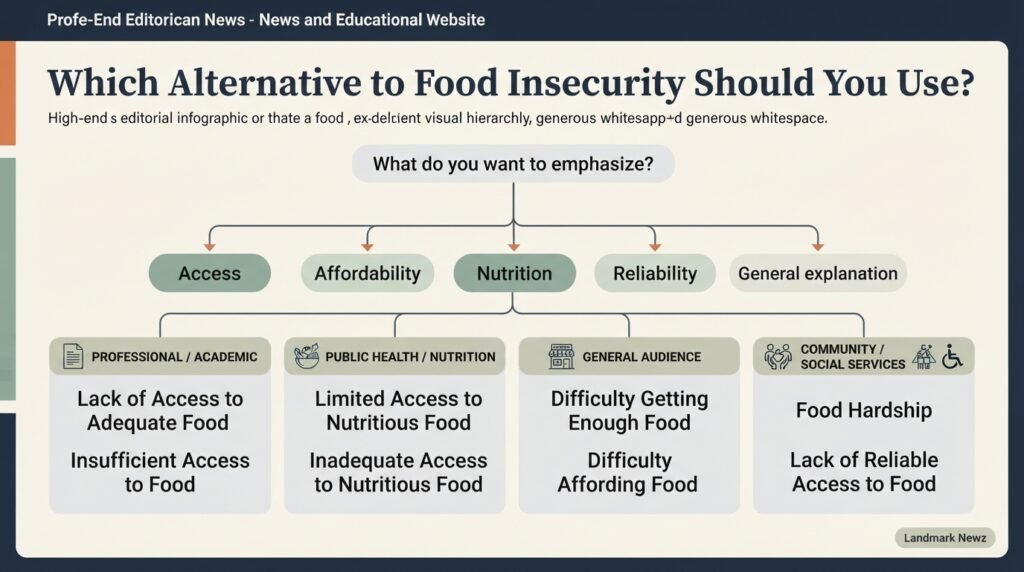
| Alternative | Best Used In | Tone |
| Lack of Access to Adequate Food | Academic, professional writing | Formal, neutral |
| Limited Access to Nutritious Food | Health and nutrition content | Professional, descriptive |
| Food Hardship | Community and social-service writing | Formal, direct |
| Difficulty Affording Food | General and financial discussions | Clear, conversational |
| Insufficient Access to Food | Reports and research | Formal, neutral |
| Lack of Reliable Access to Food | Public health and research | Professional, precise |
| Inadequate Food Access | Reports and policy writing | Formal, concise |
| Difficulty Getting Enough Food | General audiences | Plain, empathetic |
| Unreliable Access to Food | Research and community assessments | Formal, descriptive |
| Inadequate Access to Nutritious Food | Health and nutrition topics | Professional, specific |
Common Mistakes

1. Treating Every Alternative as an Exact Synonym
Not every expression has precisely the same meaning as food insecurity. For example, “difficulty affording food” focuses on finances, while food insecurity can involve several factors.
2. Ignoring the Audience
Technical wording may work well in an academic report but feel unnatural in an article written for the general public. Choose language your intended readers can understand quickly.
3. Focusing Only on Food Prices
Food insecurity is not always caused by low income or high food prices. Transportation, availability, household circumstances, and access to resources can also affect someone’s ability to obtain adequate food.
4. Using “Hunger” as a Perfect Replacement
Hunger and food insecurity are related but not identical. Hunger generally describes the physical experience of not having enough food, while food insecurity describes inadequate or uncertain access to food.
5. Using Euphemistic Language
Trying too hard to avoid the term “food insecurity” can make writing vague. If the standard term is the clearest option for your audience, use it instead of forcing an alternative.
Frequently Asked Questions
What is a simple way to say food insecurity?
A simple way to say food insecurity is “difficulty getting enough food.” This wording is easy to understand and works well for general audiences. If you need a more professional expression, “lack of access to adequate food” or “limited access to nutritious food” may be more appropriate.
What is a professional way to say food insecurity?
A professional alternative is “lack of access to adequate food.” Other suitable choices include “insufficient access to food,” “unreliable access to food,” and “inadequate food access.” The best option depends on whether your writing focuses on availability, affordability, nutrition, or consistency.
Is “food hardship” the same as food insecurity?
“Food hardship” is closely related to food insecurity, but the terms are not always interchangeable. Food hardship generally emphasizes difficulty obtaining enough food, while food insecurity is a broader term that can include uncertainty about having adequate food and limited access to nutritious choices.
What is another way to say lack of food access?
You can say “inadequate food access,” “insufficient access to food,” “limited access to nutritious food,” or “unreliable access to food.” Choose the wording based on your intended meaning. For example, “limited access to nutritious food” is especially useful when discussing diet quality or healthy food options.
Can I use “hunger” instead of food insecurity?
Not always. Hunger describes a physical sensation or experience associated with not eating enough, whereas food insecurity refers to limited or uncertain access to adequate food. A person can experience food insecurity without being hungry at every moment, so the terms should not automatically be treated as synonyms.
What is a plain-English alternative to food insecurity?
“Difficulty getting enough food” is one of the clearest plain-English alternatives. It avoids technical terminology while preserving the basic idea. “Difficulty affording food” can also work when financial limitations are specifically responsible for the problem.
What is the best alternative for an academic paper?
For an academic paper, phrases such as “lack of access to adequate food,” “insufficient access to food,” and “unreliable access to food” can work well. However, if your research specifically examines food insecurity, keeping the established term may provide greater precision and consistency.
What is another way to describe food insecurity without using the word “insecurity”?
You can describe it as “limited access to adequate food,” “difficulty getting enough food,” “unreliable access to food,” or “inadequate access to nutritious food.” These descriptions can make the concept easier to understand while avoiding the word “insecurity.”
Conclusion
Choosing another way to say food insecurity depends on what you want to emphasize. If you need a formal and neutral option, “lack of access to adequate food” is a strong choice. For health-related content, “limited access to nutritious food” provides more detail, while “difficulty affording food” works best when financial barriers are the focus.
For general readers, “difficulty getting enough food” is simple, direct, and easy to understand. Meanwhile, “food hardship” offers a concise option for community and social-service discussions.
Remember that these alternatives are not always interchangeable. Food insecurity has a specific meaning, so use the established term when precision matters and choose an alternative when it makes your particular context clearer. For greater accuracy, consult the official definition of food insecurity published by the USDA.

The Landmark Newz Editorial Team writes and reviews every guide on this site. We check each alternative phrase against standard dictionaries and real usage, explain when it fits, and update articles when readers point out errors.