
What Does “Another Way to Say How to” Mean?
The phrase “another way to say how to” refers to different words or expressions that can replace “how to” without changing the basic meaning. People usually search for alternatives when they want to avoid repetition, improve their writing, or find a phrase that fits a specific situation.
“How to” is commonly used when introducing instructions, explanations, tutorials, or methods. For example, “how to write a resume” asks for guidance on writing a resume.
However, the best replacement depends on the sentence. A phrase such as “steps to” emphasizes a sequence, while “methods for” focuses on possible techniques or approaches.
Why Use Other Ways to Say “How To”?
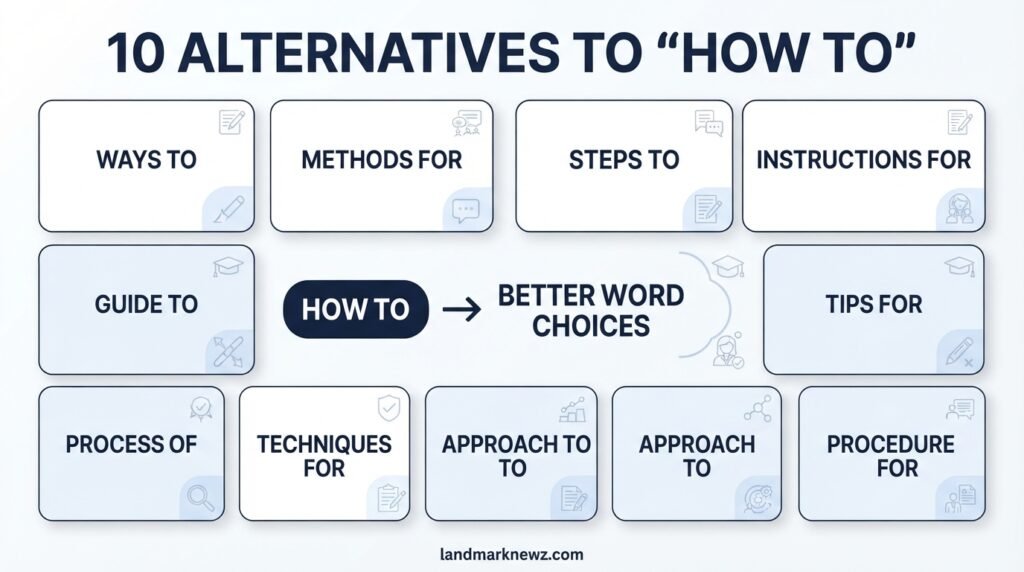
Using a suitable alternative can make your writing more precise and natural. Although “how to” is perfectly correct, repeating it too often can make titles, articles, or professional documents sound predictable.
Consider another phrase when you want to:
- Avoid repeating the same wording.
- Make a headline more engaging.
- Match a formal or professional tone.
- Explain a process more precisely.
- Make instructions easier to understand.
- Highlight methods, steps, or techniques.
- Create more varied and natural content.
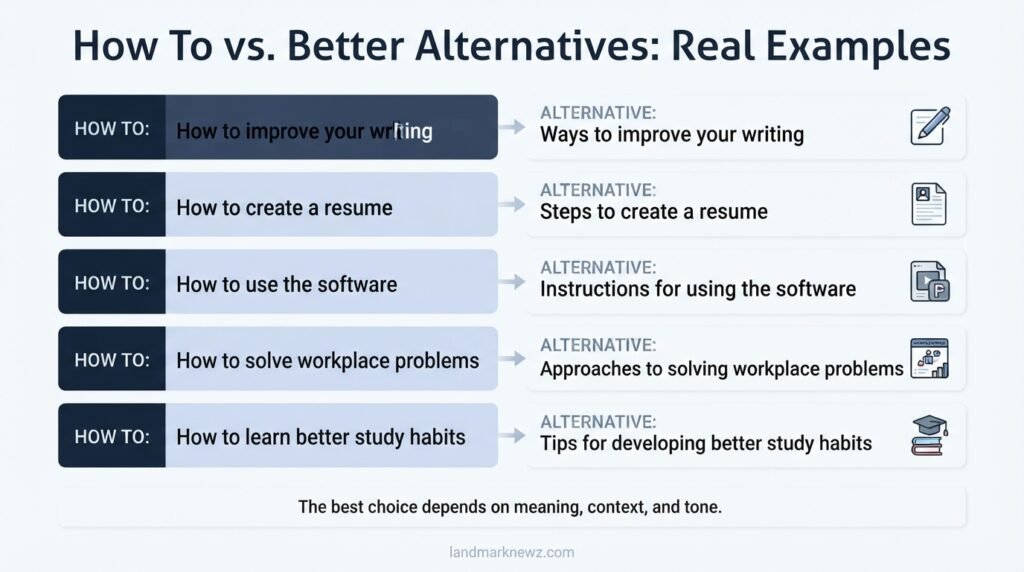
10 Best Other Ways to Say “How To”
1. Ways to
Meaning
“Ways to” describes different options or approaches for accomplishing something. It works especially well when there is more than one possible solution.
Best For
- Casual
- Friendly
- Professional
- Polite
Example 1
There are several ways to reduce your monthly expenses without making major lifestyle changes.
Example 2
Here are five practical ways to improve your communication skills at work.
Quick Tip
Use “ways to” when you want to emphasize choices rather than one fixed procedure.
2. Methods for
Meaning
“Methods for” refers to specific techniques, systems, or approaches used to accomplish a particular goal. It has a more professional and academic feel than “ways to.”
Best For
- Professional
- Formal
Example 1
The report outlines several methods for improving employee productivity.
Example 2
Researchers tested different methods for measuring customer satisfaction.
Quick Tip
Choose “methods for” when discussing tested, structured, or technical approaches.
3. Steps to
Meaning
“Steps to” suggests a sequence of actions that leads to a specific result. It is particularly useful for tutorials, instructions, checklists, and practical guides.
Best For
- Professional
- Friendly
- Polite
- Casual
Example 1
Follow these steps to create a secure online account.
Example 2
These simple steps to prepare for your interview can help you feel more confident.
Quick Tip
Use this alternative when the reader needs to complete actions in a particular order.
4. Instructions for
Meaning
“Instructions for” focuses directly on directions or guidance. It works well when the reader needs clear information about operating, completing, or using something.
Best For
- Professional
- Formal
- Polite
Example 1
Please read the instructions for installing the software before getting started.
Example 2
The package includes detailed instructions for assembling the desk.
Quick Tip
Use “instructions for” when accuracy and clarity are more important than a conversational tone.
5. Guide to
Meaning
“Guide to” introduces information that helps someone understand or accomplish something. It is one of the most natural alternatives for article titles, educational resources, and online content.
Best For
- Professional
- Friendly
- Formal
- Polite
Example 1
Our guide to choosing the right health insurance explains the main factors to consider.
Example 2
This beginner’s guide to using the platform covers the most important features.
Quick Tip
“Guide to” works especially well in headlines because it sounds useful without promising a rigid set of steps.
6. Tips for
Meaning
“Tips for” presents helpful suggestions rather than complete instructions. It is ideal when readers can choose which recommendations to follow.
Best For
- Casual
- Friendly
- Warm
Example 1
These tips for improving your presentation skills can help you speak with greater confidence.
Example 2
Try these tips for saving money on your next vacation.
Quick Tip
Choose “tips for” when you are offering advice, shortcuts, or practical suggestions rather than a full tutorial.
7. Process of
Meaning
“The process of” describes how something happens or the series of stages involved in achieving an outcome. It often sounds more explanatory than instructional.
Best For
- Professional
- Formal
Example 1
The article explains the process of applying for a business license.
Example 2
Understanding the process of buying a home can make the experience less stressful.
Quick Tip
Use this phrase when your goal is to explain stages or progression rather than give direct commands.
8. Techniques for
Meaning
“Techniques for” refers to specific skills or methods used to achieve a desired result. It is especially appropriate for subjects involving training, performance, creativity, or specialized skills.
Best For
- Professional
- Formal
- Educational
Example 1
The workshop teaches effective techniques for managing difficult conversations.
Example 2
Photographers use different techniques for capturing sharp images in low light.
Quick Tip
Use “techniques for” when the subject involves skill, practice, or specialized methods.
9. Approach to
Meaning
“Approach to” describes a particular way of dealing with a problem, task, or situation. It is useful when comparing strategies rather than explaining simple instructions.
Best For
- Professional
- Formal
Example 1
The company adopted a new approach to improving customer service.
Example 2
Her approach to solving complex problems involves breaking them into smaller tasks.
Quick Tip
Choose “approach to” when you want to highlight a strategy, mindset, or overall method.
10. Procedure for
Meaning
“Procedure for” refers to an established or formal series of actions used to complete a task. It is more official than “ways to” and often appears in workplace, technical, or regulatory writing.
Best For
- Formal
- Professional
- Polite
Example 1
The manual describes the procedure for reporting a workplace incident.
Example 2
Employees must follow the approved procedure for handling confidential documents.
Quick Tip
Use “procedure for” when the steps are standardized, required, or governed by rules.
Comparison Table
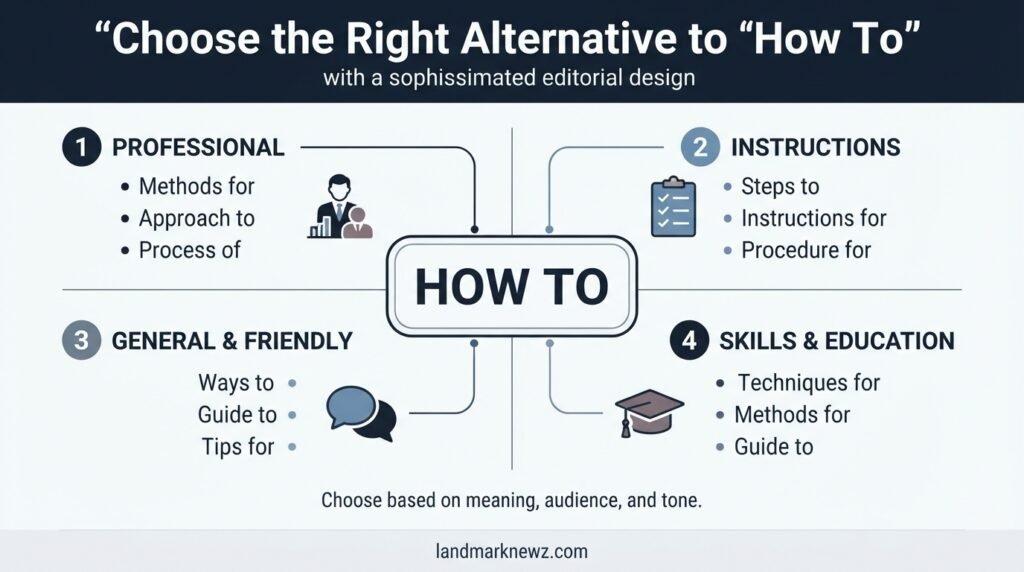
| Alternative | Best Used In | Tone |
| Ways to | General advice, articles, everyday writing | Natural, flexible |
| Methods for | Academic, technical, professional writing | Professional |
| Steps to | Tutorials, instructions, checklists | Clear, practical |
| Instructions for | Manuals, directions, workplace documents | Formal, direct |
| Guide to | Articles, resources, educational content | Helpful, approachable |
| Tips for | Advice, blogs, casual content | Friendly, conversational |
| Process of | Explanations and business writing | Professional, explanatory |
| Techniques for | Training, skills, specialized topics | Expert, educational |
| Approach to | Strategies and problem-solving | Professional, analytical |
| Procedure for | Official and standardized instructions | Formal, precise |
Common Mistakes
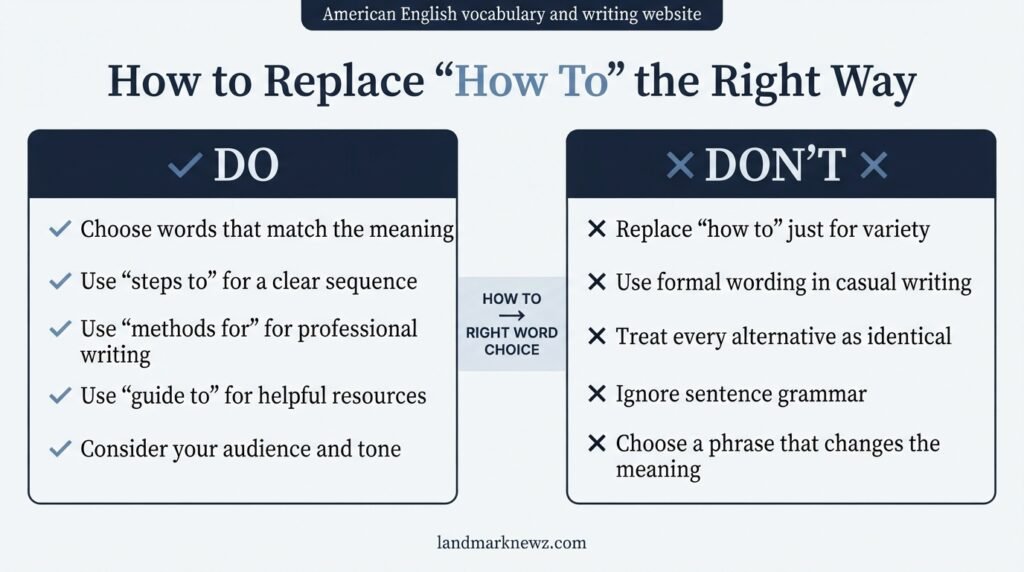
1. Using a casual phrase in formal writing
“Tips for” may sound too casual in a technical policy or formal report. In those settings, “methods for,” “procedure for,” or “instructions for” may be more suitable.
2. Choosing an overly formal alternative
Not every sentence needs to sound academic. Replacing a simple “how to” with “procedure for” can make ordinary content unnecessarily stiff.
3. Ignoring the intended meaning
Not all alternatives are exact substitutes. “Steps to” implies a sequence, while “tips for” suggests optional advice, so choose according to what you actually mean.
4. Forgetting the audience
A beginner may respond better to “guide to” or “steps to,” while a technical audience may expect terms such as “methods for” or “techniques for.”
5. Forcing an alternative into the sentence
Grammar matters. Some replacements require different sentence structures, so never change “how to” simply for variety if the new phrase makes the sentence awkward.
Frequently Asked Questions
What is another way to say “how to”?
Common alternatives include ways to, methods for, steps to, instructions for, guide to, tips for, process of, techniques for, approach to, and procedure for. The right choice depends on your intended meaning. For general writing, “ways to” and “guide to” are flexible options, while “procedure for” suits formal or standardized instructions.
What is a professional way to say “how to”?
For professional writing, consider “methods for,” “steps to,” “approach to,” “process of,” or “procedure for.” The best option depends on context. For example, “methods for improving productivity” sounds professional and analytical, while “steps to improve productivity” feels more practical and instructional.
What is a formal way to say “how to”?
Formal alternatives include “instructions for,” “procedure for,” “methods for,” and “process of.” These expressions work well in reports, manuals, policies, academic writing, and workplace documents. Avoid choosing a formal phrase simply because it sounds sophisticated; clarity should remain the priority.
What can I say instead of “how to” in a title?
For a title, you can use “guide to,” “ways to,” “steps to,” “tips for,” or “methods for.” For example, instead of “How to Improve Your Writing,” you could write “A Guide to Improving Your Writing” or “10 Ways to Improve Your Writing.”
Is “ways to” the same as “how to”?
They are closely related but not always identical. “How to” generally introduces guidance or instructions, while “ways to” emphasizes possible options. For example, “how to save money” asks for guidance, whereas “ways to save money” suggests several strategies a person could choose from.
What is another way to say “how to” in an essay?
In an essay, alternatives such as “the process of,” “the methods used to,” “the approach to,” or “the steps involved in” can sound more natural. The choice depends on whether you are explaining a process, analyzing a method, or describing a strategy.
What is a better phrase than “how to” for instructions?
“Steps to” and “instructions for” are strong choices for instructional content. “Steps to” works when actions follow a sequence, while “instructions for” is better when giving precise directions for completing a task or operating something.
Can I use these alternatives in professional emails?
Yes, but choose according to your purpose. “Steps to,” “instructions for,” and “process of” are usually appropriate in workplace emails. For example, “Here are the steps to complete your registration” sounds clear and professional without being overly formal.
Conclusion
There are many useful alternatives to “how to,” but the best choice depends on what you want your reader to understand. Use “ways to” for multiple options, “steps to” for a sequence, and “guide to” for helpful instructional content. Choose “methods for” or “techniques for” when discussing specific approaches, while “procedure for” works best for formal or standardized instructions.
Most importantly, do not replace “how to” just to sound different. Clear writing matters more than forced variety. Consider your audience, tone, sentence structure, and intended meaning before choosing an alternative. When the wording accurately reflects the content, your writing will sound more natural, precise, and professional. For more guidance on creating clear instructional content, see this guide on how to create a how-to guide.

Professional Writing & Workplace Communication Expert
Marcus Hale is a business communication specialist with 11 years of experience in corporate training and professional writing. He has worked with mid-sized companies and remote teams to improve clarity in emails, reports, performance reviews, and client-facing messages.
Marcus focuses on polished, professional alternatives that help readers sound confident without sounding stiff. His guides cover workplace phrases, resume language, leadership communication, and formal-to-natural transitions. He holds a background in business administration and technical writing, and has led workshops on effective professional English.
At LandmarkNewz, Marcus creates practical synonym lists and phrasing tips that professionals can apply immediately in emails, meetings, and career documents.