
Finding another way to say leadership skills can help you make your resume, cover letter, LinkedIn profile, or workplace communication sound more precise. Although “leadership skills” is widely understood, repeating the same phrase can make professional writing feel generic.
The right alternative depends on what you actually do as a leader. For example, managing employees, guiding a project, mentoring coworkers, and making strategic decisions each call for slightly different language.
What Does “Another Way to Say Leadership Skills” Mean?
“Another way to say leadership skills” refers to alternative words or phrases that describe a person’s ability to guide, influence, motivate, organize, and support others toward a shared goal.
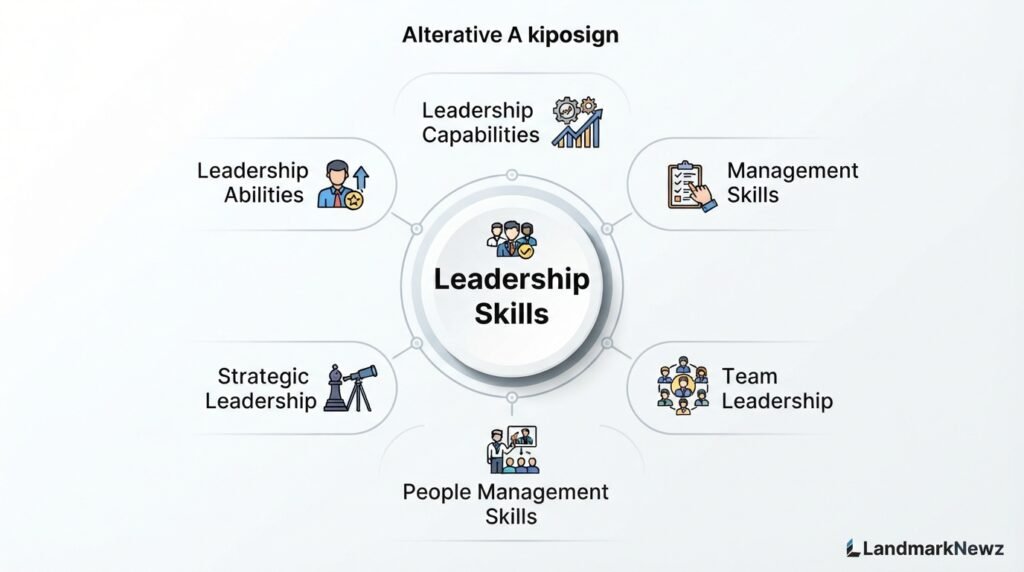
Common alternatives include leadership abilities, leadership capabilities, management skills, team leadership, and people management skills. These expressions are often used on resumes, cover letters, job applications, performance reviews, professional bios, and workplace documents.
People usually look for these alternatives when they want their writing to sound less repetitive or when they want to highlight a specific type of leadership experience.
Why Use Other Ways to Say “Leadership Skills”?
Using a more specific phrase can make your professional communication clearer and more compelling. Instead of simply claiming that you have leadership skills, you can show whether your strength lies in managing people, leading teams, mentoring others, or making decisions.
Using alternatives can help you:
- Avoid repeating “leadership skills” throughout a resume.
- Describe your strengths more precisely.
- Match your wording to a specific job description.
- Make professional writing sound more natural.
- Highlight a particular type of leadership experience.
- Create stronger resume and cover letter statements.
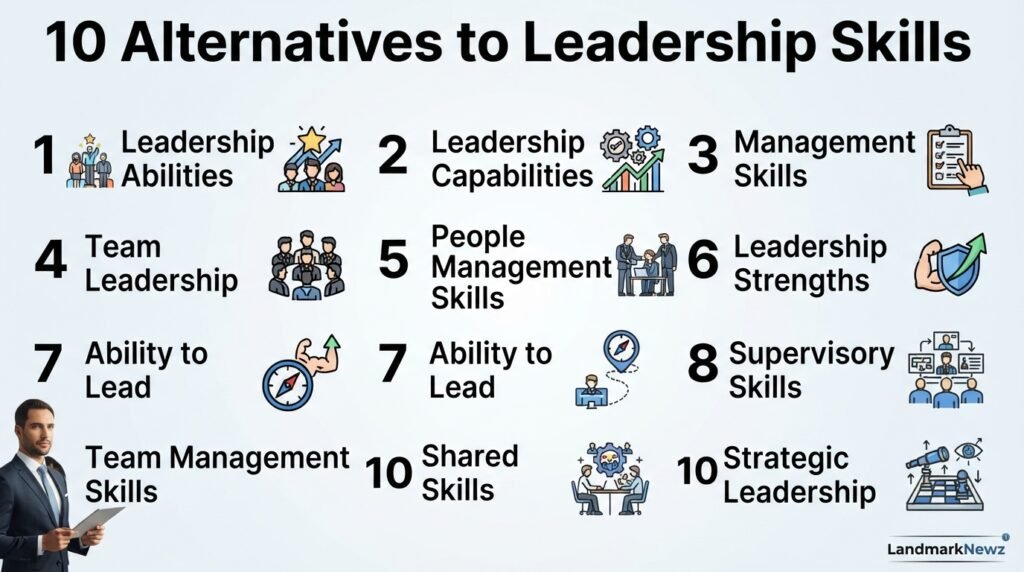
10 Best Other Ways to Say “Leadership Skills”
1. Leadership Abilities
Meaning
“Leadership abilities” describes the qualities and capacity a person uses to guide, influence, and support others. It is a close substitute for “leadership skills” and works well when you want professional wording without changing the basic meaning.
Best For
- Professional
- Formal
Example 1
Her leadership abilities helped the department meet its annual performance goals.
Example 2
The position requires strong leadership abilities and excellent communication.
Quick Tip
Use “leadership abilities” when you want a direct, natural replacement for “leadership skills” on a resume or professional profile.
2. Leadership Capabilities
Meaning
“Leadership capabilities” emphasizes what someone is capable of doing as a leader. It can suggest a broader combination of experience, judgment, communication, decision-making, and organizational strengths.
Best For
- Professional
- Formal
Example 1
The promotion reflects his strong leadership capabilities and consistent results.
Example 2
She demonstrated leadership capabilities while coordinating several cross-functional teams.
Quick Tip
Choose this phrase when describing leadership at a higher level or discussing long-term professional growth.
3. Management Skills
Meaning
“Management skills” focuses more specifically on organizing work, supervising employees, allocating resources, and achieving business objectives. It is especially useful when your leadership experience includes direct responsibility for people or operations.
Best For
- Professional
- Formal
Example 1
My management skills have helped me build productive and accountable teams.
Example 2
The role requires strong management skills and the ability to handle competing priorities.
Quick Tip
Use “management skills” only when your experience genuinely involves managing people, projects, resources, or operations.
4. Team Leadership
Meaning
“Team leadership” highlights the ability to guide a group toward a common objective. Unlike the broader term “leadership skills,” it puts the focus on working with and directing teams.
Best For
- Professional
- Friendly
Example 1
Her experience in team leadership improved collaboration across the sales department.
Example 2
The position gave me valuable experience in team leadership and employee development.
Quick Tip
This is a strong choice when applying for positions that require collaboration, team coordination, or supervision.
5. People Management Skills
Meaning
“People management skills” refers to the ability to supervise, motivate, communicate with, develop, and support employees. It is more specific than general leadership skills.
Best For
- Professional
- Formal
Example 1
His people management skills helped reduce employee turnover within the department.
Example 2
The role requires excellent people management skills and a supportive leadership style.
Quick Tip
Use this phrase when your leadership experience centers on employees, coaching, performance, or workplace relationships.
6. Leadership Strengths
Meaning
“Leadership strengths” refers to the particular qualities that make someone effective as a leader. These might include communication, delegation, problem-solving, accountability, emotional intelligence, or decision-making.
Best For
- Professional
- Friendly
- Warm
Example 1
One of her key leadership strengths is the ability to build trust within a team.
Example 2
My leadership strengths include strategic thinking, clear communication, and effective delegation.
Quick Tip
This phrase works especially well when you are describing specific qualities rather than simply listing leadership as a general skill.
7. Ability to Lead
Meaning
“The ability to lead” is a straightforward phrase that focuses on whether someone can guide people or projects effectively. It sounds natural and works well in descriptions of professional potential or demonstrated experience.
Best For
- Professional
- Formal
- Friendly
Example 1
The candidate has demonstrated a strong ability to lead teams through complex projects.
Example 2
Her ability to lead under pressure made her a valuable member of the organization.
Quick Tip
Use this expression in full sentences when you want your writing to sound conversational rather than like a list of resume keywords.
8. Supervisory Skills
Meaning
“Supervisory skills” focuses on overseeing employees, assigning responsibilities, monitoring performance, and supporting day-to-day work. It is narrower than leadership skills and is best when the role involves direct supervision.
Best For
- Professional
- Formal
Example 1
He developed strong supervisory skills while managing a team of customer service representatives.
Example 2
The position requires supervisory skills, sound judgment, and excellent communication.
Quick Tip
Choose “supervisory skills” when the job specifically involves overseeing employees or managing daily team activities.
9. Team Management Skills
Meaning
“Team management skills” describe the ability to organize, motivate, coordinate, and support a group of employees or colleagues. The phrase combines leadership with practical team-management responsibilities.
Best For
- Professional
- Formal
Example 1
Her team management skills contributed to higher productivity and stronger employee engagement.
Example 2
I used my team management skills to coordinate schedules and improve workflow.
Quick Tip
This option is particularly useful for resumes targeting team lead, supervisor, department manager, or project manager positions.
10. Strategic Leadership
Meaning
“Strategic leadership” refers to leading with a focus on long-term goals, organizational direction, decision-making, and sustainable results. It suggests a broader level of responsibility than everyday team supervision.
Best For
- Professional
- Formal
Example 1
His strategic leadership helped the company enter several new regional markets.
Example 2
The executive is known for strategic leadership and thoughtful decision-making.
Quick Tip
Use “strategic leadership” when discussing senior-level responsibilities, organizational planning, or long-term business objectives.
Comparison Table
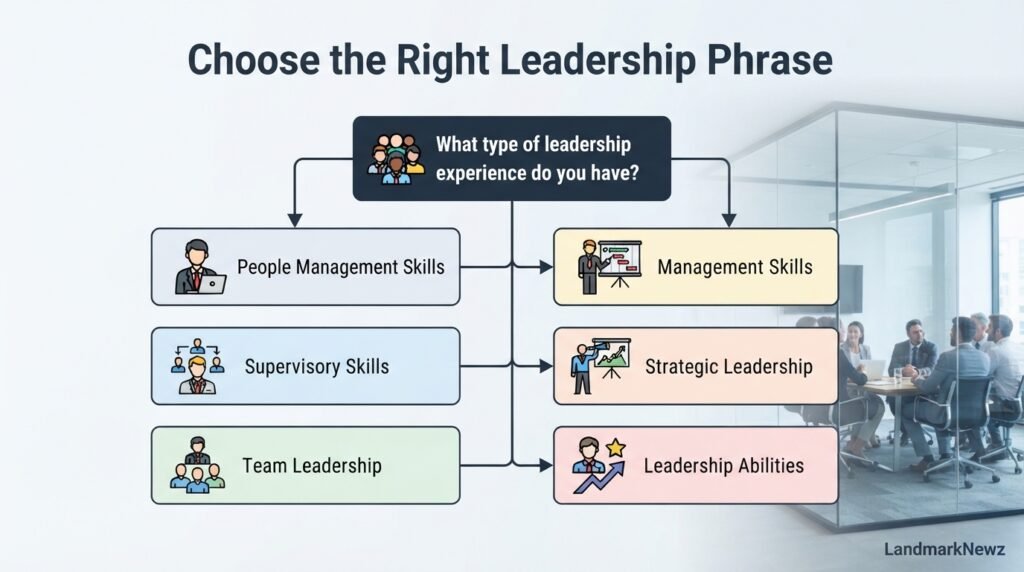
| Alternative | Best Used In | Tone |
| Leadership Abilities | Resumes, professional profiles | Professional |
| Leadership Capabilities | Executive roles, career development | Formal |
| Management Skills | Management resumes, job applications | Professional |
| Team Leadership | Team-based roles, resumes | Professional |
| People Management Skills | Supervisory and management roles | Professional |
| Leadership Strengths | Resumes, interviews, self-assessments | Warm/Professional |
| Ability to Lead | Cover letters, professional statements | Natural/Professional |
| Supervisory Skills | Supervisor and manager positions | Formal |
| Team Management Skills | Team lead and management resumes | Professional |
| Strategic Leadership | Executive and senior-level roles | Formal |
How to Choose the Right Alternative
The best alternative depends on the type of leadership you want to describe. A general phrase such as leadership abilities works in many situations, while more specific wording can communicate your experience more effectively.
For a resume, consider “leadership abilities,” “management skills,” or “team leadership.” If you supervise employees, “people management skills” or “supervisory skills” may be more accurate.
For a cover letter, “ability to lead” can sound more natural because it fits smoothly into complete sentences. For executive positions, “strategic leadership” or “leadership capabilities” can better reflect higher-level responsibilities.
Most importantly, don’t choose a phrase simply because it sounds impressive. Your wording should accurately represent what you have actually done.
Common Mistakes
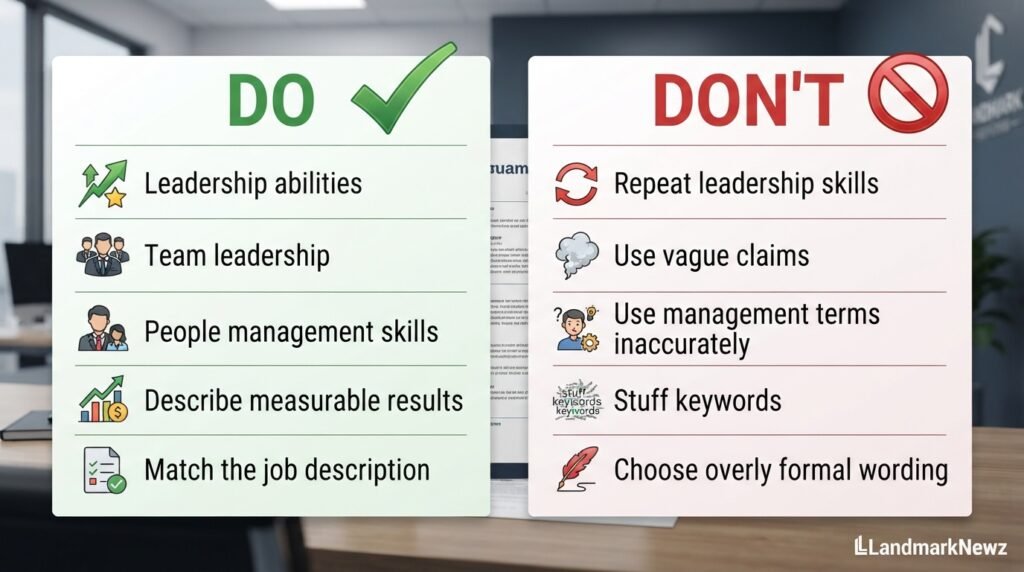
1. Using “Management Skills” for Every Leadership Role
Leadership and management overlap, but they are not identical. Someone can lead through influence, mentoring, or vision without directly managing employees.
2. Using Overly Formal Language
Terms such as “strategic leadership capabilities” may sound unnatural for an entry-level position. Match the language to your experience and the job.
3. Repeating the Same Phrase
Using “leadership skills” several times in one resume can make your writing repetitive. Use relevant alternatives when they describe genuinely different strengths.
4. Ignoring the Job Description
Employers often use specific terms for the qualities they want. If a posting emphasizes team management, supervision, or strategic planning, reflect those concepts when they accurately describe your experience.
5. Making Vague Leadership Claims
Simply writing “excellent leadership skills” does not show what you accomplished. Whenever possible, support leadership claims with results, responsibilities, or specific examples.
Frequently Asked Questions
What is a professional way to say “leadership skills”?
“Leadership abilities” is one of the most professional alternatives because it has nearly the same meaning and fits many workplace situations. Depending on your experience, you can also use “leadership capabilities,” “management skills,” “team leadership,” or “people management skills” to describe more specific areas of leadership.
What is another word for leadership skills on a resume?
Good resume alternatives include leadership abilities, management skills, team leadership, supervisory skills, and team management skills. The strongest option depends on your actual responsibilities. For example, “supervisory skills” works well for someone who oversees employees, while “strategic leadership” is better suited to senior-level roles.
How can I describe leadership skills without saying “leadership”?
You can focus on the specific ability behind your leadership experience. Words and phrases such as “team management,” “employee development,” “strategic decision-making,” “staff supervision,” “mentoring,” and “cross-functional coordination” can communicate leadership without directly using the word “leadership.”
What is a better phrase than “strong leadership skills”?
Instead of making a broad claim, choose a phrase that identifies your specific strength. For example, “proven ability to lead cross-functional teams,” “strong people management skills,” or “effective team leadership” provides more information than simply saying “strong leadership skills.”
What can I say instead of “leadership skills” in a cover letter?
In a cover letter, “ability to lead” often sounds natural and personal. You can also write phrases such as “experience leading teams,” “background in team management,” or “proven ability to guide projects.” These options allow you to connect your leadership experience directly to the position.
Is “management skills” the same as “leadership skills”?
Not exactly. Management skills usually involve planning, organizing, supervising, and coordinating work, while leadership focuses more broadly on influencing, motivating, guiding, and supporting others. There is considerable overlap, but the two terms should not automatically be treated as interchangeable.
What is a strong synonym for leadership abilities?
“Leadership capabilities” is a strong professional synonym, especially in formal or executive contexts. Other suitable choices include “leadership strengths,” “ability to lead,” and “team leadership.” The best option depends on whether you want to emphasize potential, specific qualities, team direction, or professional experience.
How do I show leadership skills on a resume?
Show leadership through specific actions and results rather than relying on a generic skills list. For example, describe how you led a team, improved a process, trained employees, coordinated a project, solved a problem, or helped achieve a measurable goal. Evidence makes leadership claims more convincing.
Conclusion
Finding another way to say leadership skills can make your professional writing more specific, natural, and persuasive. While leadership abilities is a reliable general alternative, other phrases may better match your experience. “Management skills” works well for people who manage employees or operations, while “team leadership” highlights the ability to guide groups.
“People management skills” focuses on employee development and workplace relationships, and “strategic leadership” suits senior-level responsibilities.
When choosing a phrase for a resume, cover letter, or professional profile, focus on accuracy rather than using the most impressive-sounding term.
The strongest wording is the one that clearly reflects what you have actually done. Choose the phrase that describes your leadership experience most precisely, then support it with real responsibilities and results. For more guidance, learn how to list leadership skills on your resume effectively.

Language & Everyday Communication Specialist
Elena Voss is a language enthusiast and communication coach with over 9 years of experience helping people express themselves more naturally in English. She previously worked as an ESL instructor and corporate language trainer, guiding professionals and students on clearer everyday conversations, polite alternatives, and natural phrasing.
Elena specializes in practical synonym guides and “another way to say…” content that feels conversational rather than textbook. Her writing focuses on real-life situations — emails to friends, casual workplace chat, social media, and daily interactions. She believes the best language advice is simple, useful, and easy to remember.
When she’s not creating content for LandmarkNewz, Elena enjoys analyzing modern slang trends and testing new phrases in real conversations.