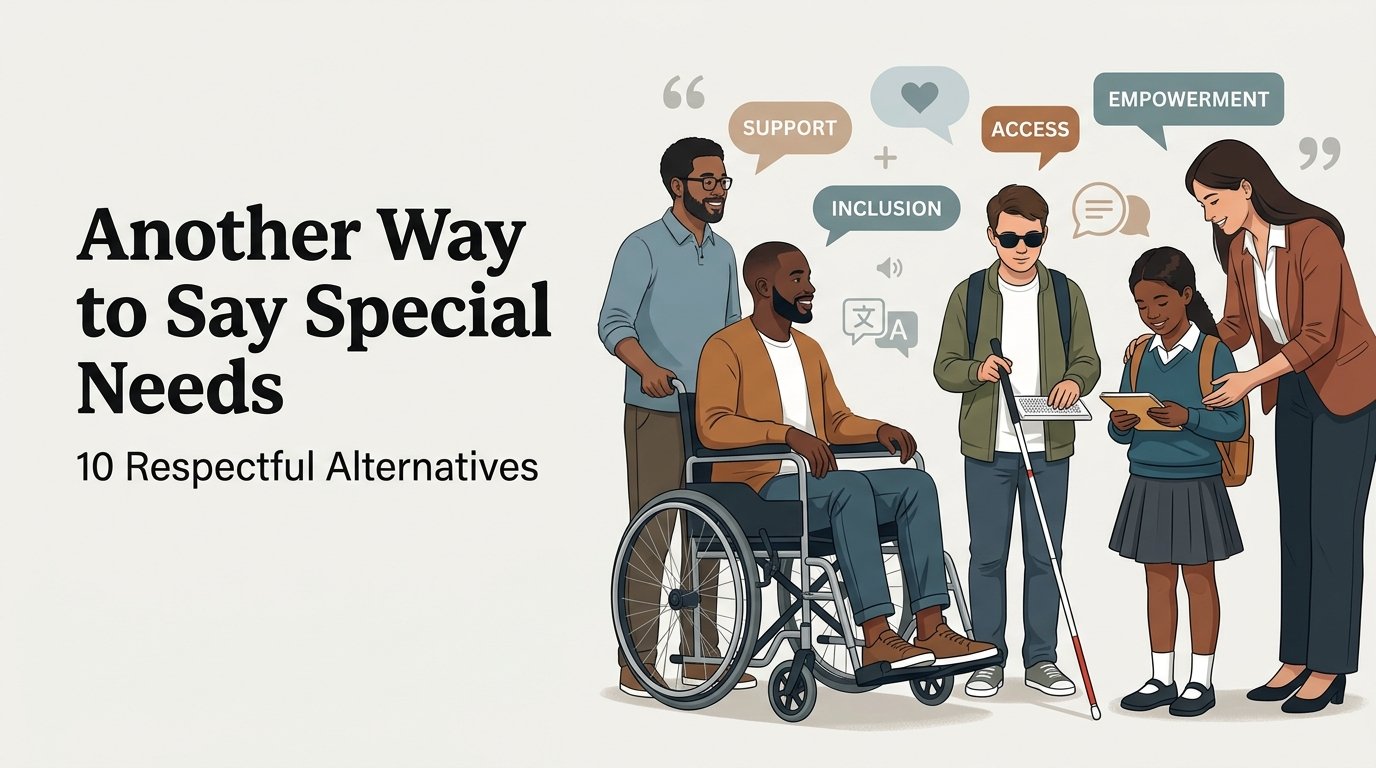
“Another way to say special needs” refers to alternative wording for describing disabilities, accessibility requirements, accommodations, or support needs.
The phrase “special needs” has traditionally appeared in schools, healthcare, workplaces, government programs, and everyday conversation. However, it can sound vague or unintentionally separate people from others. More specific language often communicates the intended meaning more clearly.
For example, instead of saying “students with special needs,” you might say “students with disabilities” when disability is the relevant topic. If you are discussing classroom accommodations, “students who need additional support” may be more precise.
The right wording depends on the person, situation, and purpose.
Why Use Other Ways to Say “Special Needs”?
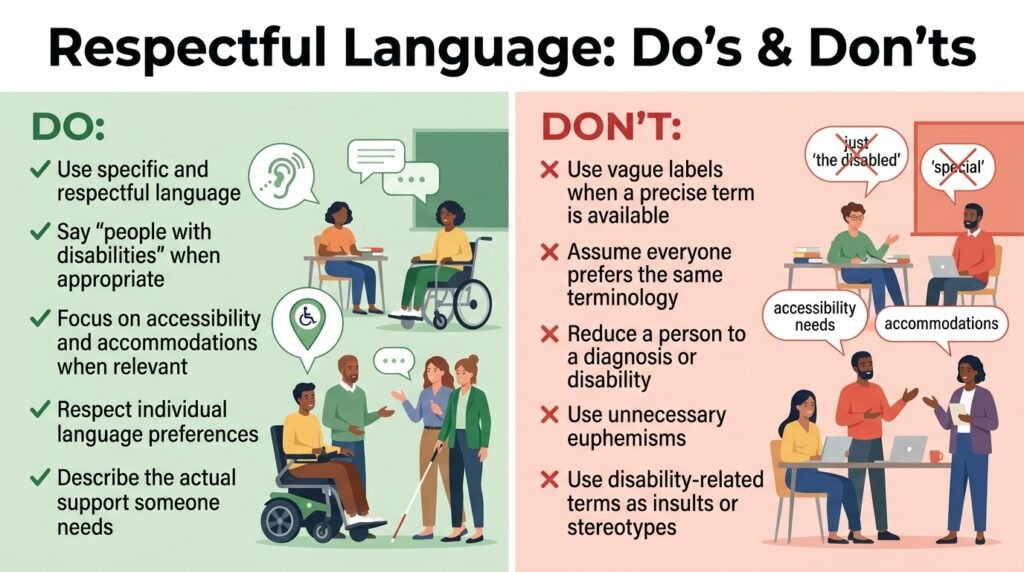
Choosing a more specific phrase can make your writing clearer, more respectful, and easier to understand.
Consider another expression when you want to:
- Avoid vague or outdated-sounding language.
- Describe a person’s situation more accurately.
- Focus on accessibility, accommodations, or support.
- Use appropriate language in professional or educational settings.
- Respect different preferences for discussing disability.
There is no single replacement that works in every sentence. Specificity is usually more helpful than simply replacing one phrase with another.
10 Best Other Ways to Say “Special Needs”
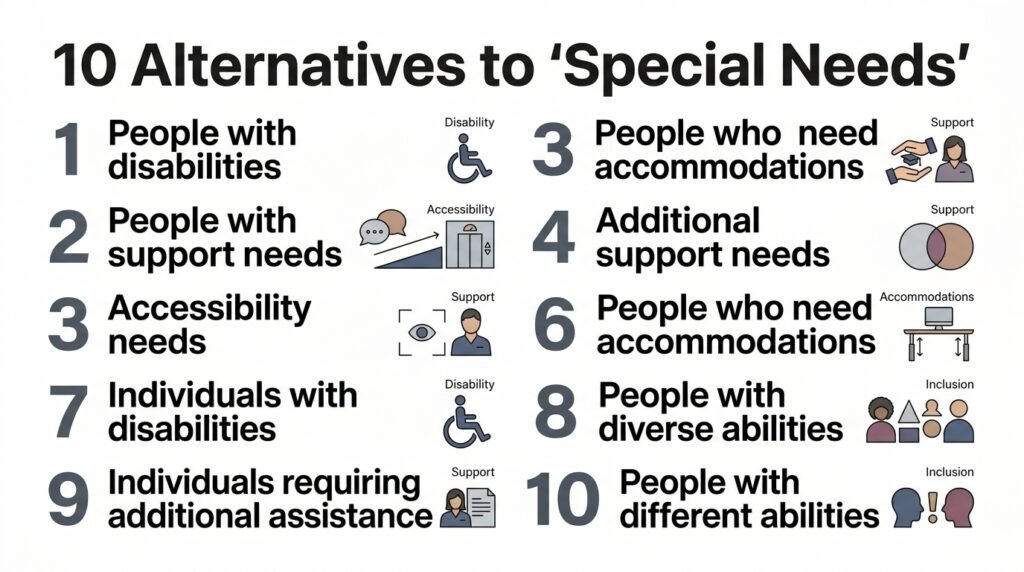
1. People With Disabilities
Meaning
“People with disabilities” is a clear, widely understood phrase for referring to people who have physical, sensory, intellectual, developmental, or other disabilities. It uses person-first language, which places the person before the disability.
Best For
- Professional
- Formal
- Polite
Example 1
“Our organization provides accessible services for people with disabilities.”
Example 2
“The conference venue includes accommodations for people with disabilities.”
Quick Tip
Use this phrase when disability itself is relevant and you want a straightforward, professional expression.
2. People With Support Needs
Meaning
“People with support needs” emphasizes the assistance a person may require rather than focusing on a diagnostic label. It can work well when discussing education, care, community services, or daily assistance.
Best For
- Professional
- Friendly
- Polite
Example 1
“The program offers personalized resources for people with support needs.”
Example 2
“Staff members receive training to better assist people with support needs.”
Quick Tip
Choose this wording when your main point is the type or level of assistance someone needs.
3. Accessibility Needs
Meaning
“Accessibility needs” describes adjustments or features that help people access a building, service, website, event, classroom, or other environment. It focuses on access rather than labeling the person.
Best For
- Professional
- Formal
- Polite
Example 1
“Please let us know about any accessibility needs before the event.”
Example 2
“The website was redesigned to better address users’ accessibility needs.”
Quick Tip
Use “accessibility needs” for accommodations involving physical spaces, digital content, communication, transportation, or services.
4. Additional Support Needs
Meaning
“Additional support needs” refers to assistance beyond what is typically provided in a particular setting. It is especially useful when discussing students, learning environments, caregiving, or community programs.
Best For
- Professional
- Formal
- Polite
Example 1
“The school developed a plan to support students with additional support needs.”
Exampgle 2
“Teachers collaborate with families to identify each student’s additional support needs.”
Quick Tip
This phrase is useful when you want to focus on support without making assumptions about a person’s diagnosis.
5. Specific Support Needs
Meaning
“Specific support needs” highlights the particular assistance a person requires. It is helpful when those needs vary significantly from one individual to another.
Best For
- Professional
- Formal
- Polite
Example 1
“Each participant can discuss their specific support needs with the program coordinator.”
Example 2
“The care plan was adjusted to reflect the resident’s specific support needs.”
Quick Tip
Use this phrase when you want to emphasize individualized support rather than applying a broad category to everyone.
6. People Who Need Accommodations
Meaning
“People who need accommodations” focuses directly on adjustments that make participation possible or easier. Accommodations can relate to work, school, communication, transportation, technology, or physical access.
Best For
- Professional
- Formal
- Polite
Example 1
“We encourage people who need accommodations to contact our office in advance.”
Example 2
“The employer provides reasonable accommodations for qualified employees.”
Quick Tip
This phrase works best when the discussion is specifically about accommodations rather than disability in general.
7. Individuals With Disabilities
Meaning
“Individuals with disabilities” is a more formal variation of “people with disabilities.” It frequently appears in professional, institutional, educational, and policy-oriented writing.
Best For
- Professional
- Formal
- Polite
Example 1
“The organization is committed to improving access for individuals with disabilities.”
Example 2
“Training materials should be available to individuals with disabilities.”
Quick Tip
Use this wording when writing formal documents, policies, reports, or organizational materials.
8. People With Diverse Abilities
Meaning
“People with diverse abilities” is an inclusive phrase that emphasizes differences in how people function or participate. However, it can be less precise than “people with disabilities” when disability is the specific subject.
Best For
- Friendly
- Warm
- Polite
Example 1
“The center welcomes people with diverse abilities to participate in its activities.”
Example 2
“Our team aims to create an environment where people with diverse abilities can contribute.”
Quick Tip
Use this phrase when an inclusive tone matters, but choose more direct terminology when legal, medical, or accessibility precision is important.
9. Individuals Requiring Additional Assistance
Meaning
“Individuals requiring additional assistance” focuses on the practical help a person may need. It can be appropriate in service-oriented settings where staff need to understand assistance requirements.
Best For
- Professional
- Formal
- Polite
Example 1
“Staff are available to assist individuals requiring additional assistance during registration.”
Example 2
“Please notify the facility if an individual requires additional assistance during the visit.”
Quick Tip
This phrase is most useful when discussing immediate assistance rather than describing a person’s identity or disability.
10. People With Different Abilities
Meaning
“People with different abilities” is a broad, positive-sounding expression that emphasizes human differences. Still, it may not communicate the specific meaning of “disability” clearly.
Best For
- Casual
- Friendly
- Warm
Example 1
“The community center welcomes people with different abilities.”
Example 2
“The program was designed to encourage participation from people with different abilities.”
Quick Tip
Use this phrase in general, inclusive communication, but prefer precise language when discussing legal rights, accommodations, or disability services.
Comparison Table
| Alternative | Best Used In | Tone |
| People with disabilities | Professional communication | Clear, respectful |
| People with support needs | Services and education | Supportive, inclusive |
| Accessibility needs | Accommodations and access | Practical, professional |
| Additional support needs | Schools and services | Neutral, respectful |
| Specific support needs | Individualized care | Precise, considerate |
| People who need accommodations | Workplace and education | Direct, professional |
| Individuals with disabilities | Policies and formal writing | Formal, respectful |
| People with diverse abilities | General inclusion | Warm, positive |
| Individuals requiring additional assistance | Service settings | Formal, practical |
| People with different abilities | Casual inclusion | Friendly, warm |
Common Mistakes
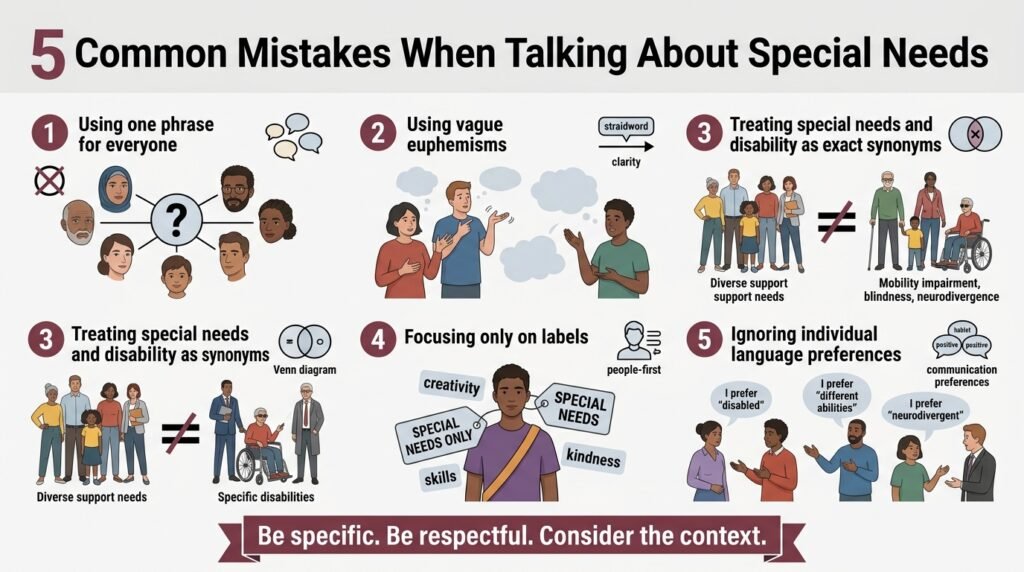
1. Assuming One Phrase Works for Everyone
Disability language is not one-size-fits-all. Some people prefer person-first language, while others prefer identity-first language, such as “autistic person” or “disabled person.”
2. Using Euphemisms When Precision Matters
Phrases such as “differently abled” or “special needs” may sound positive but can make the meaning less clear. In formal writing, direct and specific language is often more useful.
3. Treating “Special Needs” and “Disability” as Perfect Synonyms
They are not always interchangeable. “Special needs” can refer broadly to support or educational requirements, while “disability” has a more specific meaning.
4. Focusing Only on the Label
Avoid reducing someone to a disability or support requirement. When appropriate, describe the person first and discuss the relevant disability, accommodation, or support separately.
5. Ignoring Individual Preference
Language preferences differ. If you are writing about a specific person, use the terminology they prefer whenever you know it.
Frequently Asked Questions
What is a better way to say “special needs”?
A clear alternative is “people with disabilities” when you are specifically referring to disability. Other options include “people with support needs,” “people who need accommodations,” and “people with accessibility needs.” The best choice depends on whether you are discussing disability, education, accessibility, services, or a particular type of assistance.
Is “special needs” an offensive term?
“Special needs” is not automatically offensive, but many people consider it vague, outdated, or less preferable than more specific language. In American English, “people with disabilities” is often a clearer option when disability is the actual subject. When possible, follow the terminology preferred by the person or community being discussed.
What should I say instead of “special needs students”?
“Students with disabilities” is a direct alternative when the students have disabilities. If your focus is on educational assistance rather than disability, “students who need additional support” or “students with specific support needs” may be more appropriate.
What is another way to say “special needs children”?
Depending on the context, you can say “children with disabilities” or “children who need additional support.” If you are discussing school accommodations, “students who need accommodations” may be more precise. Choose the phrase that describes the actual situation instead of using a broad label for every child who needs extra assistance.
What is a professional way to say “special needs”?
For professional writing, “people with disabilities,” “individuals with disabilities,” “people with support needs,” and “people who need accommodations” are useful choices. Select the phrase based on what you are actually discussing. “Individuals with disabilities” tends to sound more formal, while “people with disabilities” is straightforward and natural.
Is “differently abled” better than “special needs”?
Not necessarily. “Differently abled” is sometimes used as an inclusive alternative, but it can be less precise than “people with disabilities.” If disability is relevant to the discussion, direct language usually makes the meaning clearer. The most respectful choice also depends on the preferences of the people being described.
Should I use person-first or identity-first language?
Both approaches are used. Person-first language says “person with a disability,” while identity-first language may say “disabled person,” “autistic person,” or another identity-based description. Neither approach is universally preferred. When writing about a specific person or community, use the language they prefer.
What is the best alternative to “special needs” on a website?
The best wording depends on the page. For accessibility information, use terms such as “accessibility needs” or “accommodations.” When discussing disability-related services, “people with disabilities” is usually clearer. In an educational context, “students with disabilities” or “students who need additional support” may fit better.
Conclusion
Finding another way to say “special needs” is less about replacing one phrase and more about choosing language that accurately describes the situation. “People with disabilities” is a strong general option when disability is the relevant subject, while “accessibility needs,” “support needs,” and “accommodations” work better when the focus is on practical assistance.
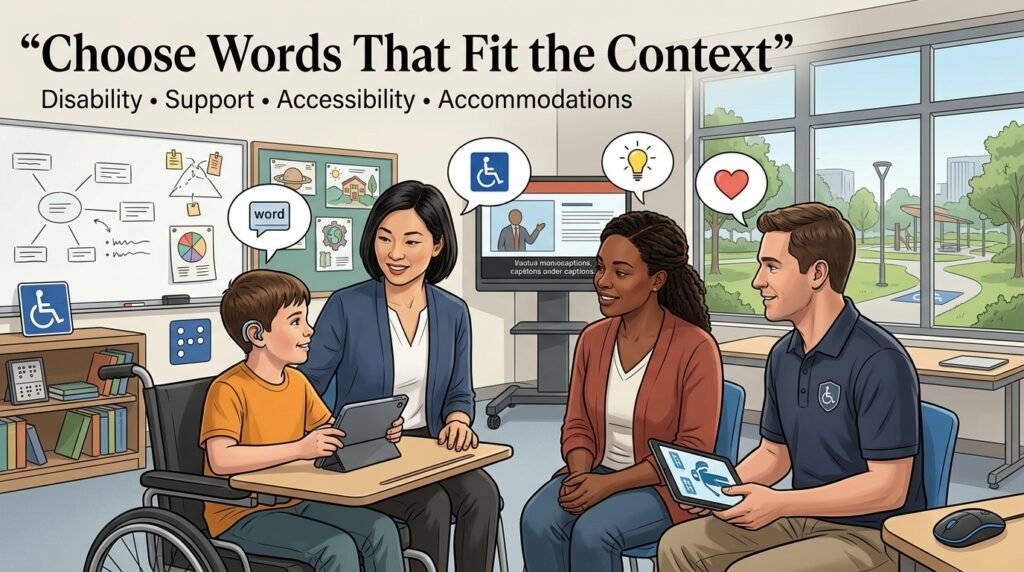
Context matters. A school may need language about educational support, while a workplace may need to discuss accommodations. When writing about an individual, their preferred terminology should guide your choice whenever possible. For more guidance, see this resource on communicating with and about people with disabilities.
The best approach is simple: be specific, respectful, and person-centered without using unnecessary euphemisms. Clear language helps readers understand exactly what you mean while recognizing the dignity and individuality of the people being discussed.
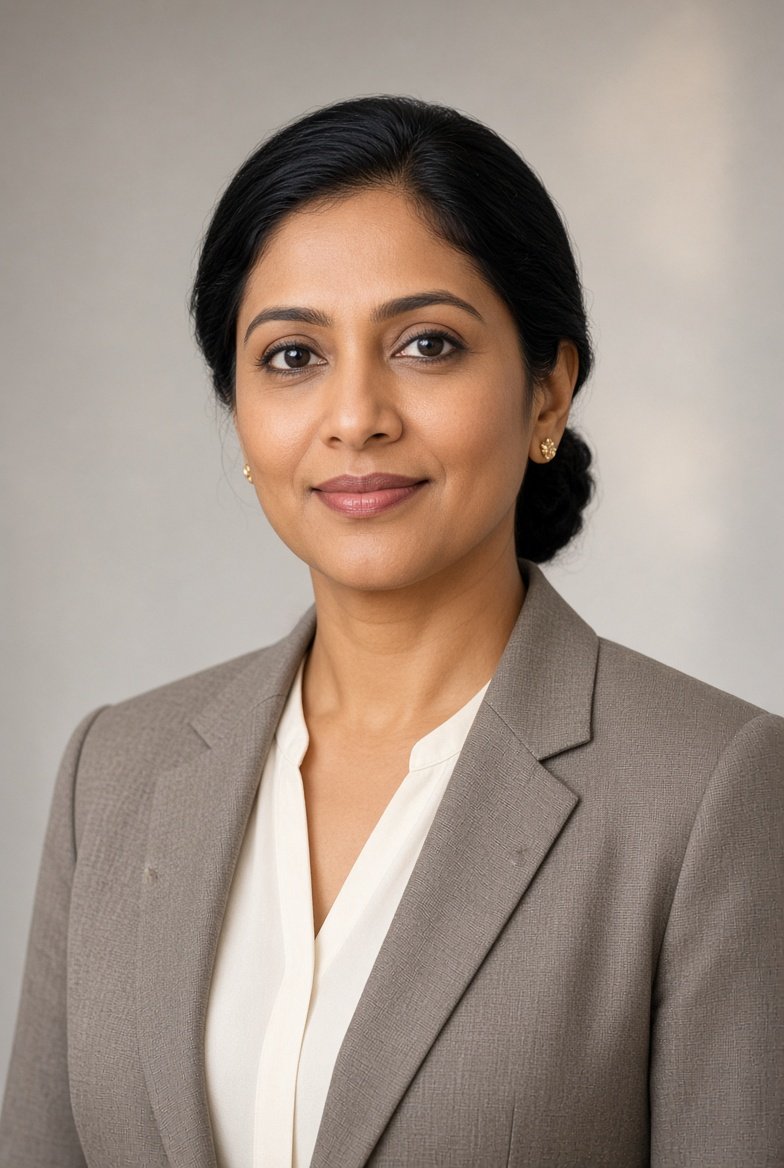
About Dr. Priya Nair
Dr. Priya Nair is a passionate Writer & Blogger at LandMarkNewz.com, dedicated to creating informative, engaging, and easy-to-understand content for readers. With a strong interest in research, current trends, lifestyle, and everyday topics, she focuses on presenting useful information in a clear and reader-friendly way.
Through her writing, Priya aims to help readers discover valuable insights, understand complex topics more easily, and stay informed about subjects that matter to them. Her approach combines thoughtful research with a simple and engaging writing style.
At LandMarkNewz.com, she contributes original articles designed to inform, educate, and provide practical value to readers.