What Does “Another Way to Say Stay Safe” Mean?
The phrase “stay safe” is a friendly expression used to show concern for someone’s well-being. It can mean that you hope the person avoids danger, takes care of themselves, or gets home safely.
People commonly say “stay safe” when ending a conversation, saying goodbye, discussing travel, or talking about potentially risky situations. The expression is simple, caring, and appropriate in many everyday situations.
However, “stay safe” can become repetitive if you use it often. Finding another way to say it allows you to match your wording to the situation and communicate your concern more naturally.
Why Use Other Ways to Say “Stay Safe”?
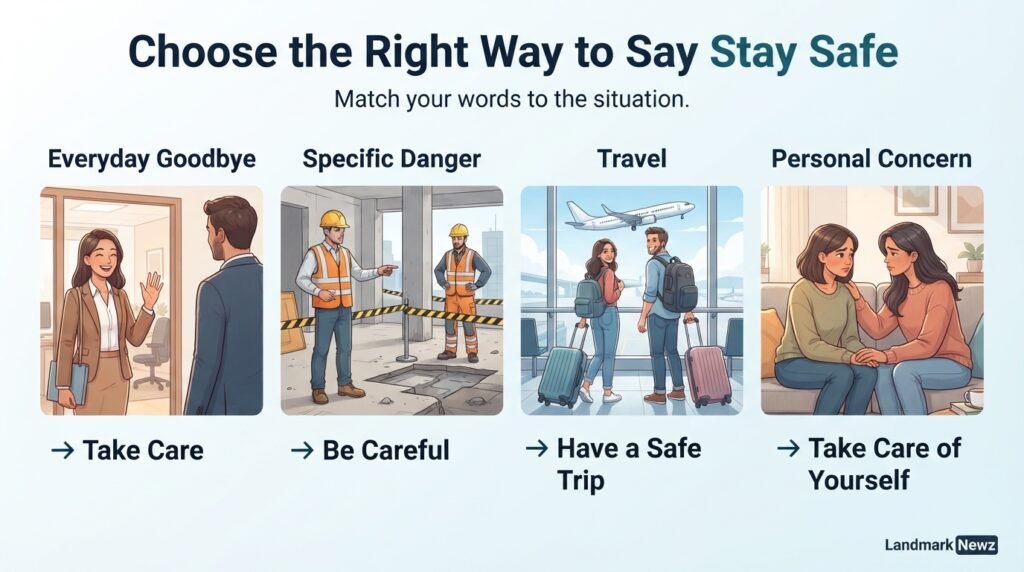
Although “stay safe” is perfectly natural, different situations may call for different expressions. A professional email, a goodbye to a close friend, and a message to someone traveling may each benefit from slightly different wording.
Using alternatives can help you:
- Avoid repeating the same expression.
- Sound more natural and conversational.
- Show warmth or concern more clearly.
- Match your tone to the relationship.
- Make professional communication more polished.
- Give a specific safety reminder when needed.
The key is not to replace “stay safe” simply for the sake of variety. Choose an alternative that fits the situation and expresses your meaning honestly.
10 Best Other Ways to Say “Stay Safe”
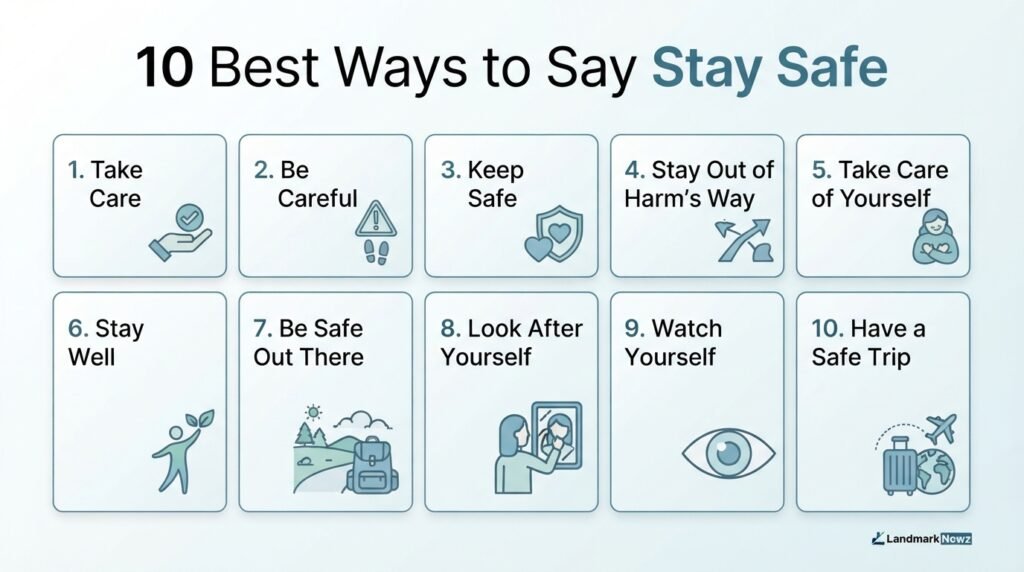
1. Take Care
Meaning
“Take care” is one of the most natural alternatives to “stay safe.” It expresses general concern for someone’s well-being without sounding overly serious or formal.
Best For
- Casual
- Friendly
- Warm
- Polite
- Professional
Example 1
“Thanks for stopping by today. Take care, and I’ll see you next week.”
Example 2
“It was great talking with you. Take care on your way home.”
Quick Tip
Use “take care” when you want a short, warm goodbye that works in both personal and professional conversations.
2. Be Careful
Meaning
“Be careful” is a more direct way to express concern about someone’s safety. It works especially well when you know the person is entering a situation that requires caution.
Best For
- Casual
- Friendly
- Polite
- Warm
Example 1
“The roads are icy tonight, so be careful driving home.”
Example 2
“Be careful around the construction area and watch your step.”
Quick Tip
Use “be careful” when you want to highlight a specific risk rather than offer a general farewell.
3. Keep Safe
Meaning
“Keep safe” communicates the same basic idea as “stay safe” but has a slightly different rhythm. It is friendly and straightforward, although “stay safe” is more common in American English.
Best For
- Friendly
- Casual
- Polite
Example 1
“Enjoy the rest of your weekend, and keep safe.”
Example 2
“Thanks for letting me know. Keep safe while you’re out tonight.”
Quick Tip
Choose “keep safe” when you want a close alternative without changing the overall meaning too much.
4. Stay Out of Harm’s Way
Meaning
“Stay out of harm’s way” means to avoid dangerous or harmful situations. It has a stronger safety-focused meaning than “take care” and can sound slightly more serious.
Best For
- Formal
- Polite
- Warm
Example 1
“Things may get hectic during the storm, so stay out of harm’s way.”
Example 2
“Follow the safety instructions and stay out of harm’s way.”
Quick Tip
Use this expression when there is a real or specific possibility of danger.
5. Take Care of Yourself
Meaning
“Take care of yourself” sounds more personal than “stay safe.” It suggests that you want someone to look after their physical or emotional well-being.
Best For
- Warm
- Friendly
- Casual
- Polite
Example 1
“You’ve been working long hours lately. Take care of yourself.”
Example 2
“I’m glad everything worked out. Take care of yourself and get some rest.”
Quick Tip
This phrase is especially effective when you want to show genuine personal concern.
6. Stay Well
Meaning
“Stay well” is a gentle expression that focuses on overall health and well-being. It is less directly connected to physical danger than “stay safe.”
Best For
- Professional
- Formal
- Warm
- Polite
Example 1
“Thank you for your help with the project. Stay well.”
Example 2
“It was wonderful catching up with you. Stay well until we speak again.”
Quick Tip
Use “stay well” when your message is about someone’s general well-being rather than a particular safety concern.
7. Be Safe Out There
Meaning
“Be safe out there” is a casual and caring expression often used when someone is heading into a busy, uncertain, or potentially challenging environment.
Best For
- Casual
- Friendly
- Warm
Example 1
“Have fun at the concert tonight, and be safe out there.”
Example 2
“The weather looks rough, so be safe out there.”
Quick Tip
This phrase sounds most natural in casual conversations and messages to people you know.
8. Look After Yourself
Meaning
“Look after yourself” tells someone to pay attention to their own well-being. It can communicate affection, concern, or a thoughtful goodbye.
Best For
- Friendly
- Warm
- Polite
- Casual
Example 1
“Thanks for everything. Look after yourself, and keep in touch.”
Example 2
“You have a busy week ahead, so look after yourself.”
Quick Tip
Use this phrase when you want your goodbye to sound thoughtful and personal.
9. Watch Yourself
Meaning
“Watch yourself” can mean “be careful,” but its tone depends heavily on context. Among friends, it can be a casual safety reminder, while in other situations it may sound like a warning or threat.
Best For
- Casual
- Friendly
Example 1
“Watch yourself on those hiking trails; some sections are pretty steep.”
Example 2
“Have a good time tonight, but watch yourself and stay with your group.”
Quick Tip
Use this expression carefully because it can sound harsher than you intend in professional or unfamiliar settings.
10. Have a Safe Trip
Meaning
“Have a safe trip” is a specific alternative to “stay safe” for someone who is traveling. It expresses both goodwill and concern about reaching their destination safely.
Best For
- Friendly
- Warm
- Polite
- Professional
Example 1
“Have a safe trip to Chicago, and let us know when you arrive.”
Example 2
“Thanks for visiting us. Have a safe trip home!”
Quick Tip
Use this phrase when the person’s immediate situation involves travel by car, plane, train, bus, or another form of transportation.
Comparison Table
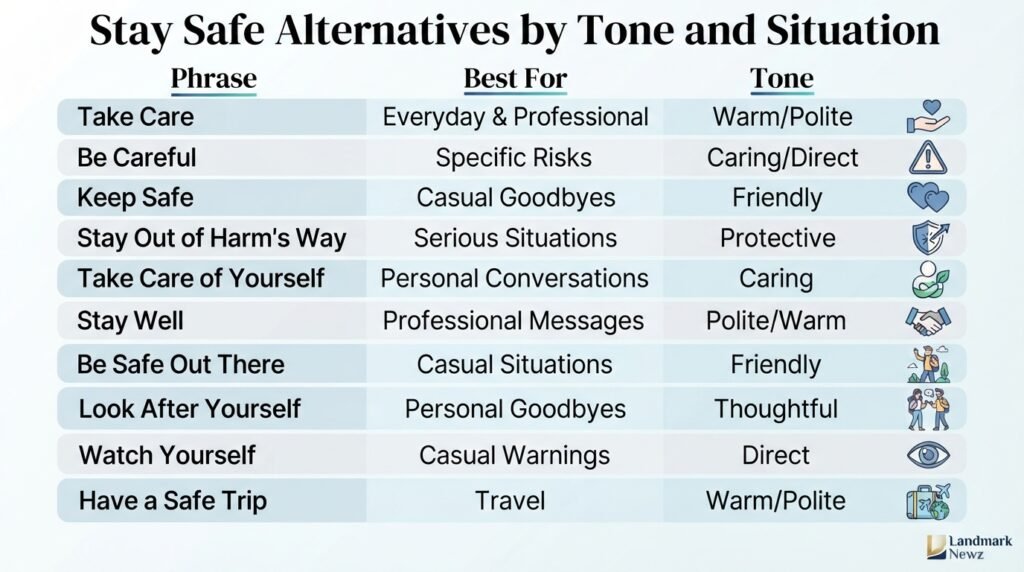
| Alternative | Best Used In | Tone |
| Take care | Everyday conversations, emails, goodbyes | Warm, polite |
| Be careful | Situations involving a specific risk | Caring, direct |
| Keep safe | Casual messages and goodbyes | Friendly |
| Stay out of harm’s way | Dangerous or serious situations | Serious, protective |
| Take care of yourself | Personal conversations | Warm, caring |
| Stay well | Professional or thoughtful messages | Polite, warm |
| Be safe out there | Casual situations | Friendly, caring |
| Look after yourself | Personal goodbyes | Warm, thoughtful |
| Watch yourself | Casual safety warnings | Direct, informal |
| Have a safe trip | Travel situations | Warm, polite |
Common Mistakes
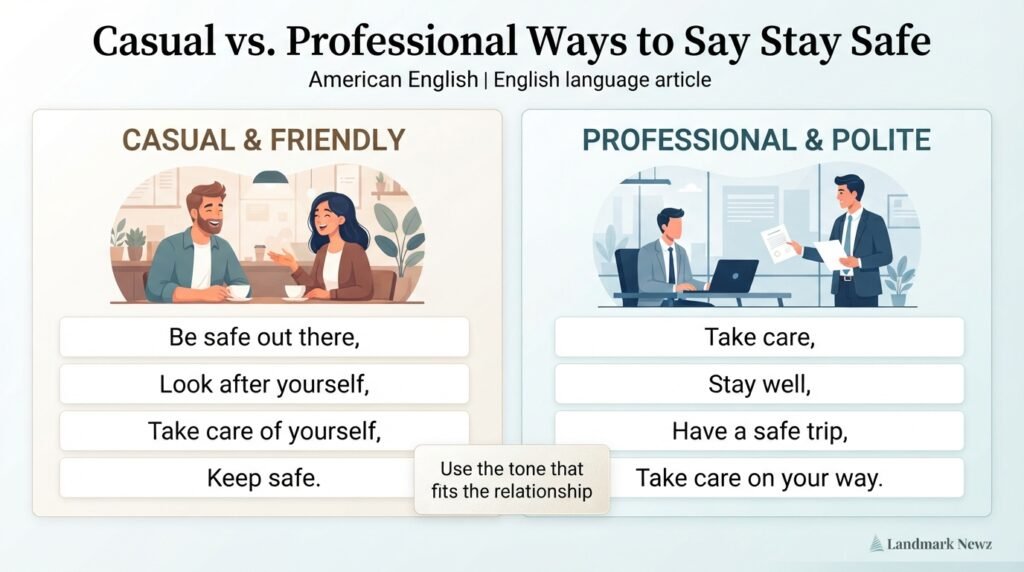
1. Using a Casual Phrase in a Professional Email
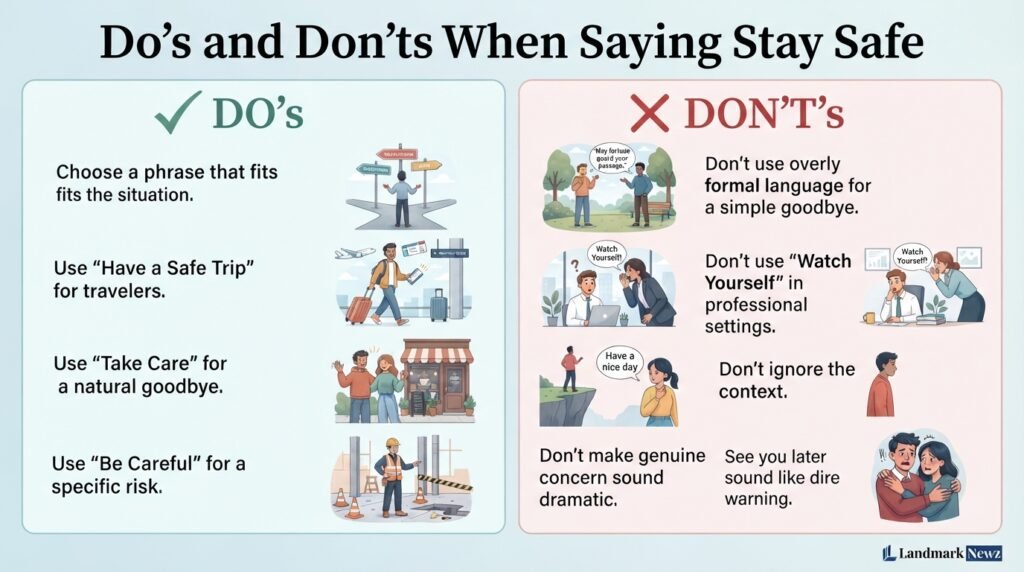
Expressions such as “watch yourself” can sound too informal or blunt at work. For professional communication, “take care” or “stay well” is usually safer.
2. Choosing an Overly Formal Expression
“Stay out of harm’s way” may sound dramatic when you’re simply saying goodbye to a coworker. Use wording that matches the seriousness of the situation.
3. Ignoring the Context
“Have a safe trip” makes sense for travelers but may sound strange when someone is simply leaving the office. Always consider what the person is actually doing.
4. Repeating the Same Expression
Using “stay safe” at the end of every conversation can make your messages feel predictable. Rotating between natural alternatives can make your communication more engaging.
5. Sounding Insincere
A safety phrase works best when it reflects genuine concern. Avoid adding dramatic language when a simple “Take care” communicates your message better.
Frequently Asked Questions
What is the most common alternative to “stay safe”?
“Take care” is probably the most versatile alternative. It works in casual conversations, friendly messages, phone calls, and many professional situations. Unlike some safety-specific phrases, it does not require a particular dangerous situation. You can use it simply as a warm way to say goodbye while showing that you care about the other person’s well-being.
What is another way to say “stay safe” professionally?
For professional communication, “Take care” and “Stay well” are strong choices. “Take care” sounds friendly without being too personal, while “stay well” has a slightly more polished tone. If the person is traveling for work, “Have a safe trip” is also natural and appropriate.
What can I say instead of “stay safe” to a friend?
You can say “Take care,” “Be safe out there,” “Look after yourself,” or “Take care of yourself.” The best choice depends on your relationship and the situation. For a simple goodbye, “take care” sounds natural. If your friend is facing a specific risk, “be safe out there” may communicate your concern more clearly.
Is “take care” the same as “stay safe”?
The two expressions are similar but not identical. “Stay safe” focuses specifically on avoiding danger, while “take care” has a broader meaning that includes general well-being. Both can be used as friendly goodbyes, but “take care” usually sounds less focused on a particular safety concern.
How do you say “stay safe” when someone is traveling?
If someone is traveling, “Have a safe trip” is one of the best choices. You can also say “Travel safely,” “Have a safe journey,” or “Take care on your way.” For everyday American English, “Have a safe trip” sounds especially natural when saying goodbye to someone who is heading home or going on vacation.
What is a warm way to say “stay safe”?
“Take care of yourself” is a warm and personal alternative. It shows that you are thinking about the person’s overall well-being rather than simply warning them about danger. “Look after yourself” can also work well when you’re saying goodbye to a friend, family member, or someone you care about.
Is “be careful” rude?
“Be careful” is not inherently rude, but the tone depends on how and when you use it. When someone is driving in bad weather or entering a risky area, it can sound caring and helpful. However, saying it repeatedly or in a commanding tone may make the listener feel criticized.
Can I use “stay safe” in a work email?
Yes, “stay safe” can be appropriate in a work email, especially when discussing travel, severe weather, health concerns, or another genuine safety issue. However, for a routine professional goodbye, “Take care” or “Stay well” may sound more natural and polished.
Conclusion
Finding another way to say “stay safe” gives you more flexibility when communicating with friends, family, coworkers, and professional contacts. The best expression depends on what you want to emphasize and how well you know the person.
For an everyday goodbye, “take care” is an easy and natural choice. When someone faces a specific risk, “be careful” makes your concern clearer. For personal conversations, “take care of yourself” or “look after yourself” adds warmth, while “have a safe trip” is ideal for travelers.
Remember that the goal is not to use complicated wording. A simple phrase that fits the situation will usually sound more sincere than an overly formal alternative. Choose the expression that matches your relationship, context, and genuine level of concern. For more guidance, explore these expressions for talking about being careful from Cambridge Dictionary.

Language & Everyday Communication Specialist
Elena Voss is a language enthusiast and communication coach with over 9 years of experience helping people express themselves more naturally in English. She previously worked as an ESL instructor and corporate language trainer, guiding professionals and students on clearer everyday conversations, polite alternatives, and natural phrasing.
Elena specializes in practical synonym guides and “another way to say…” content that feels conversational rather than textbook. Her writing focuses on real-life situations — emails to friends, casual workplace chat, social media, and daily interactions. She believes the best language advice is simple, useful, and easy to remember.
When she’s not creating content for LandmarkNewz, Elena enjoys analyzing modern slang trends and testing new phrases in real conversations.