What Does “Another Way to Say Waste of Time” Mean?
“Waste of time” describes something that uses your time without producing enough value, progress, or benefit. For example, you might say, “Waiting three hours for a meeting that was canceled was a waste of time.”
People often search for another way to say “waste of time” because the original phrase can sound negative or too direct. Choosing a more precise alternative lets you communicate the same idea while sounding professional, polite, frustrated, or casual.
You may need these alternatives in workplace emails, conversations, essays, reviews, presentations, or everyday communication.
Why Use Other Ways to Say “Waste of Time”?
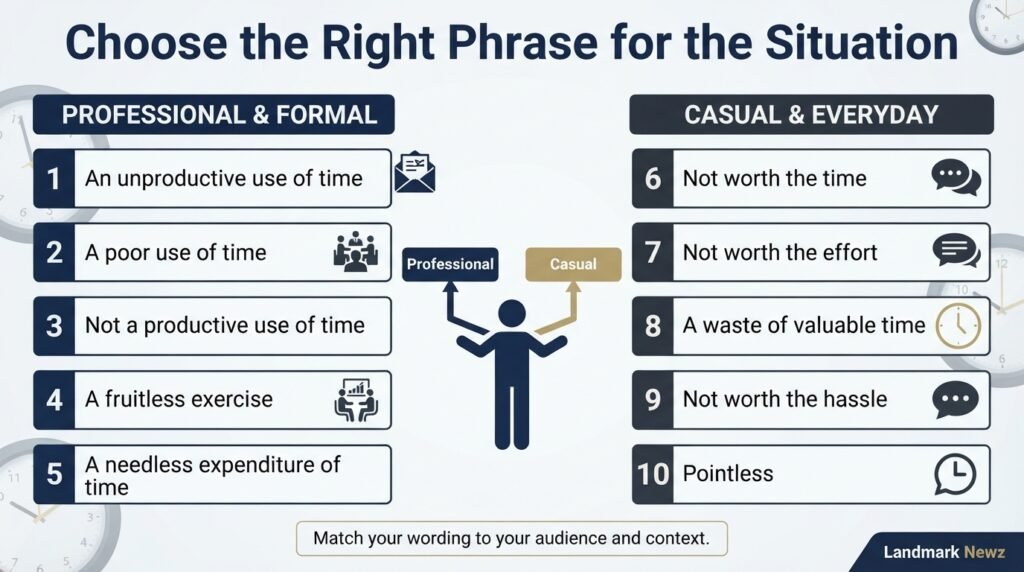
Using different expressions can make your communication more natural and specific. Instead of repeating “waste of time,” you can choose wording that better reflects how strongly you feel.
Other benefits include:
- Avoiding repetition: Different expressions keep your writing fresh.
- Sounding professional: Softer wording works better in workplace settings.
- Being more precise: Some alternatives emphasize inefficiency, while others stress a lack of results.
- Matching the situation: Casual conversations and formal writing require different tones.
- Communicating tactfully: A less direct phrase can prevent unnecessary conflict.
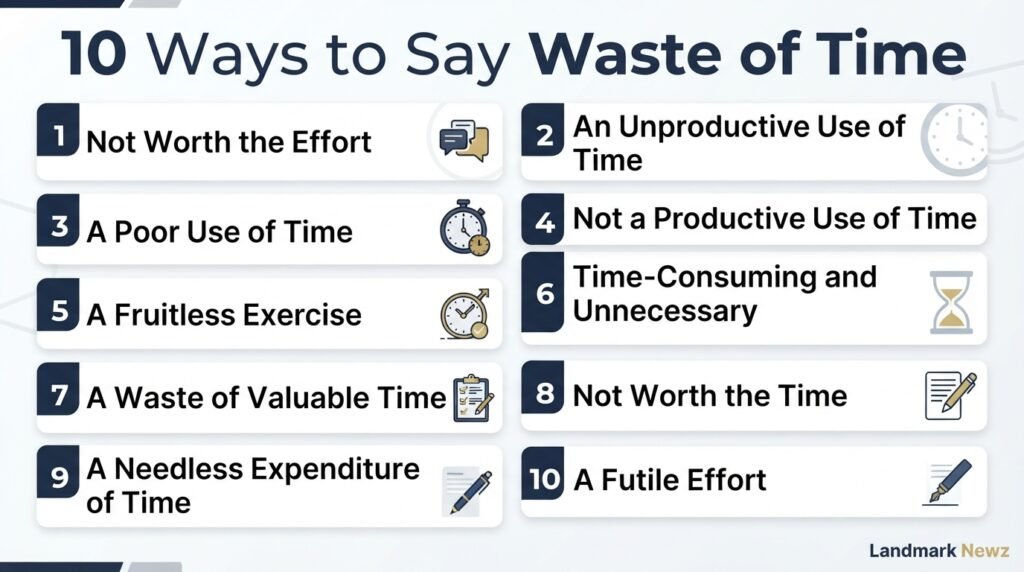
10 Best Other Ways to Say “Waste of Time”
1. Not Worth the Effort
Meaning
“Not worth the effort” suggests that the time, energy, or resources required are greater than the benefit received. It is a natural alternative when you want to express disappointment without sounding overly harsh.
Best For
- Casual
- Friendly
- Polite
Example 1
I decided that arguing over such a small issue was not worth the effort.
Example 2
Trying to fix that outdated software may not be worth the effort.
Quick Tip
Use this phrase when you want to focus on the lack of benefit rather than criticize the activity itself.
2. An Unproductive Use of Time
Meaning
“An unproductive use of time” is a professional way to describe an activity that does not lead to useful progress. It sounds more objective than “waste of time.”
Best For
- Professional
- Formal
Example 1
Spending the entire afternoon on unnecessary meetings was an unproductive use of time.
Example 2
Manually entering the same data twice is an unproductive use of time.
Quick Tip
This is one of the strongest choices for business emails, reports, and workplace discussions.
3. A Poor Use of Time
Meaning
“A poor use of time” means that someone could have spent their time in a more valuable or productive way. It communicates criticism while remaining relatively professional.
Best For
- Professional
- Formal
- Polite
Example 1
Reviewing the same document five times was a poor use of our team’s time.
Example 2
I believe this meeting would be a poor use of everyone’s time.
Quick Tip
Choose this expression when you want to be honest but avoid the sharper tone of “waste of time.”
4. Not a Productive Use of Time
Meaning
“Not a productive use of time” emphasizes that an activity is not helping you reach a useful goal. It works particularly well when discussing work processes or decisions.
Best For
- Professional
- Formal
- Polite
Example 1
Discussing issues that have already been resolved is not a productive use of time.
Example 2
Checking the same report repeatedly is not a productive use of time.
Quick Tip
This phrase is useful when you want to redirect a conversation toward a more constructive activity.
5. A Fruitless Exercise
Meaning
“A fruitless exercise” describes an activity that produces little or no useful result. It has a somewhat formal tone and works especially well in writing.
Best For
- Formal
- Professional
Example 1
Negotiating with a company that had already rejected our proposal became a fruitless exercise.
Example 2
Searching for the missing file without checking the archive first was a fruitless exercise.
Quick Tip
Use this phrase in formal writing when you want to emphasize the lack of results.
6. Time-Consuming and Unnecessary
Meaning
“Time-consuming and unnecessary” describes something that takes considerable time while providing little or no reason to be done. It is useful when explaining why a process should change.
Best For
- Professional
- Formal
- Polite
Example 1
The manual approval process is time-consuming and unnecessary for simple requests.
Example 2
Repeating these steps for every customer is time-consuming and unnecessary.
Quick Tip
This expression works best when you want to identify a specific problem and suggest that it should be removed.
7. A Waste of Valuable Time
Meaning
“A waste of valuable time” is a stronger version of “waste of time.” It highlights the fact that the time could have been used for something more important.
Best For
- Casual
- Friendly
- Direct
Example 1
Waiting in line for an hour just to discover the store was closed felt like a waste of valuable time.
Example 2
Spending the morning arguing about minor details was a waste of valuable time.
Quick Tip
Use this when you want to express clear frustration without using insulting language.
8. Not Worth the Time
Meaning
“Not worth the time” means that something does not provide enough value to justify the amount of time it requires. It is short, natural, and common in everyday American English.
Best For
- Casual
- Friendly
- Polite
Example 1
The discount is so small that driving across town is not worth the time.
Example 2
If the repair costs almost as much as a replacement, it may not be worth the time.
Quick Tip
This is a simple choice for everyday conversations when you want your wording to sound natural.
9. A Needless Expenditure of Time
Meaning
“A needless expenditure of time” is a formal expression for spending time unnecessarily. It focuses on inefficiency rather than emotion.
Best For
- Formal
- Professional
Example 1
Repeating the entire process manually would be a needless expenditure of time.
Example 2
The additional paperwork created a needless expenditure of time for the entire department.
Quick Tip
Reserve this phrase for formal documents, reports, or situations where a more sophisticated tone is appropriate.
10. A Futile Effort
Meaning
“A futile effort” describes an attempt that is unlikely to succeed or produce the desired result. Unlike “waste of time,” it specifically emphasizes the lack of a meaningful outcome.
Best For
- Formal
- Professional
- Direct
Example 1
Trying to change the decision after the deadline had passed was a futile effort.
Example 2
Without the required information, completing the application would have been a futile effort.
Quick Tip
Use “futile effort” when the main issue is that success is unlikely, rather than simply saying an activity takes too long.
Comparison Table
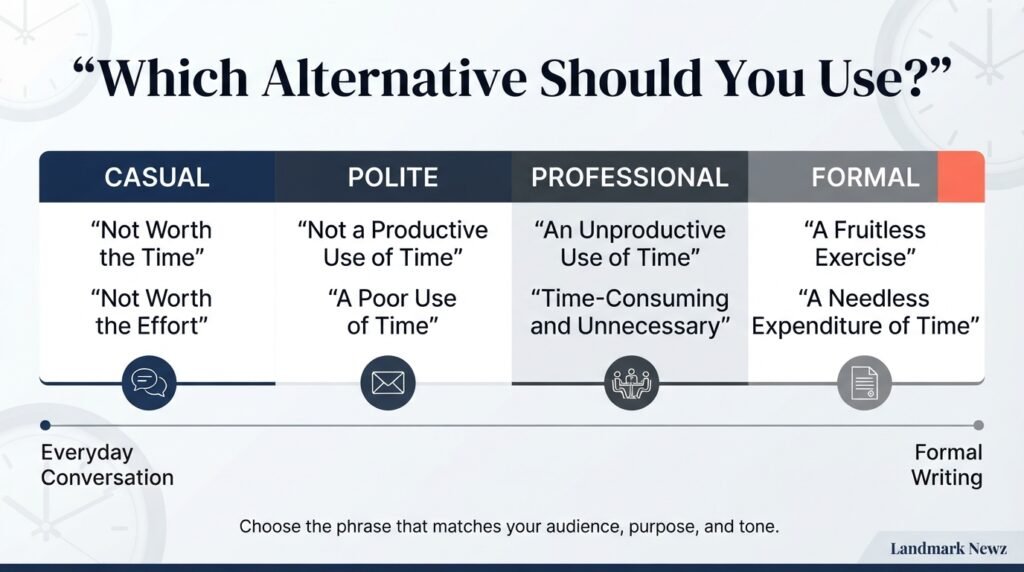
| Alternative | Best Used In | Tone |
| Not worth the effort | Everyday conversations | Polite, casual |
| An unproductive use of time | Workplace communication | Professional |
| A poor use of time | Business discussions | Professional, polite |
| Not a productive use of time | Workplace communication | Professional |
| A fruitless exercise | Formal writing | Formal |
| Time-consuming and unnecessary | Work processes | Professional |
| A waste of valuable time | Everyday situations | Direct |
| Not worth the time | Casual conversations | Friendly, casual |
| A needless expenditure of time | Reports and formal writing | Formal |
| A futile effort | Formal and professional contexts | Direct, formal |
Common Mistakes
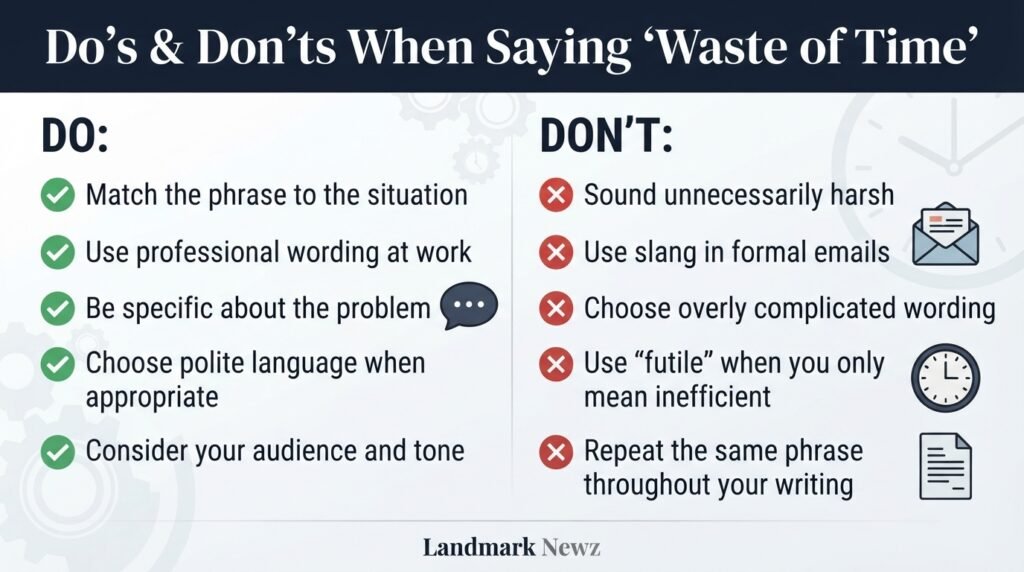
1. Using Casual Phrases in Professional Emails
Saying “That was a total waste of time” can sound unnecessarily blunt at work. A phrase such as “That was not a productive use of our time” communicates the concern more professionally.
2. Choosing Overly Formal Language
Not every situation requires sophisticated wording. Saying “a needless expenditure of time” to a close friend may sound unnatural when “not worth the time” would be much clearer.
3. Repeating “Waste of Time”
Using the same phrase throughout an article, email, or conversation can make your language feel repetitive. Choose alternatives that accurately reflect the situation.
4. Forgetting the Context
Not every synonym has exactly the same meaning. “Futile effort” suggests that success is unlikely, while “time-consuming and unnecessary” focuses on inefficiency.
5. Sounding Insincere
Overly polished language can sometimes hide your real message. Choose a phrase that clearly explains the problem while maintaining the level of directness your situation requires.
Frequently Asked Questions
What is a professional way to say “waste of time”?
A professional way to say “waste of time” is “an unproductive use of time” or “a poor use of time.” These expressions communicate that something did not provide enough value without sounding unnecessarily harsh. They work particularly well in workplace emails, meetings, reports, performance discussions, and business communication.
What is another word for “waste of time”?
Depending on the context, alternatives include inefficient, unproductive, fruitless, futile, unnecessary, pointless, and unprofitable. However, these words are not always interchangeable. For example, “futile” suggests that an effort cannot succeed, while “unproductive” simply means it did not produce useful progress.
How do you politely say something is a waste of time?
You can politely say “I don’t think this is the best use of our time” or “This may not be the most productive approach.” These alternatives soften the criticism and focus on the situation rather than blaming a person. They are especially useful during workplace discussions.
What is a formal way to say “waste of time”?
Formal alternatives include “an unproductive use of time,” “a fruitless exercise,” and “a needless expenditure of time.” The best option depends on your sentence. “An unproductive use of time” is generally the clearest choice for professional communication because it sounds objective and easy to understand.
What is a casual way to say “waste of time”?
In casual American English, you can say “not worth the time,” “not worth the effort,” or “not worth the hassle.” These expressions sound natural in conversations with friends, family members, and coworkers you know well. Choose the one that best explains whether the problem involves time, effort, or inconvenience.
Is “fruitless exercise” the same as “waste of time”?
They are similar but not identical. “Fruitless exercise” emphasizes that an activity produced no useful result, while “waste of time” focuses more generally on time being spent without sufficient value. “Fruitless exercise” also has a more formal tone and is more common in professional or written contexts.
Can I use “futile effort” instead of “waste of time”?
Yes, but only when the context involves an unsuccessful or unlikely attempt. “Futile effort” suggests that the effort cannot achieve its intended goal. If an activity simply takes too long or offers little benefit, “unproductive use of time” or “not worth the time” may be more accurate.
What is the best alternative to “waste of time” in an email?
For most professional emails, “not a productive use of time” is a strong choice because it sounds clear, respectful, and objective. For example, instead of saying “The meeting was a waste of time,” you could write, “I don’t think the meeting was a productive use of our time.”
Conclusion
There are many effective ways to say “waste of time,” and the best choice depends on your audience and purpose. For professional communication, “an unproductive use of time,” “a poor use of time,” and “not a productive use of time” are clear and respectful.
For everyday conversations, “not worth the time” and “not worth the effort” sound more natural. If you want to emphasize that an attempt could not succeed, “a futile effort” is more precise, while “a fruitless exercise” works well in formal writing.
The key is to match the phrase to the situation rather than simply replacing one expression with another. A thoughtful alternative can make your message clearer, more natural, and more professional. For a clearer understanding of the original expression, consult the Cambridge Dictionary’s meaning of “waste time”.

About Dr. Priya Nair
Dr. Priya Nair is a passionate Writer & Blogger at LandMarkNewz.com, dedicated to creating informative, engaging, and easy-to-understand content for readers. With a strong interest in research, current trends, lifestyle, and everyday topics, she focuses on presenting useful information in a clear and reader-friendly way.
Through her writing, Priya aims to help readers discover valuable insights, understand complex topics more easily, and stay informed about subjects that matter to them. Her approach combines thoughtful research with a simple and engaging writing style.
At LandMarkNewz.com, she contributes original articles designed to inform, educate, and provide practical value to readers.