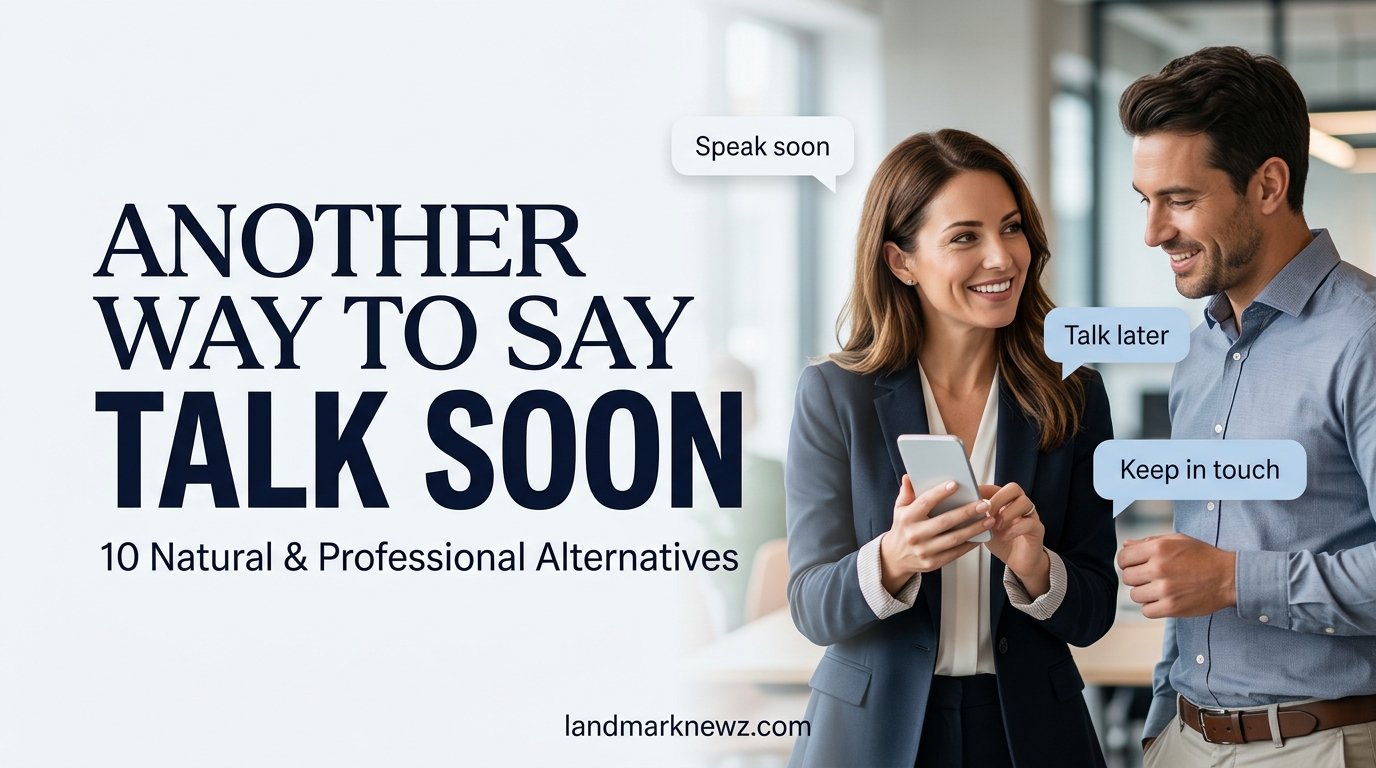
“Talk soon” is a casual expression used when saying goodbye to someone you expect to communicate with again in the near future. It can refer to another conversation by phone, text, email, video call, or in person.
People often use it because it feels warmer than a simple “goodbye” without sounding overly formal. It also leaves the door open for future communication without setting an exact date or time.
For example, you might write, “Thanks for your help today. Talk soon!” to a coworker you know well, or say it to a friend after a phone call.
Why Use Other Ways to Say “Talk Soon”?
Using different expressions helps you match your words to the situation. “Talk soon” may sound perfectly natural in a text but slightly casual in a formal business email.
Other options can help you:
- Avoid repeating the same closing phrase.
- Sound more natural in different conversations.
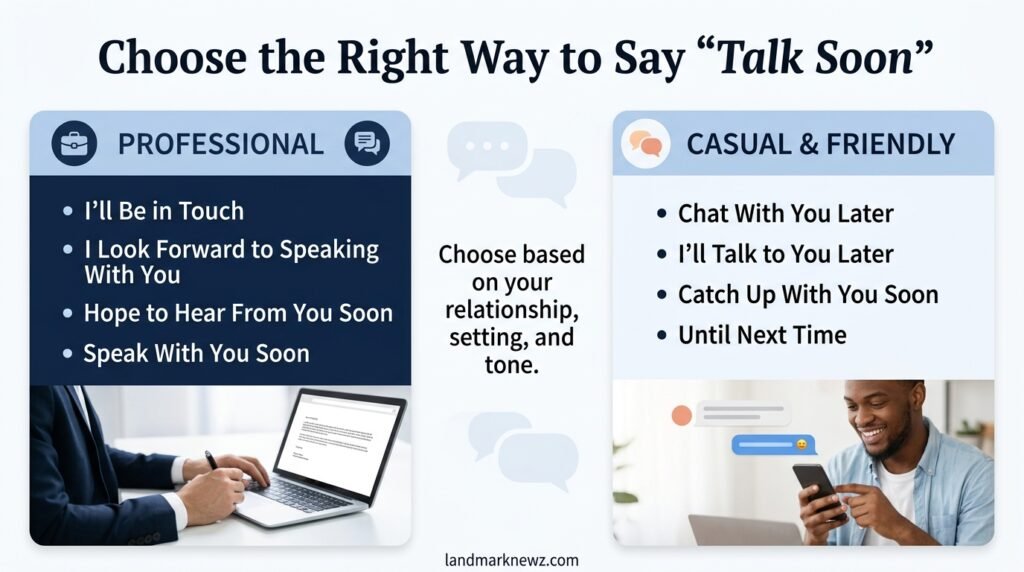
- Match professional, friendly, or formal settings.
- Make emails and messages feel more polished.
- Show warmth without sounding overly familiar.
- Communicate whether you expect to reconnect soon.
The key is not to choose the fanciest phrase. Choose the one that sounds natural for your relationship and the reason you are communicating.
10 Best Other Ways to Say “Talk Soon”
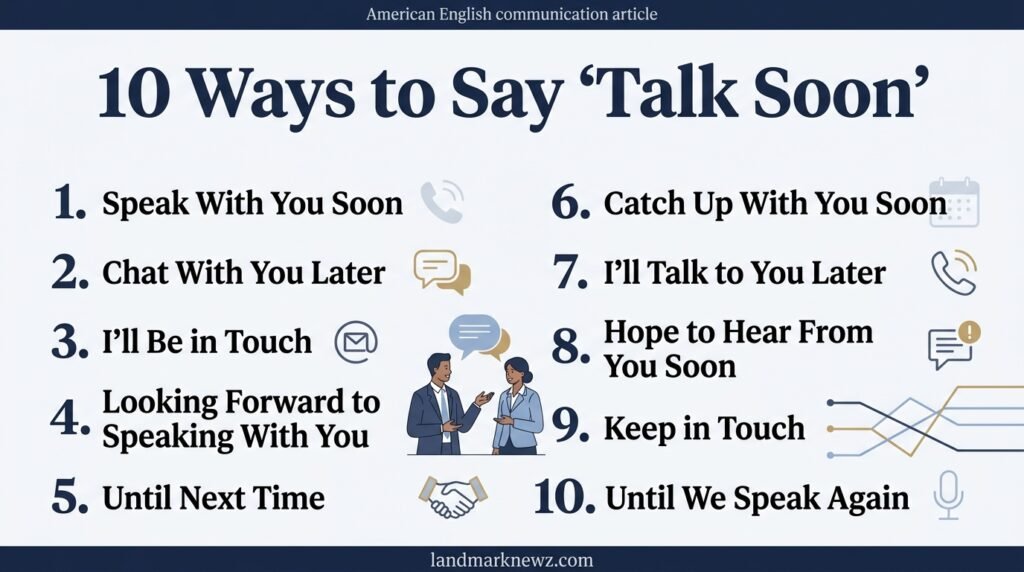
1. Speak With You Soon
Meaning
“Speak with you soon” communicates that you expect to have another conversation in the near future. It is slightly more polished than “talk soon,” making it a flexible choice for both work and personal communication.
Best For
- Professional
- Friendly
- Polite
- Formal
Example 1
“Thank you for taking the time to meet with me today. I’ll speak with you soon.”
Example 2
“I enjoyed catching up with you. Speak with you soon!”
Quick Tip
Use this when you want a natural closing that is professional without sounding stiff.
2. Chat With You Later
Meaning
“Chat with you later” has a relaxed and conversational feel. It suggests that you expect to communicate again but does not make the interaction sound formal or scheduled.
Best For
- Casual
- Friendly
- Warm
Example 1
“I have to run, but I’ll send you the details tonight. Chat with you later!”
Example 2
“Thanks for helping me figure this out. Chat with you later.”
Quick Tip
This phrase works especially well in texts, instant messages, and conversations with people you know well.
3. I’ll Be in Touch
Meaning
“I’ll be in touch” means you intend to contact the other person again. Unlike “talk soon,” it can refer to a phone call, email, text, or another form of communication.
Best For
- Professional
- Formal
- Polite
Example 1
“I’ll review the proposal this afternoon and be in touch with my feedback.”
Example 2
“Thanks for your interest in the position. I’ll be in touch after the interviews.”
Quick Tip
Choose this when you specifically expect yourself to initiate the next contact.
4. Looking Forward to Speaking With You
Meaning
“Looking forward to speaking with you” expresses positive anticipation about a future conversation. It sounds more professional and deliberate than “talk soon.”
Best For
- Professional
- Formal
- Polite
Example 1
“I appreciate your time and look forward to speaking with you next week.”
Example 2
“Thank you for reaching out. I look forward to speaking with you about the project.”
Quick Tip
This is an excellent choice for business emails, interviews, client communication, and scheduled calls.
5. Until Next Time
Meaning
“Until next time” is a warm goodbye that assumes you will meet or communicate again. It does not promise that the next interaction will happen immediately.
Best For
- Friendly
- Casual
- Warm
Example 1
“Thanks for a great evening. Until next time!”
Example 2
“It was wonderful seeing everyone again. Until next time, take care.”
Quick Tip
Use this when you want a warm closing but do not know exactly when you will reconnect.
6. Catch Up With You Soon
Meaning
“Catch up with you soon” suggests another conversation where you can share updates, discuss what has happened, or simply reconnect. It feels personal and relaxed.
Best For
- Casual
- Friendly
- Warm
Example 1
“Things have been hectic lately, but I’d love to catch up with you soon.”
Example 2
“Enjoy your trip, and I hope we can catch up with you soon when you get back.”
Quick Tip
This works best when the purpose of the future conversation is to reconnect or exchange updates.
7. I’ll Talk to You Later
Meaning
“I’ll talk to you later” is a familiar, everyday alternative to “talk soon.” It is casual and often implies that another conversation will happen relatively soon.
Best For
- Casual
- Friendly
Example 1
“I need to finish dinner, but I’ll talk to you later.”
Example 2
“Have a good afternoon! I’ll talk to you later.”
Quick Tip
This is best for friends, family members, and casual conversations rather than formal business messages.
8. Hope to Hear From You Soon
Meaning
“Hope to hear from you soon” shifts the focus toward receiving a response from the other person. It is especially useful when you are waiting for information, a decision, or a reply.
Best For
- Professional
- Polite
- Formal
Example 1
“Please let me know if you need any additional information. I hope to hear from you soon.”
Example 2
“Thank you for considering my application. I hope to hear from you soon.”
Quick Tip
Do not use this if you plan to contact the person yourself; it naturally suggests that you are waiting for their response.
9. Keep in Touch
Meaning
“Keep in touch” expresses a desire to maintain contact over time. It is broader than “talk soon” because it does not necessarily suggest another conversation in the immediate future.
Best For
- Friendly
- Warm
- Casual
- Polite
Example 1
“It was great working with you. Keep in touch!”
Example 2
“We may be moving to different cities, but let’s keep in touch.”
Quick Tip
Use this when you want to maintain a relationship rather than promise a specific upcoming conversation.
10. Until We Speak Again
Meaning
“Until we speak again” is a warm and slightly more formal way to close a conversation. It clearly suggests another conversation while sounding more intentional than “talk soon.”
Best For
- Formal
- Warm
- Polite
- Friendly
Example 1
“Thank you for sharing your thoughts. Until we speak again, have a wonderful weekend.”
Example 2
“I appreciate your guidance and look forward to our next conversation. Until we speak again.”
Quick Tip
This phrase works best when you want a thoughtful closing with a little more warmth and formality.
Comparison Table
| Alternative | Best Used In | Tone |
| Speak With You Soon | Work, emails, conversations | Professional, friendly |
| Chat With You Later | Texts, casual chats | Casual, warm |
| I’ll Be in Touch | Business communication | Professional, polite |
| Looking Forward to Speaking With You | Emails, meetings, interviews | Formal, professional |
| Until Next Time | Personal conversations | Warm, friendly |
| Catch Up With You Soon | Friends, acquaintances | Casual, warm |
| I’ll Talk to You Later | Everyday conversations | Casual, friendly |
| Hope to Hear From You Soon | Emails, applications, inquiries | Polite, formal |
| Keep in Touch | Farewells, networking | Warm, friendly |
| Until We Speak Again | Thoughtful closings | Warm, formal |
Common Mistakes
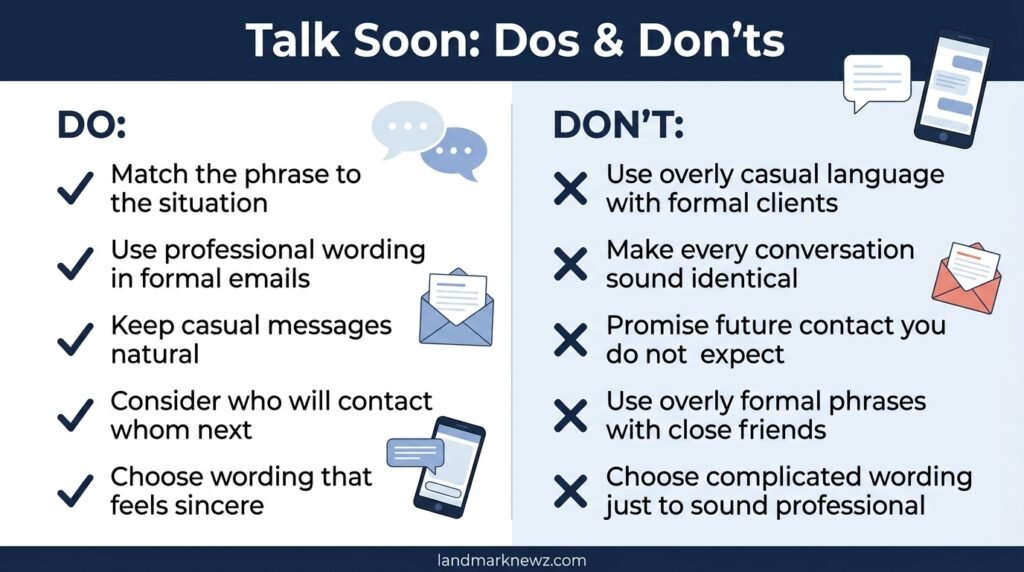
1. Using Casual Phrases in Professional Emails
Expressions such as “chat with you later” can sound too relaxed when writing to a client, hiring manager, or senior colleague. In those cases, choose “I’ll be in touch” or “I look forward to speaking with you.”
2. Choosing Overly Formal Language
Not every conversation needs a formal closing. Saying “until we speak again” to a close friend may sound unnatural when “talk soon” would be perfectly appropriate.
3. Repeating the Same Phrase
Using “talk soon” in every message can make your communication feel routine. Varying your closing based on the situation can make your messages more natural.
4. Forgetting the Context
Some alternatives suggest that you will contact the other person, while others suggest that you are waiting for them. For example, “I’ll be in touch” and “hope to hear from you soon” do not communicate the same expectation.
5. Sounding Insincere
Avoid choosing a phrase simply because it sounds polished. If you do not actually expect future contact, saying “talk soon” or “I’ll be in touch” may create the wrong impression.
Frequently Asked Questions
What is another way to say “talk soon” professionally?
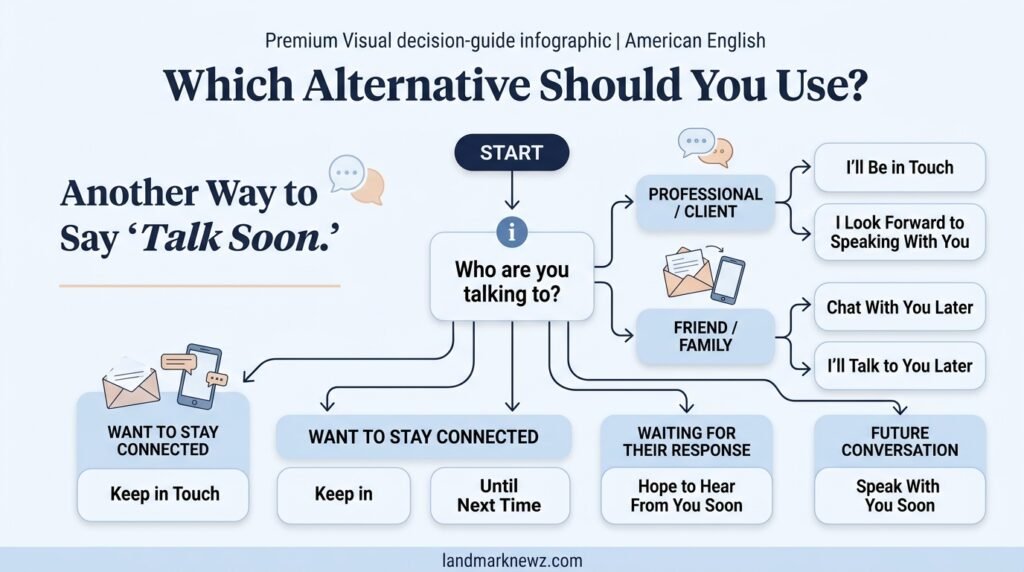
Professional alternatives include “I’ll be in touch,” “I look forward to speaking with you,” and “I look forward to our next conversation.” These expressions work well in business emails, client messages, interviews, and workplace communication because they sound courteous without being overly casual.
What is a casual way to say “talk soon”?
For casual conversations, you can say “chat with you later,” “I’ll talk to you later,” or “catch up with you soon.” These phrases work naturally with friends, family, classmates, and people you communicate with regularly.
Is “talk soon” professional?
“Talk soon” can be professional in the right relationship, especially when communicating with a familiar coworker or colleague. However, it is relatively casual. For formal emails, “I look forward to speaking with you” or “I’ll be in touch” is usually a safer choice.
What is another way to say “talk to you soon” in an email?
In an email, you can use “I look forward to speaking with you,” “I’ll be in touch,” or “I hope to hear from you soon.” The best option depends on who is expected to initiate the next conversation.
Can I say “talk soon” to my boss?
You can use “talk soon” with your boss if your workplace communication is relaxed and you already have an informal relationship. If the message is more formal, “I look forward to speaking with you” sounds more polished and respectful.
Is “speak soon” the same as “talk soon”?
Yes, “speak soon” and “talk soon” have nearly the same basic meaning. Both suggest that you expect to communicate again shortly. “Speak soon” can sound slightly more polished, while “talk soon” is especially common in everyday American English.
What should I say instead of “talk soon” in a text?
In a text, natural alternatives include “chat later,” “talk to you later,” “catch up soon,” and “until next time.” Choose based on the relationship. A close friend may appreciate something casual, while a newer acquaintance may call for a more neutral expression.
What is the best alternative to “talk soon”?
There is no single best alternative for every situation. “Speak with you soon” is one of the most versatile choices, while “I’ll be in touch” works especially well professionally. For friends, “chat with you later” or “catch up soon” usually sounds more natural.
Conclusion
“Talk soon” is a simple, friendly way to end a conversation when you expect to communicate again. However, choosing a more specific alternative can help your message fit the situation better.
For professional communication, “I’ll be in touch” and “I look forward to speaking with you” are strong choices. With friends, “chat with you later” and “catch up with you soon” feel more relaxed. If you want a warm farewell without suggesting an exact timeline, “until next time” or “keep in touch” works well.
The most important factor is context. Consider your relationship with the reader, the communication channel, and whether you expect them or yourself to make the next contact. When your closing matches those details, your message will sound natural and sincere. For more guidance, see these tips on professional email closings.

Professional Writing & Workplace Communication Expert
Marcus Hale is a business communication specialist with 11 years of experience in corporate training and professional writing. He has worked with mid-sized companies and remote teams to improve clarity in emails, reports, performance reviews, and client-facing messages.
Marcus focuses on polished, professional alternatives that help readers sound confident without sounding stiff. His guides cover workplace phrases, resume language, leadership communication, and formal-to-natural transitions. He holds a background in business administration and technical writing, and has led workshops on effective professional English.
At LandmarkNewz, Marcus creates practical synonym lists and phrasing tips that professionals can apply immediately in emails, meetings, and career documents.