
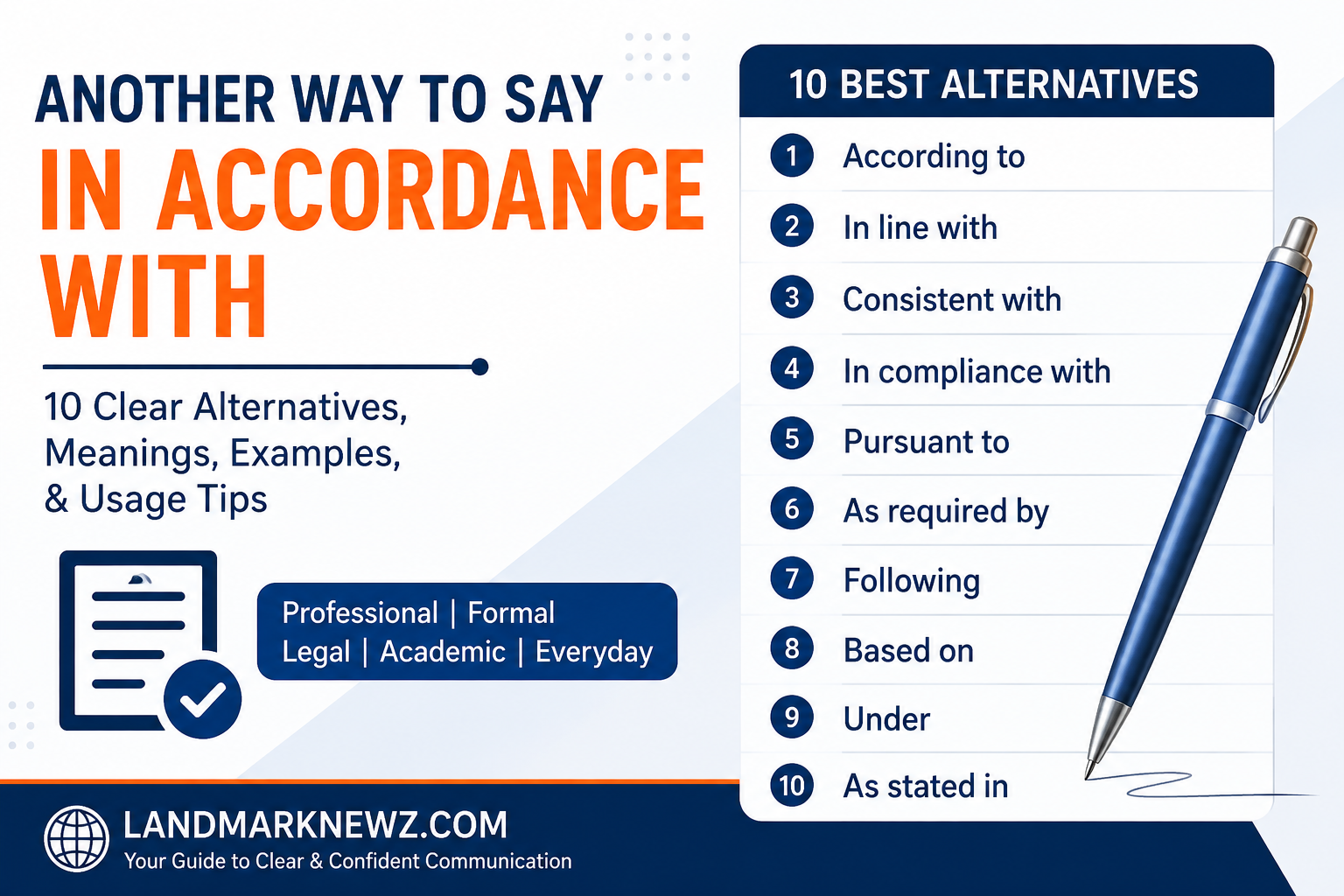
What Does “Another Way to Say In Accordance With” Mean?
“In accordance with” means following, obeying, or acting consistently with a particular rule, instruction, agreement, standard, decision, or piece of information.
For example, “The report was prepared in accordance with company policy” means the report was prepared by following company policy.
The phrase is common in professional emails, business documents, legal writing, academic work, policies, contracts, and official communication. Although it is correct, repeating it can make your writing sound formal or repetitive.
Why Use Other Ways to Say “In Accordance With”?
Using a suitable alternative can make your writing clearer and better matched to your audience. Not every synonym carries exactly the same meaning or level of formality.
Consider another expression when you want to:
- Avoid repeating the same phrase.
- Make a sentence sound more natural.
- Use simpler language.
- Match a formal or legal context.
- Show that something follows a rule or requirement.
- Make professional communication more concise.
- Clearly explain the source of information or instructions.
10 Best Other Ways to Say “In Accordance With”
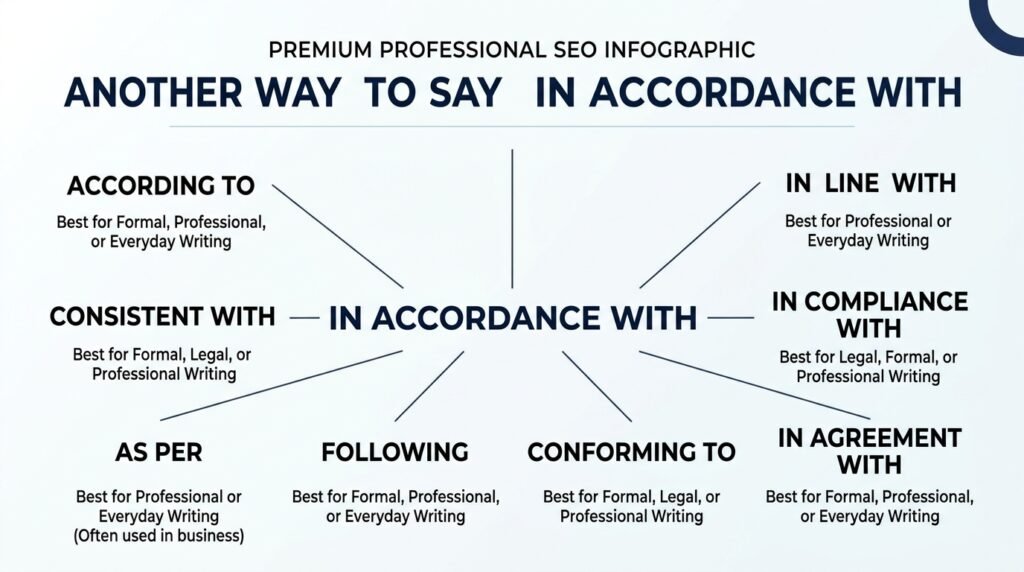
1. According to
Meaning
“According to” means that something follows information, instructions, a statement, rule, or source. It is one of the most natural alternatives and usually sounds less formal than “in accordance with.”
Best For
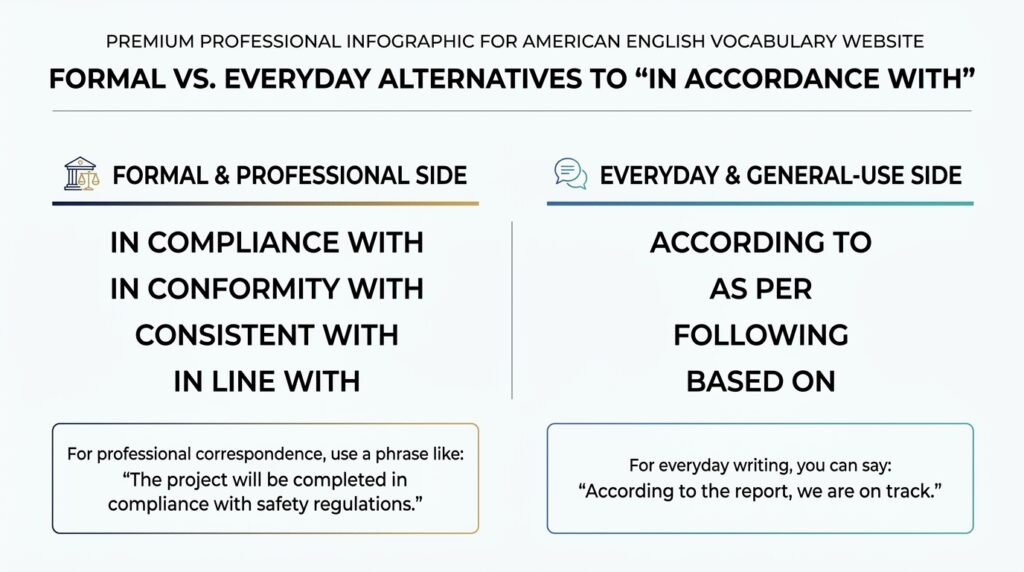
- Professional
- Formal
- Casual
- Polite
Example 1
According to the employee handbook, all vacation requests must be submitted two weeks in advance.
Example 2
According to the latest project guidelines, the team should complete the review by Friday.
Quick Tip
Use “according to” when you are referring to what a person, document, rule, or source says.
2. In line with
Meaning
“In line with” means consistent with a particular policy, goal, expectation, standard, or decision. It is especially useful in workplace and business writing.
Best For
- Professional
- Formal
Example 1
The new hiring strategy is in line with the company’s long-term growth plans.
Example 2
Our revised schedule is in line with the client’s updated requirements.
Quick Tip
Choose “in line with” when you want to emphasize consistency rather than strict legal compliance.
3. Consistent with
Meaning
“Consistent with” means compatible with or not conflicting with something else. It works well when discussing policies, evidence, decisions, practices, or expectations.
Best For
- Professional
- Formal
- Academic
Example 1
The findings are consistent with previous research on workplace productivity.
Example 2
Her decision was consistent with the organization’s established procedures.
Quick Tip
Use this phrase when the main idea is agreement or compatibility, rather than simply following an instruction.
4. In compliance with
Meaning
“In compliance with” specifically indicates that someone or something meets a rule, law, regulation, standard, or requirement. It is stronger and more precise than many general alternatives.
Best For
- Professional
- Formal
- Legal
Example 1
The facility was upgraded in compliance with federal safety regulations.
Example 2
All employees must complete the training in compliance with company policy.
Quick Tip
Use “in compliance with” when following a requirement is mandatory or legally important.
5. Pursuant to
Meaning
“Pursuant to” is a highly formal expression meaning in accordance with or under the authority of a law, agreement, order, policy, or provision.
Best For
- Formal
- Legal
- Professional
Example 1
The payment was issued pursuant to the terms of the agreement.
Example 2
The agency acted pursuant to federal regulations.
Quick Tip
Reserve “pursuant to” mainly for legal, regulatory, contractual, or highly formal writing. In everyday communication, it can sound unnecessarily stiff.
6. As required by
Meaning
“As required by” clearly states that an action is being taken because a rule, policy, law, contract, or authority requires it.
Best For
- Professional
- Formal
- Legal
Example 1
As required by state law, the company posted the notice in a public location.
Example 2
The records were retained for seven years as required by company policy.
Quick Tip
Use this phrase when you want to highlight the requirement behind an action.
7. Following
Meaning
“Following” can mean acting after or according to something, depending on context. When it refers to instructions, procedures, or guidelines, it provides a simple and direct alternative.
Best For
- Professional
- Casual
- Friendly
Example 1
Following the manager’s instructions, the team updated the customer database.
Example 2
Following the safety procedure, workers inspected the equipment before use.
Quick Tip
Use “following” when you want a shorter, more conversational sentence.
8. Based on
Meaning
“Based on” means that something is developed, decided, or performed using particular information, evidence, instructions, or criteria as its foundation.
Best For
- Professional
- Casual
- Academic
Example 1
The committee made its recommendation based on the results of the employee survey.
Example 2
The final design was developed based on customer feedback.
Quick Tip
Use “based on” when the idea is about a foundation or source, not necessarily strict obedience to a rule.
9. Under
Meaning
“Under” can mean according to the authority, terms, conditions, or provisions of a law, agreement, policy, or system. It is concise and common in formal writing.
Best For
- Professional
- Formal
- Legal
Example 1
Employees are entitled to paid leave under the company’s benefits policy.
Example 2
The tenant may terminate the agreement under certain conditions.
Quick Tip
Use “under” when referring to the terms or authority of a specific rule, law, policy, or agreement.
10. As stated in
Meaning
“As stated in” means according to information explicitly written or expressed in a document, statement, policy, report, or other source.
Best For
- Professional
- Formal
- Academic
Example 1
As stated in the contract, either party may request a review after six months.
Example 2
As stated in the report, customer satisfaction increased during the second quarter.
Quick Tip
Choose “as stated in” when you want to direct readers to the exact source of a claim or requirement.
Comparison Table
| Alternative | Best Used In | Tone |
| According to | General, professional, academic writing | Neutral |
| In line with | Business and workplace communication | Professional |
| Consistent with | Academic, professional, analytical writing | Formal |
| In compliance with | Laws, regulations, policies | Formal |
| Pursuant to | Contracts and legal documents | Very formal |
| As required by | Rules, laws, requirements | Formal |
| Following | Instructions and procedures | Natural |
| Based on | Decisions, evidence, information | Neutral |
| Under | Laws, policies, agreements | Formal |
| As stated in | Reports, contracts, policies, documents | Formal |
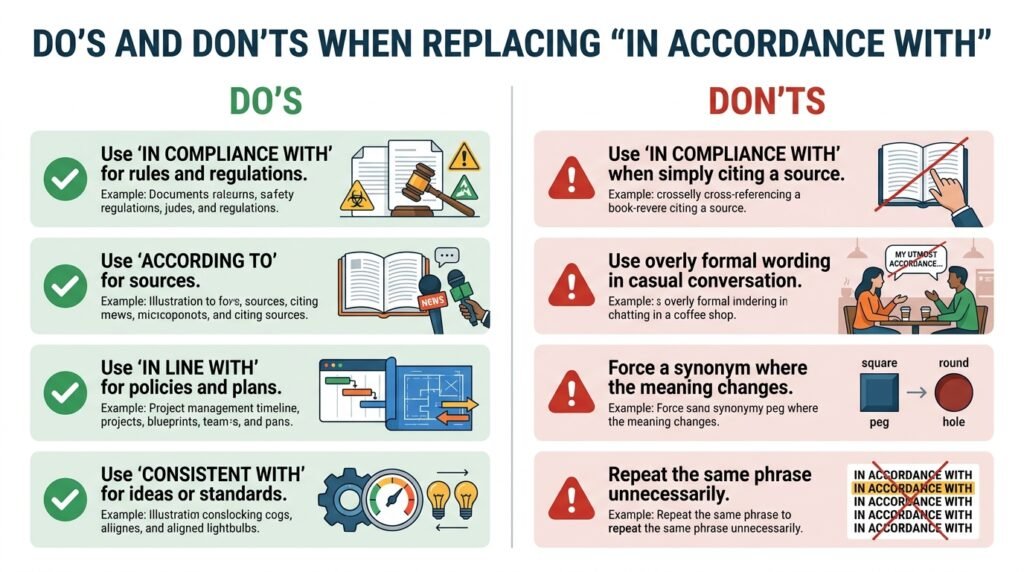
Common Mistakes
1. Using casual phrases in formal documents
A conversational alternative may not fit a contract, legal notice, or official policy. Choose terminology that matches the seriousness of the document.
2. Treating every synonym as interchangeable
These phrases have related meanings, but they are not identical. “In compliance with” suggests meeting a requirement, while “based on” suggests using something as a foundation.
3. Overusing “pursuant to”
Although grammatically correct, “pursuant to” can make ordinary business writing sound overly legalistic. Use a simpler option when the situation does not require formal language.
4. Ignoring the source of the information
If a sentence refers to a document or authority, make the connection clear. “As stated in the policy” may be more precise than a vague alternative.
5. Choosing a phrase without considering tone
The best alternative depends on your audience. A phrase that works in a contract may sound unnatural in an email to a coworker.
Frequently Asked Questions
What is the best professional alternative to “in accordance with”?
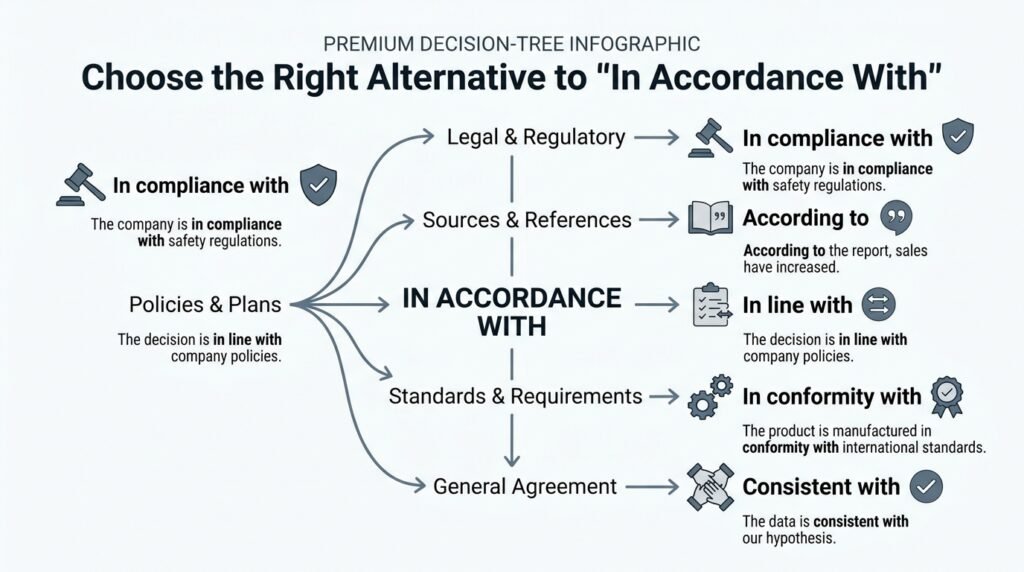
“In line with” and “according to” are strong professional alternatives in many situations. “In line with” emphasizes consistency with a policy, goal, or plan, while “according to” works well when referring to instructions, information, or a source.
What is a simple way to say “in accordance with”?
“According to” is usually the simplest replacement. For example, “In accordance with company policy” can become “According to company policy.” The second version is more conversational while keeping the basic meaning clear.
Is “in compliance with” the same as “in accordance with”?
They are similar but not always identical. “In compliance with” strongly suggests that someone is meeting a rule, law, regulation, or requirement. “In accordance with” has a broader meaning and can describe following policies, instructions, standards, or agreements.
Is “pursuant to” a synonym for “in accordance with”?
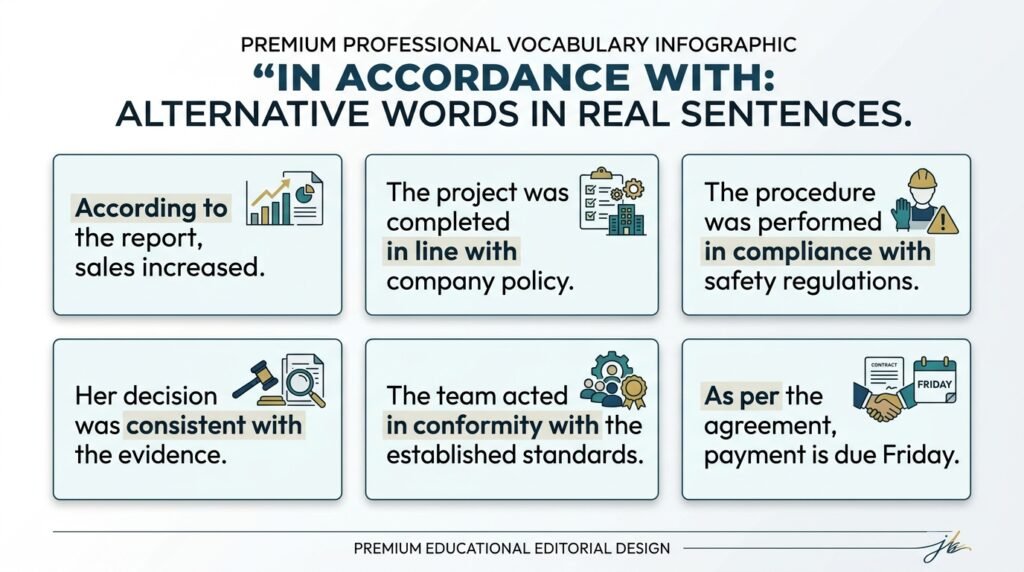
Yes, but it is much more formal. “Pursuant to” commonly appears in legal documents, contracts, regulations, and official notices. It generally means that an action is being taken under the authority or terms of a specific law, agreement, or provision.
Can I use “following” instead of “in accordance with”?
Yes, when the sentence refers to instructions, procedures, directions, or guidelines. For example, “Following the safety procedure, the technician inspected the equipment” is a natural alternative to “In accordance with the safety procedure.”
What is the best alternative for legal writing?
“Pursuant to,” “in compliance with,” and “as required by” are useful in legal contexts, depending on the intended meaning. However, legal documents require precise wording, so the best choice depends on the specific rule, contract provision, or legal authority being referenced.
What is the difference between “according to” and “in accordance with”?
“According to” usually identifies what a source says or what information indicates. “In accordance with” usually means that an action follows a rule, instruction, policy, or standard. For example, you can act “in accordance with company policy” but cite information “according to the company report.”
What should I use instead of “in accordance with” in an email?
For most professional emails, “according to,” “in line with,” “following,” or “as required by” will sound natural. Choose based on your meaning. For example, “In line with your request, I have attached the revised proposal” sounds polished without being overly formal.
Conclusion
There are many useful ways to say “in accordance with,” but the right choice depends on context. For everyday and professional communication, “according to,” “in line with,” and “following” are often the most natural. When you need to emphasize legal or regulatory requirements, “in compliance with,” “as required by,” or “pursuant to” may be more precise.
For academic or analytical writing, “consistent with” and “based on” can communicate the intended relationship more clearly. Meanwhile, “as stated in” works well when pointing readers to a specific document or source.
The key is not simply to replace the phrase with any synonym. Choose the alternative that accurately expresses whether you mean following a rule, complying with a requirement, agreeing with an idea, or referring to a source. This approach is especially important in formal writing.

Language & Everyday Communication Specialist
Elena Voss is a language enthusiast and communication coach with over 9 years of experience helping people express themselves more naturally in English. She previously worked as an ESL instructor and corporate language trainer, guiding professionals and students on clearer everyday conversations, polite alternatives, and natural phrasing.
Elena specializes in practical synonym guides and “another way to say…” content that feels conversational rather than textbook. Her writing focuses on real-life situations — emails to friends, casual workplace chat, social media, and daily interactions. She believes the best language advice is simple, useful, and easy to remember.
When she’s not creating content for LandmarkNewz, Elena enjoys analyzing modern slang trends and testing new phrases in real conversations.