
“As needed” is a common phrase used when something should happen only when necessary or when a particular situation calls for it. While the phrase is perfectly natural, using another way to say “as needed” can make your writing more precise, professional, or varied.
What Does “Another Way to Say As Needed” Mean?
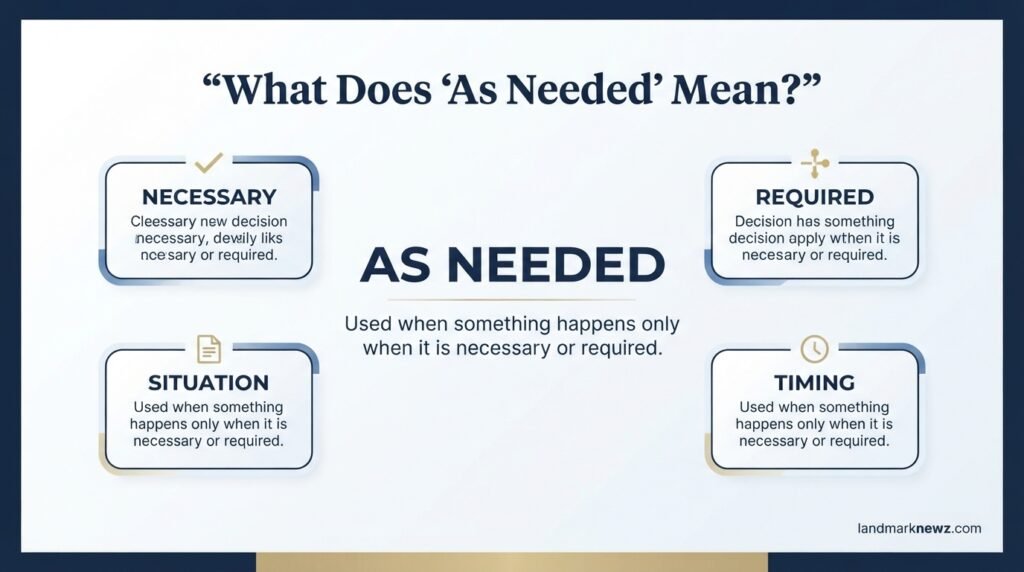
“As needed” means whenever something is necessary, useful, or required by a particular situation. It does not suggest a fixed schedule; instead, the action happens based on circumstances.
For example, a manager might say, “We will schedule additional meetings as needed.” This means meetings will be arranged whenever there is a reason to have one.
The phrase appears frequently in workplace emails, instructions, policies, healthcare information, schedules, contracts, customer service messages, and everyday conversations.
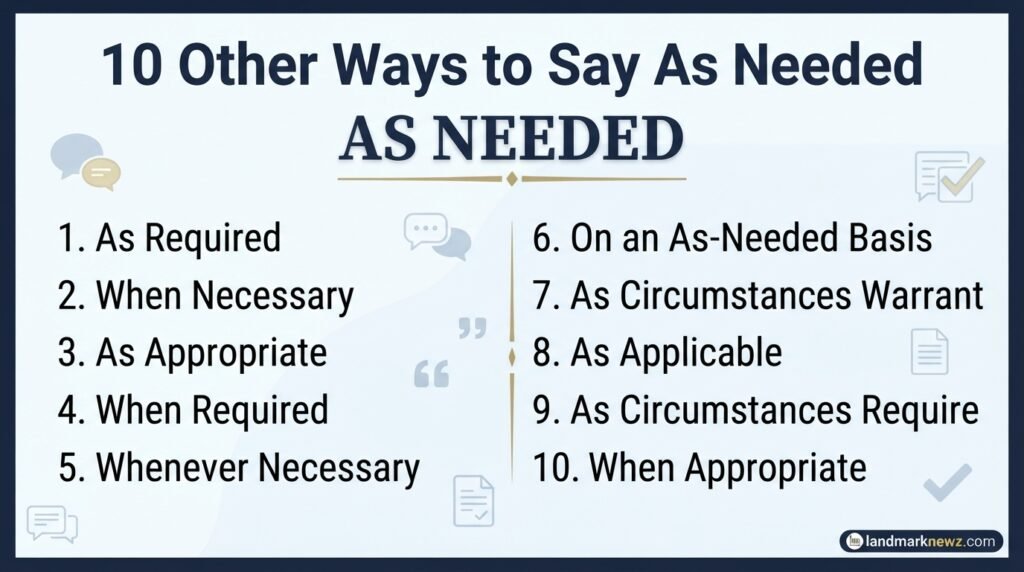
Depending on the context, you can replace “as needed” with phrases such as “as required,” “when necessary,” or “as appropriate.”
Why Use Other Ways to Say “As Needed”?
Using different expressions can make your communication clearer and better suited to the situation. Although “as needed” is versatile, some alternatives provide a more specific meaning or tone.
You might use another phrase to:
- Avoid repeating the same expression.
- Make professional writing sound more polished.
- Choose a more formal expression for policies or documents.
- Clarify when an action should take place.
- Match your language to a specific situation.
- Make everyday communication sound more natural.
The key is to choose an alternative based on meaning, not simply replace the phrase word for word.
10 Best Other Ways to Say “As Needed”
1. As Required
Meaning
“As required” means something should be done whenever it is necessary or specifically called for. It has a professional and somewhat formal tone, making it useful for workplace communication, policies, instructions, and official documents.
Best For
- Professional
- Formal
- Polite
Example 1
Employees should complete additional training as required by company policy.
Example 2
Please provide supporting documents as required during the application process.
Quick Tip
Choose “as required” when you want your writing to sound professional and direct.
2. When Necessary
Meaning
“When necessary” means an action should happen only when circumstances make it necessary. It is one of the most natural replacements for “as needed” and works in both everyday and professional communication.
Best For
- Professional
- Casual
- Polite
Example 1
We may contact you again when necessary to confirm your information.
Example 2
Take short breaks when necessary during the project.
Quick Tip
Use “when necessary” when you want a simple alternative that most readers will understand immediately.
3. As Appropriate
Meaning
“As appropriate” suggests that an action should be taken when it fits the situation. Unlike “as needed,” it can involve judgment about what is suitable rather than simply responding to necessity.
Best For
- Professional
- Formal
- Polite
Example 1
Managers should provide additional guidance as appropriate.
Example 2
Please adjust the presentation as appropriate for your audience.
Quick Tip
Use this phrase when suitability or judgment matters more than strict necessity.
4. When Required
Meaning
“When required” indicates that something should happen when a rule, situation, person, or process makes it necessary. It is especially useful when discussing requirements or procedures.
Best For
- Professional
- Formal
Example 1
Submit a signed form when required by the department.
Example 2
Additional identification may be requested when required for verification.
Quick Tip
Use “when required” when the action is connected to a specific requirement.
5. Whenever Necessary
Meaning
“Whenever necessary” emphasizes that an action can happen at any time the situation calls for it. It is slightly more flexible than “when necessary” and works well when repeated action may be needed.
Best For
- Professional
- Friendly
- Polite
Example 1
Please update the report whenever necessary to reflect new information.
Example 2
Our support team can assist you whenever necessary.
Quick Tip
Choose this option when something may need to happen more than once over time.
6. On an As-Needed Basis
Meaning
“On an as-needed basis” is a direct variation of “as needed.” It means something is provided or performed only when there is a reason for it rather than according to a fixed schedule.
Best For
- Professional
- Formal
Example 1
The consultant will meet with the team on an as-needed basis.
Example 2
Temporary staff may be added on an as-needed basis during busy periods.
Quick Tip
This phrase works particularly well when describing services, staffing, meetings, or resources.
7. As Circumstances Warrant
Meaning
“As circumstances warrant” means an action should be taken when changing conditions make it suitable or necessary. It has a formal tone and is more common in business, legal, policy, and official writing.
Best For
- Formal
- Professional
Example 1
The company may revise the policy as circumstances warrant.
Example 2
Additional safety measures will be introduced as circumstances warrant.
Quick Tip
Use this phrase for formal documents where changing conditions determine what happens next.
8. As Applicable
Meaning
“As applicable” means something should be considered or used when it applies to a particular person, situation, rule, or case. It is more specific than “as needed.”
Best For
- Professional
- Formal
Example 1
Complete the sections below as applicable to your business.
Example 2
Please include the relevant certificates, as applicable.
Quick Tip
Use “as applicable” when the key question is whether something applies, rather than whether it is necessary.
9. As Circumstances Require
Meaning
“As circumstances require” means an action should be taken according to what a situation demands. It is a formal option that works well in policies, business writing, and official statements.
Best For
- Professional
- Formal
Example 1
The project schedule may be adjusted as circumstances require.
Example 2
Additional resources will be allocated as circumstances require.
Quick Tip
This expression is useful when you want to emphasize that the situation determines the response.
10. When Appropriate
Meaning
“When appropriate” means something should happen when it is suitable or makes sense in a particular situation. It is a natural choice when you want to leave room for professional judgment.
Best For
- Professional
- Friendly
- Polite
Example 1
Please share the information with other team members when appropriate.
Example 2
You can follow up with the customer when appropriate.
Quick Tip
Use “when appropriate” when an action depends on what seems suitable rather than what is strictly required.
Comparison Table
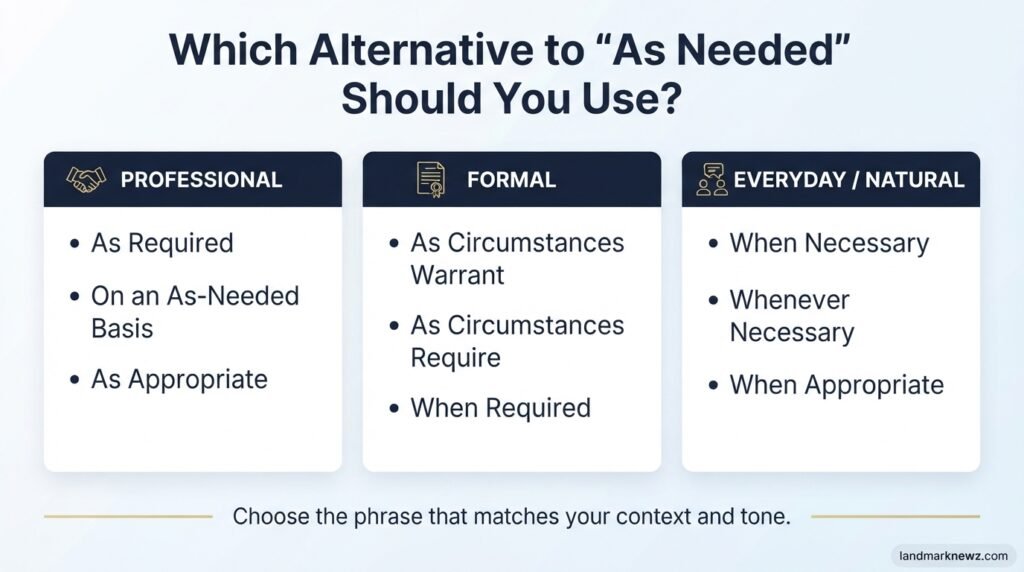
| Alternative | Best Used In | Tone |
| As required | Workplace, policies, instructions | Professional |
| When necessary | Everyday and professional writing | Neutral |
| As appropriate | Business and formal communication | Polished |
| When required | Rules and procedures | Formal |
| Whenever necessary | Ongoing communication | Flexible |
| On an as-needed basis | Services, staffing, meetings | Professional |
| As circumstances warrant | Policies and official documents | Formal |
| As applicable | Forms, instructions, business documents | Formal |
| As circumstances require | Business and policy writing | Formal |
| When appropriate | Emails and workplace communication | Polite |
Common Mistakes When Replacing “As Needed”
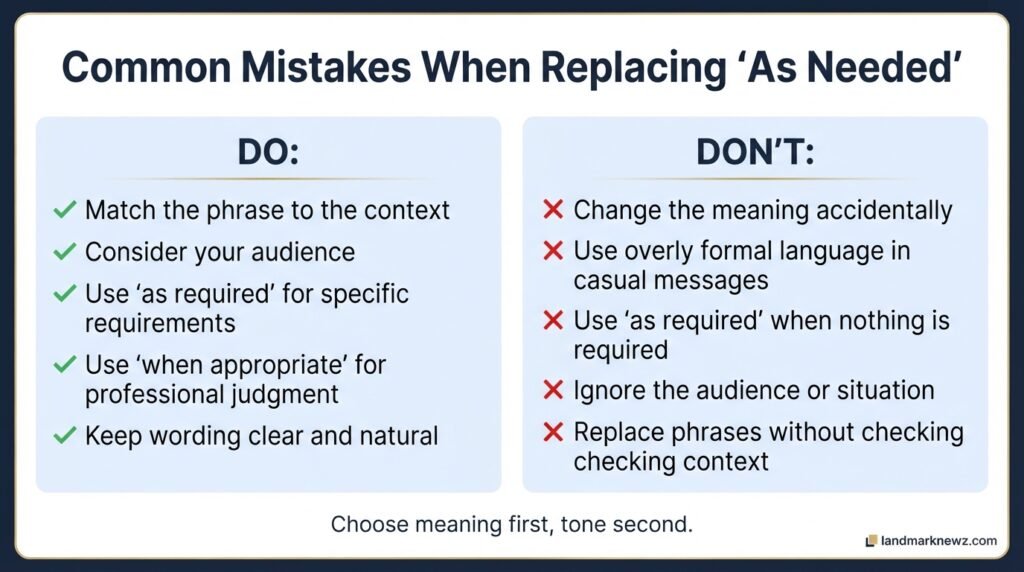
1. Choosing a phrase that changes the meaning
Not every alternative means exactly the same thing. For example, “as applicable” focuses on whether something applies, while “when necessary” focuses on necessity.
2. Using overly formal language
Phrases such as “as circumstances warrant” may sound unnatural in a casual text. For everyday communication, “when necessary” or “whenever necessary” is usually clearer.
3. Using “as required” when nothing is actually required
“As required” can imply an obligation, rule, or specific requirement. If an action is optional and simply useful, “when appropriate” may be a better choice.
4. Ignoring the audience
A phrase that works in a policy document may sound stiff in a friendly email. Always consider whether you are writing to a customer, coworker, manager, friend, or general audience.
5. Replacing the phrase without checking context
“As needed” can describe timing, necessity, availability, or flexible service. Read the complete sentence before selecting an alternative so the original meaning remains clear.
Frequently Asked Questions
What is another way to say “as needed”?
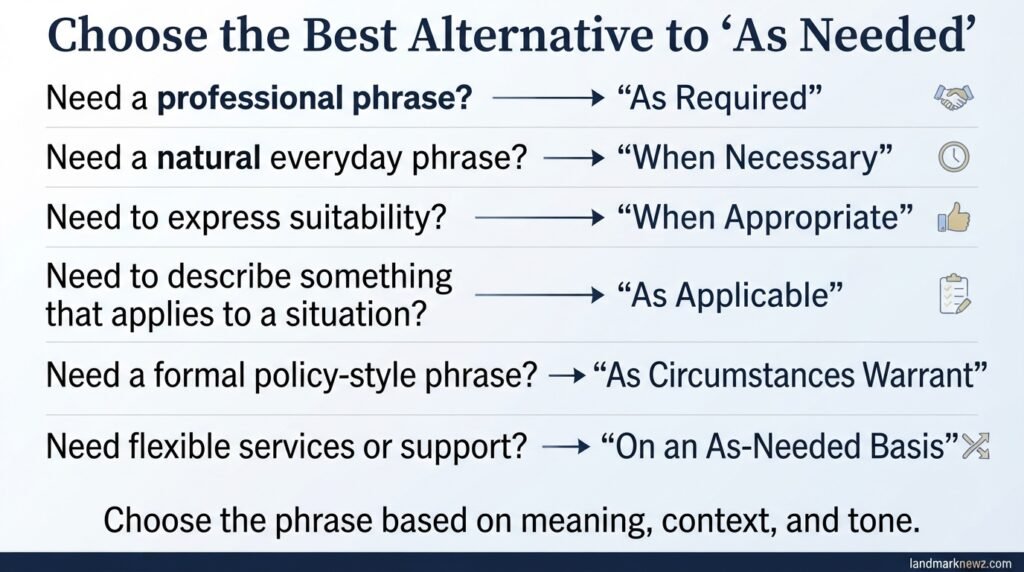
Common alternatives include “as required,” “when necessary,” “as appropriate,” “when required,” “whenever necessary,” and “on an as-needed basis.” The best choice depends on context. “When necessary” is a versatile everyday option, while “as required” is especially suitable for professional or formal writing.
What is a professional way to say “as needed”?
“As required” and “on an as-needed basis” are strong professional alternatives. For example, instead of saying, “We will provide assistance as needed,” you could write, “We will provide assistance as required.” The latter sounds concise and appropriate for workplace communication.
What is a formal synonym for “as needed”?
Formal alternatives include “as circumstances warrant,” “as circumstances require,” “when required,” and “as applicable.” However, each has a slightly different meaning. “As circumstances warrant” focuses on changing conditions, while “as applicable” indicates that something applies to a particular case.
Is “when necessary” the same as “as needed”?
They are very similar and can often be used interchangeably. Both indicate that something should happen when circumstances make it necessary. However, “whenever necessary” can emphasize repeated or ongoing action, while “as needed” is often broader and more flexible.
How do you say “as needed” in an email?
For most professional emails, you can use “when necessary,” “as required,” “when appropriate,” or “whenever necessary.” For example, “Please contact me when necessary” sounds natural and polite. If you are discussing a formal process, “Please provide the information as required” may be more suitable.
What is a casual way to say “as needed”?
In casual conversation, “when necessary,” “whenever you need to,” or “if needed” can work well. For example, “Just call me if needed” sounds natural and friendly. The best choice depends on whether you are talking about a person, task, resource, or specific situation.
What is another way to say “if needed”?
Good alternatives include “if necessary,” “when necessary,” “should it be necessary,” “as required,” and “whenever necessary.” “If necessary” is particularly useful when an action may or may not be required. For example, “We can schedule another meeting if necessary” clearly leaves the decision open.
Which alternative to “as needed” sounds the most natural?
“When necessary” is one of the most natural choices because it works across many situations without sounding overly formal. For professional writing, “as required” can be stronger. If you want to emphasize judgment or suitability, “when appropriate” is often the better choice.
Conclusion
Finding another way to say “as needed” is useful when you want your writing to sound clearer, more professional, or less repetitive. The best alternative depends on the exact meaning you want to communicate.
Use “when necessary” for a simple, natural choice. Choose “as required” when a rule or requirement is involved, and use “as appropriate” or “when appropriate” when professional judgment matters. For formal documents, “as circumstances warrant” can work well, while “on an as-needed basis” is useful for flexible services, staffing, and support.
Before replacing “as needed,” consider the context and audience. A precise phrase will make your sentence easier to understand and help your communication sound natural rather than forced. Clear and precise writing can also make your word choices more effective.

Professional Writing & Workplace Communication Expert
Marcus Hale is a business communication specialist with 11 years of experience in corporate training and professional writing. He has worked with mid-sized companies and remote teams to improve clarity in emails, reports, performance reviews, and client-facing messages.
Marcus focuses on polished, professional alternatives that help readers sound confident without sounding stiff. His guides cover workplace phrases, resume language, leadership communication, and formal-to-natural transitions. He holds a background in business administration and technical writing, and has led workshops on effective professional English.
At LandmarkNewz, Marcus creates practical synonym lists and phrasing tips that professionals can apply immediately in emails, meetings, and career documents.