
What Does “Another Way to Say Conflict Resolution” Mean?
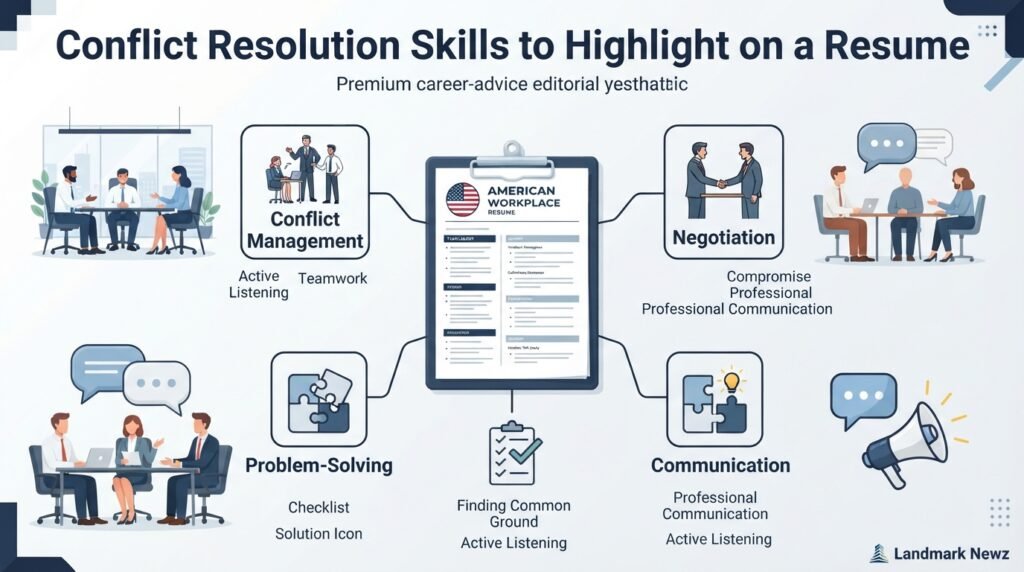
The phrase “another way to say conflict resolution” refers to different words or expressions that communicate the idea of addressing disagreements and finding a workable solution. These alternatives can describe workplace disputes, personal disagreements, customer concerns, or formal negotiations.
People often search for alternatives because “conflict resolution” can sound repetitive or overly formal in certain situations. Choosing a more precise expression can make a resume, email, conversation, or professional document sound clearer and more natural.
Why Use Other Ways to Say “Conflict Resolution”?
Using different expressions allows you to match your wording to the situation instead of relying on the same phrase repeatedly. The right alternative can also highlight a specific skill, such as communication, negotiation, mediation, or problem-solving.
You may want an alternative to:
- Avoid repeating the same phrase.
- Make professional writing more polished.
- Describe a specific conflict-handling skill.
- Improve resume and cover letter language.
- Adjust your tone for formal or casual situations.
- Explain disagreement management more naturally.
10 Best Other Ways to Say “Conflict Resolution”
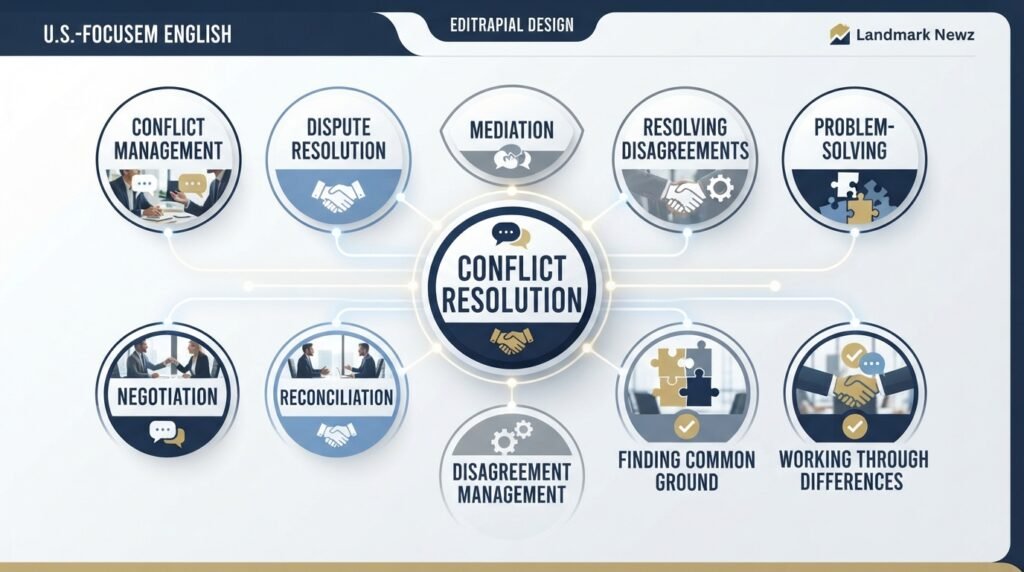
1. Conflict Management
Meaning
Conflict management refers to handling disagreements in a constructive way and preventing them from becoming more serious. Unlike conflict resolution, it does not always mean completely eliminating the disagreement; instead, it focuses on managing it effectively.
Best For
- Professional
- Formal
Example 1
My experience in conflict management helps teams communicate effectively during challenging situations.
Example 2
Strong conflict management skills allowed her to address employee concerns before they affected productivity.
Quick Tip
Use “conflict management” on resumes when you want to emphasize your ability to handle difficult workplace situations.
2. Dispute Resolution
Meaning
Dispute resolution describes the process of addressing a disagreement and reaching an acceptable outcome. It is especially common in legal, business, workplace, and customer-service settings.
Best For
- Professional
- Formal
Example 1
The manager has extensive experience in dispute resolution and employee relations.
Example 2
Our team follows a structured process for customer dispute resolution.
Quick Tip
Choose this phrase when the disagreement is more formal or involves competing claims between two parties.
3. Mediation
Meaning
Mediation involves helping people with different views reach an agreement, usually with assistance from a neutral third party. It emphasizes communication, cooperation, and voluntary agreement.
Best For
- Formal
- Professional
- Polite
Example 1
The two departments agreed to use mediation to address their ongoing concerns.
Example 2
She completed professional training in workplace mediation.
Quick Tip
Use “mediation” when a neutral person or structured process plays an important role in resolving the disagreement.
4. Resolving Disagreements
Meaning
Resolving disagreements is a straightforward and natural way to describe finding a solution when people have different opinions or expectations. It sounds less technical than “conflict resolution.”
Best For
- Professional
- Friendly
- Polite
Example 1
Effective communication is essential for resolving disagreements between team members.
Example 2
He is skilled at resolving disagreements without creating unnecessary tension.
Quick Tip
This is a strong choice when you want your writing to sound natural while remaining professional.
5. Problem-Solving
Meaning
Problem-solving focuses on identifying an issue and finding a practical way forward. Although it can apply to many situations beyond conflict, it works well when disagreements require cooperation and thoughtful solutions.
Best For
- Professional
- Formal
- Casual
Example 1
Her problem-solving skills helped the team reach an agreement quickly.
Example 2
Managers need strong problem-solving abilities when handling competing priorities.
Quick Tip
Use “problem-solving” when you want to emphasize solutions rather than the conflict itself.
6. Negotiation
Meaning
Negotiation is the process of discussing different positions to reach an agreement that works for the parties involved. It is particularly useful when people need to compromise or balance competing interests.
Best For
- Professional
- Formal
Example 1
His negotiation skills helped both departments agree on a realistic project timeline.
Example 2
Successful negotiation requires patience, preparation, and clear communication.
Quick Tip
Choose “negotiation” when reaching an agreement requires discussion, compromise, or bargaining.
7. Reconciliation
Meaning
Reconciliation refers to restoring a positive relationship after a disagreement or period of tension. It focuses not only on settling the issue but also on rebuilding trust and cooperation.
Best For
- Formal
- Warm
- Polite
Example 1
The meeting created an opportunity for reconciliation between the two colleagues.
Example 2
Honest communication played an important role in their reconciliation.
Quick Tip
Use “reconciliation” when repairing a relationship is as important as resolving the original disagreement.
8. Disagreement Management
Meaning
Disagreement management describes the ability to handle differences of opinion calmly and productively. It can be useful when the situation involves normal differences rather than serious disputes.
Best For
- Professional
- Formal
Example 1
The training program teaches disagreement management and effective communication.
Example 2
Good disagreement management can keep workplace discussions productive.
Quick Tip
This phrase works best when you want to distinguish everyday differences of opinion from serious conflict.
9. Finding Common Ground
Meaning
Finding common ground means identifying shared interests, goals, or values between people who disagree. It has a cooperative and positive tone because it focuses on what the parties can agree on.
Best For
- Friendly
- Warm
- Polite
- Professional
Example 1
The supervisor helped both employees find common ground during the discussion.
Example 2
Finding common ground allowed the teams to move forward with the project.
Quick Tip
Use this expression when you want to emphasize cooperation rather than confrontation.
10. Working Through Differences
Meaning
Working through differences means addressing disagreements through communication, patience, and cooperation. It sounds natural and human, making it useful for everyday and professional conversations.
Best For
- Casual
- Friendly
- Warm
- Professional
Example 1
We had an honest conversation and worked through our differences.
Example 2
Strong teams know how to work through differences without losing sight of their shared goals.
Quick Tip
Choose this phrase when you want a softer, less formal alternative to “conflict resolution.”
Comparison Table
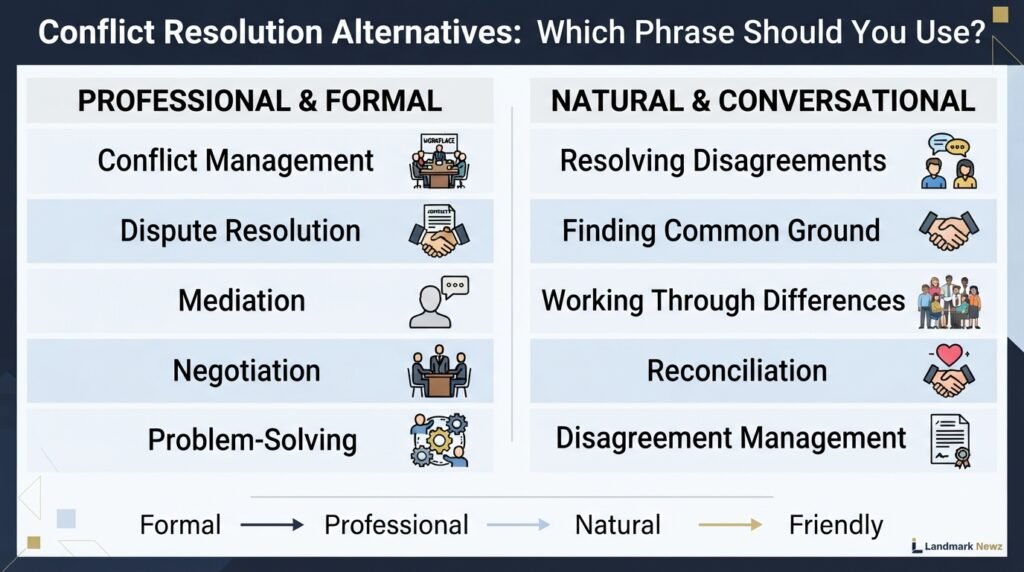
| Alternative | Best Used In | Tone |
| Conflict Management | Workplace, resumes | Professional |
| Dispute Resolution | Business, legal, formal settings | Formal |
| Mediation | Disputes, negotiations | Formal, neutral |
| Resolving Disagreements | Workplace, everyday communication | Professional, natural |
| Problem-Solving | Resumes, interviews, workplace | Professional |
| Negotiation | Business, workplace, agreements | Formal, professional |
| Reconciliation | Relationships, serious disagreements | Warm, formal |
| Disagreement Management | Workplace training | Professional |
| Finding Common Ground | Meetings, teamwork, relationships | Positive, friendly |
| Working Through Differences | Conversations, teamwork | Warm, natural |
Common Mistakes
1. Using Casual Phrases in Formal Writing
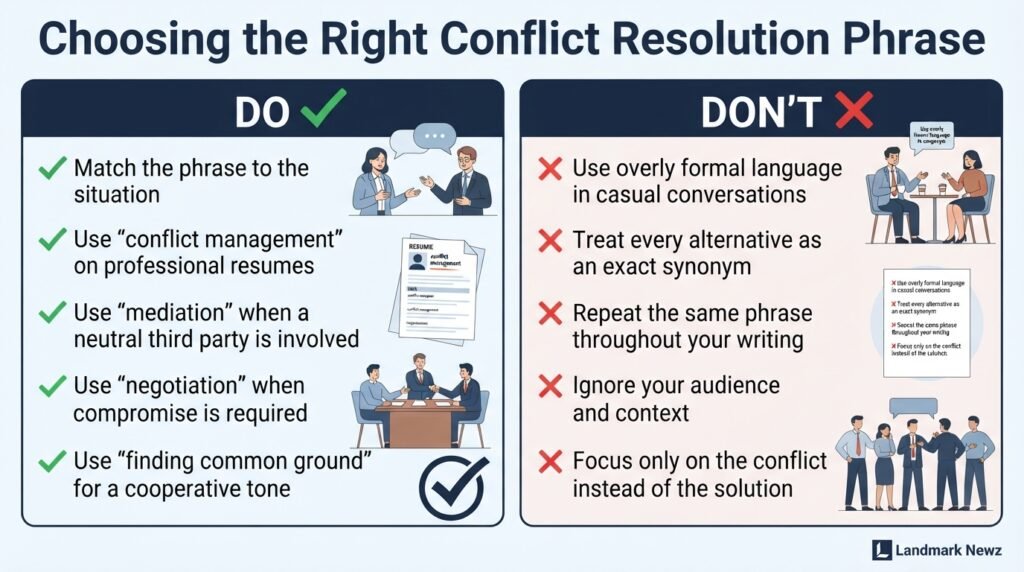
Expressions such as “working through differences” may sound too conversational in a legal document or formal business report. Choose “dispute resolution” or “conflict management” when the setting requires a more professional tone.
2. Choosing Overly Formal Language
Not every disagreement needs technical language. Saying “mediation” or “dispute resolution” in a casual conversation can sound unnecessarily formal when “working through differences” would be clearer.
3. Treating Every Alternative as an Exact Synonym
These phrases are related but not identical. “Negotiation” focuses on reaching an agreement, while “reconciliation” emphasizes repairing a relationship.
4. Forgetting the Context
The best phrase depends on what you are describing. A resume may benefit from “conflict management,” while a conversation with a coworker may sound more natural with “resolving disagreements.”
5. Focusing Too Much on the Conflict
Professional communication should usually emphasize the solution rather than the disagreement itself. Words such as “problem-solving” and “finding common ground” can create a more constructive impression.
Frequently Asked Questions
What is another way to say conflict resolution professionally?
Professional alternatives include conflict management, dispute resolution, mediation, negotiation, and disagreement management. The best choice depends on what you actually did. For example, “conflict management” works well on a resume, while “dispute resolution” is more suitable for formal business or legal contexts.
What is a good synonym for conflict resolution on a resume?
Conflict management is one of the strongest resume-friendly alternatives because it clearly communicates the ability to handle workplace disagreements. “Problem-solving,” “negotiation,” and “mediation” can also work when they accurately describe your specific skills and responsibilities.
What is a softer way to say conflict resolution?
A softer alternative is “working through differences.” Another positive option is “finding common ground.” Both expressions focus on cooperation and communication instead of making the disagreement sound severe or confrontational.
Is conflict management the same as conflict resolution?
They are closely related but not exactly the same. Conflict resolution generally focuses on addressing a disagreement and reaching a solution, while conflict management focuses on handling the situation constructively, even when complete agreement is not possible.
What is another word for resolving disagreements?
Depending on the context, you can use mediation, negotiation, reconciliation, problem-solving, or dispute resolution. For everyday communication, “working through differences” and “finding common ground” are more natural choices.
How can I describe conflict resolution skills on a resume?
You can describe them with specific skills such as conflict management, negotiation, mediation, active listening, problem-solving, and communication. Whenever possible, connect the skill to an outcome, such as improving teamwork, addressing customer concerns, or reaching agreements.
What is a formal way to say resolving conflict?
Dispute resolution is a highly formal option, particularly in business, legal, and organizational settings. “Conflict management” is another professional choice that works well for workplace policies, resumes, performance reviews, and leadership descriptions.
What phrase should I use instead of conflict resolution in an interview?
Choose a phrase that matches the skill you want to highlight. “Conflict management” emphasizes handling difficult situations, “negotiation” highlights reaching agreements, and “problem-solving” focuses on finding practical solutions. Giving a short example will make your answer more convincing.
Conclusion
Choosing another way to say conflict resolution can make your writing more precise, natural, and effective. The best alternative depends on the situation and the skill you want to emphasize.
For resumes and professional documents, conflict management and dispute resolution are strong choices. If you are describing a structured process involving a neutral third party, mediation is more precise. For situations that involve compromise, negotiation works well, while finding common ground and working through differences create a warmer, more conversational tone.
Remember that related phrases are not always exact synonyms. Consider your audience, purpose, and context before choosing your wording. The right expression can show not only that you handle disagreements, but also that you communicate, cooperate, and focus on practical solutions while developing strong conflict management skills.
About Dr. Priya Nair
Dr. Priya Nair is a passionate Writer & Blogger at LandMarkNewz.com, dedicated to creating informative, engaging, and easy-to-understand content for readers. With a strong interest in research, current trends, lifestyle, and everyday topics, she focuses on presenting useful information in a clear and reader-friendly way.
Through her writing, Priya aims to help readers discover valuable insights, understand complex topics more easily, and stay informed about subjects that matter to them. Her approach combines thoughtful research with a simple and engaging writing style.
At LandMarkNewz.com, she contributes original articles designed to inform, educate, and provide practical value to readers.