

What Does “Another Way to Say This Is Why” Mean?
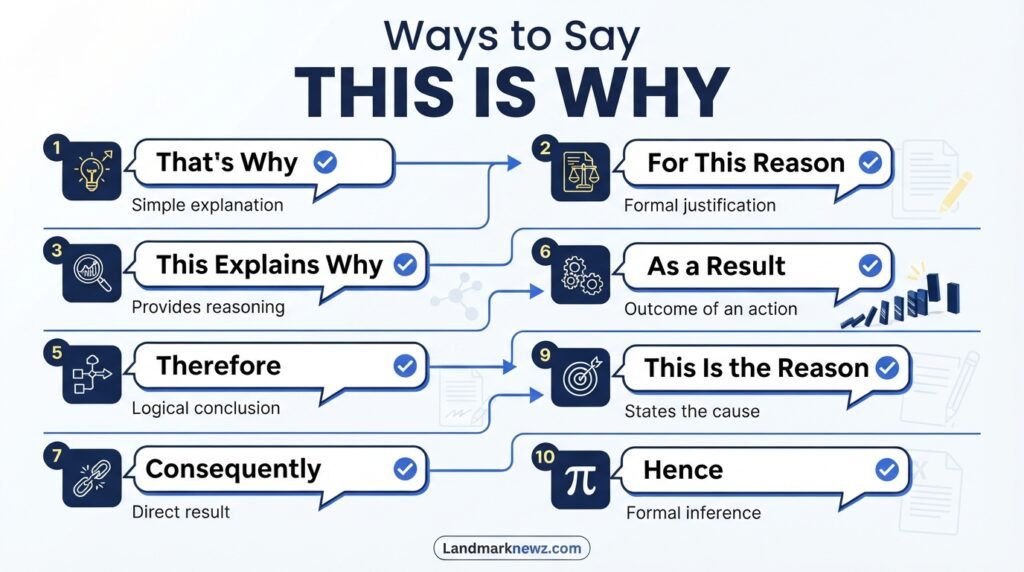
“This is why” is commonly used to explain the reason something happened or to connect a cause with its result. For example, “I wanted to improve my skills. This is why I took the course.”
People often search for another way to say this is why when they want to avoid repetition, make their writing sound smoother, or choose a phrase that better fits a professional or formal situation.
You may see these alternatives in emails, essays, reports, conversations, presentations, business writing, and everyday speech.
Why Use Other Ways to Say “This Is Why”?
Using different expressions can make your communication clearer and more natural. Although “this is why” is correct, repeating it too often can make your writing feel predictable.
Consider another expression when you want to:
- Avoid repeating the same phrase.
- Create smoother transitions between ideas.
- Make professional writing more polished.
- Explain cause and effect more clearly.
- Adjust your tone for formal or casual situations.
- Make an argument sound more precise.
10 Best Other Ways to Say “This Is Why”
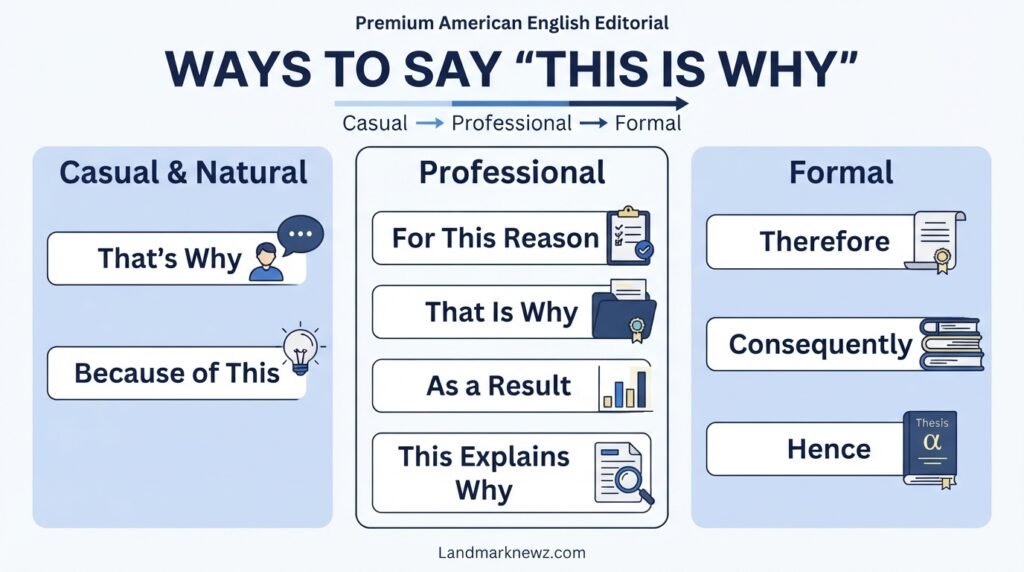
1. That’s Why
Meaning
“That’s why” is one of the most natural alternatives to “this is why.” It connects a previous reason with the result that follows and is especially common in everyday American English.
Best For
- Casual
- Friendly
- Professional
- Warm
Example 1
I knew the deadline was approaching, so that’s why I started early.
Example 2
She enjoys working with children, and that’s why she became a teacher.
Quick Tip
Use “that’s why” in conversation and informal writing when you want a natural, conversational tone.
2. For This Reason
Meaning
“For this reason” clearly points back to something previously mentioned and explains why a particular conclusion or action follows. It sounds more polished than “that’s why.”
Best For
- Professional
- Formal
- Polite
Example 1
The roads may become icy overnight. For this reason, drivers should use extra caution.
Example 2
The proposal addresses several customer concerns. For this reason, we recommend moving forward.
Quick Tip
Choose “for this reason” for reports, business documents, academic writing, and formal explanations.
3. This Explains Why
Meaning
“This explains why” emphasizes that the information just presented helps explain a particular situation or outcome. It is useful when discussing evidence, facts, or observations.
Best For
- Professional
- Formal
- Polite
Example 1
The company increased its training budget. This explains why employee satisfaction improved.
Example 2
He practiced every morning for six months. This explains why his performance improved so quickly.
Quick Tip
Use this phrase when you want to highlight the connection between evidence and an outcome.
4. That Is Why
Meaning
“That is why” has the same basic meaning as “that’s why,” but it sounds slightly more complete and deliberate. It works well when you want your explanation to feel clear and direct.
Best For
- Professional
- Formal
- Friendly
- Polite
Example 1
Customer safety remains our priority. That is why we inspect every product carefully.
Example 2
She values honest feedback. That is why she regularly asks her team for suggestions.
Quick Tip
Use “that is why” when you want a slightly more polished alternative without sounding overly formal.
5. Therefore
Meaning
“Therefore” introduces a logical conclusion that follows from information already provided. It is concise and often used when the relationship between ideas is clear.
Best For
- Formal
- Professional
Example 1
The test results were inconsistent; therefore, the team repeated the experiment.
Example 2
The position requires strong communication skills. Therefore, applicants should provide relevant examples.
Quick Tip
“Therefore” is strongest in formal writing, but it can sound too stiff in casual conversation.
6. As a Result
Meaning
“As a result” focuses on the outcome of a previous action, event, or condition. Unlike “this is why,” it often emphasizes the consequence rather than simply introducing a reason.
Best For
- Professional
- Formal
Example 1
The store extended its hours. As a result, customers had more flexibility.
Example 2
We updated the website navigation. As a result, visitors can find information more quickly.
Quick Tip
Use “as a result” when you want to clearly emphasize what happened because of something else.
7. Consequently
Meaning
“Consequently” is a formal transition that shows a direct result or consequence. It works particularly well in academic, business, and analytical writing.
Best For
- Formal
- Professional
Example 1
The project exceeded its budget. Consequently, management reviewed the remaining expenses.
Example 2
Several flights were delayed. Consequently, the conference schedule was adjusted.
Quick Tip
Use “consequently” sparingly because it can sound more formal than necessary in everyday communication.
8. Because of This
Meaning
“Because of this” directly identifies a previous situation as the reason for what happens next. It is simple, clear, and easy to understand.
Best For
- Professional
- Casual
- Friendly
- Polite
Example 1
The team completed the work ahead of schedule. Because of this, we were able to begin the next phase early.
Example 2
My schedule changed unexpectedly. Because of this, I had to reschedule our meeting.
Quick Tip
Use “because of this” when you want a straightforward explanation without sounding overly formal.
9. This Is the Reason
Meaning
“This is the reason” directly identifies something as the cause of an action, decision, or situation. It is more explicit than “this is why” and can add emphasis.
Best For
- Professional
- Formal
- Polite
Example 1
The position offers opportunities for growth. This is the reason I am interested in joining the company.
Example 2
The software saves employees several hours each week. This is the reason the company decided to adopt it.
Quick Tip
Use this expression when you want to emphasize a specific reason rather than simply create a transition.
10. Hence
Meaning
“Hence” is a concise and formal transition meaning “for this reason” or “as a result.” It is more common in formal, technical, academic, and carefully edited writing than in everyday conversation.
Best For
- Formal
- Professional
Example 1
The evidence was insufficient; hence, the committee requested additional information.
Example 2
The demand for the service increased significantly, hence the need for additional staff.
Quick Tip
Use “hence” when writing formally, but choose “that’s why” or “for this reason” for more natural everyday communication.
Comparison Table
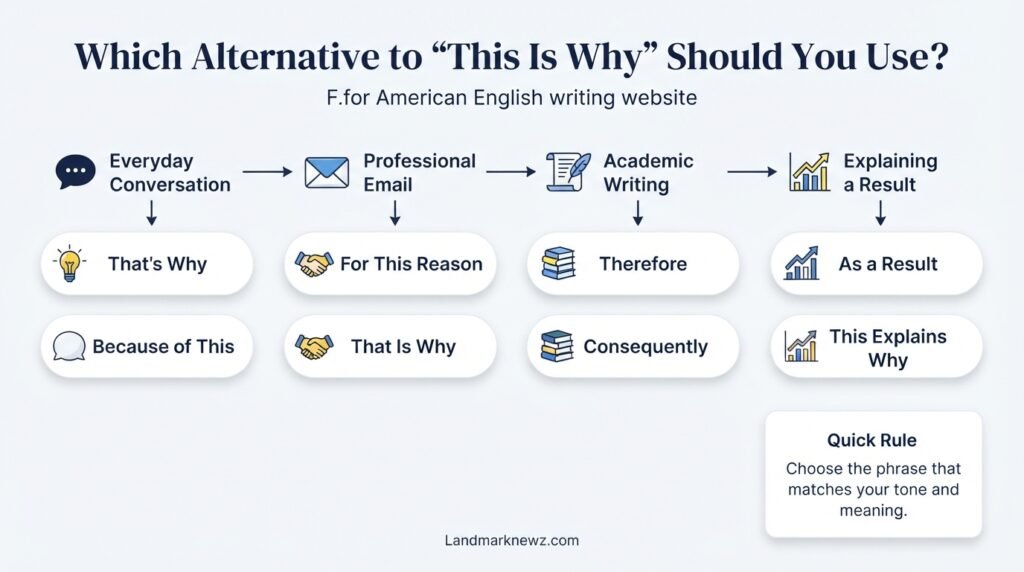
| Alternative | Best Used In | Tone |
| That’s why | Conversations, emails | Casual, natural |
| For this reason | Reports, business writing | Professional, formal |
| This explains why | Explanations, analysis | Clear, professional |
| That is why | General and professional writing | Polished, direct |
| Therefore | Academic and business writing | Formal, logical |
| As a result | Reports and explanations | Professional, neutral |
| Consequently | Formal analysis | Formal, authoritative |
| Because of this | Everyday and workplace communication | Clear, natural |
| This is the reason | Explanations and formal writing | Direct, emphatic |
| Hence | Academic and technical writing | Formal, concise |
Common Mistakes
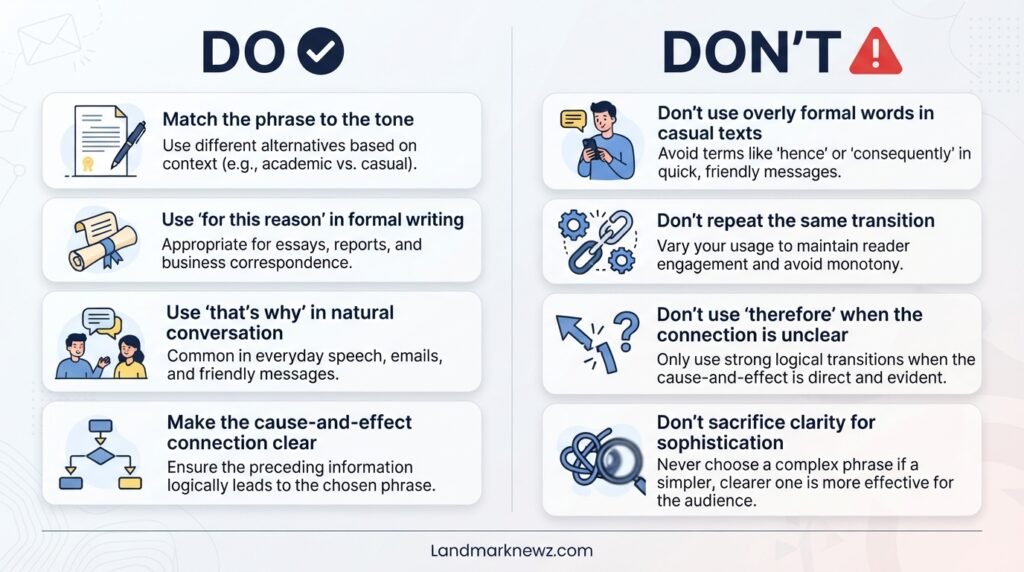
- Using “therefore” in every situation:
“Therefore” can sound overly formal in a casual conversation. Choose “that’s why” when speaking naturally. - Ignoring the cause-and-effect relationship:
Make sure your alternative actually connects the previous idea to the result you are explaining. - Using overly formal language:
Words such as “hence” and “consequently” may feel unnatural in a friendly email or text message. - Repeating one transition too often:
Even a useful phrase can become repetitive. Rotate between suitable alternatives when the context allows. - Choosing tone over clarity:
The most sophisticated phrase is not always the best choice. Pick the expression that makes your meaning easiest to understand.
Frequently Asked Questions
What is the most natural way to say “this is why”?
The most natural alternative in everyday American English is “that’s why.” It sounds conversational and works in many ordinary situations. For example, “I had an early meeting, so that’s why I left the party early.” In professional writing, “for this reason” or “therefore” may be more appropriate.
What is a professional way to say “this is why”?
“For this reason” is an excellent professional alternative to “this is why.” It clearly connects a previous fact or situation with a decision or conclusion. You can use it in emails, reports, presentations, proposals, and workplace communication without making the sentence sound unnecessarily complicated.
What is a formal way to say “this is why”?
Formal alternatives include “therefore,” “consequently,” “for this reason,” and “hence.” The best choice depends on the sentence. “Therefore” usually introduces a logical conclusion, while “consequently” and “as a result” emphasize an outcome.
Can I use “that’s why” in a professional email?
Yes. “That’s why” is grammatically correct and can sound perfectly natural in many workplace emails. However, if the message is highly formal, “for this reason” may create a more polished tone. Consider your relationship with the reader and the purpose of the email before choosing one.
Is “this explains why” the same as “this is why”?
They are closely related but not always identical. “This explains why” emphasizes that information provides an explanation for something. “This is why” more directly introduces the reason for an action, situation, or result. Choose “this explains why” when you want to highlight evidence or an explanation.
What can I say instead of “this is why” in an essay?
For an essay, consider “therefore,” “for this reason,” “as a result,” or “consequently.” These transitions can create a more academic tone. However, avoid forcing formal transitions into every paragraph. The best choice should clearly show how the ideas in your essay are connected.
Is “because of this” a good alternative to “this is why”?
Yes. “Because of this” is a clear and natural alternative when you want to show that a previous situation caused a particular result. It works in both everyday and professional communication and is especially useful when you want your cause-and-effect relationship to be easy to understand.
Which alternative should I use in a business email?
“For this reason” and “that is why” are strong choices for most business emails. Use “therefore” when presenting a logical conclusion and “as a result” when emphasizing an outcome. For a friendly workplace message, “that’s why” may sound more natural and approachable.
Conclusion
There are many useful alternatives when you need another way to say “this is why.” The best choice depends on your audience, purpose, and desired tone. For everyday conversations, “that’s why” is usually the most natural option. In professional or formal writing, “for this reason,” “therefore,” and “as a result” are strong choices.
If you are explaining evidence, “this explains why” makes the connection especially clear. For a more formal style, “consequently” or “hence” can work when used appropriately. The key is not to replace “this is why” simply for the sake of using a synonym. Instead, choose the phrase that makes your cause-and-effect relationship clear and sounds natural in the situation.

Language & Everyday Communication Specialist
Elena Voss is a language enthusiast and communication coach with over 9 years of experience helping people express themselves more naturally in English. She previously worked as an ESL instructor and corporate language trainer, guiding professionals and students on clearer everyday conversations, polite alternatives, and natural phrasing.
Elena specializes in practical synonym guides and “another way to say…” content that feels conversational rather than textbook. Her writing focuses on real-life situations — emails to friends, casual workplace chat, social media, and daily interactions. She believes the best language advice is simple, useful, and easy to remember.
When she’s not creating content for LandmarkNewz, Elena enjoys analyzing modern slang trends and testing new phrases in real conversations.