
Finding another way to say “helped” can make your writing more precise, professional, and natural. While “helped” is perfectly correct, stronger alternatives can show exactly what you did and make your message more engaging.
Whether you are writing a resume, email, performance review, school assignment, or everyday message, the right synonym depends on the context.
What Does “Another Way to Say Helped” Mean?
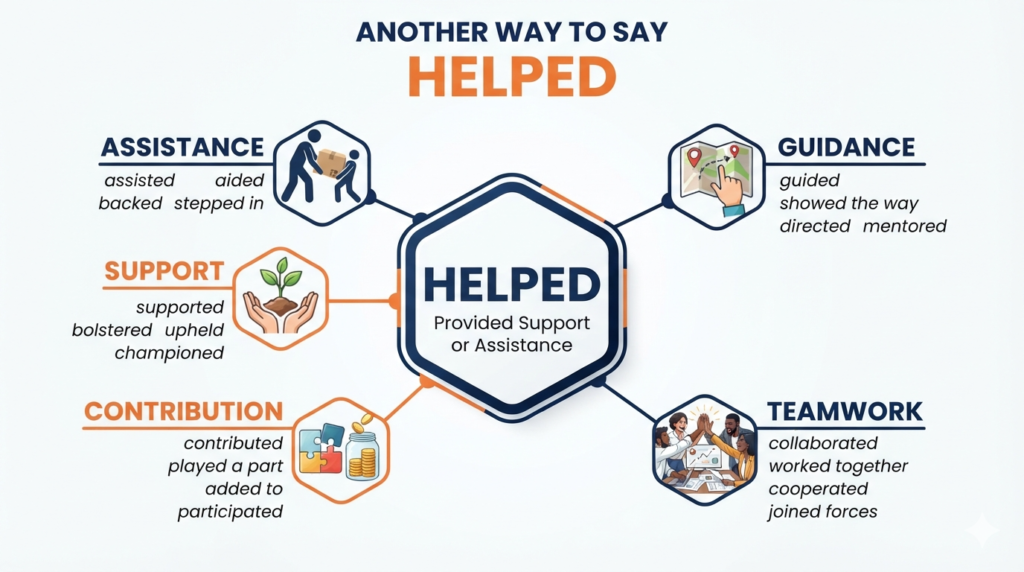
“Another way to say helped” refers to alternative words or phrases that communicate the idea of providing assistance, support, guidance, or useful action.
The word “helped” is common in everyday English, but it can sometimes sound too general. For example, saying “I helped my team” does not explain how you contributed. A phrase such as “I supported my team” or “I guided my team through the process” gives the reader more information.
These alternatives are commonly used in professional writing, resumes, cover letters, academic work, business communication, and casual conversations.
Why Use Other Ways to Say “Helped”?
Using different expressions for “helped” can make your writing clearer and more specific. The best alternative tells readers what kind of assistance you provided instead of relying on a broad word.
You may want another expression to:
- Avoid repeating the same word.
- Make a resume achievement more specific.
- Sound more professional in workplace communication.
- Match formal or casual situations.
- Show leadership, teamwork, or expertise.
- Describe support more accurately.
- Make your writing sound more natural.
For example, “helped customers” is broad, while “assisted customers with product selection” explains the action more clearly.
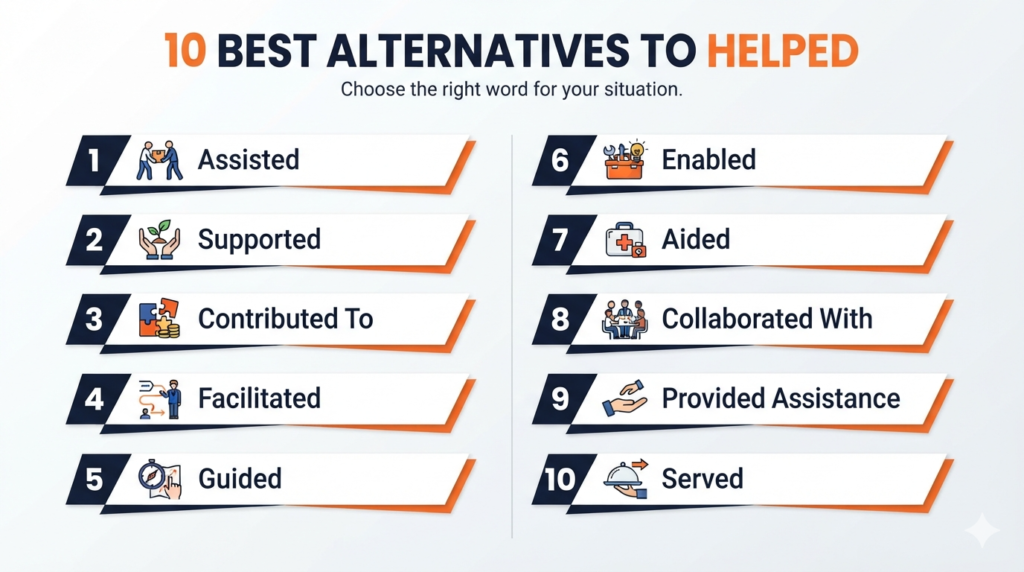
10 Best Other Ways to Say “Helped”
1. Assisted
Meaning
“Assisted” means you provided practical support or aid to someone. It is a polished and professional alternative to “helped,” especially when describing workplace responsibilities.
Best For
- Professional
- Formal
- Polite
Example 1
I assisted customers with product selection and checkout questions.
Example 2
The technician assisted the team during the equipment installation.
Quick Tip
Use “assisted” on resumes and in professional writing when you want a direct, polished replacement for “helped.”
2. Supported
Meaning
“Supported” means you provided assistance, resources, encouragement, or ongoing help. It works especially well when your contribution made it easier for someone else to succeed.
Best For
- Professional
- Formal
- Friendly
- Warm
Example 1
I supported new employees during their first weeks on the job.
Example 2
Our department supported the community through several volunteer programs.
Quick Tip
Choose “supported” when your role involved ongoing assistance rather than a single task.
3. Contributed to
Meaning
“Contributed to” emphasizes your role in achieving a result or completing a project. It is particularly useful when several people worked together toward the same goal.
Best For
- Professional
- Formal
Example 1
She contributed to the successful launch of the company’s new website.
Example 2
My research contributed to a better understanding of customer preferences.
Quick Tip
Use this phrase when you want to highlight your part in a larger achievement without claiming sole responsibility.
4. Facilitated
Meaning
“Facilitated” means you made a process, activity, discussion, or outcome easier to accomplish. It often suggests organization, coordination, or leadership.
Best For
- Professional
- Formal
Example 1
He facilitated communication between the sales and marketing teams.
Example 2
The manager facilitated a productive discussion about the project’s next steps.
Quick Tip
“Facilitated” is stronger than “helped” when you actively made a process easier or kept it moving.
5. Guided
Meaning
“Guided” means you provided direction, advice, or expertise that helped someone make progress. It suggests a more active role than simply offering basic assistance.
Best For
- Professional
- Formal
- Friendly
- Warm
Example 1
The mentor guided the interns through their first major assignments.
Example 2
She guided customers toward solutions that matched their needs.
Quick Tip
Use “guided” when your help involved instruction, advice, coaching, or direction.
6. Enabled
Meaning
“Enabled” means you made something possible or gave someone the ability or resources to accomplish something. It focuses on the result of your support.
Best For
- Professional
- Formal
Example 1
The new software enabled employees to complete reports more efficiently.
Example 2
Her training enabled the team to handle customer requests independently.
Quick Tip
Choose “enabled” when your contribution directly made an action, improvement, or achievement possible.
7. Aided
Meaning
“Aided” means provided assistance or support. It is a concise alternative to “helped,” although it tends to sound more formal than everyday conversation.
Best For
- Formal
- Professional
- Polite
Example 1
The updated instructions aided employees in completing the process correctly.
Example 2
Volunteers aided residents affected by the severe winter storm.
Quick Tip
“Aided” works best in formal writing, reports, academic contexts, and situations where a concise tone is appropriate.
8. Collaborated With
Meaning
“Collaborated with” means worked together with another person or group to accomplish a shared objective. Unlike “helped,” it emphasizes teamwork and active participation.
Best For
- Professional
- Formal
- Friendly
Example 1
I collaborated with the design team to improve the company’s website.
Example 2
She collaborated with local teachers to develop new classroom materials.
Quick Tip
Use this phrase when you worked alongside others rather than simply providing one-way assistance.
9. Provided Assistance
Meaning
“Provided assistance” is a clear and professional phrase meaning that you gave someone the support they needed. It is especially useful when you want a formal alternative without changing the basic meaning of “helped.”
Best For
- Professional
- Formal
- Polite
Example 1
The staff provided assistance to visitors throughout the event.
Example 2
Our support team provided assistance with account setup and troubleshooting.
Quick Tip
This phrase is useful in reports, workplace documents, customer service descriptions, and other formal contexts.
10. Served
Meaning
“Served” can mean that you assisted, supported, or met the needs of a person or group. It is especially effective when describing customer service, community work, or a role focused on meeting people’s needs.
Best For
- Professional
- Formal
- Polite
- Warm
Example 1
She served customers by answering questions and resolving concerns promptly.
Example 2
The organization served local families by providing educational resources.
Quick Tip
Use “served” when your help involved meeting needs or providing a valuable service.
Comparison Table
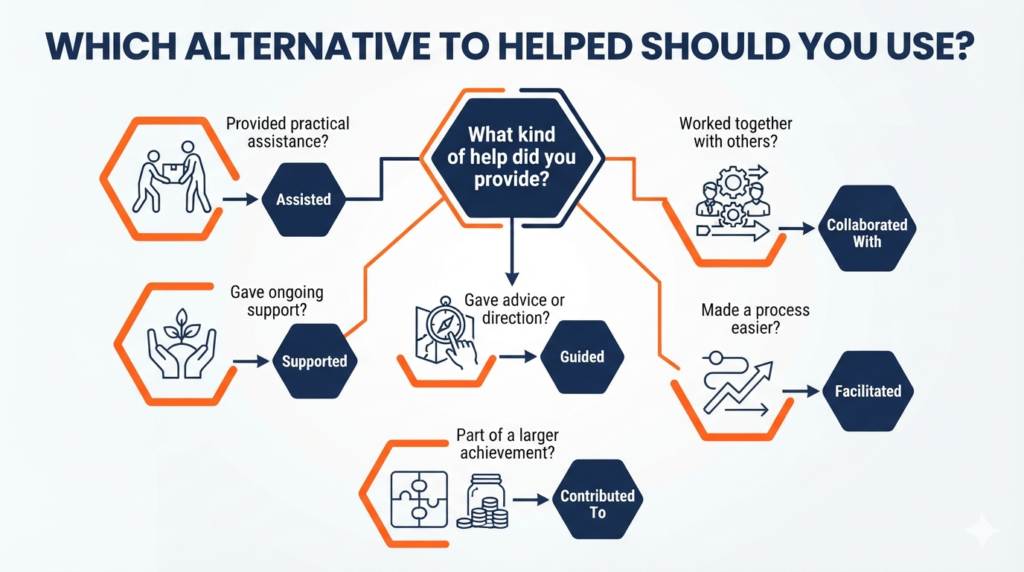
| Alternative | Best Used In | Tone |
| Assisted | Resumes, workplace writing | Professional |
| Supported | Teamwork, ongoing assistance | Professional, warm |
| Contributed to | Projects, achievements | Professional |
| Facilitated | Meetings, processes, coordination | Formal |
| Guided | Training, mentoring, advice | Professional, supportive |
| Enabled | Results, improvements, processes | Formal |
| Aided | Reports, formal writing | Formal |
| Collaborated with | Team projects | Professional, cooperative |
| Provided assistance | Customer service, reports | Formal, polite |
| Served | Customer service, community work | Professional, service-oriented |
Common Mistakes When Replacing “Helped”
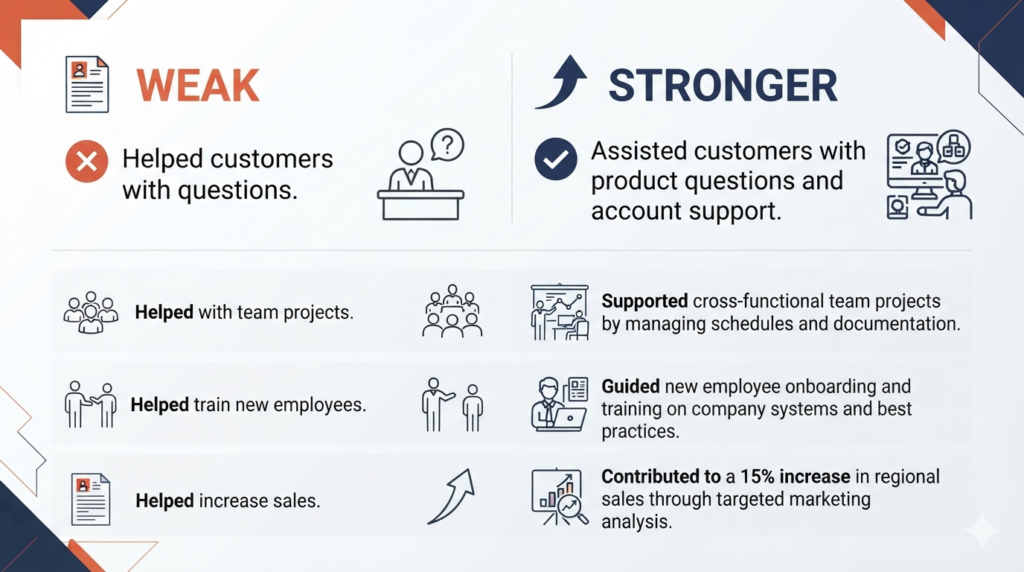
1. Choosing a word that does not match the action
Not every synonym means exactly the same thing. For example, “guided” suggests direction, while “collaborated” suggests working together.
2. Using overly formal language in casual situations
Words such as “facilitated” and “aided” can sound unnatural in everyday conversation. In a casual message, “supported” or “helped out” may sound more natural.
3. Using “helped” repeatedly on a resume
Repeating “helped” in several bullet points can make your accomplishments sound vague. Choose precise action verbs that explain your contribution.
4. Forgetting the context
The best alternative depends on what you actually did. If you trained someone, “guided” may work better than “assisted.” If you worked with colleagues, “collaborated with” may be more accurate.
5. Using impressive words without evidence
Avoid choosing a sophisticated synonym simply to sound professional. Your wording should accurately describe your real contribution and, when possible, show the result.
Frequently Asked Questions
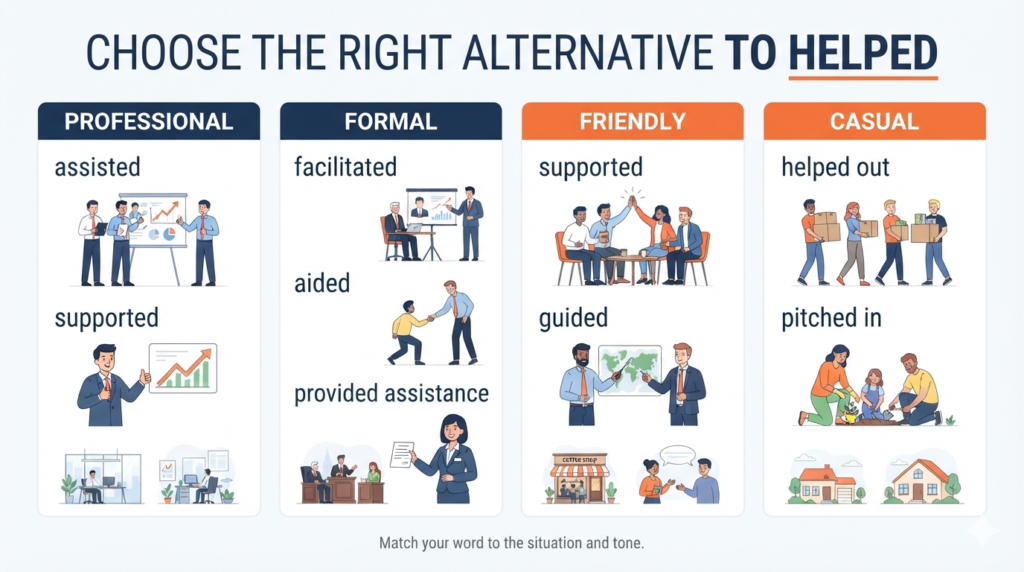
What is a professional way to say “helped”?
“Assisted” is one of the most versatile professional alternatives to “helped.” Other choices include “supported,” “contributed to,” “facilitated,” and “provided assistance.” The right option depends on your specific action. For a resume, a more precise action verb is usually better because it shows employers exactly how you contributed.
What is another way to say “helped” on a resume?
Strong resume alternatives include “assisted,” “supported,” “facilitated,” “guided,” “contributed to,” and “enabled.” Whenever possible, connect the verb to a measurable result. For example, instead of writing “helped customers,” you could write “assisted 50+ customers daily with product selection and account questions.”
What is a formal word for “helped”?
“Aided,” “assisted,” “facilitated,” and “provided assistance” are formal alternatives. “Facilitated” works particularly well when you made a process or discussion easier, while “assisted” is a general choice for professional documents and workplace communication.
What is a better word than “helped” for teamwork?
“Collaborated with” is often a strong choice when describing teamwork because it shows that you worked alongside other people toward a shared goal. “Supported” and “contributed to” are also useful when you want to emphasize your role without suggesting that you worked alone.
How do you say “helped someone” professionally?
You can say “assisted someone,” “supported someone,” or “guided someone,” depending on the type of help provided. For example, “I assisted new employees with onboarding” sounds professional, while “I guided new employees through their training” emphasizes instruction and direction.
Is “assisted” better than “helped”?
“Assisted” is not always better, but it is often more appropriate in professional writing. “Helped” is natural and widely understood, while “assisted” has a more polished tone. The best choice is the word that most accurately describes what you did.
What is another way to say “helped improve”?
Depending on the sentence, you could use “contributed to improvements in,” “enhanced,” “supported improvements in,” or “facilitated improvements in.” If you directly caused the improvement, choose a stronger verb. If you were one contributor among several, “contributed to” is usually more accurate.
What is a good synonym for “helped” in an email?
“Assisted” and “supported” are reliable choices for professional emails. For example, “I’m glad I could assist with the request” sounds polished, while “Thank you for supporting me during the project” has a warmer tone. Select the phrase based on whether you provided practical assistance, ongoing support, or guidance.
Conclusion
Choosing another way to say “helped” can make your writing more precise without making it sound complicated. The best alternative depends on the action you performed and the tone you want to create. For additional guidance on choosing stronger wording for a resume, see these “helped” resume synonyms.
Use assisted for general professional situations, supported for ongoing help, and contributed to when describing your role in a larger achievement. Choose guided when you provided direction, facilitated when you made a process easier, and collaborated with when you worked as part of a team. For customer service or community-focused writing, served can be especially effective.
The key is accuracy. Instead of replacing “helped” with a more impressive word just for variety, choose the expression that clearly shows what you did and why it

Language & Everyday Communication Specialist
Elena Voss is a language enthusiast and communication coach with over 9 years of experience helping people express themselves more naturally in English. She previously worked as an ESL instructor and corporate language trainer, guiding professionals and students on clearer everyday conversations, polite alternatives, and natural phrasing.
Elena specializes in practical synonym guides and “another way to say…” content that feels conversational rather than textbook. Her writing focuses on real-life situations — emails to friends, casual workplace chat, social media, and daily interactions. She believes the best language advice is simple, useful, and easy to remember.
When she’s not creating content for LandmarkNewz, Elena enjoys analyzing modern slang trends and testing new phrases in real conversations.