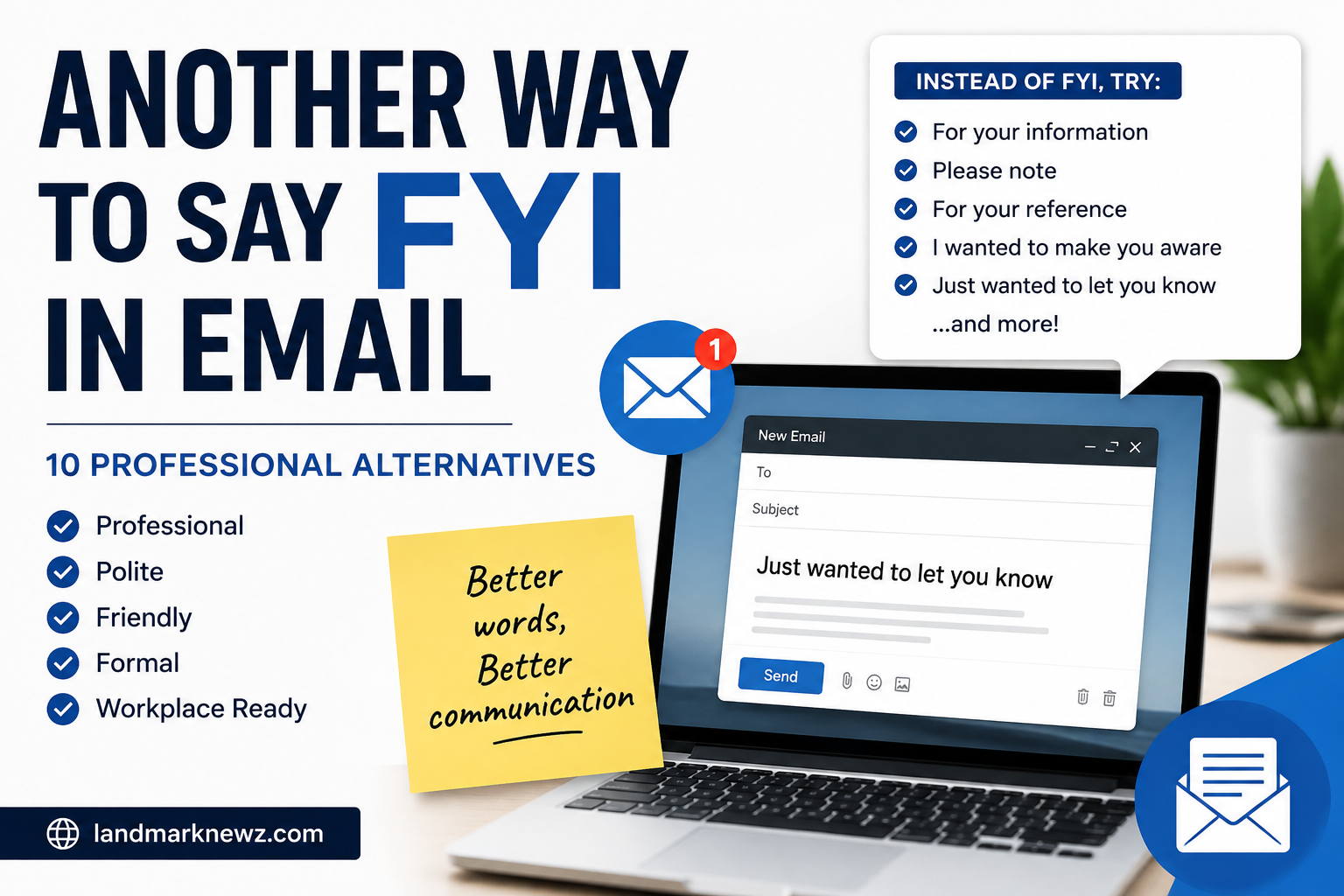
“FYI” stands for “for your information.” People use it in emails when they want to share information that may be useful or relevant but does not necessarily require an immediate response or action.
While FYI is common in American workplace communication, it can occasionally sound brief or impersonal. Using a fuller phrase can make your email sound warmer, clearer, or more professional.
You might look for another way to say FYI in email when writing to a manager, client, customer, coworker, professor, or someone outside your organization.
Why Use Other Ways to Say FYI in Email?
Replacing “FYI” can help you make your message fit the situation instead of relying on the same abbreviation every time.
Consider an alternative when you want to:
- Sound more professional in workplace emails.
- Make your message feel more conversational.
- Draw attention to important information.
- Explain why you are sharing something.
- Avoid sounding abrupt or overly direct.
- Match the tone of a formal or client-facing message.
The goal is not to eliminate “FYI.” It is to know when another expression communicates your meaning more naturally.
10 Best Other Ways to Say FYI in Email
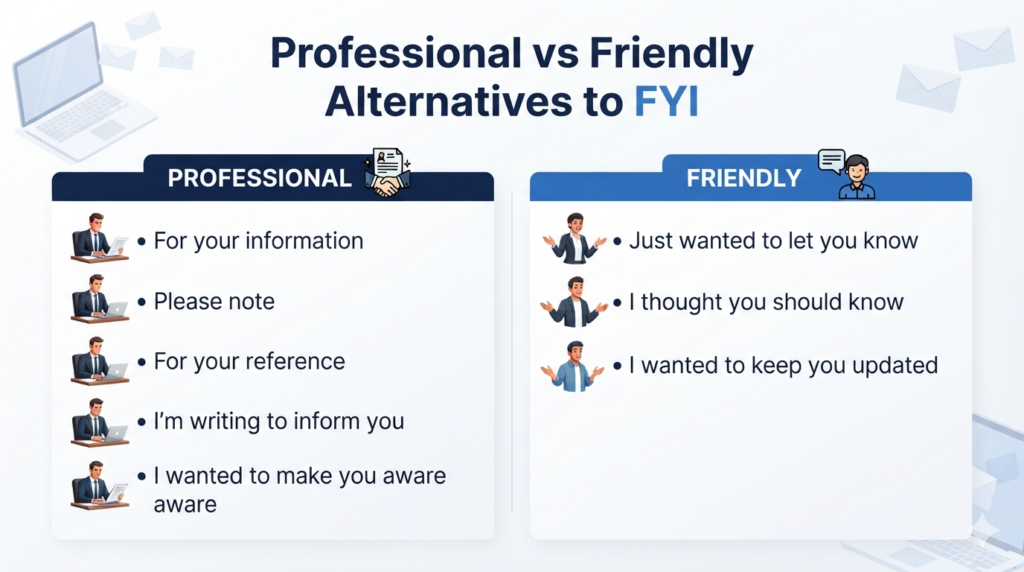
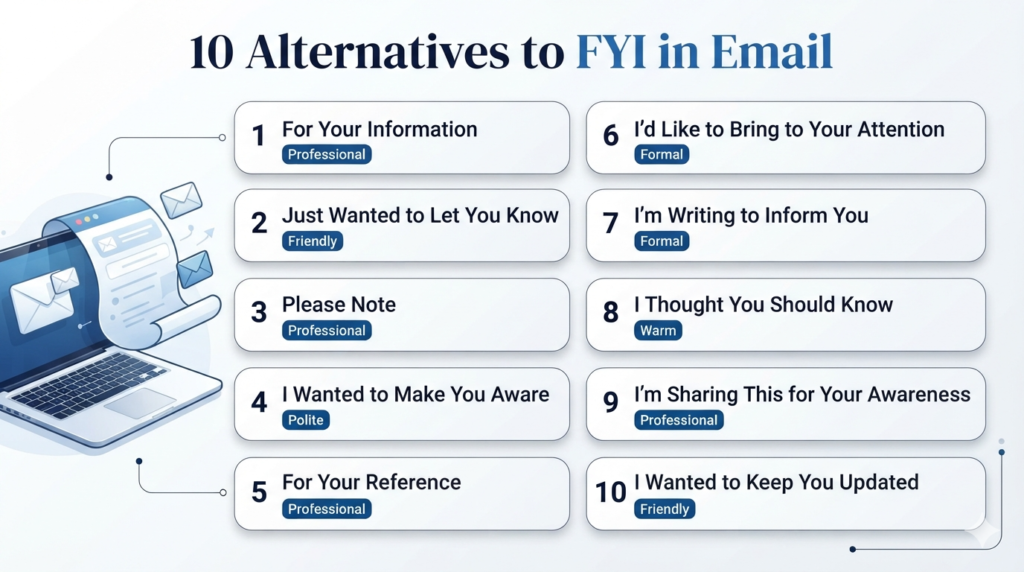
1. For Your Information
Meaning
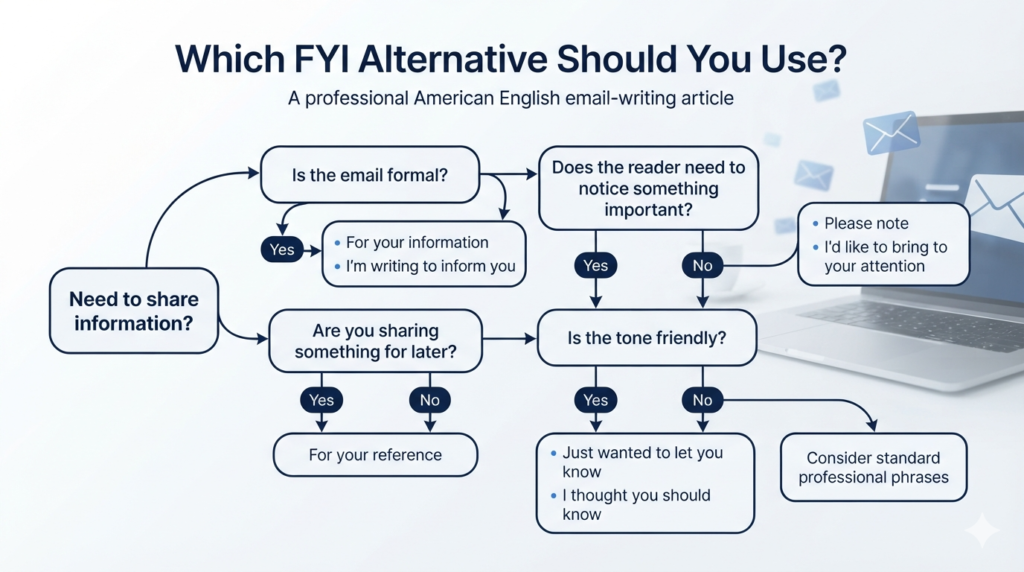
“For your information” is the most direct and formal alternative to FYI. It tells the recipient that you are providing information they may want or need to know.
It works particularly well when you want a professional tone without adding unnecessary explanation.
Best For
- Professional
- Formal
- Polite
Example 1
For your information, the updated project timeline is attached to this email.
Example 2
For your information, the office will be closed next Monday for the holiday.
Quick Tip
Use this phrase when you want a clear, neutral replacement for “FYI,” especially in formal business communication.
2. Just Wanted to Let You Know
Meaning
“Just wanted to let you know” sounds more personal and conversational than “for your information.” It is a natural choice when sharing an update without making the message feel stiff.
Best For
- Friendly
- Professional
- Casual
- Warm
Example 1
I just wanted to let you know that your application has moved to the next stage.
Example 2
I just wanted to let you know that the meeting location has changed to Room 204.
Quick Tip
This is an excellent choice when you communicate regularly with coworkers or people you already know.
3. Please Note
Meaning
“Please note” signals that the recipient should pay attention to a particular detail. Unlike FYI, it can imply that the information is especially important.
Best For
- Professional
- Formal
- Polite
Example 1
Please note that all expense reports must be submitted by Friday.
Example 2
Please note that the revised policy takes effect on September 1.
Quick Tip
Use “please note” when you want the reader to notice or remember something important.
4. I Wanted to Make You Aware
Meaning
“I wanted to make you aware” is a professional phrase that emphasizes that you are intentionally informing someone about a situation. It can sound more thoughtful than simply writing “FYI.”
Best For
- Professional
- Formal
- Polite
Example 1
I wanted to make you aware of a change to the client’s delivery schedule.
Example 2
I wanted to make you aware that the report contains updated sales figures.
Quick Tip
This phrase is especially useful when the information could affect the recipient’s work or decisions.
5. For Your Reference
Meaning
“For your reference” suggests that the information may be useful later. It is commonly used when attaching documents, records, instructions, or other resources.
Best For
- Professional
- Formal
- Polite
Example 1
For your reference, I have attached the signed agreement.
Example 2
For your reference, here is the presentation we discussed during yesterday’s meeting.
Quick Tip
Use this phrase when the recipient may need to consult the information again rather than act on it immediately.
6. I’d Like to Bring to Your Attention
Meaning
“I’d like to bring to your attention” is more deliberate and formal. It works when you want someone to notice a specific issue, update, concern, or development.
Best For
- Formal
- Professional
- Polite
Example 1
I’d like to bring to your attention a discrepancy in the latest invoice.
Example 2
I’d like to bring to your attention the updated requirements for the application.
Quick Tip
Because it sounds serious, reserve this expression for information that genuinely deserves attention.
7. I’m Writing to Inform You
Meaning
“I’m writing to inform you” clearly states the purpose of the email. It has a formal tone and is useful when communicating an official update or decision.
Best For
- Formal
- Professional
- Polite
Example 1
I’m writing to inform you that your request has been approved.
Example 2
I’m writing to inform you of a change to our billing procedures.
Quick Tip
Use this phrase for formal announcements rather than casual updates between coworkers.
8. I Thought You Should Know
Meaning
“I thought you should know” has a personal and considerate tone. It suggests that you are sharing information because you believe it could matter to the recipient.
Best For
- Friendly
- Warm
- Casual
- Polite
Example 1
I thought you should know that the client has approved the revised proposal.
Example 2
I thought you should know that the training session has been moved to Thursday.
Quick Tip
This expression works best when the information has a clear reason for being relevant to the reader.
9. I’m Sharing This for Your Awareness
Meaning
“I’m sharing this for your awareness” makes it clear that you are providing information without necessarily asking the recipient to take action.
It is especially useful for workplace updates where keeping someone informed is the main purpose.
Best For
- Professional
- Formal
- Polite
Example 1
I’m sharing this for your awareness as we prepare for the upcoming audit.
Example 2
I’m sharing this for your awareness in case the customer contacts you directly.
Quick Tip
Use this phrase when you want to distinguish between keeping someone informed and asking them to do something.
10. I Wanted to Keep You Updated
Meaning
“I wanted to keep you updated” is a warm and natural way to share new information. It suggests an ongoing conversation or project rather than a one-time announcement.
Best For
- Professional
- Friendly
- Warm
- Polite
Example 1
I wanted to keep you updated on our progress with the new website.
Example 2
I wanted to keep you updated on the status of your order.
Quick Tip
Choose this option when you have previously discussed the topic and are now providing a progress update.
Comparison Table
| Alternative | Best Used In | Tone |
| For Your Information | Formal emails, business communication | Formal, neutral |
| Just Wanted to Let You Know | Coworker and everyday emails | Friendly, warm |
| Please Note | Important instructions and details | Professional, direct |
| I Wanted to Make You Aware | Workplace updates and concerns | Professional, polite |
| For Your Reference | Attachments and useful resources | Formal, neutral |
| I’d Like to Bring to Your Attention | Important issues or developments | Formal, serious |
| I’m Writing to Inform You | Official announcements | Formal, professional |
| I Thought You Should Know | Personal or relevant updates | Warm, friendly |
| I’m Sharing This for Your Awareness | Workplace information | Professional, neutral |
| I Wanted to Keep You Updated | Ongoing projects and updates | Warm, professional |
Common Mistakes
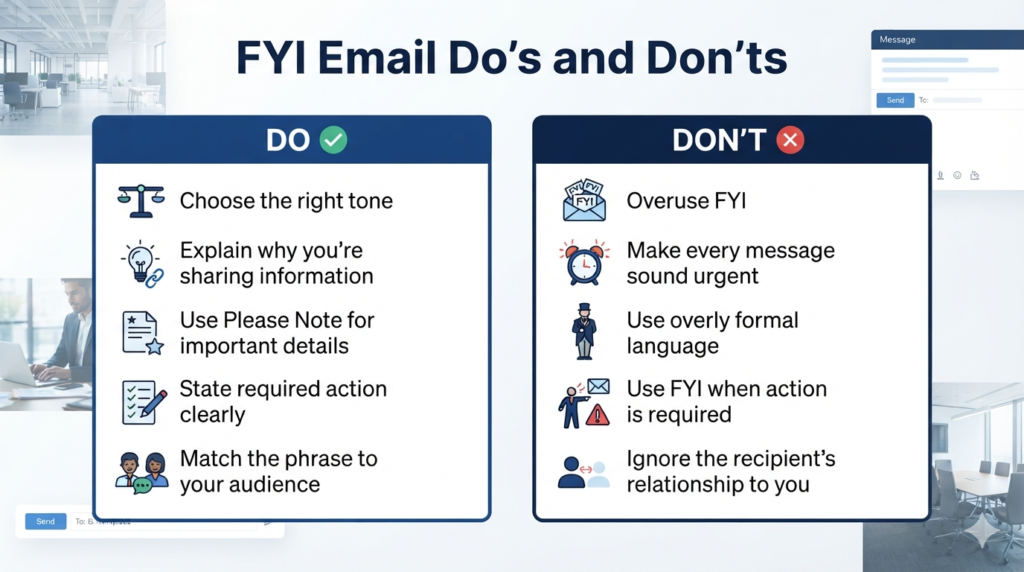
1. Using Casual Phrases in Formal Emails
“Just wanted to let you know” may sound too relaxed in certain official messages. For formal correspondence, “I’m writing to inform you” or “For your information” may be more appropriate.
2. Making Every Message Sound Urgent
“Please note” can draw attention to important information. However, using it for every minor update can make routine messages sound more serious than they are.
3. Adding an Alternative Without Explaining the Context
Simply replacing FYI with another phrase does not automatically improve an email. Make sure the wording matches the purpose of your message and the relationship with the recipient.
4. Using Overly Formal Language
Not every email needs formal business language. A simple message to a coworker may sound more natural with “I just wanted to let you know” than with “I’m writing to inform you.”
5. Using FYI When Action Is Required
FYI usually suggests that no action is necessary. If you need the recipient to respond or complete a task, say so clearly instead of relying on FYI.
For example, write “Please review the attached document and send me your feedback by Friday” rather than simply saying “FYI, the document is attached.”
Frequently Asked Questions
1. What is a professional way to say FYI in an email?
“For your information” is the closest professional alternative to FYI. Other strong choices include “Please note,” “I wanted to make you aware,” and “For your reference.” The best phrase depends on whether you are simply sharing information, highlighting an important detail, or providing something the recipient may need later.
2. What can I say instead of FYI in a formal email?
In a formal email, try “For your information,” “I’m writing to inform you,” or “I’d like to bring to your attention.” These expressions sound more polished than the abbreviation FYI and allow you to communicate the purpose of your message more clearly.
3. Is “for your information” rude?
No. “For your information” is generally neutral and professional. However, its tone can become negative if it is used to correct someone or emphasize information they should already know. When you want a warmer tone, “I just wanted to let you know” can be a better choice.
4. Is FYI appropriate in professional emails?
Yes, FYI is widely used in professional emails, particularly in informal workplace communication. Still, it may not be ideal for every audience. When writing to a client, executive, customer, or someone unfamiliar with your communication style, a complete phrase can sound more polished.
5. What is a friendly way to say FYI?
“I just wanted to let you know” is one of the friendliest alternatives. “I thought you should know” and “I wanted to keep you updated” also work well. These phrases feel conversational while still being appropriate for many workplace emails.
6. What is the best alternative to FYI when no action is required?
“For your information” and “For your reference” are strong choices when you do not need the recipient to take action. “I’m sharing this for your awareness” also makes the purpose clear when you simply want someone to stay informed.
7. What should I use instead of FYI when something is important?
“Please note” or “I’d like to bring to your attention” can work well when you want the recipient to focus on a specific detail. If the information requires action, however, state the requested action directly instead of relying on an FYI-style phrase.
8. Can I use “just wanted to let you know” in a business email?
Yes. “Just wanted to let you know” is common and natural in American business communication. It works especially well with coworkers, clients you know well, and other professional contacts where a friendly tone is appropriate.
Conclusion
Finding another way to say FYI in email can make your communication more precise and better suited to the situation. “For your information” is the closest formal replacement, while “just wanted to let you know” creates a warmer, more conversational tone.
For important details, “please note” signals that the reader should pay attention. If you are attaching something for later use, “for your reference” is more specific. Meanwhile, “I wanted to keep you updated” works naturally for ongoing projects and conversations.
The key is to choose the phrase based on your audience and purpose. FYI itself is not wrong, but a more specific expression can make your message clearer, more professional, and more natural.
When in doubt, focus on what you want the recipient to understand or do. Choosing the right professional email tone can also help ensure your message is appropriate for the situation.

Professional Writing & Workplace Communication Expert
Marcus Hale is a business communication specialist with 11 years of experience in corporate training and professional writing. He has worked with mid-sized companies and remote teams to improve clarity in emails, reports, performance reviews, and client-facing messages.
Marcus focuses on polished, professional alternatives that help readers sound confident without sounding stiff. His guides cover workplace phrases, resume language, leadership communication, and formal-to-natural transitions. He holds a background in business administration and technical writing, and has led workshops on effective professional English.
At LandmarkNewz, Marcus creates practical synonym lists and phrasing tips that professionals can apply immediately in emails, meetings, and career documents.