
“I feel” is one of the most common phrases in everyday English. It can introduce an emotion, personal opinion, physical sensation, or impression, which makes it useful in many situations.
However, repeating “I feel” too often can make your writing sound predictable. Choosing a more precise expression can help you communicate exactly what you mean while making your conversations, emails, essays, and professional writing more natural.
What Does “Another Way to Say I Feel” Mean?
The phrase “another way to say I feel” refers to alternative expressions you can use instead of “I feel.” The best replacement depends on what follows the phrase.
For example, “I feel that this plan will work” expresses an opinion, so “I believe this plan will work” is a natural alternative. On the other hand, “I feel nervous” describes an emotion, so “I’m feeling nervous” or “I’m experiencing anxiety” may work better.
“I feel” commonly appears in conversations, personal writing, workplace communication, essays, emails, and discussions. Using the right alternative adds variety and makes your meaning clearer.
Why Use Other Ways to Say “I Feel”?
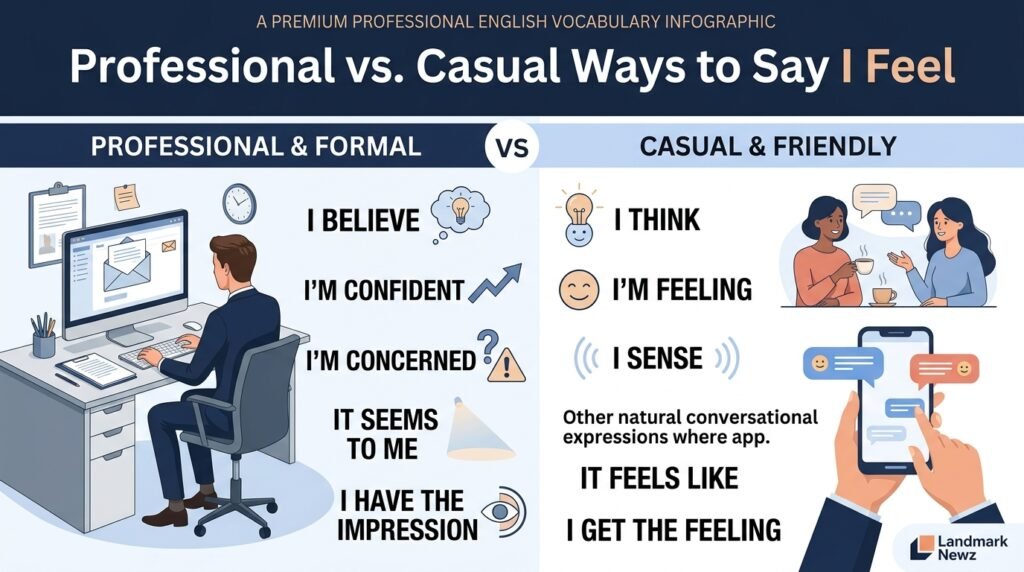
There are several good reasons to replace “I feel” when the context calls for something more specific:
- Avoid repetition: Different expressions make your writing less monotonous.
- Sound more natural: Some alternatives fit certain conversations better.
- Express meaning clearly: You can distinguish an opinion from an emotion or physical sensation.
- Improve professional communication: Precise wording can make workplace writing more polished.
- Match the tone: You can choose casual, warm, formal, or professional language.
- Strengthen your writing: Specific phrases can make your point more direct and confident.
10 Best Other Ways to Say “I Feel”
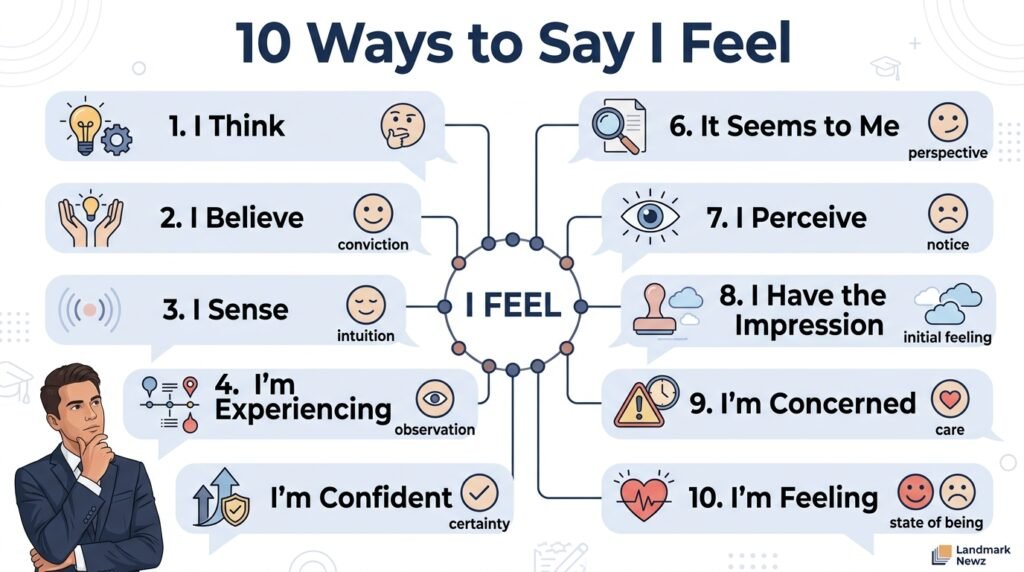
1. I Think
Meaning
“I think” is a simple and natural way to introduce a personal opinion, idea, or judgment. It is less suitable when you are specifically describing an emotion.
Best For
- Casual
- Friendly
- Professional
- Polite
Example 1
I think we should review the proposal before making a final decision.
Example 2
I think this restaurant would be a great choice for dinner.
Quick Tip
Use “I think” when you mean “this is my opinion,” rather than when describing an emotion.
2. I Believe
Meaning
“I believe” expresses an opinion or personal conviction with slightly more confidence than “I think.” It works especially well in professional, academic, and formal communication.
Best For
- Professional
- Formal
- Polite
Example 1
I believe this approach will give the team better results.
Example 2
I believe every customer deserves clear and respectful communication.
Quick Tip
Choose “I believe” when you want your statement to sound thoughtful and confident without being overly forceful.
3. I Sense
Meaning
“I sense” describes an impression or awareness that may come from observation, intuition, or subtle clues. It often suggests that you notice something without having complete proof.
Best For
- Formal
- Professional
- Warm
Example 1
I sense that the team is becoming more comfortable with the new process.
Example 2
I sense some hesitation in the room, so perhaps we should pause for questions.
Quick Tip
Use “I sense” when you are picking up on a mood, reaction, or situation rather than stating a firm fact.
4. I’m Experiencing
Meaning
“I’m experiencing” focuses on what you are currently going through or noticing. It works well for emotions, physical sensations, challenges, and personal situations.
Best For
- Professional
- Formal
- Polite
Example 1
I’m experiencing some difficulty adjusting to the new schedule.
Example 2
I’m experiencing a strong sense of excitement about the upcoming event.
Quick Tip
This phrase is useful when you want to describe an experience objectively instead of simply saying “I feel.”
5. I’m Confident
Meaning
“I’m confident” communicates strong belief or certainty about something. It is more assertive than “I think” and can make professional communication sound decisive.
Best For
- Professional
- Formal
Example 1
I’m confident that our team can complete the project on time.
Example 2
I’m confident this solution will address the customer’s main concern.
Quick Tip
Use this expression when you have a solid reason for your confidence and want to communicate assurance.
6. It Seems to Me
Meaning
“It seems to me” introduces a personal impression while leaving room for other viewpoints. It is a useful alternative when you want to sound thoughtful rather than overly certain.
Best For
- Professional
- Polite
- Formal
- Friendly
Example 1
It seems to me that the second option offers better long-term value.
Example 2
It seems to me that everyone would benefit from a little more preparation.
Quick Tip
Use this phrase when discussing an interpretation or observation and you want to acknowledge that your perspective may not be the only one.
7. I Perceive
Meaning
“I perceive” means that you understand, notice, or interpret something in a particular way. It is more formal than everyday alternatives and is best used selectively.
Best For
- Formal
- Professional
Example 1
I perceive a growing interest in sustainable products among our customers.
Example 2
I perceive the change as an opportunity to improve our current process.
Quick Tip
Because “I perceive” sounds formal, use it mainly in academic, professional, or analytical writing.
8. I Have the Impression
Meaning
“I have the impression” communicates a personal observation or belief without presenting it as an absolute fact. It is helpful when you want to express uncertainty politely.
Best For
- Formal
- Professional
- Polite
Example 1
I have the impression that the client would prefer a simpler design.
Example 2
I have the impression that we may need additional information before proceeding.
Quick Tip
This phrase is a good choice when you want to share an observation without sounding overly certain.
9. I’m Concerned
Meaning
“I’m concerned” is more specific than “I feel” when you want to communicate worry about a person, decision, situation, or possible outcome. It clearly signals that something deserves attention.
Best For
- Professional
- Formal
- Polite
- Warm
Example 1
I’m concerned that the current timeline may not give us enough time for testing.
Example 2
I’m concerned about the impact this change could have on our customers.
Quick Tip
Use “I’m concerned” when your feeling involves worry or caution rather than general emotion.
10. I’m Feeling
Meaning
“I’m feeling” is one of the closest everyday alternatives to “I feel” when talking about emotions or physical sensations. It sounds natural and personal in casual conversation.
Best For
- Casual
- Friendly
- Warm
Example 1
I’m feeling much more relaxed now that the presentation is finished.
Example 2
I’m feeling excited about spending the weekend with my family.
Quick Tip
Use “I’m feeling” for current emotions or sensations, especially in conversations and personal messages.
Comparison Table
| Alternative | Best Used In | Tone |
| I think | Everyday conversations, opinions | Casual, natural |
| I believe | Work, academic writing, opinions | Professional, confident |
| I sense | Impressions and observations | Thoughtful, subtle |
| I’m experiencing | Situations, emotions, sensations | Neutral, professional |
| I’m confident | Decisions and predictions | Assertive, professional |
| It seems to me | Personal observations | Polite, thoughtful |
| I perceive | Formal or analytical writing | Formal, precise |
| I have the impression | Uncertain observations | Polite, cautious |
| I’m concerned | Worries and potential problems | Serious, professional |
| I’m feeling | Current emotions and sensations | Casual, warm |
Common Mistakes
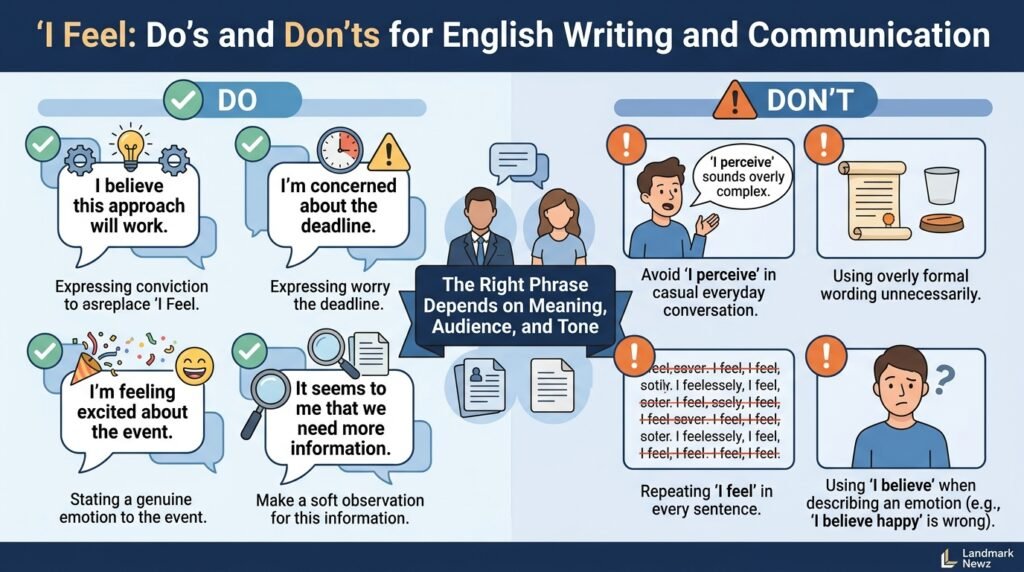
1. Using Casual Phrases in Professional Emails
Expressions such as “I’m feeling” may sound too personal in some workplace situations. When discussing an opinion or business judgment, “I believe” or “it seems to me” may be more appropriate.
2. Choosing Overly Formal Language
Not every situation needs sophisticated wording. Using “I perceive” in a casual conversation can sound unnatural when “I think” or “I sense” would communicate the idea more comfortably.
3. Repeating “I Feel” Too Often
Repeating the same phrase throughout an email, essay, or article can make the writing sound repetitive. Vary your wording when the meaning genuinely changes.
4. Forgetting Context
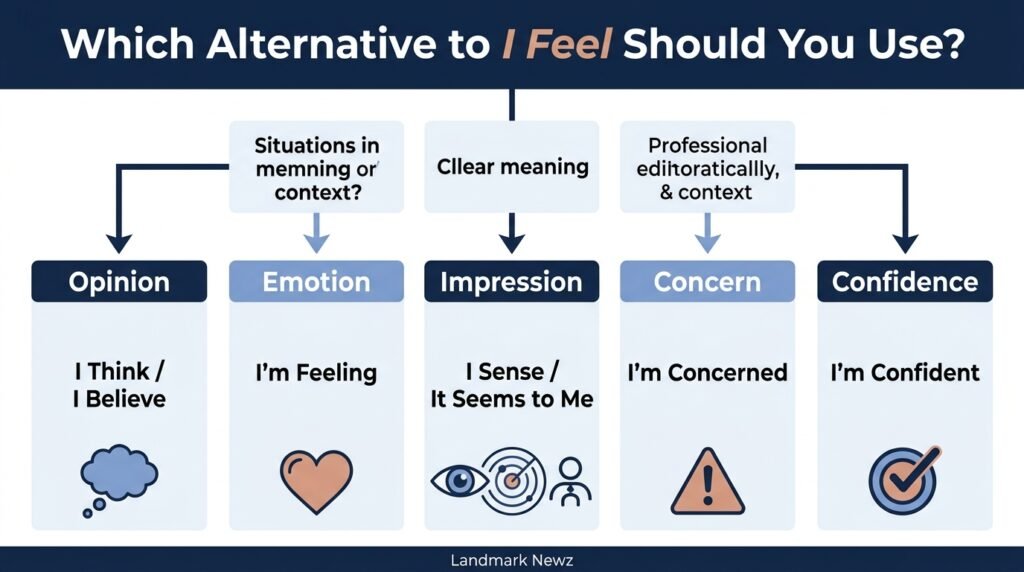
An alternative should match the meaning of the original sentence. “I believe” works for opinions, while “I’m concerned” communicates worry. They cannot always replace “I feel” interchangeably.
5. Sounding Insincere
Avoid choosing complicated phrases simply to sound more professional. Clear, honest language is usually more effective than wording that feels forced.
Frequently Asked Questions
What is a professional way to say “I feel”?
“I believe,” “I’m concerned,” “it seems to me,” and “I’m confident” can work well in professional communication. The best choice depends on your meaning. Use “I believe” for an opinion, “I’m concerned” for a worry, and “I’m confident” when you want to express strong assurance.
What can I say instead of “I feel” in an essay?
For an essay, consider “I believe,” “I argue,” “it seems,” or “this suggests,” depending on the sentence. Academic writing often benefits from reducing unnecessary first-person language. However, when the assignment asks for your personal viewpoint, phrases such as “I believe” can clearly introduce your position.
What is another way to say “I feel” when expressing an opinion?
“I think,” “I believe,” and “it seems to me” are natural alternatives for opinions. “I think” sounds conversational, while “I believe” sounds more confident and professional. “It seems to me” is useful when you want to present your view without making it sound absolute.
What is another way to say “I feel” in a professional email?
“I believe,” “I’m concerned,” “I’m confident,” and “it seems to me” are strong choices. For example, instead of writing “I feel we should revise the plan,” you could write “I believe we should revise the plan.” This sounds direct while remaining respectful.
How can I say “I feel happy” differently?
You can say “I’m feeling happy,” “I’m delighted,” “I’m pleased,” “I’m in a good mood,” or “I’m thrilled,” depending on the situation. Each expression has a slightly different level of emotion. “I’m pleased” is professional, while “I’m thrilled” sounds much more enthusiastic.
What is a formal synonym for “I feel”?
“I believe,” “I perceive,” and “I have the impression” can provide more formal alternatives. However, the correct choice depends on what “I feel” means in your sentence. “I believe” indicates an opinion, while “I perceive” focuses more on how you interpret or understand something.
Is “I think” the same as “I feel”?
Not always. “I think” usually introduces an opinion or judgment, while “I feel” can describe an emotion, sensation, or personal opinion. For example, “I think the plan is effective” gives an opinion, while “I feel nervous” describes an emotional state.
How do I avoid repeating “I feel” in writing?
First, identify what “I feel” means in each sentence. Replace it with a more precise phrase, such as “I believe” for an opinion, “I’m concerned” for worry, “I sense” for an impression, or “I’m experiencing” for something you are currently going through.
Conclusion
Finding another way to say “I feel” is not simply about replacing one phrase with another. The best alternative depends on whether you are expressing an opinion, emotion, concern, impression, or physical experience. Exploring synonyms for “feel” can help you choose a more precise expression.
For everyday opinions, “I think” is simple and natural. In professional writing, “I believe,” “it seems to me,” or “I’m confident” can sound more polished. When describing emotions, “I’m feeling” is often the most natural choice, while “I’m concerned” clearly communicates worry.
The key is to choose words that match your exact meaning and the audience you are addressing. Rather than forcing a synonym into every sentence, use alternatives when they make your communication clearer, more precise, or more natural.

About Dr. Priya Nair
Dr. Priya Nair is a passionate Writer & Blogger at LandMarkNewz.com, dedicated to creating informative, engaging, and easy-to-understand content for readers. With a strong interest in research, current trends, lifestyle, and everyday topics, she focuses on presenting useful information in a clear and reader-friendly way.
Through her writing, Priya aims to help readers discover valuable insights, understand complex topics more easily, and stay informed about subjects that matter to them. Her approach combines thoughtful research with a simple and engaging writing style.
At LandMarkNewz.com, she contributes original articles designed to inform, educate, and provide practical value to readers.