
“I would like to” is one of the most useful phrases in English when you want to express a request, preference, intention, or desire politely. If you are looking for another way to say “I would like to,” several natural alternatives can make your writing more precise while keeping the right tone.
However, using the same phrase repeatedly can make your communication sound repetitive. Fortunately, there are several natural alternatives that can make your writing more precise while keeping the right tone.
What Does “Another Way to Say I Would Like to” Mean?
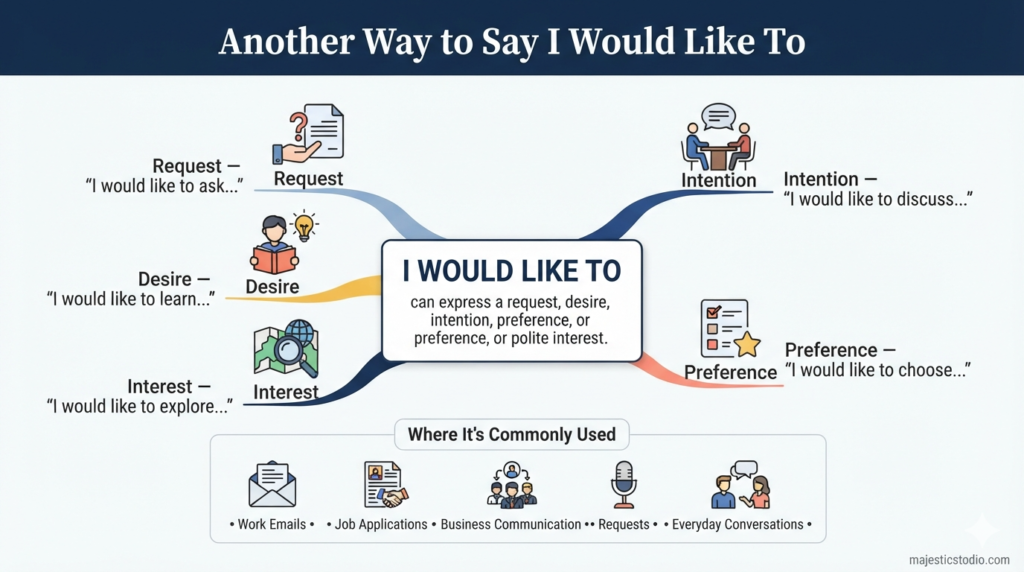
The phrase “another way to say I would like to” refers to alternative expressions that communicate a desire, intention, request, or preference without using the exact words “I would like to.”
For example, instead of writing, “I would like to discuss the proposal,” you could say, “I am interested in discussing the proposal” or “I am hoping to discuss the proposal.”
“I would like to” is common because it sounds polite without being overly formal. You may see it in professional emails, customer service messages, job applications, invitations, requests, and everyday conversations.
Why Use Other Ways to Say “I Would Like to”?
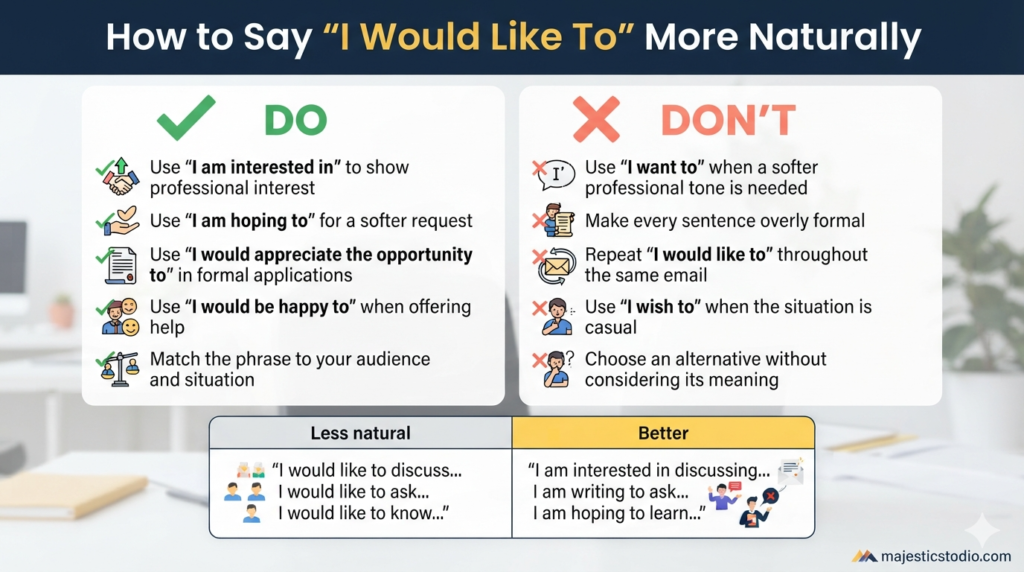
Choosing a different expression can help your message sound more natural and better suited to the situation.
Other phrases can help you:
- Avoid repeating the same wording.
- Make professional emails sound more polished.
- Show a specific level of interest or intention.
- Make requests sound warmer and less demanding.
- Adjust your language for formal or casual situations.
- Communicate your purpose more clearly.
The best alternative depends on what you actually mean. A phrase expressing interest may not be the best choice when you are making a direct request.
10 Best Other Ways to Say “I Would Like to”
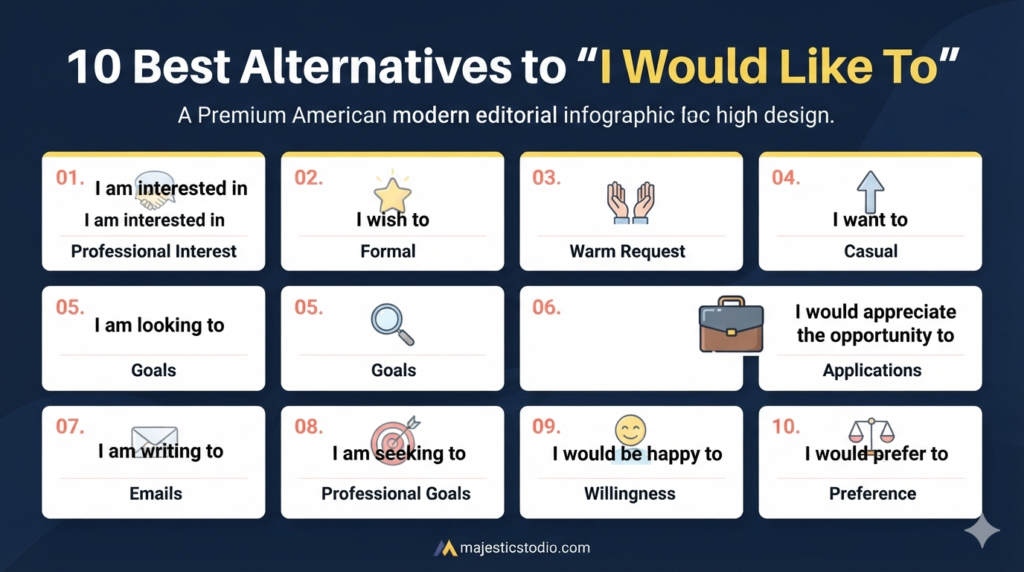
1. I Am Interested in
Meaning
“I am interested in” expresses genuine curiosity, attention, or desire toward something. It is especially useful when discussing opportunities, projects, positions, services, or future plans.
Best For
- Professional
- Formal
- Polite
Example 1
I am interested in learning more about the marketing position.
Example 2
I am interested in discussing how we can improve the customer experience.
Quick Tip
Use this phrase when you want to emphasize interest rather than make a direct request.
2. I Wish to
Meaning
“I wish to” is a formal and direct alternative to “I would like to.” It clearly communicates your intention and works particularly well in formal letters, official correspondence, and business communication.
Best For
- Formal
- Professional
- Polite
Example 1
I wish to request additional information about the application process.
Example 2
I wish to confirm that we received your documents.
Quick Tip
Because it sounds formal, use “I wish to” selectively in everyday workplace conversations.
3. I Am Hoping to
Meaning
“I am hoping to” communicates an intention or desire in a softer, more conversational way. It can make a request feel less forceful while still making your goal clear.
Best For
- Professional
- Friendly
- Warm
- Polite
Example 1
I am hoping to schedule a meeting with you next week.
Example 2
I am hoping to hear from you once you have reviewed the proposal.
Quick Tip
Choose this phrase when you want your request to sound friendly and approachable.
4. I Want to
Meaning
“I want to” is the simplest and most direct alternative. It clearly expresses what you desire or intend to do, but it is less formal than “I would like to.”
Best For
- Casual
- Friendly
Example 1
I want to learn more about your photography services.
Example 2
I want to thank everyone who helped with the event.
Quick Tip
Use it freely in casual communication, but consider a softer phrase for formal requests or business emails.
5. I Am Looking to
Meaning
“I am looking to” expresses an intention to find, pursue, or accomplish something. It is common in professional and conversational American English.
Best For
- Professional
- Casual
- Friendly
Example 1
I am looking to expand my skills in project management.
Example 2
We are looking to partner with a local business for the upcoming campaign.
Quick Tip
This phrase works especially well when discussing goals, opportunities, services, or partnerships.
6. I Would Appreciate the Opportunity to
Meaning
“I would appreciate the opportunity to” is a polite and professional way to express a desire for a chance to do something. It also communicates appreciation, making it useful for applications and professional requests.
Best For
- Professional
- Formal
- Polite
Example 1
I would appreciate the opportunity to discuss my qualifications further.
Example 2
I would appreciate the opportunity to contribute to your upcoming project.
Quick Tip
This is an excellent choice for cover letters, job applications, and networking emails.
7. I Am Writing to
Meaning
“I am writing to” focuses on the purpose of your message rather than simply expressing what you want. It is a natural opening for professional emails and formal correspondence.
Best For
- Professional
- Formal
- Polite
Example 1
I am writing to inquire about the status of my application.
Example 2
I am writing to request a copy of the updated contract.
Quick Tip
Use this phrase when you want to introduce the specific reason for contacting someone.
8. I Am Seeking to
Meaning
“I am seeking to” expresses a clear goal or intention. It has a professional tone and is particularly effective when describing career objectives, business goals, or efforts to achieve a specific result.
Best For
- Professional
- Formal
Example 1
I am seeking to develop stronger leadership skills through this program.
Example 2
Our company is seeking to establish long-term relationships with reliable suppliers.
Quick Tip
Use it when you want your language to sound purposeful and goal-oriented.
9. I Would Be Happy to
Meaning
“I would be happy to” expresses willingness rather than simply desire. It makes an offer sound positive, cooperative, and friendly.
Best For
- Professional
- Friendly
- Warm
- Polite
Example 1
I would be happy to provide additional details if needed.
Example 2
I would be happy to meet with your team and answer any questions.
Quick Tip
Use this phrase when you are offering to do something, rather than merely asking to do it.
10. I Would Prefer to
Meaning
“I would prefer to” communicates a choice or preference between options. It is more specific than “I would like to” when you want to explain what you favor.
Best For
- Professional
- Formal
- Polite
Example 1
I would prefer to discuss the matter privately.
Example 2
I would prefer to receive the documents by email.
Quick Tip
Use this expression when your main purpose is to communicate a preference, not simply a desire.
Comparison Table
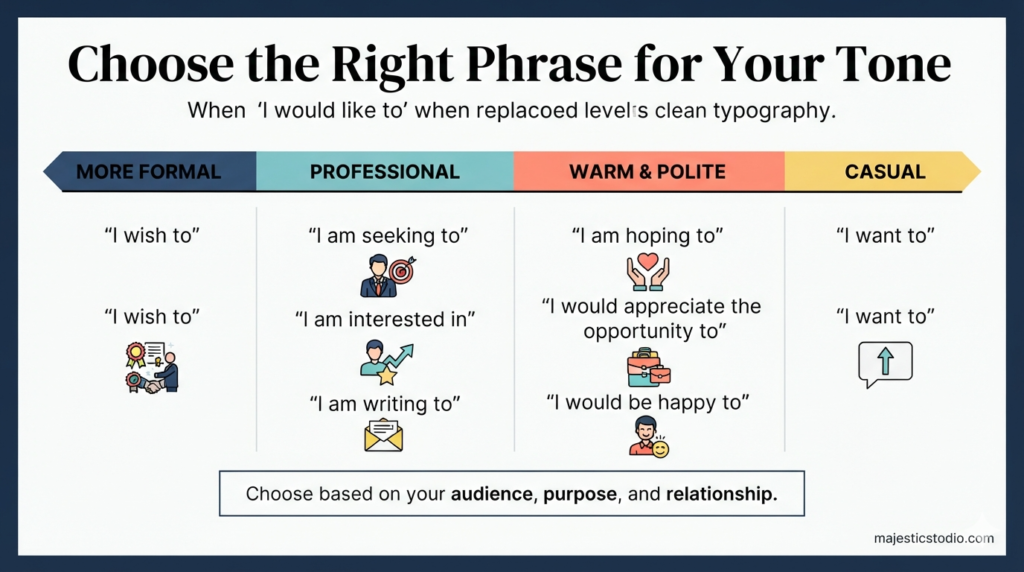
| Alternative | Best Used In | Tone |
| I am interested in | Work, networking, opportunities | Professional |
| I wish to | Formal letters, official requests | Formal |
| I am hoping to | Emails, requests, conversations | Warm and polite |
| I want to | Everyday conversations | Casual |
| I am looking to | Career, business, goals | Professional and natural |
| I would appreciate the opportunity to | Applications, networking | Formal and polite |
| I am writing to | Emails and formal correspondence | Professional |
| I am seeking to | Career and business goals | Formal and purposeful |
| I would be happy to | Offers and cooperation | Warm and friendly |
| I would prefer to | Choices and preferences | Polite and direct |
Common Mistakes
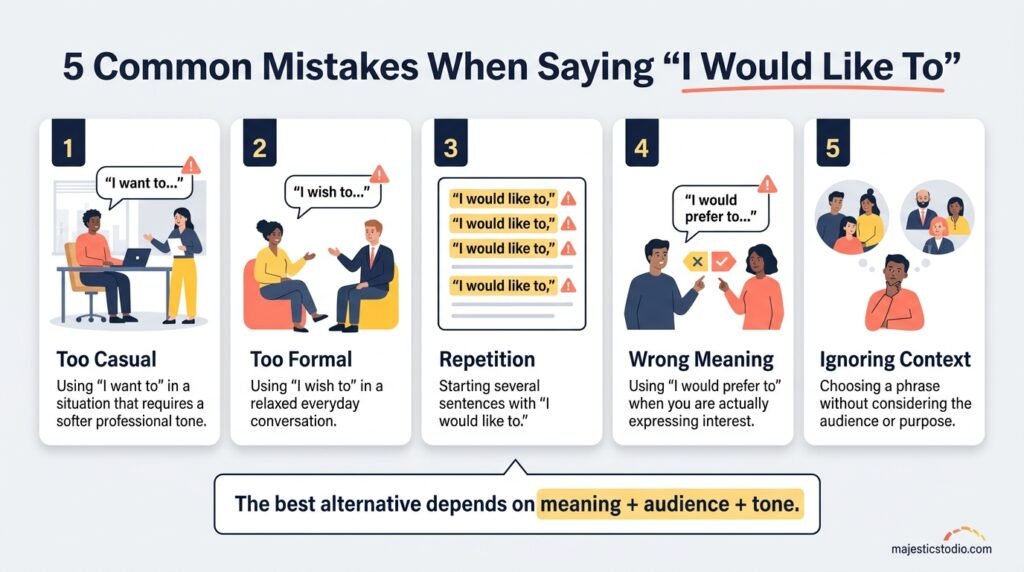
1. Using Casual Phrases in Formal Emails
“I want to” is perfectly natural in conversation, but it can sound too direct in some professional situations. Consider “I am interested in” or “I would appreciate the opportunity to” when communicating formally.
2. Making Every Sentence Sound Formal
Not every message needs phrases such as “I wish to” or “I am seeking to.” Overly formal wording can make a simple email sound stiff or unnatural.
3. Repeating “I Would Like to”
Using “I would like to” once or twice is completely fine. However, repeating it throughout an email can make your writing feel mechanical, so vary your wording when appropriate.
4. Forgetting the Context
Each alternative has a slightly different meaning. “I would prefer to” expresses a preference, while “I would be happy to” expresses willingness, so they should not be treated as exact substitutes.
5. Sounding Insincere
Choose wording that reflects what you genuinely mean. For example, “I am excited to” may sound inappropriate if you simply want to make a routine business request.
Frequently Asked Questions
What is another way to say “I would like to” professionally?
Professional alternatives include “I am interested in,” “I am hoping to,” “I am looking to,” and “I would appreciate the opportunity to.” The best choice depends on your purpose. For example, use “I am interested in” to show interest and “I would appreciate the opportunity to” when requesting a chance to do something.
What is a formal way to say “I would like to”?
“I wish to” is one of the most formal alternatives. “I am seeking to” can also work well when describing a professional goal or intention. For formal requests, “I am writing to request” is often clearer because it immediately explains why you are contacting someone.
What is a polite way to say “I would like to”?
“I am hoping to” and “I would appreciate the opportunity to” are both polite choices. “I am hoping to” sounds softer and more conversational, while “I would appreciate the opportunity to” sounds more professional and is especially useful in applications, business emails, and networking messages.
Can I use “I want to” instead of “I would like to”?
Yes. “I want to” is grammatically correct and very common in everyday American English. However, it can sound more direct. In professional situations, especially when making a request, “I am hoping to” or “I am interested in” may sound more tactful.
What can I say instead of “I would like to request”?
You can say “I am writing to request,” “I wish to request,” or “I would appreciate” depending on the situation. “I am writing to request” is particularly natural in professional emails because it clearly states the purpose of your message without unnecessary wording.
Is “I am interested in” the same as “I would like to”?
Not exactly. “I am interested in” focuses on curiosity, attention, or willingness to explore something. “I would like to” is broader and can express a request, intention, preference, or desire. Choose “I am interested in” when showing genuine interest in an opportunity or subject.
What is a good alternative to “I would like to” in an email?
“I am writing to” is an excellent choice when opening a professional email. For example, instead of “I would like to ask about the position,” you can write, “I am writing to inquire about the position.” Other options include “I am hoping to” and “I would appreciate the opportunity to.”
How can I sound less repetitive than “I would like to”?
Vary the phrase according to its meaning. Use “I am interested in” for interest, “I am hoping to” for a gentle intention, “I would be happy to” for an offer, and “I would prefer to” for a choice. This makes your writing more natural without forcing unnecessary synonyms.
Conclusion
There are many natural ways to say “I would like to,” but the best alternative depends on what you want to communicate. For professional situations, “I am interested in,” “I am writing to,” and “I would appreciate the opportunity to” are strong choices. For formal communication, “I wish to” and “I am seeking to” can work well. If you want a warmer tone, “I am hoping to” or “I would be happy to” may sound more natural.
For everyday conversations, “I want to” is simple and direct. Meanwhile, “I would prefer to” is better when expressing a specific choice. “The key is not to replace “I would like to” every time, but to choose wording that accurately matches your meaning, audience, and tone. For more guidance on choosing clear and appropriate wording, see how to write a professional email.”

Professional Writing & Workplace Communication Expert
Marcus Hale is a business communication specialist with 11 years of experience in corporate training and professional writing. He has worked with mid-sized companies and remote teams to improve clarity in emails, reports, performance reviews, and client-facing messages.
Marcus focuses on polished, professional alternatives that help readers sound confident without sounding stiff. His guides cover workplace phrases, resume language, leadership communication, and formal-to-natural transitions. He holds a background in business administration and technical writing, and has led workshops on effective professional English.
At LandmarkNewz, Marcus creates practical synonym lists and phrasing tips that professionals can apply immediately in emails, meetings, and career documents.