

Whether you are applying for a job, responding to an opportunity, contacting a potential client, or reaching out to a professional connection, the phrase “express my interest” is useful but can become repetitive.
Fortunately, you have several natural alternatives. The right choice can make your email, cover letter, LinkedIn message, or business communication sound more confident and appropriate for the situation.
What Does “Another Way to Say Express My Interest” Mean?
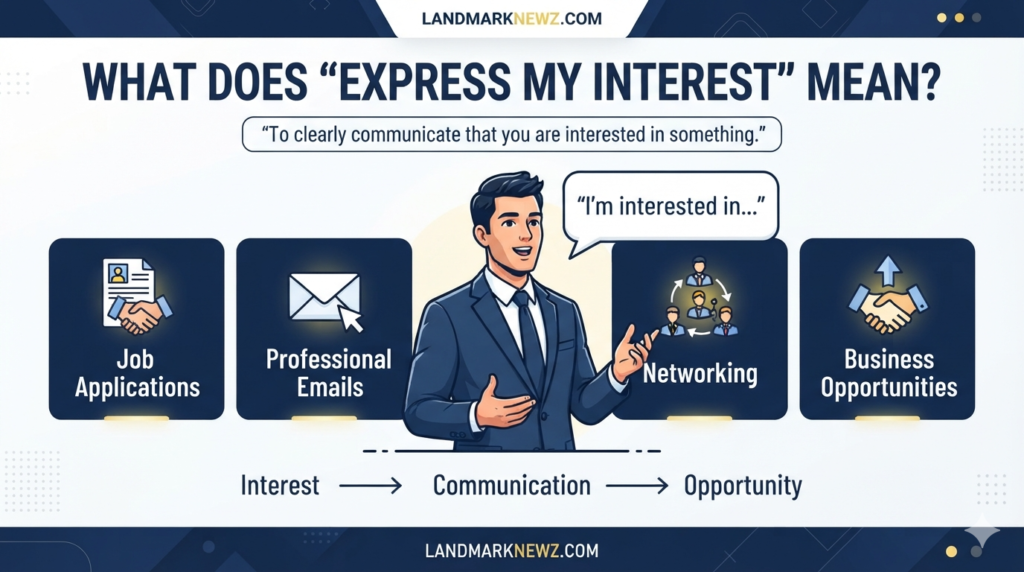
“Express my interest” means to communicate or show that you are interested in something. It is commonly used when discussing job opportunities, business proposals, volunteer positions, academic programs, collaborations, and other opportunities.
For example, you might write, “I am writing to express my interest in the marketing position.” The sentence tells the reader directly that you want to be considered for the opportunity.
People often look for another way to say “express my interest” because they want to avoid repetition, make their writing sound more natural, or choose wording that better matches a formal or conversational setting.
Why Use Other Ways to Say “Express My Interest”?
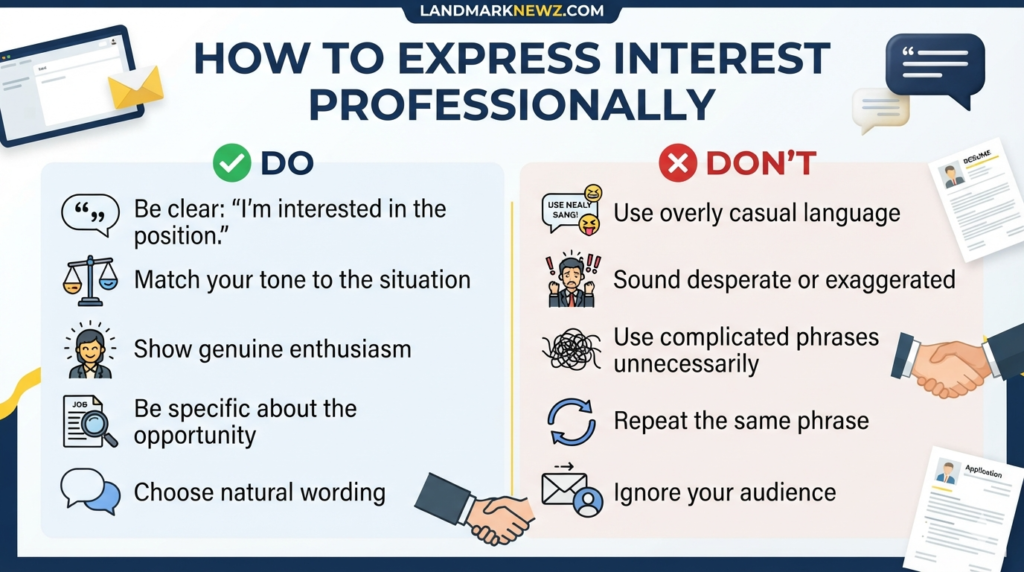
Using different expressions can make your communication more polished without changing its meaning.
Consider an alternative when you want to:
- Avoid repeating the same phrase in emails or applications.
- Make your writing sound more natural and confident.
- Match the tone to a formal or casual situation.
- Create stronger wording for a cover letter or professional message.
- Clearly communicate enthusiasm about an opportunity.
- Make your language more personal instead of formulaic.
The key is to choose an expression that fits the context. Not every synonym sounds equally natural in every situation.
10 Best Other Ways to Say “Express My Interest”
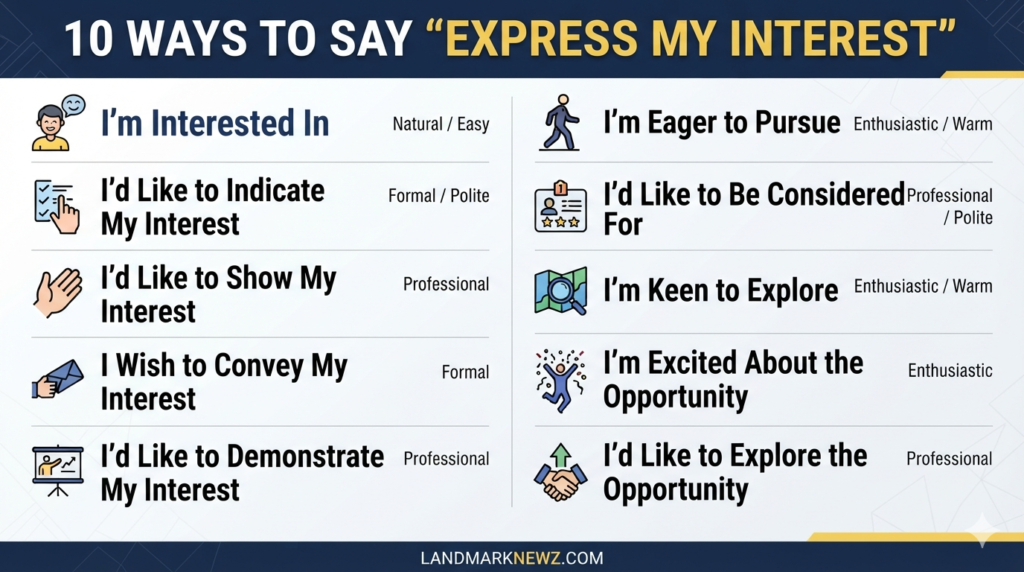
1. I’m Interested In
Meaning
“I’m interested in” is one of the simplest and most natural alternatives. It clearly tells the reader that you want to learn more about, participate in, or pursue something.
Best For
- Professional
- Casual
- Friendly
- Polite
Example 1
“I’m interested in learning more about the project manager position.”
Example 2
“I’m interested in discussing how we might work together on this project.”
Quick Tip
Use this phrase when you want your writing to sound direct and conversational rather than overly formal.
2. I’d Like to Indicate My Interest
Meaning
“I’d like to indicate my interest” communicates the same basic idea in a more formal way. It works particularly well when you want to sound respectful and professional.
Best For
- Professional
- Formal
- Polite
Example 1
“I’d like to indicate my interest in the open communications position.”
Example 2
“I’d like to indicate my interest in participating in the upcoming leadership program.”
Quick Tip
This phrase is useful in formal correspondence, but avoid using it repeatedly in the same document.
3. I’d Like to Show My Interest
Meaning
“I’d like to show my interest” emphasizes that you want to make your interest clear. It sounds approachable while remaining suitable for many professional situations.
Best For
- Professional
- Friendly
- Polite
Example 1
“I’d like to show my interest in joining your volunteer team.”
Example 2
“I’d like to show my interest in the partnership opportunity you recently announced.”
Quick Tip
Use this option when you want a warmer tone than “indicate my interest.”
4. I Wish to Convey My Interest
Meaning
“I wish to convey my interest” is a formal alternative that focuses on communicating your interest clearly. It is more polished and traditional than everyday phrases such as “I’m interested in.”
Best For
- Formal
- Professional
- Polite
Example 1
“I wish to convey my interest in the research fellowship advertised on your website.”
Example 2
“I wish to convey my interest in discussing potential opportunities with your organization.”
Quick Tip
This wording is best reserved for formal letters and professional correspondence where a more traditional tone is appropriate.
5. I’d Like to Demonstrate My Interest
Meaning
“I’d like to demonstrate my interest” suggests that you plan to show your interest through your actions, qualifications, experience, or involvement. It can sound stronger than simply stating that you are interested.
Best For
- Professional
- Formal
- Polite
Example 1
“I’d like to demonstrate my interest in the role by sharing my experience in customer relations.”
Example 2
“I’d like to demonstrate my interest in the program through my previous community service work.”
Quick Tip
Choose this phrase when you can support your stated interest with specific experience or actions.
6. I’m Eager to Pursue
Meaning
“I’m eager to pursue” communicates both interest and enthusiasm. It is especially useful when you want to show that you are serious about an opportunity rather than merely curious about it.
Best For
- Professional
- Warm
- Friendly
Example 1
“I’m eager to pursue the opportunity to join your product development team.”
Example 2
“I’m eager to pursue further opportunities in nonprofit communications.”
Quick Tip
Use “eager” when you genuinely feel enthusiastic, but avoid it when a neutral tone is more appropriate.
7. I’d Like to Be Considered for
Meaning
“I’d like to be considered for” is an excellent choice when you want someone to evaluate you for a specific opportunity. It is especially common in job applications and professional requests.
Best For
- Professional
- Formal
- Polite
Example 1
“I’d like to be considered for the senior account executive position.”
Example 2
“I’d like to be considered for a role on the community outreach team.”
Quick Tip
Use this phrase when your goal is not just to express interest but also to ask for consideration.
8. I’m Keen to Explore
Meaning
“I’m keen to explore” expresses interest in learning about or pursuing a possibility. It works well when the opportunity is still developing or when you want to discuss potential options.
Best For
- Professional
- Friendly
- Warm
Example 1
“I’m keen to explore opportunities to collaborate with your design team.”
Example 2
“I’m keen to explore how our companies could support one another.”
Quick Tip
This phrase is useful for networking and collaboration because it expresses interest without sounding overly demanding.
9. I’m Excited About the Opportunity
Meaning
“I’m excited about the opportunity” communicates strong enthusiasm in a warm and personal way. It is particularly effective when you genuinely want the position, project, or experience.
Best For
- Professional
- Warm
- Friendly
Example 1
“I’m excited about the opportunity to contribute to your customer success team.”
Example 2
“I’m excited about the opportunity to bring my event-planning experience to the organization.”
Quick Tip
This phrase is more enthusiastic than “I’m interested in,” so use it when you want to show genuine excitement.
10. I’d Like to Explore the Opportunity
Meaning
“I’d like to explore the opportunity” communicates interest while leaving room for further discussion. It is useful when you want to learn more before making a firm commitment.
Best For
- Professional
- Friendly
- Polite
Example 1
“I’d like to explore the opportunity to work with your consulting team.”
Example 2
“I’d like to explore the possibility of contributing to your upcoming initiative.”
Quick Tip
Choose this wording when you are interested but still want more information before deciding.
Comparison Table
| Alternative | Best Used In | Tone |
| I’m Interested In | Emails, conversations, applications | Direct, natural |
| I’d Like to Indicate My Interest | Formal letters, business communication | Formal, polite |
| I’d Like to Show My Interest | Professional messages, networking | Warm, approachable |
| I Wish to Convey My Interest | Formal correspondence | Formal, respectful |
| I’d Like to Demonstrate My Interest | Applications, professional statements | Professional, confident |
| I’m Eager to Pursue | Job applications, opportunities | Enthusiastic, professional |
| I’d Like to Be Considered for | Job applications, selections | Formal, direct |
| I’m Keen to Explore | Networking, collaborations | Warm, professional |
| I’m Excited About the Opportunity | Interviews, applications, follow-ups | Enthusiastic, warm |
| I’d Like to Explore the Opportunity | Business discussions, networking | Polite, open |
Common Mistakes
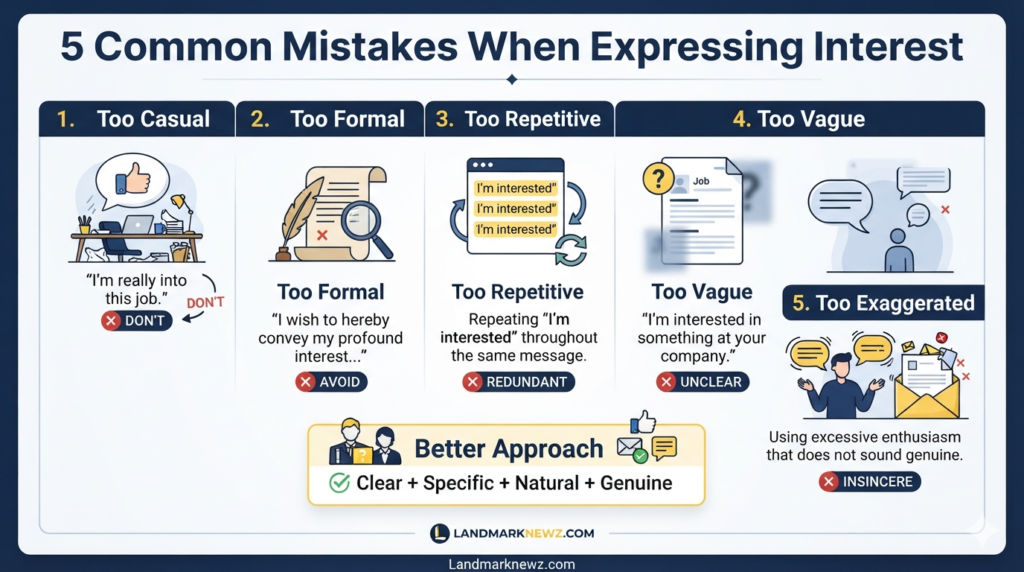
1. Using Casual Phrases in Professional Emails
Phrases such as “I’m really into this” may sound too casual for a hiring manager or business contact. Choose professional wording when communicating in a formal setting.
2. Choosing Overly Formal Language
Formal does not always mean better. Expressions such as “I wish to convey my interest” may sound stiff in a casual networking conversation, where “I’m interested in” would feel more natural.
3. Repeating the Same Phrase
Using “express my interest” several times can make a cover letter or email sound mechanical. Vary your wording only when the alternatives fit naturally.
4. Forgetting the Context
Your goal matters. If you want a job, “I’d like to be considered for” is more specific than simply saying “I’m interested in.”
5. Sounding Insincere
Avoid strong phrases such as “I’m extremely excited” unless your message supports that enthusiasm. Specific details about why you are interested often sound more convincing than exaggerated language.
Frequently Asked Questions
What is another way to say “express my interest”?
Common alternatives include “I’m interested in,” “I’d like to show my interest,” “I’d like to indicate my interest,” and “I’d like to be considered for.” The best option depends on the context. For most everyday professional emails, “I’m interested in” is clear, natural, and easy to understand.
What is a professional way to say “express my interest”?
A professional option is “I’d like to indicate my interest in…” Another strong choice is “I’d like to be considered for…” when you are applying for a specific position or opportunity. For general business communication, “I’m interested in discussing…” sounds professional without being unnecessarily formal.
How do I say “express my interest” in a job application?
You can write, “I’m interested in the position,” “I’d like to be considered for the position,” or “I’m eager to pursue this opportunity.” If you are writing a cover letter, briefly explain why the role interests you and connect that interest to your relevant skills or experience.
Is “I’m interested in” professional?
Yes. “I’m interested in” is professional, natural, and widely used in American English. It works well in emails, interviews, networking conversations, and job applications. Its main advantage is simplicity: it communicates your point clearly without making the sentence sound overly formal.
What is a formal way to say “I’m interested”?
For formal writing, you can use “I’d like to indicate my interest,” “I wish to convey my interest,” or “I’d like to express my interest in.” However, formal wording should serve a purpose. If a simpler phrase communicates the same idea, it is often the stronger choice.
How can I express interest in a job without sounding desperate?
Focus on enthusiasm and qualifications rather than urgency. For example, say, “I’m interested in the position and believe my experience in project coordination would be a strong fit.” This approach shows genuine interest while keeping the tone confident and professional.
What is a good alternative to “I would like to express my interest”?
“I’d like to be considered for” is a strong alternative when applying for a position. If you are contacting someone about a broader opportunity, “I’d like to explore the opportunity” or “I’m interested in discussing the opportunity” may sound more natural.
Can I use these alternatives in an email?
Yes. Most of these expressions work well in professional emails. For a straightforward message, use “I’m interested in…” For a formal email, consider “I’d like to indicate my interest…” If you are asking to participate or apply, “I’d like to be considered for…” is more specific.
Conclusion
Finding another way to say “express my interest” can make your professional communication sound more natural, specific, and confident. The best phrase depends on what you want to communicate and who will read your message.
For everyday professional writing, “I’m interested in” is usually the safest choice because it is clear and natural. If you are applying for a position, “I’d like to be considered for” directly communicates your goal.
For formal correspondence, “I’d like to indicate my interest” or “I wish to convey my interest” may be appropriate. If you are contacting an employer about a potential opportunity, learning how to write a letter of interest can help you communicate your goals professionally.
If you want to emphasize enthusiasm, try “I’m eager to pursue” or “I’m excited about the opportunity.” Ultimately, strong communication is not about using the most complicated phrase—it is about choosing wording that accurately reflects your interest and fits the situation.

Language & Everyday Communication Specialist
Elena Voss is a language enthusiast and communication coach with over 9 years of experience helping people express themselves more naturally in English. She previously worked as an ESL instructor and corporate language trainer, guiding professionals and students on clearer everyday conversations, polite alternatives, and natural phrasing.
Elena specializes in practical synonym guides and “another way to say…” content that feels conversational rather than textbook. Her writing focuses on real-life situations — emails to friends, casual workplace chat, social media, and daily interactions. She believes the best language advice is simple, useful, and easy to remember.
When she’s not creating content for LandmarkNewz, Elena enjoys analyzing modern slang trends and testing new phrases in real conversations.