

The word lead is useful, but repeating it too often can make your writing sound flat. Choosing a more precise synonym can show exactly how someone influenced a team, handled a project, or moved an idea forward.
What Does “Another Way to Say Lead” Mean?
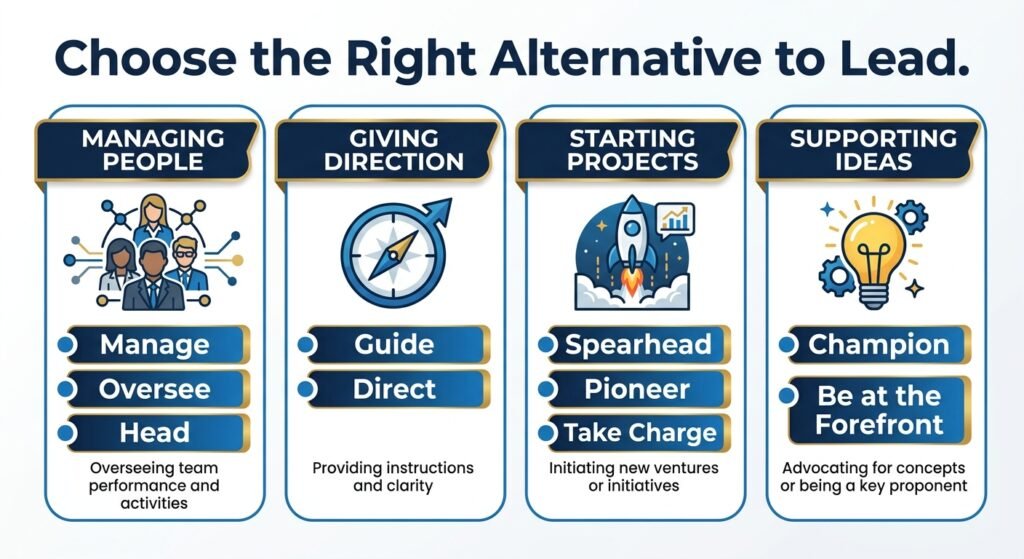
The phrase “another way to say lead” refers to alternative words or phrases that can replace lead while keeping a similar meaning.
The word lead has several meanings. It can describe guiding people, managing a team, directing an activity, taking responsibility for a project, or being the person who starts an important effort.
For example, you might say, “She led the marketing team,” but you could also say, “She managed the marketing team” or “She headed the marketing team.” The best choice depends on what you want to emphasize.
These alternatives are especially useful in resumes, cover letters, business writing, performance reviews, academic writing, emails, and everyday conversations.
Why Use Other Ways to Say “Lead”?
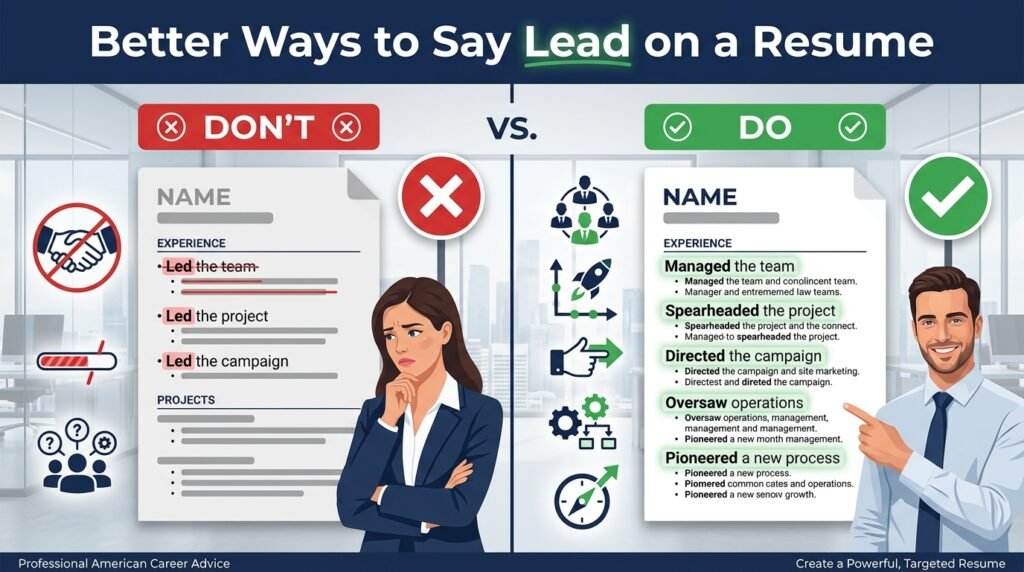
Using a synonym for lead is not just about avoiding repetition. A more specific word can make your writing clearer and show the exact type of leadership involved.
Consider these benefits:
- Avoid repetition: Prevent the same verb from appearing throughout a resume or article.
- Sound more precise: Choose a word that describes the person’s actual responsibility.
- Match the situation: Some alternatives sound better in professional, formal, or casual settings.
- Strengthen resumes: Specific action verbs can describe accomplishments more clearly.
- Show leadership style: Words such as guide, champion, and spearhead communicate different forms of leadership.
10 Best Other Ways to Say “Lead”
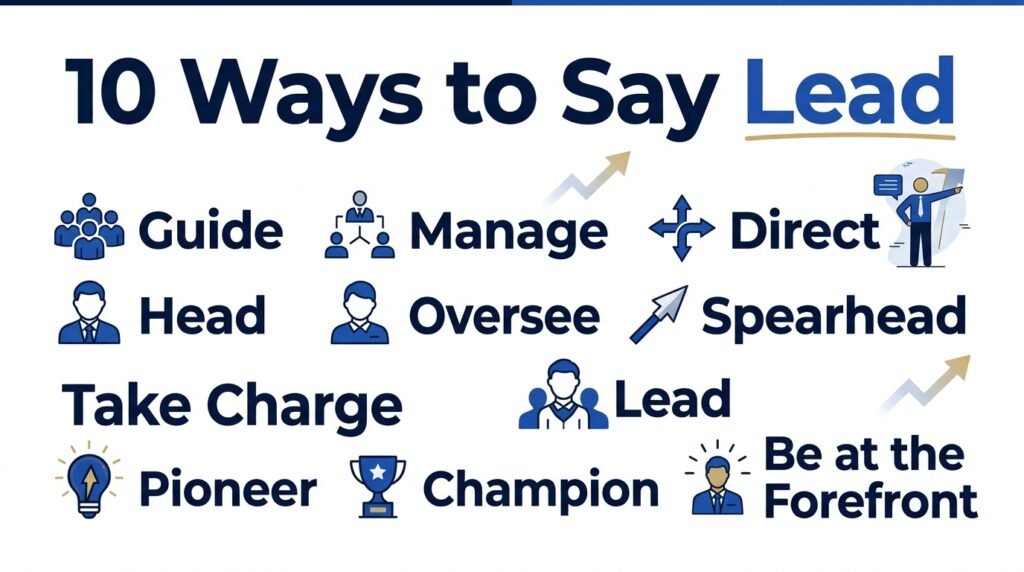
1. Guide
Meaning
Guide means to help someone or a group move in the right direction. Unlike lead, it often suggests support, advice, and direction rather than formal authority.
Best For
- Professional
- Friendly
- Warm
- Polite
Example 1
“Maria guided the new employees through their first month on the job.”
Example 2
“His experience helped guide the team toward a practical solution.”
Quick Tip
Use guide when you want to emphasize support and direction rather than control.
2. Manage
Meaning
Manage means to organize, supervise, and control people, tasks, resources, or operations. It is one of the strongest alternatives to lead in workplace and resume writing.
Best For
- Professional
- Formal
Example 1
“Jordan managed a team of 12 customer service representatives.”
Example 2
“She managed the project budget while keeping the team on schedule.”
Quick Tip
Choose manage when the person’s responsibilities included planning, organization, supervision, or resources.
3. Direct
Meaning
Direct means to give instructions or guide the actions of people or an organization. It sounds authoritative and focuses on decision-making and coordination.
Best For
- Professional
- Formal
Example 1
“The operations manager directed the staff during the facility upgrade.”
Example 2
“Alex directed the production team through a challenging deadline.”
Quick Tip
Use direct when someone had clear authority over decisions, activities, or personnel.
4. Head
Meaning
Head means to be the person in charge of a group, department, project, or organization. It often sounds natural and concise in professional English.
Best For
- Professional
- Formal
- Casual
Example 1
“Priya heads the company’s product development department.”
Example 2
“David headed the volunteer committee for two consecutive years.”
Quick Tip
Use head when the person holds a recognized position of responsibility.
5. Oversee
Meaning
Oversee means to supervise work and make sure that activities are completed correctly. It usually suggests responsibility for the overall process rather than handling every task personally.
Best For
- Professional
- Formal
Example 1
“Lauren oversaw the company’s transition to a new accounting system.”
Example 2
“Mike oversees daily operations at three retail locations.”
Quick Tip
Choose oversee when someone supervises a process, team, or operation from a broader level.
6. Spearhead
Meaning
Spearhead means to take the main responsibility for starting and driving an important project or initiative. It strongly suggests initiative, energy, and ownership.
Best For
- Professional
- Formal
Example 1
“Emma spearheaded a campaign that increased community participation.”
Example 2
“Carlos spearheaded the company’s expansion into two new markets.”
Quick Tip
Use spearhead when someone actively started and pushed an initiative forward.
7. Take Charge of
Meaning
Take charge of means to accept responsibility and become the person directing an activity or situation. It is more conversational than many professional synonyms.
Best For
- Professional
- Casual
- Friendly
Example 1
“After the supervisor left, Jenna took charge of the evening shift.”
Example 2
“Marcus took charge of organizing the neighborhood fundraiser.”
Quick Tip
This phrase works especially well when the focus is on stepping forward and accepting responsibility.
8. Pioneer
Meaning
Pioneer means to be among the first to develop, introduce, or establish something new. It emphasizes innovation rather than ordinary supervision.
Best For
- Professional
- Formal
Example 1
“The research team pioneered a new approach to sustainable packaging.”
Example 2
“She pioneered several training methods that later became standard practice.”
Quick Tip
Use pioneer only when the person introduced something genuinely new or innovative.
9. Champion
Meaning
Champion means to strongly support, promote, or advocate for an idea, cause, project, or group. It emphasizes commitment rather than direct supervision.
Best For
- Professional
- Formal
- Friendly
- Warm
Example 1
“Daniel championed flexible work policies across the organization.”
Example 2
“She championed the proposal and helped secure support from senior leaders.”
Quick Tip
Choose champion when someone actively supports an idea or cause, even if they were not officially in charge.
10. Be at the Forefront of
Meaning
Be at the forefront of means to be in a leading or influential position within an area of activity. It works particularly well when discussing innovation, change, research, or industry trends.
Best For
- Professional
- Formal
Example 1
“The company is at the forefront of sustainable construction technology.”
Example 2
“Dr. Lee was at the forefront of research into renewable energy systems.”
Quick Tip
Use this phrase for broad influence or innovation rather than ordinary team supervision.
Comparison Table
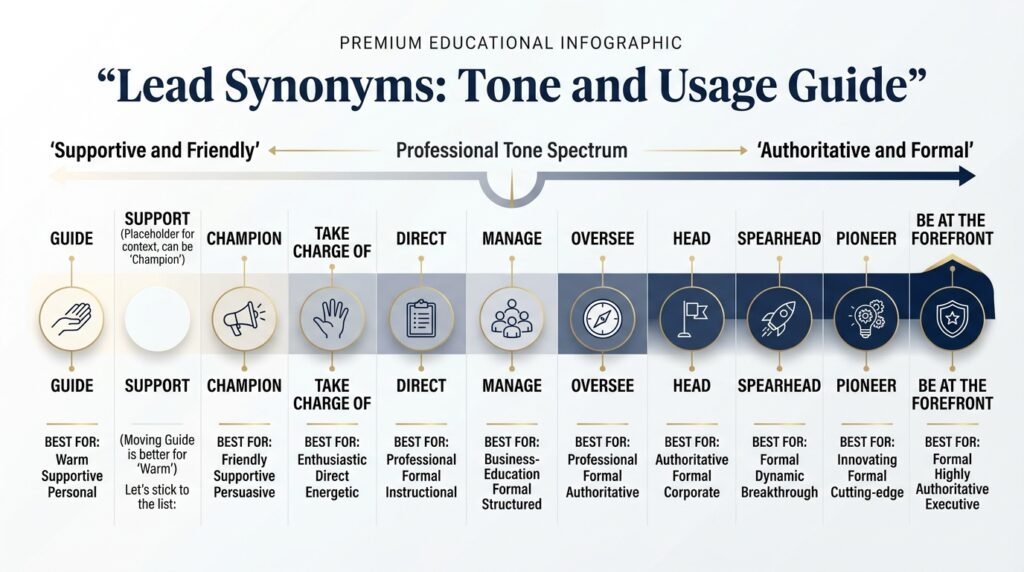
| Alternative | Best Used In | Tone |
| Guide | Mentoring, teamwork, support | Helpful |
| Manage | Teams, operations, projects | Professional |
| Direct | Supervision, decisions, operations | Authoritative |
| Head | Departments, teams, organizations | Professional |
| Oversee | Projects, processes, operations | Formal |
| Spearhead | New initiatives and campaigns | Strong, proactive |
| Take charge of | Situations, teams, activities | Direct, conversational |
| Pioneer | Innovation and new developments | Formal, impressive |
| Champion | Ideas, causes, initiatives | Supportive, persuasive |
| Be at the forefront of | Innovation and industry leadership | Formal, authoritative |
Common Mistakes
1. Using every synonym interchangeably
Not every alternative has exactly the same meaning. Manage suggests responsibility for people or resources, while champion usually means strongly supporting an idea.
2. Choosing an overly formal word
Words such as pioneer and be at the forefront of may sound unnatural in a simple email. Choose a straightforward option when the situation does not require formal language.
3. Using “spearhead” for routine supervision
Spearhead suggests initiative and active leadership. It may not accurately describe someone who simply supervised an established daily process.
4. Ignoring the difference between authority and influence
Someone can champion an idea without being in charge of the team. Likewise, someone can guide others without having formal authority.
5. Focusing on synonyms instead of accuracy
The strongest replacement is not always the most impressive-sounding word. Select the term that accurately describes what the person actually did.
Frequently Asked Questions
What is a professional way to say “lead”?
Manage, oversee, direct, head, and spearhead are strong professional alternatives to lead. The right choice depends on the responsibility. For example, manage works well for supervising employees, while spearhead is better for describing someone who initiated and drove a major project.
What is another word for lead on a resume?
Strong resume alternatives include managed, directed, oversaw, headed, spearheaded, pioneered, and championed. Use an action verb that matches your actual contribution. For example, “Managed a team of 15” clearly communicates supervisory responsibility, while “Spearheaded a product launch” highlights initiative and ownership.
What is a synonym for lead a team?
Useful alternatives include manage a team, direct a team, head a team, oversee a team, and guide a team. Manage is especially common on resumes, while guide emphasizes mentorship. If you were responsible for overall decisions, head or direct may be more precise.
What is another way to say “lead a project”?
You can say manage a project, oversee a project, direct a project, spearhead a project, or take charge of a project. Choose spearhead when you started and drove the initiative, and manage when your role involved planning, coordination, deadlines, and resources.
What is a stronger word for “lead”?
There is no single stronger word because each synonym emphasizes a different skill. Spearhead suggests initiative, pioneer suggests innovation, direct suggests authority, and manage suggests organizational responsibility. The strongest choice is the one that accurately reflects the work being described.
What is a casual way to say “lead”?
In casual conversation, you can say take charge of, head up, guide, or simply be in charge of. For example, “Sam took charge of the event” sounds natural in everyday American English and emphasizes that Sam accepted responsibility for organizing it.
Is “spearhead” a good synonym for “lead”?
Yes, but only in the right context. Spearhead means to take the initiative and drive an important effort, so it is particularly effective for projects, campaigns, programs, and major changes. It is less suitable for describing routine supervision or ordinary day-to-day management.
What is the best synonym for “lead” in business writing?
Manage, oversee, direct, and spearhead are among the most useful choices. Use manage for people and resources, oversee for broader supervision, direct for authority and decision-making, and spearhead for initiatives that someone actively started and drove.
Conclusion
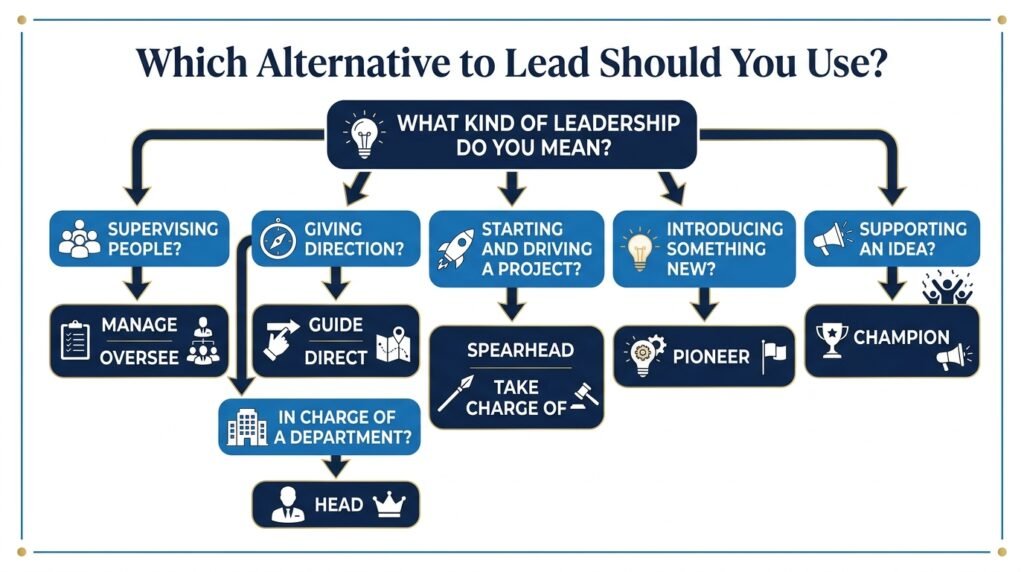
There are many ways to say lead, but the best alternative depends on what you actually mean. Manage is a strong choice for supervising people or resources, while oversee emphasizes broader responsibility. Guide works well when support and mentorship matter, and direct highlights authority and decision-making.
For projects and initiatives, spearhead can show initiative, while pioneer is best when someone introduced something genuinely new. If a person strongly supports an idea or cause, champion may be more accurate than lead.
The key is to choose precision over impressive wording. A well-chosen synonym makes resumes, business writing, emails, and everyday communication clearer while showing exactly how someone contributed. Choosing the right leadership words for your resume can also help you describe your experience more clearly and specifically.

Language & Everyday Communication Specialist
Elena Voss is a language enthusiast and communication coach with over 9 years of experience helping people express themselves more naturally in English. She previously worked as an ESL instructor and corporate language trainer, guiding professionals and students on clearer everyday conversations, polite alternatives, and natural phrasing.
Elena specializes in practical synonym guides and “another way to say…” content that feels conversational rather than textbook. Her writing focuses on real-life situations — emails to friends, casual workplace chat, social media, and daily interactions. She believes the best language advice is simple, useful, and easy to remember.
When she’s not creating content for LandmarkNewz, Elena enjoys analyzing modern slang trends and testing new phrases in real conversations.