

Looking for another way to say “no matter what”? This phrase is used when something remains true or happens despite problems, changes, or unexpected situations. Depending on the context, you can use alternatives such as “regardless,” “whatever happens,” “in any case,” or “come what may.”
Fortunately, you have several natural alternatives. Some work best in professional writing, while others sound more conversational, emotional, or determined.
What Does “Another Way to Say No Matter What” Mean?
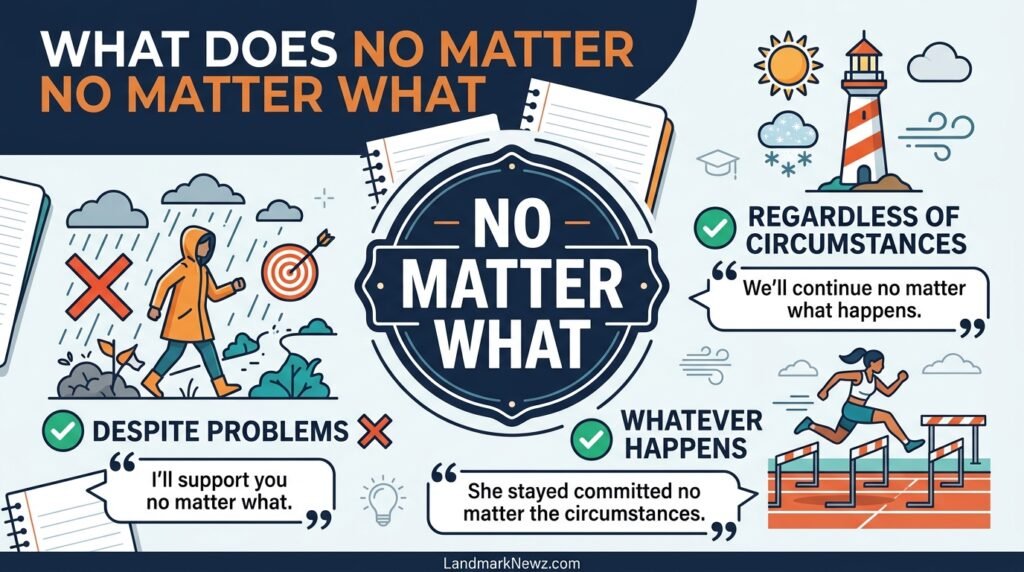
When someone searches for another way to say no matter what, they usually want a synonym or alternative expression that communicates the same basic idea: something will happen or remain true regardless of circumstances.
For example:
“I’ll support you no matter what.”
You could say:
“I’ll support you regardless of what happens.”
The exact replacement depends on what you want to emphasize. “Regardless” is concise and professional, while “whatever happens” sounds warmer and more conversational.
The phrase commonly appears in conversations, emails, essays, workplace communication, motivational writing, and personal messages.
Why Use Other Ways to Say “No Matter What”?
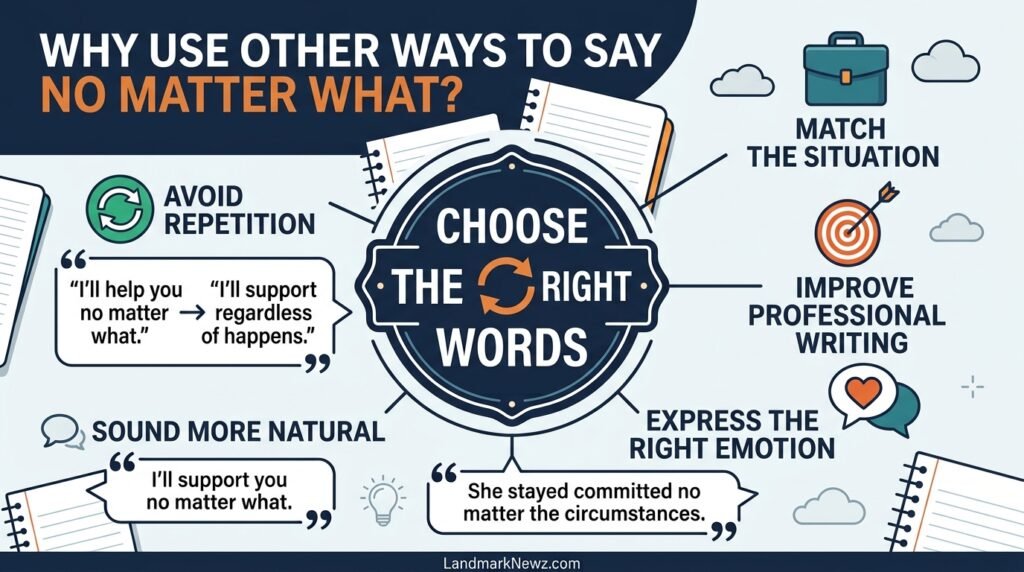
Using different expressions helps you communicate the same idea without sounding repetitive. It also lets you adjust your tone for different audiences.
Consider alternative wording when you want to:
- Avoid repeating the same phrase.
- Make professional writing sound more polished.
- Add warmth or emotional strength.
- Match formal and casual situations.
- Make your writing more precise.
- Show determination without sounding overly dramatic.
The best synonym is not always the most literal one. Think about your audience and what you want the sentence to communicate.
10 Best Other Ways to Say “No Matter What”
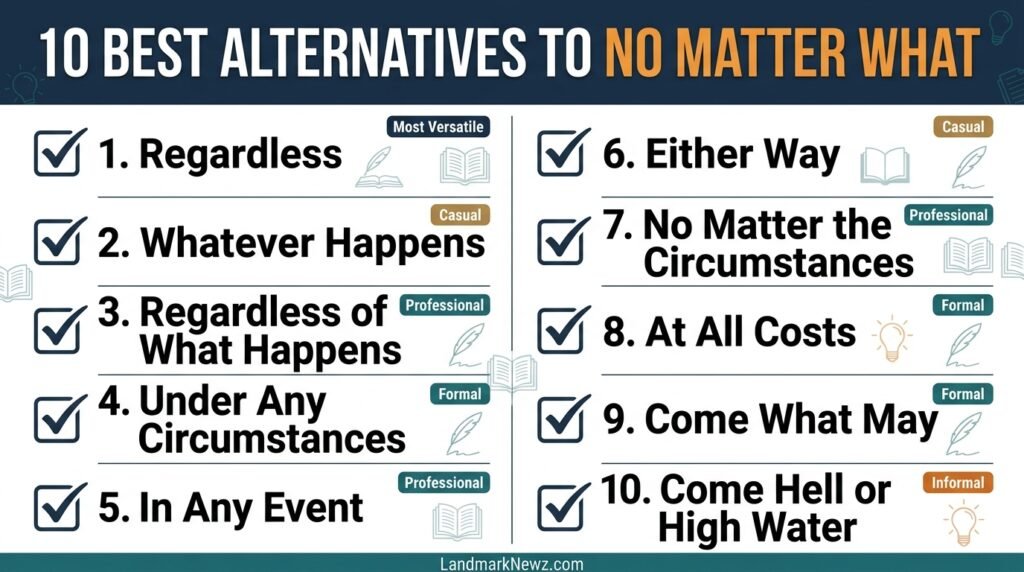
1. Regardless
Meaning
Regardless means that something remains true despite a particular condition or situation. It is one of the closest and most flexible alternatives to “no matter what.”
Best For
- Professional
- Formal
- Polite
Example 1
“Regardless of the outcome, we should be proud of the progress we made.”
Example 2
“We will move forward with the project regardless of the challenges.”
Quick Tip
Use “regardless of” when you want to clearly identify the condition being ignored.
2. Whatever Happens
Meaning
Whatever happens means that your decision, feeling, or action will not change because of future events. It sounds natural and reassuring in everyday communication.
Best For
- Casual
- Friendly
- Warm
Example 1
“Whatever happens, I know you gave the interview your best effort.”
Example 2
“Whatever happens this weekend, we’ll find a way to enjoy the trip.”
Quick Tip
This is a strong choice when you want to sound supportive or encouraging.
3. Regardless of What Happens
Meaning
This phrase directly communicates that something will remain true even if circumstances change. It is slightly more explicit than simply saying “regardless.”
Best For
- Professional
- Formal
- Polite
Example 1
“Regardless of what happens during the negotiations, we will remain respectful.”
Example 2
“Regardless of what happens next, the team has prepared thoroughly.”
Quick Tip
Choose this expression when clarity matters more than brevity.
4. Under Any Circumstances
Meaning
Under any circumstances means that something applies in every possible situation. It often carries a firm, serious, or formal tone.
Best For
- Formal
- Professional
Example 1
“Employees should not share confidential information under any circumstances.”
Example 2
“Under any circumstances, customer safety must remain our top priority.”
Quick Tip
Use this phrase for rules, warnings, policies, or strong statements rather than casual conversation.
5. In Any Event
Meaning
In any event means that something will remain true or happen regardless of what occurs. It can also introduce a conclusion or shift attention to the next point.
Best For
- Professional
- Formal
- Polite
Example 1
“In any event, we should have the final report ready by Friday.”
Example 2
“In any event, your feedback will help us improve the next version.”
Quick Tip
This expression works particularly well in business writing, reports, and formal discussions.
6. Either Way
Meaning
Either way means that the outcome or choice will not change the speaker’s decision, response, or conclusion. It is short, natural, and common in conversation.
Best For
- Casual
- Friendly
- Professional
Example 1
“We can meet online or in person; either way, I’ll be there at noon.”
Example 2
“Either way, we need to finish the presentation before Monday.”
Quick Tip
Use either way when there are two known possibilities and both lead to the same result.
7. No Matter the Circumstances
Meaning
No matter the circumstances emphasizes that a person’s attitude, commitment, or action will not change because of the situation.
Best For
- Formal
- Warm
- Professional
Example 1
“No matter the circumstances, our staff should treat every customer with respect.”
Example 2
“She remained committed to her goal no matter the circumstances.”
Quick Tip
This version works well when you want to emphasize resilience, commitment, or consistency.
8. At All Costs
Meaning
At all costs means that someone is determined to achieve something regardless of the difficulty involved. Unlike “no matter what,” it can suggest a particularly strong or intense level of determination.
Best For
- Formal
- Casual
- Determined
Example 1
“The rescue team was determined to protect the hikers at all costs.”
Example 2
“We need to protect our customers’ personal information at all costs.”
Quick Tip
Use this phrase carefully because it can imply that achieving the goal matters more than the sacrifices required.
9. Come What May
Meaning
Come what may means that you will remain committed or continue forward regardless of what happens. It has a more literary or expressive feel than everyday alternatives.
Best For
- Formal
- Warm
- Friendly
Example 1
“Come what may, she planned to keep pursuing her dream.”
Example 2
“We’ll face the future together, come what may.”
Quick Tip
Use it when you want a memorable, emotional, or slightly poetic tone.
10. Come Hell or High Water
Meaning
Come hell or high water is an idiomatic expression meaning that someone intends to do something despite serious obstacles. It is informal and strongly emphasizes determination.
Best For
- Casual
- Friendly
- Warm
Example 1
“Come hell or high water, I’m going to finish this marathon.”
Example 2
“We’ll get the new store ready for opening day, come hell or high water.”
Quick Tip
Avoid this expression in formal business writing because its idiomatic and dramatic tone may not suit a professional audience.
Comparison Table
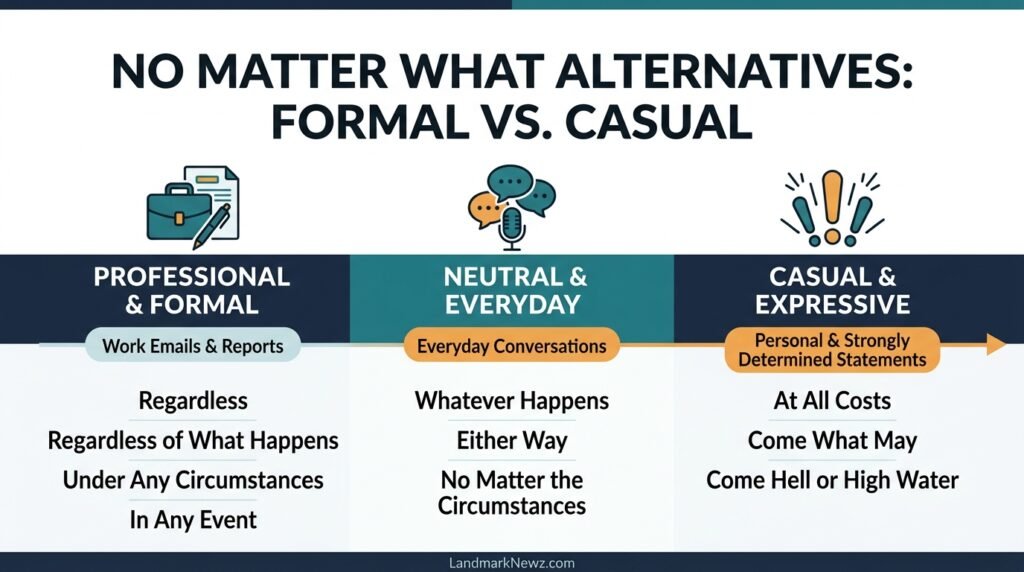
| Alternative | Best Used In | Tone |
| Regardless | Professional, formal writing | Neutral |
| Whatever happens | Conversations, supportive messages | Warm |
| Regardless of what happens | Business and formal writing | Professional |
| Under any circumstances | Rules and serious statements | Firm |
| In any event | Reports and business communication | Formal |
| Either way | Everyday conversation | Casual |
| No matter the circumstances | Motivational and professional writing | Strong |
| At all costs | Determined statements | Intense |
| Come what may | Personal or expressive writing | Literary |
| Come hell or high water | Informal conversation | Dramatic |
Common Mistakes
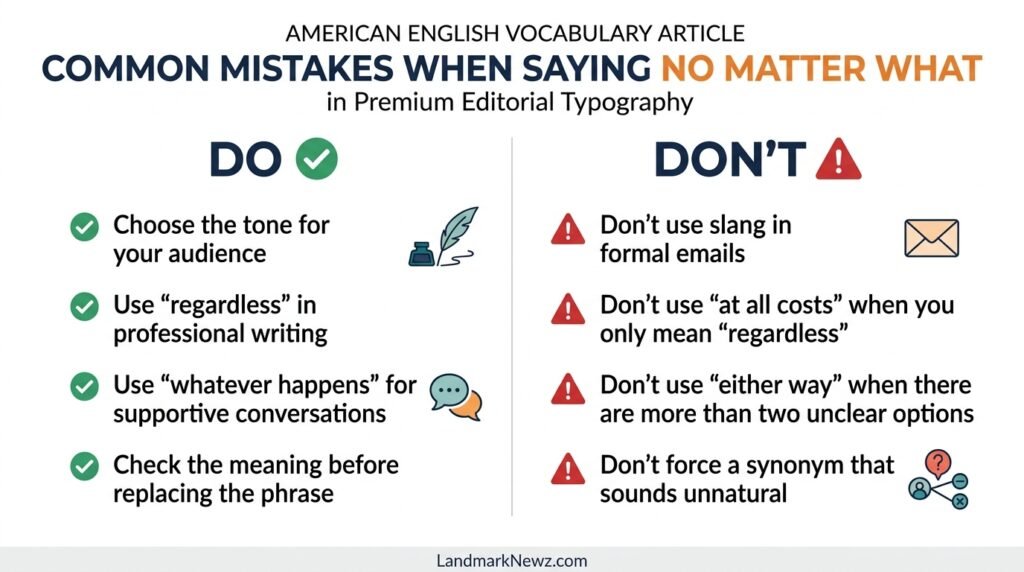
1. Using a Casual Phrase in a Formal Email
Expressions such as “come hell or high water” can sound too informal for workplace communication. Choose “regardless” or “under any circumstances” when professionalism matters.
2. Choosing an Overly Formal Alternative
Not every sentence needs formal language. In a friendly text, “whatever happens” will usually sound more natural than “under any circumstances.”
3. Ignoring the Context
Some alternatives are not perfect replacements in every sentence. For example, “either way” usually refers to two possible choices, while “regardless” has a broader meaning.
4. Overusing Strong Expressions
“At all costs” suggests intense determination and may sound extreme in ordinary situations. Use it when the sentence genuinely calls for that level of emphasis.
5. Making the Sentence Sound Insincere
A sophisticated synonym cannot fix a sentence that feels forced. Choose the wording you would naturally use when speaking to the intended audience.
Frequently Asked Questions
What is the most professional way to say “no matter what”?
“Regardless” is usually the safest professional alternative. It is concise, neutral, and appropriate for emails, reports, presentations, and workplace conversations. For example, “Regardless of the outcome, we will review the results carefully” sounds polished without being overly formal.
What is a casual way to say “no matter what”?
“Whatever happens” and “either way” are natural casual alternatives. “Whatever happens” works especially well when offering encouragement or support, while “either way” fits situations involving two possible choices or outcomes.
Is “regardless” the same as “no matter what”?
They are very similar, but they are not always interchangeable. “Regardless” generally means that something remains true despite a condition. “No matter what” can sound more emotional or emphatic, especially when discussing personal commitments.
How can I say “no matter what” in a formal way?
Good formal choices include “regardless of what happens,” “under any circumstances,” and “in any event.” The best option depends on your sentence. “Under any circumstances” is especially useful for rules and policies, while “regardless” works well in general professional writing.
What is another way to say “I’ll be there no matter what”?
You could say, “I’ll be there regardless,” “I’ll be there whatever happens,” or “I’ll be there regardless of the circumstances.” For a warmer personal message, “Whatever happens, I’ll be there” sounds natural and reassuring.
Is “at all costs” a good synonym for “no matter what”?
Sometimes, but it is stronger. “At all costs” suggests that someone is extremely determined to achieve a particular result despite significant sacrifices or difficulties. Use it when that intensity is intentional rather than as a routine replacement.
What is a stronger way to say “no matter what”?
“Under any circumstances” can sound firm, while “at all costs” emphasizes determination. For an informal and dramatic option, “come hell or high water” communicates a very strong commitment to completing something despite obstacles.
What is the best alternative for “no matter what” in an essay?
For most essays, “regardless,” “regardless of the circumstances,” or “regardless of what happens” will work well. These choices sound clear and polished without making the writing unnecessarily complicated or informal.
Conclusion
There are many natural ways to say “no matter what,” but the best choice depends on your audience and purpose. “Regardless” is the most versatile option for professional and formal writing, while “whatever happens” adds warmth to personal conversations. Understanding the meaning of “no matter what” can help you choose the right alternative for each context.
If you want to emphasize determination, “at all costs” can be effective, while “come what may” gives your writing a more expressive feel. For casual conversations, “come hell or high water” adds strong personality.
The key is to match the phrase to the situation rather than simply replacing words. When the tone, meaning, and context all fit, your writing will sound more natural and confident.

Professional Writing & Workplace Communication Expert
Marcus Hale is a business communication specialist with 11 years of experience in corporate training and professional writing. He has worked with mid-sized companies and remote teams to improve clarity in emails, reports, performance reviews, and client-facing messages.
Marcus focuses on polished, professional alternatives that help readers sound confident without sounding stiff. His guides cover workplace phrases, resume language, leadership communication, and formal-to-natural transitions. He holds a background in business administration and technical writing, and has led workshops on effective professional English.
At LandmarkNewz, Marcus creates practical synonym lists and phrasing tips that professionals can apply immediately in emails, meetings, and career documents.