
When a new law, policy, contract, or requirement takes effect, existing people or arrangements may sometimes continue under the old rules. The phrase “grandfathered in” describes this situation.
While the expression is common in American English, it is not always the best choice. In professional or formal writing, phrases such as “exempt from new requirements” or “allowed to continue under previous rules” can make your meaning clearer.
What Does “Another Way to Say Grandfathered In” Mean?
Looking for another way to say grandfathered in usually means you want a clearer or more professional expression for something that remains permitted because it existed before a new rule took effect.
For example, a city may introduce a new building requirement, but an older property may be allowed to remain under previous standards. Similarly, an employee may keep an existing benefit even after the company changes its policy for new employees.
The expression commonly appears in business, employment, housing, construction, government regulations, technology, contracts, and membership policies.
Why Use Other Ways to Say “Grandfathered In”?
Although “grandfathered in” is widely understood, an alternative can make your writing more precise or appropriate for the audience.
Using a different expression can help you:
- Sound more professional in business writing.
- Make legal or policy language easier to understand.
- Avoid repetition in longer articles or documents.
- Explain the exact type of protection being provided.
- Use neutral, straightforward language.
- Clarify whether the person or arrangement is exempt, protected, or simply allowed to continue.
The best alternative depends on what you actually mean. For example, “exempt from new rules” suggests an exception, while “allowed to continue under previous rules” emphasizes continuity.
10 Best Other Ways to Say “Grandfathered In”
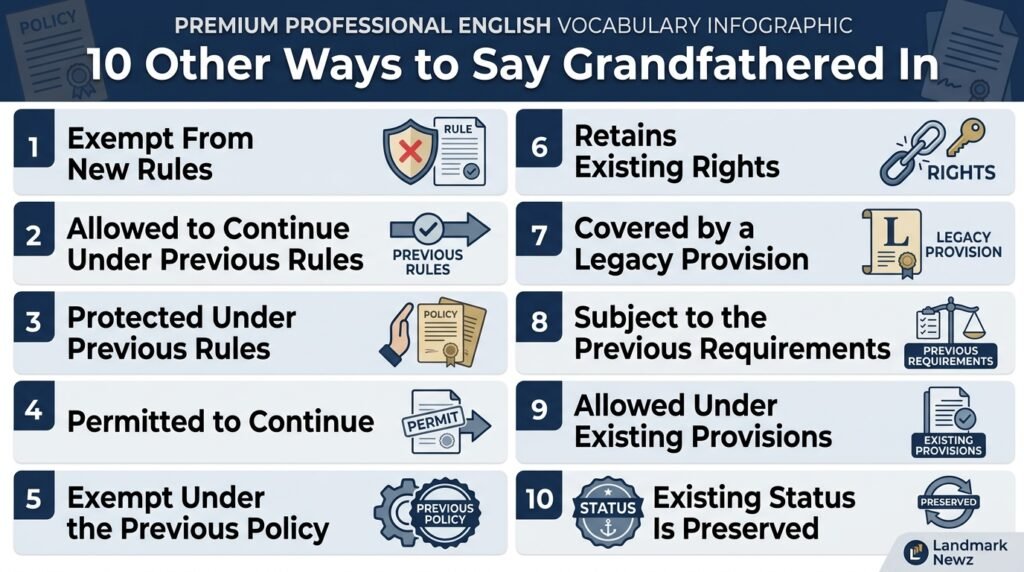
1. Exempt From New Rules
Meaning
Exempt from new rules means an existing person, business, product, or arrangement does not have to follow a newly introduced requirement. It is one of the clearest alternatives when the situation involves a specific exception.
Best For
- Professional
- Formal
- Polite
Example 1
Existing customers are exempt from the new service fee.
Example 2
Properties built before 1980 may be exempt from the updated requirement.
Quick Tip
Use this phrase when the key point is that a new rule does not apply.
2. Allowed to Continue Under Previous Rules
Meaning
This phrase explains that an existing arrangement can remain in place under the standards that applied before a change. It is especially useful when you want to emphasize continuity rather than exemption.
Best For
- Professional
- Formal
Example 1
Current members are allowed to continue under previous membership rules.
Example 2
The existing agreement is allowed to continue under the previous terms.
Quick Tip
Choose this wording when you want to explain the situation plainly without using industry jargon.
3. Protected Under Previous Rules
Meaning
Protected under previous rules suggests that an existing right, status, or arrangement remains valid because earlier regulations provide protection. It works particularly well when the person or organization has an established status.
Best For
- Formal
- Professional
Example 1
The property is protected under previous zoning rules.
Example 2
Existing employees are protected under previous benefit provisions.
Quick Tip
Use “protected” when the old rules actively preserve an existing right or status.
4. Permitted to Continue
Meaning
Permitted to continue means something that already exists is still allowed after a change. This wording is concise and neutral, making it useful for policies, notices, and professional communication.
Best For
- Professional
- Formal
- Polite
Example 1
Existing installations are permitted to continue without modification.
Example 2
Current users are permitted to continue using the older system.
Quick Tip
This is a strong choice when you want a short, neutral replacement.
5. Exempt Under the Previous Policy
Meaning
This phrase indicates that an existing situation falls under an exception created by an earlier policy. It is more specific than simply saying something is “grandfathered in.”
Best For
- Formal
- Professional
Example 1
Current employees are exempt under the previous policy.
Example 2
The existing contract is exempt under the previous pricing policy.
Quick Tip
Use this option when the older policy is directly responsible for the exemption.
6. Retains Existing Rights
Meaning
Retains existing rights focuses on what a person or organization is allowed to keep after a policy or regulation changes. It works especially well when discussing benefits, permissions, licenses, or legal protections.
Best For
- Formal
- Professional
Example 1
Current subscribers retain existing rights under the updated agreement.
Example 2
Property owners retain existing rights despite the zoning change.
Quick Tip
Use this phrase when the important point is the preservation of a specific right.
7. Covered by a Legacy Provision
Meaning
A legacy provision is an older rule or clause that continues to apply to an existing situation. This phrase has a professional and technical tone and can work well in policy or regulatory discussions.
Best For
- Professional
- Formal
Example 1
The facility is covered by a legacy provision in the current regulations.
Example 2
Existing accounts remain covered by a legacy provision.
Quick Tip
Use “legacy provision” when writing for readers familiar with policies, contracts, or regulations.
8. Subject to the Previous Requirements
Meaning
This wording indicates that an existing person, product, or arrangement continues to follow the requirements that applied before a new standard was introduced. It is precise and formal.
Best For
- Formal
- Professional
Example 1
Existing projects remain subject to the previous requirements.
Example 2
Current permit holders are subject to the previous requirements until renewal.
Quick Tip
This phrase is useful when you need to identify exactly which requirements still apply.
9. Allowed Under Existing Provisions
Meaning
Allowed under existing provisions means a situation remains permissible because an established rule, clause, or provision supports it. It fits naturally into business, policy, and regulatory writing.
Best For
- Professional
- Formal
Example 1
The current arrangement is allowed under existing provisions.
Example 2
Older equipment remains allowed under existing provisions.
Quick Tip
Choose this option when you want a formal alternative without making the sentence unnecessarily complicated.
10. Existing Status Is Preserved
Meaning
This phrase emphasizes that a person, property, product, or arrangement keeps its current status after a new rule takes effect. It is useful when the change does not remove an established position.
Best For
- Formal
- Professional
- Polite
Example 1
Under the new policy, the existing status is preserved for current members.
Example 2
The existing status of the property is preserved despite the updated ordinance.
Quick Tip
Use this phrase when “grandfathered in” refers mainly to maintaining an existing status rather than receiving a complete exemption.
Comparison Table
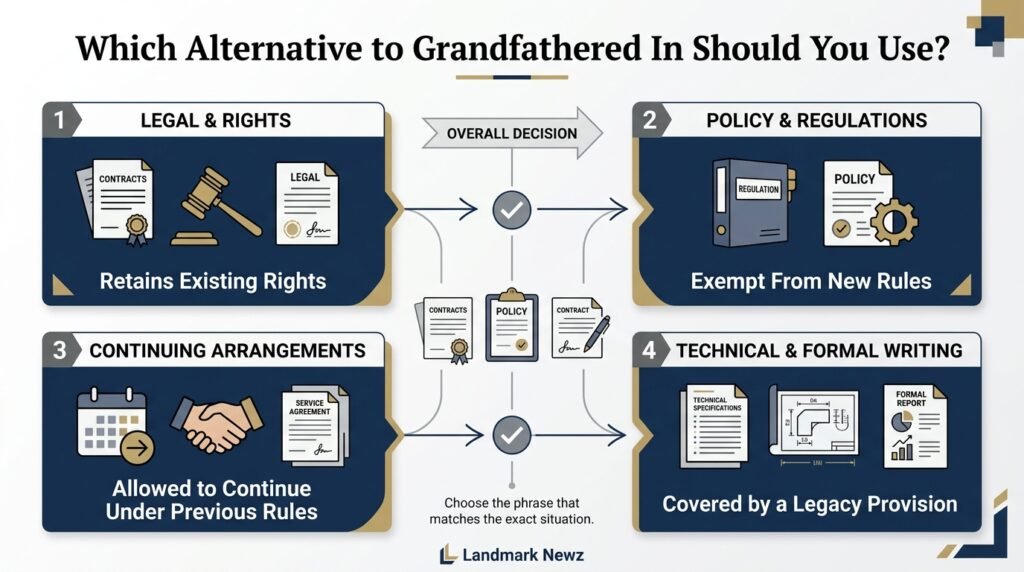
| Alternative | Best Used In | Tone |
| Exempt From New Rules | Policies, business, regulations | Professional |
| Allowed to Continue Under Previous Rules | General and professional writing | Clear, formal |
| Protected Under Previous Rules | Legal, housing, employment | Formal |
| Permitted to Continue | Policies, notices, technical writing | Neutral |
| Exempt Under the Previous Policy | Workplace and policy documents | Formal |
| Retains Existing Rights | Legal, contracts, benefits | Formal |
| Covered by a Legacy Provision | Regulatory and technical writing | Professional |
| Subject to the Previous Requirements | Compliance and regulations | Formal |
| Allowed Under Existing Provisions | Business and policy writing | Professional |
| Existing Status Is Preserved | Legal, membership, property | Formal |
Common Mistakes
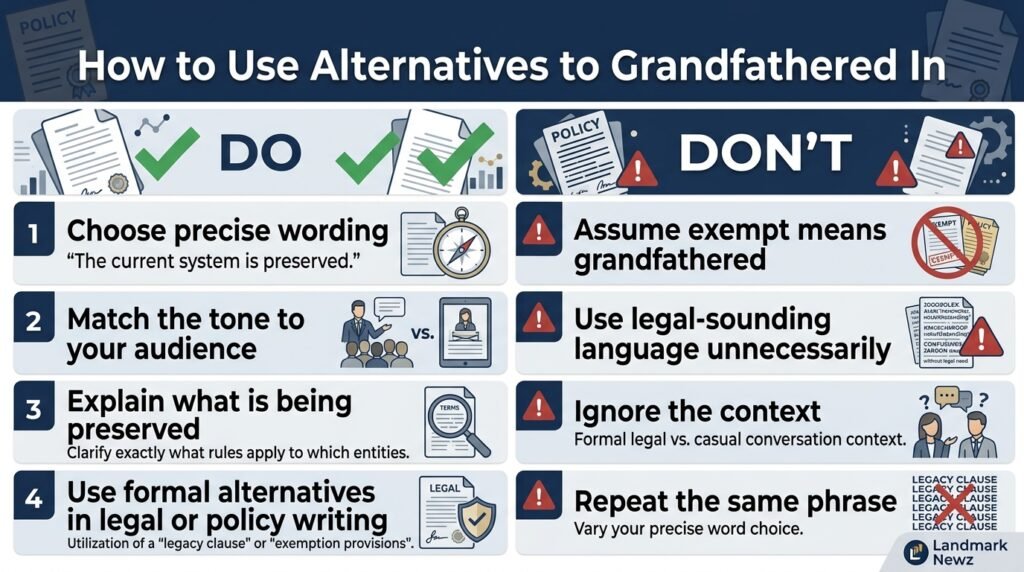
1. Assuming Every Situation Is an Exemption
“Grandfathered in” does not always mean completely exempt from every new requirement. Sometimes only certain provisions remain under the old rules, so choose wording that accurately describes the situation.
2. Using Overly Formal Language
Terms such as “legacy provision” may sound unnatural in a casual conversation. For everyday communication, “allowed to continue under the old rules” is often clearer.
3. Ignoring the Context
A phrase that works for a zoning rule may not work equally well for an employee benefit. Consider whether you are discussing rights, exemptions, requirements, contracts, or continued permission.
4. Treating “Grandfathered In” as Always Negative or Positive
The phrase itself does not necessarily indicate whether the arrangement is good or bad. The surrounding context determines its meaning and impact.
5. Using “Exempt” When the Old Rules Still Apply
An arrangement may continue under previous requirements rather than being exempt altogether. If the old standards still govern it, “subject to the previous requirements” may be more accurate.
Frequently Asked Questions
What is the most professional way to say “grandfathered in”?
One of the most professional alternatives is “exempt from new rules.” However, the best wording depends on the situation. If an existing arrangement continues under its original standards, “allowed to continue under previous rules” may be more accurate and clearer for a business or professional audience.
What does “grandfathered in” mean in simple terms?
“Grandfathered in” means an existing person, property, product, service, or arrangement can continue under an earlier rule even though a new rule has been introduced. In simple terms, the new requirement applies to newer situations but does not fully affect certain existing ones.
Is “grandfathered in” professional language?
Yes, “grandfathered in” is common and widely understood in American English, including professional settings. However, formal documents may benefit from more precise wording such as “exempt from new requirements,” “retains existing rights,” or “allowed to continue under previous rules.”
What is another way to say “grandfathered” in a contract?
In a contract, you might say “existing rights are preserved,” “the existing terms remain in effect,” or “the arrangement remains subject to the previous requirements.” The best choice depends on whether the contract preserves rights, terms, pricing, obligations, or another specific condition.
What is a simple synonym for “grandfathered in”?
A simple alternative is “allowed to continue.” This phrase is easy to understand and works in many everyday and professional situations. If you need to emphasize that a new rule does not apply, “exempt from new rules” is another straightforward option.
Can I use “grandfathered in” in a business email?
Yes. The phrase is familiar to most American English speakers and can work in business emails. Still, if the email involves a formal policy, customer notice, legal issue, or compliance matter, a more precise phrase may make the message clearer and less open to interpretation.
What is another way to say “grandfathered in” for legal writing?
Legal writing often benefits from precise language rather than a general expression. Depending on the circumstances, alternatives include “retains existing rights,” “protected under previous rules,” or “subject to the previous requirements.” The exact wording should reflect what the applicable law or agreement actually preserves.
Is “grandfathered in” the same as “exempt”?
Not always. “Exempt” usually means a person or situation does not have to follow a particular rule. “Grandfathered in” can mean something more specific: an existing arrangement may continue under an older rule, even while new arrangements must follow a newer standard.
Conclusion
The best another way to say grandfathered in depends on what you want to emphasize. For a clear professional explanation, “exempt from new rules” is a strong choice. If you want to stress continuity, use “allowed to continue under previous rules” or “permitted to continue.” Understanding the meaning of “grandfathered in” can also help you choose the most precise alternative for your context.
For legal, regulatory, or policy writing, more precise options such as “retains existing rights,” “protected under previous rules,” or “subject to the previous requirements” can communicate the exact situation more effectively.
The key is to avoid treating every synonym as interchangeable. Before choosing a phrase, determine whether the existing arrangement is exempt, protected, permitted to continue, or still governed by an earlier standard. That small distinction can make your writing much clearer and more professional.

About Dr. Priya Nair
Dr. Priya Nair is a passionate Writer & Blogger at LandMarkNewz.com, dedicated to creating informative, engaging, and easy-to-understand content for readers. With a strong interest in research, current trends, lifestyle, and everyday topics, she focuses on presenting useful information in a clear and reader-friendly way.
Through her writing, Priya aims to help readers discover valuable insights, understand complex topics more easily, and stay informed about subjects that matter to them. Her approach combines thoughtful research with a simple and engaging writing style.
At LandMarkNewz.com, she contributes original articles designed to inform, educate, and provide practical value to readers.