Another Way to Say Little Did I Know: Mean?
The phrase “little did I know” means that someone did not understand or realize something at a particular time, but later discovered that it was important, surprising, or meaningful.
For example: “Little did I know that the small decision would change my career.” The phrase often creates a sense of hindsight and shows that the writer now understands something they could not have known before.
It is common in storytelling, personal essays, conversations, social media posts, and reflective writing. Because it can sound slightly dramatic, some writers look for a simpler or more natural alternative.
Why Use Other Ways to Say “Little Did I Know”?
Using a different expression can make your writing fit the situation better. While “little did I know” is natural, repeating it can make your writing sound predictable or overly dramatic.
Alternative phrases can help you:
- Avoid repeating the same expression.
- Sound more natural and conversational.
- Match formal, professional, or casual situations.
- Make a story feel more reflective or personal.
- Express surprise without sounding overly dramatic.
- Make your writing clearer and easier to understand.
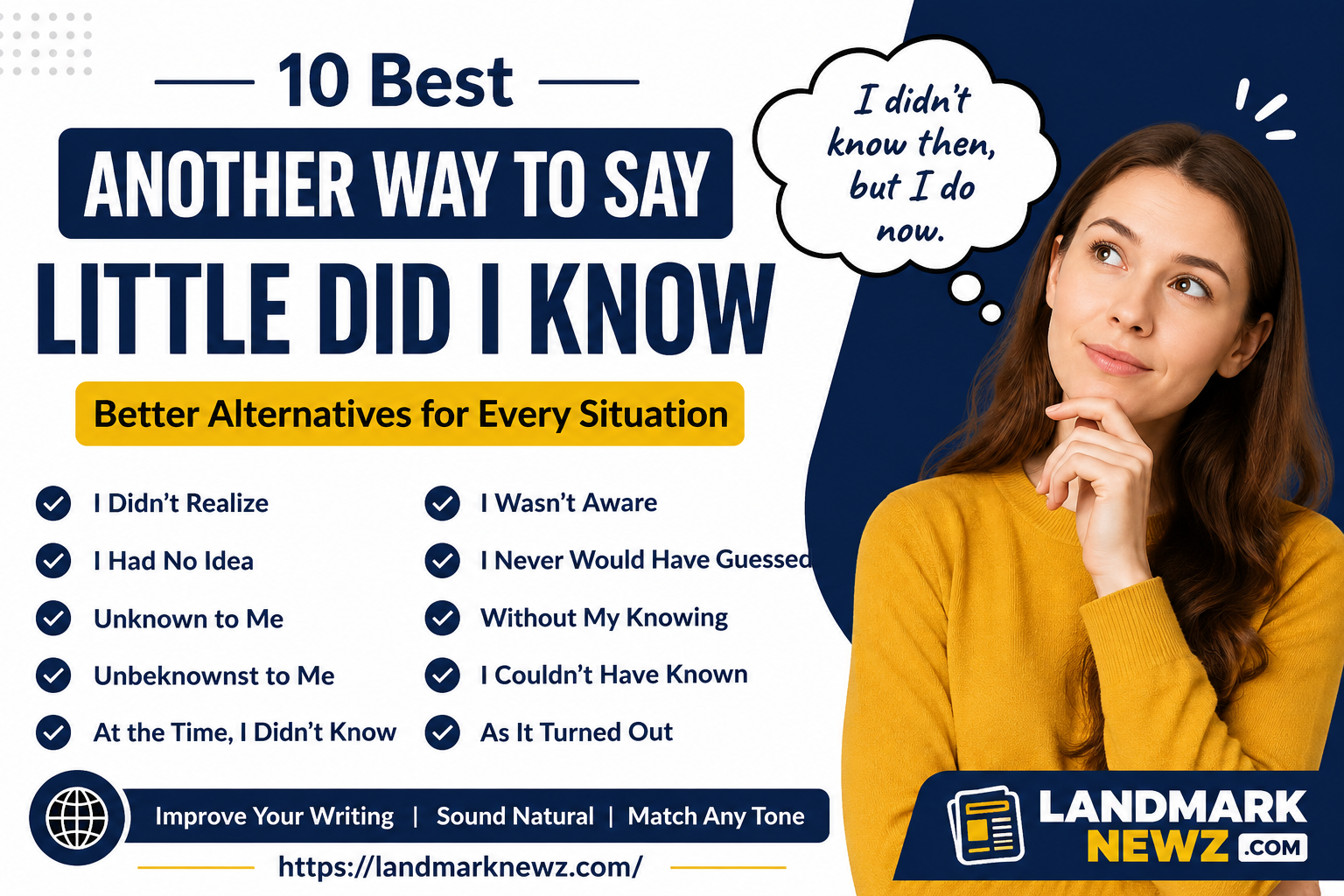
10 Best Other Ways to Say “Little Did I Know”
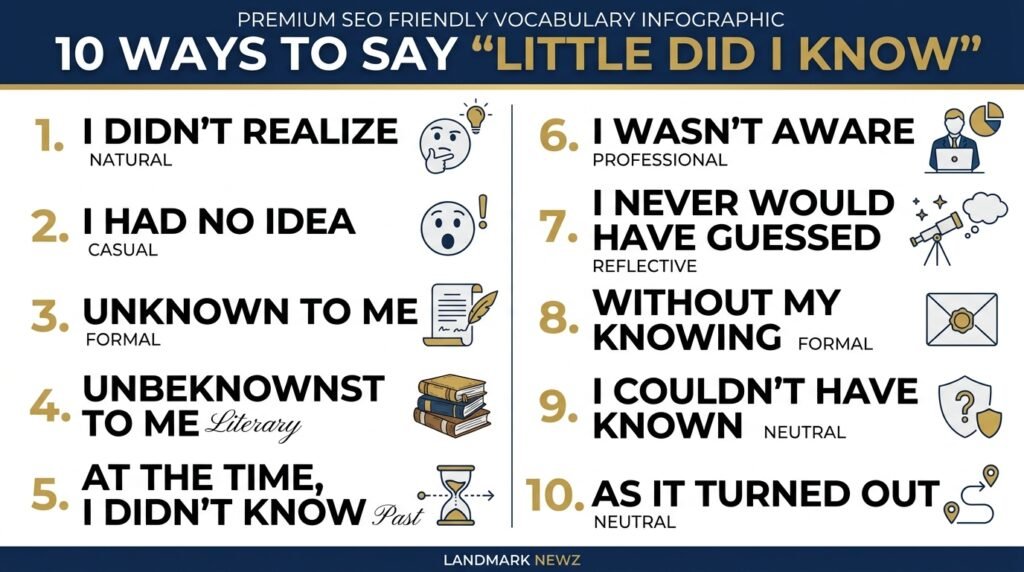
1. I Didn’t Realize
Meaning
“I didn’t realize” is one of the simplest and most natural alternatives to “little did I know.” It shows that you were unaware of a fact, situation, or consequence at the time.
Unlike the original phrase, it usually sounds straightforward rather than dramatic.
Best For
- Professional
- Casual
- Friendly
- Polite
Example 1
I didn’t realize how much that first project would influence my career.
Example 2
I didn’t realize she had already made plans for the weekend.
Quick Tip
Use “I didn’t realize” when you want clarity and natural conversation rather than a dramatic storytelling effect.
2. I Had No Idea
Meaning
“I had no idea” strongly emphasizes that you were completely unaware of something. It is especially common in spoken American English and casual writing.
The phrase can express genuine surprise, confusion, or hindsight.
Best For
- Casual
- Friendly
- Warm
Example 1
I had no idea that the restaurant would become so popular.
Example 2
I had no idea how difficult the new assignment would be.
Quick Tip
Choose this phrase when you want to emphasize that you were genuinely surprised or completely unaware.
3. Unknown to Me
Meaning
“Unknown to me” means that something was happening or was true without your knowledge. It has a more polished and slightly formal feel than “I didn’t know.”
It works particularly well when describing events that happened outside your awareness.
Best For
- Formal
- Professional
Example 1
Unknown to me, the team had already approved the revised proposal.
Example 2
Unknown to me, my colleagues were preparing a celebration for my final day.
Quick Tip
Use “unknown to me” when you want concise, polished wording in formal or narrative writing.
4. Unbeknownst to Me
Meaning
“Unbeknownst to me” means that something happened without your knowledge. It is a close substitute for “little did I know,” but it can sound more literary or sophisticated.
It often works best in storytelling and formal prose.
Best For
- Formal
- Professional
Example 1
Unbeknownst to me, the editor had already selected my article for publication.
Example 2
Unbeknownst to me, that conversation would become an important turning point.
Quick Tip
Use this expression sparingly because it can sound more formal than ordinary conversation.
5. At the Time, I Didn’t Know
Meaning
“At the time, I didn’t know” clearly establishes that you lacked information in the past. It is especially useful when explaining an event from a present-day perspective.
The phrase sounds natural without adding too much drama.
Best For
- Professional
- Casual
- Friendly
- Warm
Example 1
At the time, I didn’t know that the experience would help me prepare for my next job.
Example 2
At the time, I didn’t know why he had asked so many questions.
Quick Tip
This is a strong choice for personal stories because it clearly separates what you knew then from what you know now.
6. I Wasn’t Aware
Meaning
“I wasn’t aware” communicates that you did not have knowledge of a particular fact or situation. It sounds more professional and restrained than “I had no idea.”
It is useful when you want to acknowledge a lack of information without sounding overly emotional.
Best For
- Professional
- Formal
- Polite
Example 1
I wasn’t aware that the deadline had been moved to Friday.
Example 2
I wasn’t aware of the policy change when I submitted the original request.
Quick Tip
Use “I wasn’t aware” in workplace communication when you want to sound professional and respectful.
7. I Never Would Have Guessed
Meaning
“I never would have guessed” focuses on surprise rather than simple lack of knowledge. It suggests that the outcome was difficult or impossible for you to predict.
It works especially well when the ending of a story is unexpected.
Best For
- Casual
- Friendly
- Warm
Example 1
I never would have guessed that a casual conversation would lead to a lifelong friendship.
Example 2
I never would have guessed that the old building would become one of the city’s busiest cafés.
Quick Tip
Choose this phrase when the important part of the story is how unexpected the result was.
8. Without My Knowing
Meaning
“Without my knowing” describes something that occurred without the speaker being aware of it. It places more attention on the hidden or unnoticed nature of the event.
The phrase can work well in narratives and reflective writing.
Best For
- Formal
- Casual
- Literary
Example 1
Without my knowing, the company had already started planning the transition.
Example 2
Without my knowing, my brother had saved every letter I had sent him.
Quick Tip
Use this expression when another person or event was involved behind the scenes.
9. I Couldn’t Have Known
Meaning
“I couldn’t have known” emphasizes that the speaker had no reasonable way to predict what would happen. It can express hindsight without implying that the speaker should have known better.
This makes it useful when explaining an unexpected outcome.
Best For
- Formal
- Casual
- Warm
Example 1
I couldn’t have known that accepting the offer would lead to such a rewarding opportunity.
Example 2
I couldn’t have known what was waiting for us when we started the journey.
Quick Tip
Use this phrase when you want to stress that the future outcome was genuinely impossible to predict.
10. As It Turned Out
Meaning
“As it turned out” introduces information that became clear later. It does not directly mean that you were unaware, but it often replaces “little did I know” when the main point is the unexpected result.
It is especially useful for concise storytelling.
Best For
- Professional
- Formal
- Casual
Example 1
As it turned out, the small meeting became the beginning of a major partnership.
Example 2
As it turned out, we had chosen the perfect time to visit the town.
Quick Tip
Use “as it turned out” when you want to emphasize the eventual outcome rather than your lack of knowledge.
Comparison Table
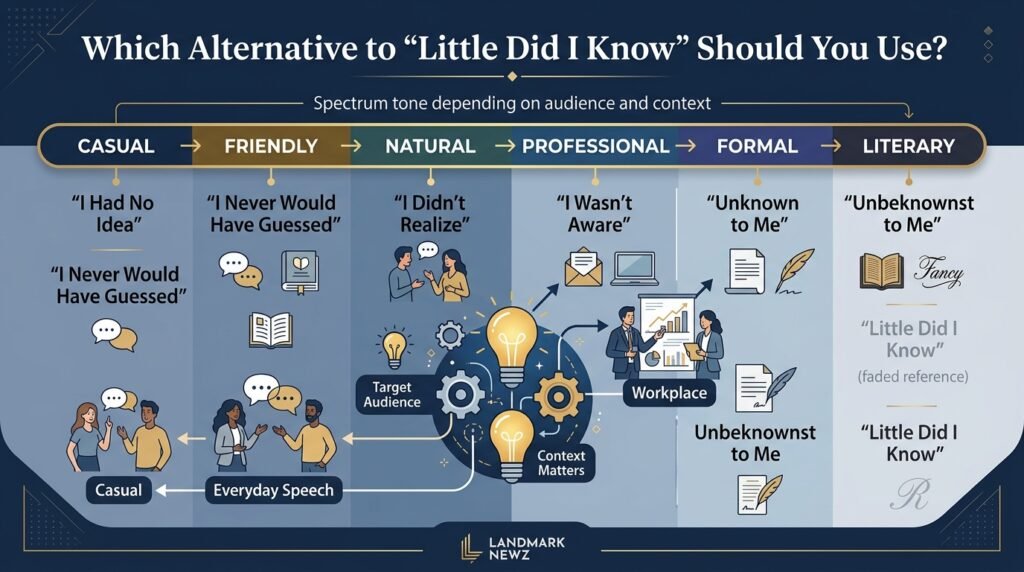
| Alternative | Best Used In | Tone |
| I Didn’t Realize | Everyday writing, work, conversation | Natural |
| I Had No Idea | Conversation, personal stories | Casual |
| Unknown to Me | Formal and narrative writing | Polished |
| Unbeknownst to Me | Literary and formal writing | Sophisticated |
| At the Time, I Didn’t Know | Stories and reflections | Reflective |
| I Wasn’t Aware | Workplace and formal communication | Professional |
| I Never Would Have Guessed | Personal stories and conversation | Surprised |
| Without My Knowing | Narrative and reflective writing | Literary |
| I Couldn’t Have Known | Personal reflections and explanations | Thoughtful |
| As It Turned Out | Storytelling and professional writing | Neutral |
Common Mistakes
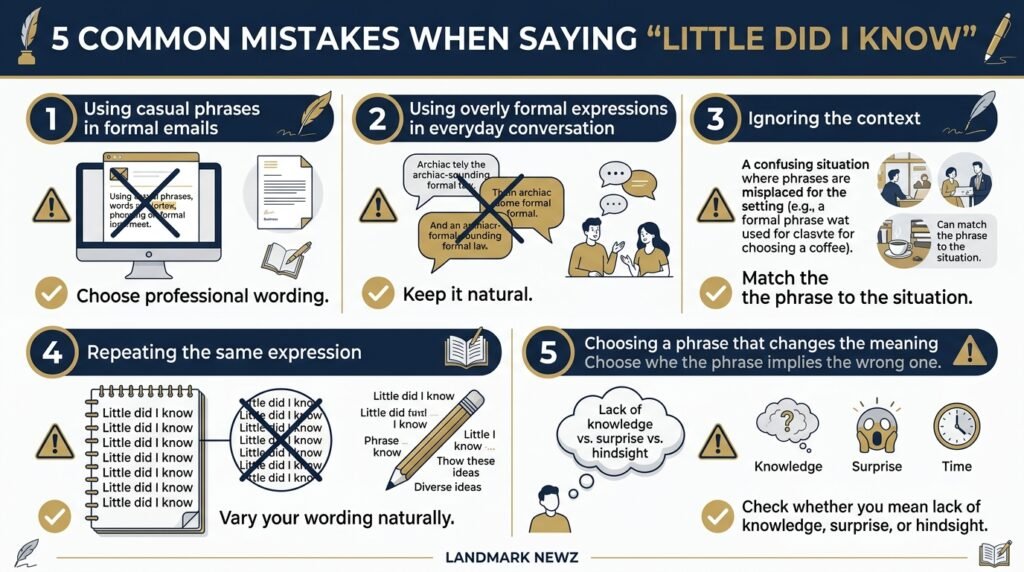
1. Using a Casual Phrase in Professional Writing
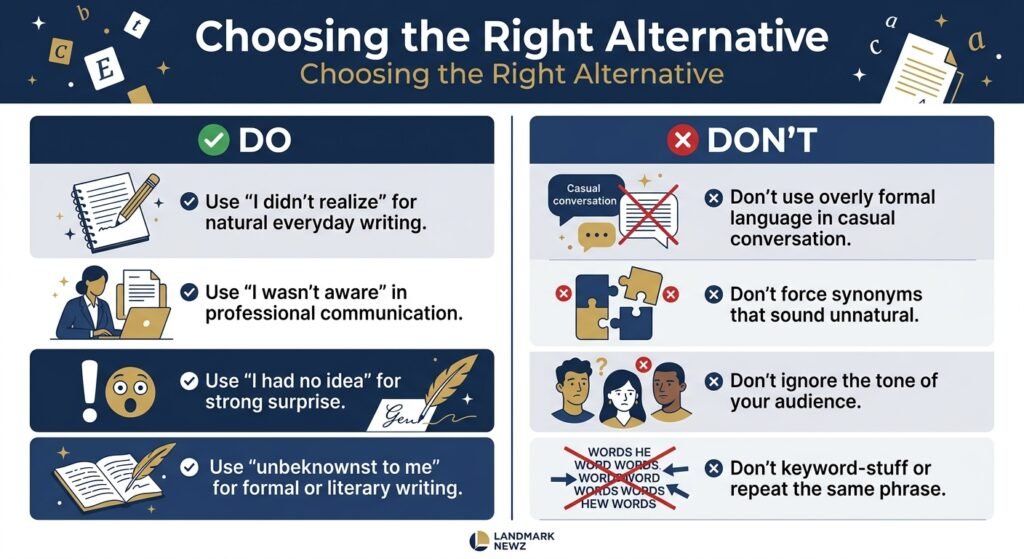
Phrases such as “I had no idea” can sound too conversational in some business settings. For workplace communication, “I wasn’t aware” is often a better choice.
2. Choosing Overly Formal Language
“Unbeknownst to me” is grammatically correct, but it may sound stiff in an everyday conversation. Use simpler wording such as “I didn’t realize” when a natural tone matters more.
3. Ignoring the Element of Surprise
“Little did I know” often carries a sense of surprise or hindsight. A basic replacement like “I didn’t know” may lose some of that storytelling effect.
4. Using the Wrong Context
Not every alternative works in every situation. “As it turned out” focuses on the final outcome, while “I wasn’t aware” focuses on a lack of knowledge.
5. Making the Phrase Sound Forced
Avoid choosing an unusual synonym simply to make your writing sound sophisticated. The best alternative is usually the one that communicates your meaning clearly and naturally.
Frequently Asked Questions
What is another way to say “little did I know”?
Common alternatives include “I didn’t realize,” “I had no idea,” “unknown to me,” “unbeknownst to me,” and “at the time, I didn’t know.” For everyday American English, “I didn’t realize” is usually the most natural option, while “unbeknownst to me” creates a more formal or literary tone.
What is a simple synonym for “little did I know”?
A simple synonym is “I didn’t realize.” It communicates the same basic idea without the dramatic or literary quality sometimes associated with “little did I know.” For example, “Little did I know this would change my life” can become “I didn’t realize this would change my life.”
Is “I had no idea” the same as “little did I know”?
They are very similar, but they are not identical in tone. “I had no idea” emphasizes complete surprise or lack of knowledge, while “little did I know” often creates a sense of hindsight and foreshadows an important future event.
What is a professional way to say “little did I know”?
For professional writing, consider “I wasn’t aware,” “I didn’t realize,” or “at the time, I didn’t know.” These expressions are clear and restrained. “I wasn’t aware” is particularly useful in workplace emails, reports, and explanations where you want to acknowledge missing information professionally.
What is a formal way to say “little did I know”?
“Unbeknownst to me” and “unknown to me” are formal alternatives. However, “unbeknownst to me” has a literary quality, so it may be better suited to storytelling, essays, and polished narrative writing than routine business communication.
How can I say “little did I know” in a story?
For storytelling, you can use “at the time, I didn’t know,” “I never would have guessed,” or “I couldn’t have known.” These choices preserve the feeling of hindsight while allowing you to control how dramatic, reflective, or conversational the story sounds.
Can I use “little did I know” in professional writing?
Yes, but context matters. The phrase is grammatically correct and can work in personal narratives, presentations, speeches, or creative professional content. In a formal email or business report, however, a direct phrase such as “I wasn’t aware” or “I didn’t realize” is usually clearer.
What is the difference between “unknown to me” and “unbeknownst to me”?
Both mean that something happened without your knowledge. “Unknown to me” is generally more straightforward, while “unbeknownst to me” sounds more literary or formal. Choose “unknown to me” for simple polished writing and reserve “unbeknownst to me” for situations where a more sophisticated narrative tone fits.
Conclusion
There are many effective ways to say “little did I know,” and the best option depends on your purpose and tone. Understanding the meaning of “little did I know” can help you choose the right alternative.
When writing a personal story, “at the time, I didn’t know” and “I never would have guessed” can create a stronger sense of hindsight. Meanwhile, “unbeknownst to me” and “unknown to me” suit more formal or literary contexts.
The key is to choose the phrase that matches your message rather than simply replacing words. A natural expression will always make your writing clearer, more engaging, and more authentic.

Professional Writing & Workplace Communication Expert
Marcus Hale is a business communication specialist with 11 years of experience in corporate training and professional writing. He has worked with mid-sized companies and remote teams to improve clarity in emails, reports, performance reviews, and client-facing messages.
Marcus focuses on polished, professional alternatives that help readers sound confident without sounding stiff. His guides cover workplace phrases, resume language, leadership communication, and formal-to-natural transitions. He holds a background in business administration and technical writing, and has led workshops on effective professional English.
At LandmarkNewz, Marcus creates practical synonym lists and phrasing tips that professionals can apply immediately in emails, meetings, and career documents.