
The phrase “another way to say used to” refers to alternative words or expressions that communicate a past habit, repeated action, former situation, or something that was once true.
For example, “I used to live in Chicago” could become “I formerly lived in Chicago” or “I lived in Chicago in the past.” However, not every synonym works in every situation.
The expression used to is common in everyday American English. People use it to talk about things that happened regularly before but do not happen now, such as “I used to play baseball.”
Why Use Other Ways to Say “Used To”?
Although used to is natural and correct, repeating it too often can make your writing sound predictable. Choosing a suitable alternative can also help you communicate the exact meaning more clearly.
Other expressions can help you:
- Avoid repeating the same phrase.
- Make professional writing more polished.
- Add variety to storytelling.
- Clarify whether you mean a past habit or past situation.
- Adjust your tone for formal or casual communication.
- Make sentences sound more natural and precise.
10 Best Other Ways to Say “Used To”
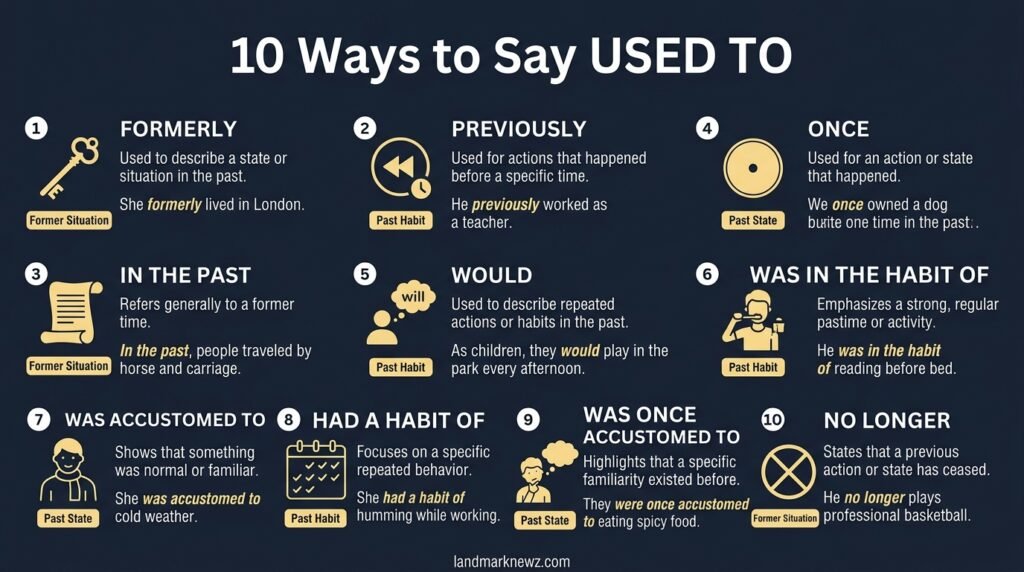
1. Formerly
Meaning
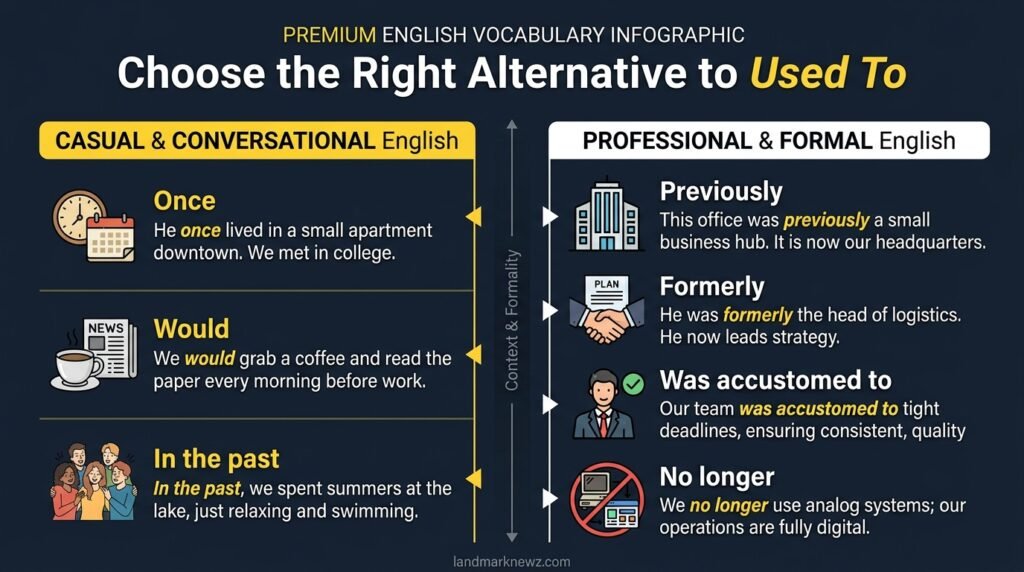
Formerly means that something was true in the past but is no longer true. It is especially useful when describing a person’s previous position, name, status, location, or condition.
Best For
- Professional
- Formal
Example 1
She was formerly the director of the company’s marketing department.
Example 2
The building was formerly a public library before it became a community center.
Quick Tip
Use formerly when describing a previous status or condition rather than a repeated daily habit.
2. Previously
Meaning
Previously means at an earlier time or before the current situation. It works well when you want to connect a past circumstance with the present.
Best For
- Professional
- Formal
- Polite
Example 1
I previously worked for a nonprofit organization in Seattle.
Example 2
The software was previously available only to business customers.
Quick Tip
Choose previously when you want a clean, professional alternative in reports, emails, resumes, or business writing.
3. In the Past
Meaning
In the past refers generally to an earlier period. It is one of the easiest alternatives to understand and can describe both past habits and past situations.
Best For
- Casual
- Professional
- Friendly
Example 1
In the past, I spent most of my weekends hiking with friends.
Example 2
We in the past relied on paper records, but everything is digital now.
Quick Tip
This phrase is flexible, but place it carefully in the sentence so the timing is immediately clear.
4. Once
Meaning
Once can mean that something was true at an earlier point but is not true now. It is concise and often gives writing a smoother, more polished feel.
Best For
- Formal
- Casual
- Friendly
Example 1
She once dreamed of becoming a professional photographer.
Example 2
This quiet neighborhood was once a busy industrial area.
Quick Tip
Use once when you want to emphasize that a former condition has changed.
5. Would
Meaning
Would can replace used to when talking about repeated actions or habits in the past. It often appears in stories or memories, especially when the past time period has already been established.
Best For
- Casual
- Friendly
- Warm
Example 1
When we were kids, we would ride our bikes around the neighborhood until sunset.
Example 2
Every summer, my grandparents would take us to the lake.
Quick Tip
Do not normally use would to replace used to when describing a past state, such as “I used to know him.”
6. Was in the Habit of
Meaning
Was in the habit of means someone regularly did something in the past. It clearly emphasizes a repeated behavior or routine.
Best For
- Formal
- Professional
Example 1
He was in the habit of reviewing his goals every Friday afternoon.
Example 2
The manager was in the habit of checking customer feedback before making major decisions.
Quick Tip
Use this phrase when you want to emphasize a consistent routine rather than simply mention something that happened before.
7. Was Accustomed To
Meaning
Was accustomed to means someone was familiar with or comfortable with something because they experienced it regularly. Unlike used to, it focuses more on familiarity than on a past action.
Best For
- Formal
- Professional
- Polite
Example 1
After several years in Alaska, she was accustomed to extremely cold winters.
Example 2
The new employee quickly became accustomed to the company’s flexible schedule.
Quick Tip
Use was accustomed to when the main idea is familiarity or adaptation, not simply a former habit.
8. Had a Habit of
Meaning
Had a habit of describes something a person regularly did, often over a period of time. It can be neutral, positive, or negative depending on the behavior.
Best For
- Professional
- Casual
- Friendly
Example 1
My brother had a habit of leaving his keys on the kitchen counter.
Example 2
The team had a habit of celebrating every successful project with a group dinner.
Quick Tip
This expression is useful when you want to draw attention to a person’s repeated behavior.
9. Was Once Accustomed To
Meaning
A more direct way to express a former routine or condition is to say someone was once accustomed to it. This emphasizes that the situation was familiar in the past but has changed.
Best For
- Formal
- Professional
Example 1
The residents were once accustomed to frequent power interruptions.
Example 2
She was once accustomed to working long hours before moving to a more flexible role.
Quick Tip
Use this construction sparingly because it is more formal and wordy than simply saying used to.
10. No Longer
Meaning
No longer does not directly replace used to, but it can communicate the same change from a past situation to the present when the sentence is rewritten.
Best For
- Professional
- Formal
- Polite
Example 1
I no longer work in the downtown office.
Example 2
The company no longer accepts applications through the old website.
Quick Tip
Use no longer when the important point is that something stopped being true. It often creates a concise and professional sentence.
Comparison Table
| Alternative | Best Used In | Tone |
| Formerly | Professional, formal writing | Formal |
| Previously | Business, academic, professional | Formal |
| In the past | Everyday and professional writing | Neutral |
| Once | Stories and general writing | Natural |
| Would | Past habits and memories | Conversational |
| Was in the habit of | Formal descriptions of routines | Formal |
| Was accustomed to | Familiarity and adaptation | Formal |
| Had a habit of | Repeated behavior | Neutral |
| Was once accustomed to | Past familiarity | Formal |
| No longer | Changed present conditions | Direct |
Common Mistakes
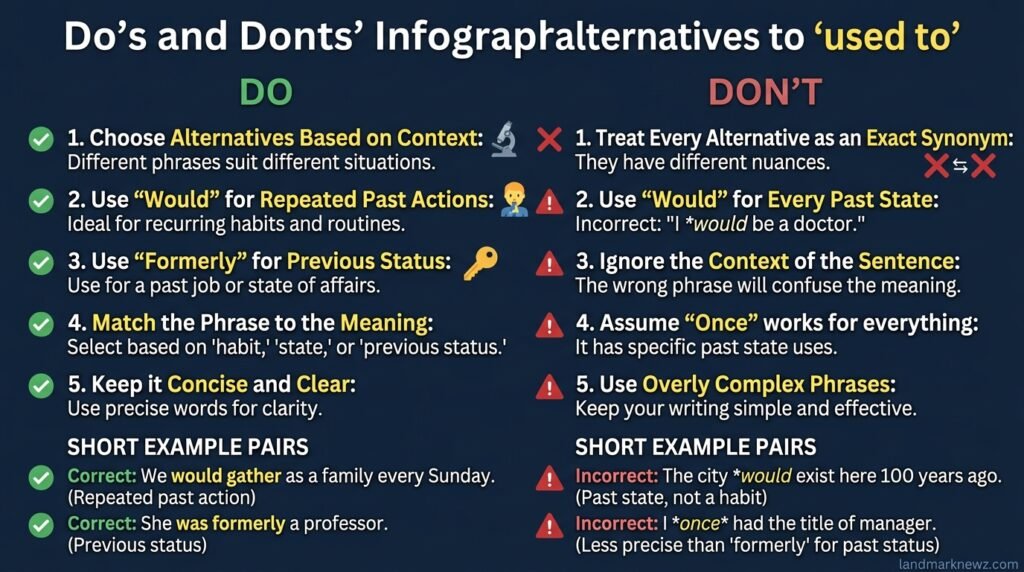
1. Using “Would” for a Past State
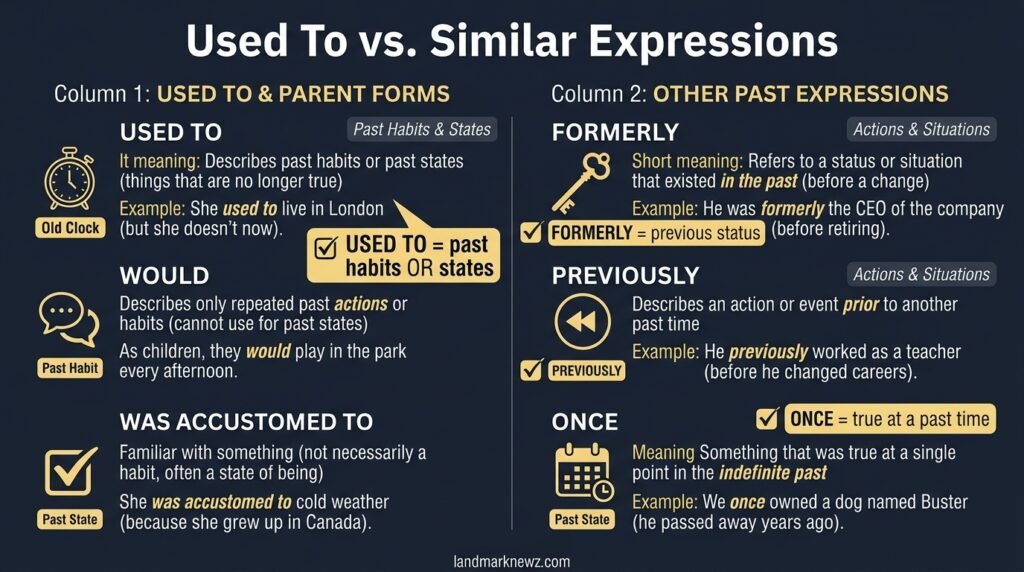
Would generally describes repeated actions, not permanent or ongoing past states. “I used to live in Boston” is correct, while “I would live in Boston” usually changes the intended meaning.
2. Treating Every Alternative as an Exact Synonym
Words such as formerly, once, and previously overlap with “used to,” but their meanings are not identical. Always consider whether you are describing a habit, state, status, or familiarity.
3. Choosing Overly Formal Language
Expressions such as was in the habit of may sound unnatural in casual conversation. Sometimes the simplest option—used to—is actually the best choice.
4. Ignoring the Time Reference
Some alternatives need enough context to show when the earlier situation happened. If the reader cannot tell which period you mean, add a clear time reference such as “when I was younger” or “before I changed jobs.”
5. Repeating the Same Alternative
Replacing every instance of “used to” with previously can create another form of repetition. Vary your wording naturally while keeping the intended meaning clear.
Frequently Asked Questions
What is another way to say “used to” in professional writing?
In professional writing, previously, formerly, and in the past are strong choices. For example, “She previously worked in sales” sounds professional and direct. Formerly is particularly useful when describing a former position, role, name, or status.
What is a formal word for “used to”?
Formerly and previously are among the most useful formal alternatives. “Formerly” often describes a previous status or identity, while “previously” simply indicates that something happened earlier. Choose between them based on the sentence rather than treating them as interchangeable in every situation.
Can I use “would” instead of “used to”?
Yes, but mainly when used to describes a repeated past action. For example, “When I was young, I used to visit my grandparents every Sunday” can become “When I was young, I would visit my grandparents every Sunday.” However, would generally does not work for past states.
What is another way to say “I used to”?
Depending on the meaning, you can say I previously, I formerly, I once, or in the past, I. For repeated actions, I would can also work when the time period is clear. The best choice depends on whether you are describing an action, habit, role, or former situation.
What is another way to say “used to” in an essay?
For an essay, previously, formerly, in the past, and once are useful options. They can make formal writing more varied without sounding unnatural. However, “used to” itself is perfectly acceptable in many essays when the sentence is clear and the tone is appropriate.
How do you say “used to” without repeating it?
You can vary the wording with expressions such as previously, formerly, once, in the past, and would. However, do not change the wording simply for variety. Select an alternative that preserves the exact meaning and fits the surrounding sentence.
Is “formerly” the same as “used to”?
Not always. Formerly usually means that a person, place, role, or situation had a different status in the past. Used to can describe both past states and repeated habits. For example, “I used to run every morning” cannot naturally become “I formerly ran every morning” in every context.
What is the difference between “used to” and “was accustomed to”?
Used to can describe a past habit or state that is no longer true. Was accustomed to focuses on being familiar or comfortable with something because it was experienced regularly. For example, “I used to work nights” describes a former routine, while “I was accustomed to working nights” emphasizes familiarity with that schedule.
Conclusion
There are many natural alternatives to used to, but the right choice depends on what you want to communicate. Understanding the meaning and use of “used to” can help you choose the right alternative. Use previously or formerly for professional and formal writing, once for a concise reference to the past, and in the past when you want a simple, flexible expression. …
For repeated actions in stories, would can create a natural conversational tone. If you want to emphasize familiarity, was accustomed to is more precise. Meanwhile, no longer works well when your main point is that something has changed.
The key is not to replace “used to” automatically. Choose the expression that matches the meaning, audience, and tone of your sentence. Clear wording will always matter more than forcing a synonym.

About Dr. Priya Nair
Dr. Priya Nair is a passionate Writer & Blogger at LandMarkNewz.com, dedicated to creating informative, engaging, and easy-to-understand content for readers. With a strong interest in research, current trends, lifestyle, and everyday topics, she focuses on presenting useful information in a clear and reader-friendly way.
Through her writing, Priya aims to help readers discover valuable insights, understand complex topics more easily, and stay informed about subjects that matter to them. Her approach combines thoughtful research with a simple and engaging writing style.
At LandMarkNewz.com, she contributes original articles designed to inform, educate, and provide practical value to readers.