
Another Way to Say In Essence: Mean?
The phrase “in essence” means “in its basic nature,” “at its core,” or “when reduced to the most important point.” People use it when they want to summarize the central meaning of an idea without focusing on minor details.
For example, you might say, “In essence, the policy gives employees more flexibility.” This means that the main point of the policy is to provide greater flexibility.
The phrase commonly appears in essays, business writing, presentations, reports, academic discussions, and everyday explanations. However, repeating “in essence” can make your writing feel predictable, so using a suitable alternative can improve variety and clarity.
Why Use Other Ways to Say “In Essence”?
Choosing a different expression can make your writing sound more natural and better suited to the situation. Some alternatives are more formal, while others feel simpler and more conversational.
Using different phrases can help you:
- Avoid repeating the same expression.
- Make complex ideas easier to understand.
- Match the tone to your audience.
- Improve professional and academic writing.
- Emphasize the central idea more naturally.
- Make explanations sound less repetitive.
The key is to choose an alternative based on what you are trying to emphasize. For example, “fundamentally” highlights a basic principle, while “in short” focuses more on summarizing information.
10 Best Other Ways to Say “In Essence”
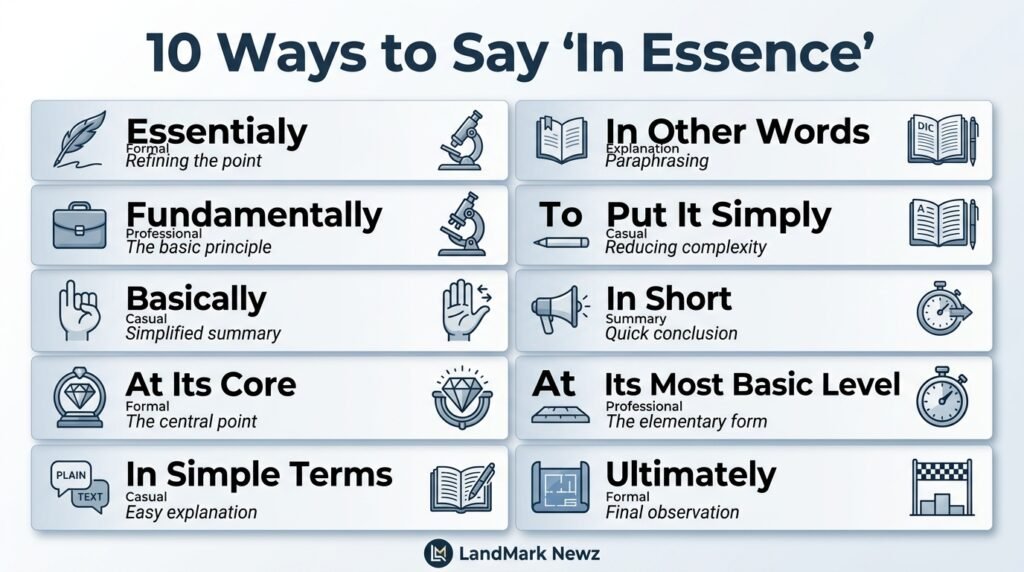
1. Essentially
Meaning
Essentially is one of the closest alternatives to “in essence.” It introduces the main or most important nature of something while leaving out secondary details.
It works naturally in both professional and everyday American English.
Best For
- Professional
- Formal
- Friendly
Example 1
Essentially, the new system allows customers to complete their orders faster.
Example 2
The two proposals are essentially designed to solve the same problem.
Quick Tip
Use “essentially” when you want the closest natural replacement for “in essence.”
2. Fundamentally
Meaning
Fundamentally refers to something basic, central, or deeply important. It is especially useful when discussing principles, causes, systems, or major differences.
The word has a slightly more formal tone than “essentially.”
Best For
- Professional
- Formal
Example 1
Fundamentally, the company needs to improve how it communicates with customers.
Example 2
The two approaches are fundamentally different in how they handle risk.
Quick Tip
Choose “fundamentally” when you want to emphasize a basic principle rather than simply summarize an idea.
3. Basically
Meaning
Basically presents the main idea in a simple and direct way. It is common in everyday American English and works well in casual conversations.
Although useful, it can sound less formal than “in essence.”
Best For
- Casual
- Friendly
- Polite
Example 1
Basically, the app helps users keep all their appointments in one place.
Example 2
The job is basically about helping customers find the right products.
Quick Tip
Use “basically” in conversational writing, but choose a more formal alternative for academic or highly professional documents.
4. At Its Core
Meaning
At its core focuses on the central quality, purpose, or idea behind something. It is a vivid and natural expression that can make explanations easier to understand.
It works particularly well when discussing businesses, concepts, relationships, and values.
Best For
- Professional
- Friendly
- Warm
Example 1
At its core, the program is designed to help small businesses grow.
Example 2
At its core, good leadership is about building trust with your team.
Quick Tip
Use “at its core” when you want to draw attention to the central idea or purpose.
5. In Simple Terms
Meaning
In simple terms signals that you are about to explain something in an easier or more accessible way. It is especially useful when your audience may not know technical or complicated terminology.
This phrase prioritizes clarity over formality.
Best For
- Professional
- Friendly
- Polite
Example 1
In simple terms, the agreement allows both companies to share resources.
Example 2
In simple terms, the software turns complicated data into useful reports.
Quick Tip
Choose this expression when your main goal is to make a complicated point easier to understand.
6. In Other Words
Meaning
In other words means that you are restating the same idea using different language. It is particularly useful when the original explanation may be difficult or unclear.
Unlike “in essence,” it focuses more on rephrasing than reducing an idea to its core.
Best For
- Professional
- Formal
- Friendly
Example 1
The deadline cannot be extended. In other words, we need to finish the project today.
Example 2
The product requires less maintenance. In other words, customers can spend less time managing it.
Quick Tip
Use “in other words” when you are clarifying or restating something rather than simply summarizing it.
7. To Put It Simply
Meaning
To put it simply introduces a straightforward explanation of a more complicated point. It tells readers that you are reducing an idea to language that is easier to follow.
It sounds natural in explanations, articles, presentations, and conversations.
Best For
- Friendly
- Professional
- Polite
Example 1
To put it simply, the new policy gives employees more control over their schedules.
Example 2
To put it simply, customers want a service that is fast, reliable, and easy to use.
Quick Tip
Use this phrase when you want to simplify a complex explanation without sounding too technical.
8. In Short
Meaning
In short is a concise way to summarize a longer explanation. It emphasizes the final or most important point rather than explaining the nature of something.
It is especially useful at the end of a paragraph or discussion.
Best For
- Professional
- Formal
- Friendly
Example 1
The project faced several unexpected problems. In short, we need more time to complete it.
Example 2
The research examined cost, quality, and customer satisfaction. In short, quality had the strongest effect on retention.
Quick Tip
Use “in short” when you want to condense several points into one clear conclusion.
9. At Its Most Basic Level
Meaning
At its most basic level focuses on the simplest underlying idea or function of something. It is useful when explaining systems, theories, processes, or technical subjects.
The phrase sounds more explanatory than conversational.
Best For
- Professional
- Formal
Example 1
At its most basic level, the program helps businesses organize customer information.
Example 2
At its most basic level, supply and demand determine how prices respond to market conditions.
Quick Tip
Use this phrase when breaking down a complex subject into its simplest fundamental concept.
10. Ultimately
Meaning
Ultimately focuses on the final, most important point or result. It does not always mean exactly the same thing as “in essence,” but it can work when the intended meaning involves the central conclusion.
It is common in professional, academic, and persuasive writing.
Best For
- Professional
- Formal
- Polite
Example 1
Ultimately, the success of the project depends on how well the team works together.
Example 2
Ultimately, customers want a solution that saves them time and reduces unnecessary costs.
Quick Tip
Use “ultimately” when emphasizing the final conclusion rather than simply restating the basic meaning.
Comparison Table
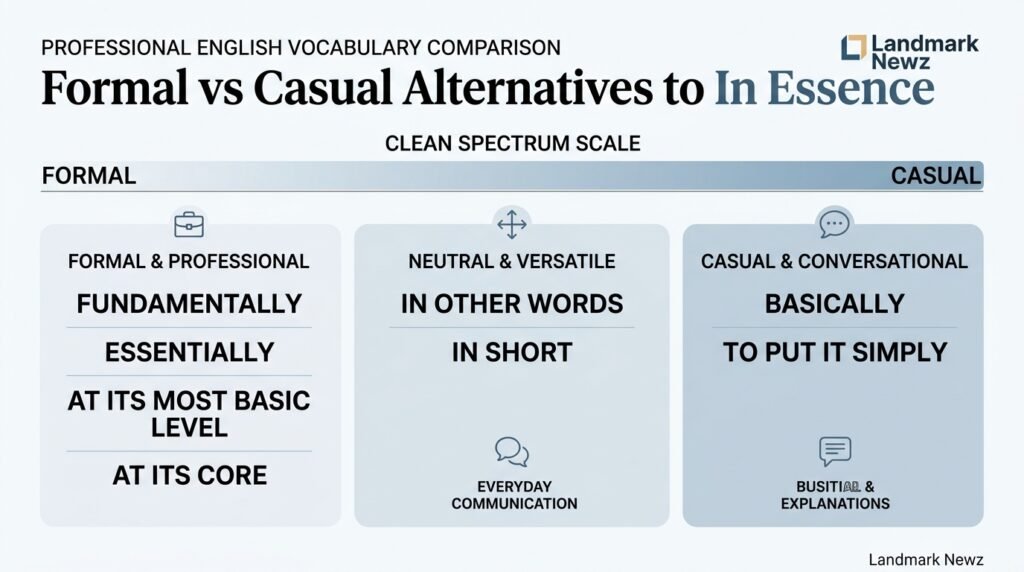
| Alternative | Best Used In | Tone |
| Essentially | Professional writing and general explanations | Neutral |
| Fundamentally | Academic and professional writing | Formal |
| Basically | Conversations and casual writing | Casual |
| At its core | Explanations and persuasive writing | Natural |
| In simple terms | Educational and explanatory content | Clear |
| In other words | Clarifications and restatements | Neutral |
| To put it simply | Explanations and presentations | Conversational |
| In short | Summaries and conclusions | Concise |
| At its most basic level | Technical and academic explanations | Formal |
| Ultimately | Conclusions and professional writing | Formal |
Common Mistakes
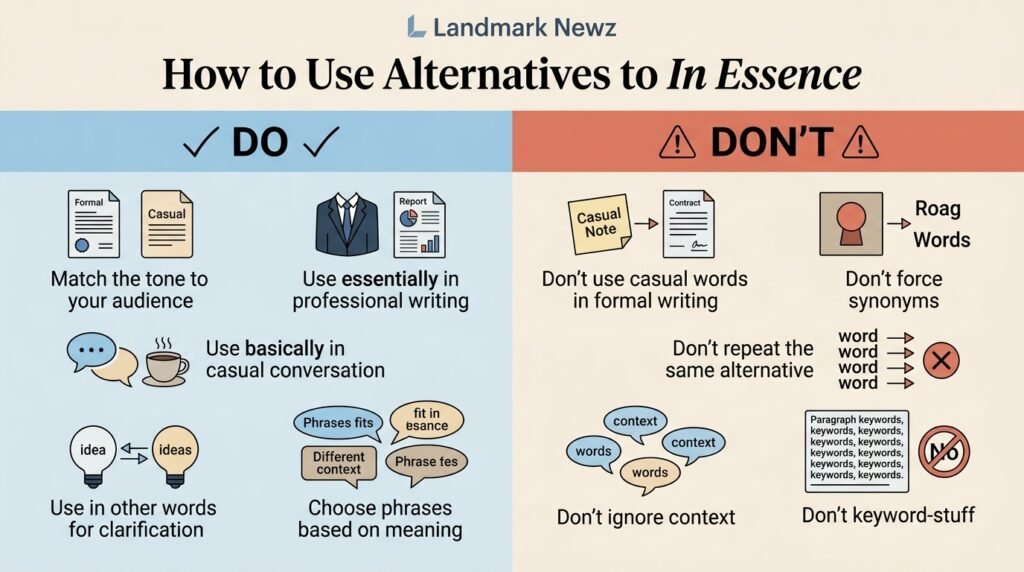
1. Using a casual phrase in formal writing
Words such as “basically” can sound too conversational in academic papers, legal documents, or formal reports. In these situations, “essentially” or “fundamentally” may be a better fit.
2. Treating every alternative as an exact synonym
Not every phrase has precisely the same meaning. For example, “in other words” means you are restating an idea, while “ultimately” usually introduces a final conclusion.
3. Overusing the same alternative
Replacing “in essence” with “essentially” in every sentence does not solve repetition. Rotate your wording naturally when the context allows it.
4. Choosing formality over clarity
A sophisticated word is not automatically better. If your audience needs a simple explanation, “in simple terms” may communicate your point more effectively than “fundamentally.”
5. Using an alternative that changes the meaning
Always check what you are emphasizing. If you are simplifying an explanation, use “to put it simply.” If you are identifying a central characteristic, “at its core” may be more accurate.
Frequently Asked Questions
What is the best professional alternative to “in essence”?
Essentially is usually the best professional alternative to “in essence.” It has nearly the same meaning and sounds natural in emails, reports, presentations, and business writing. Fundamentally is another strong choice when you want to emphasize a basic principle, underlying issue, or major characteristic.
What is a simple way to say “in essence”?
You can say “basically,” “in simple terms,” “to put it simply,” or “at its core.” The best choice depends on the context. “Basically” is more conversational, while “in simple terms” works well when explaining a complicated idea to a general audience.
Is “essentially” the same as “in essence”?
Yes, in many situations, “essentially” and “in essence” can be used interchangeably. Both can introduce the central meaning or basic nature of something. However, “essentially” often sounds more natural in modern American English, especially in professional and everyday communication.
Is “basically” a good replacement for “in essence”?
Basically can replace “in essence” in casual or conversational situations. However, it may sound less polished in formal writing. For a business report, academic paper, or professional email, “essentially,” “fundamentally,” or “at its core” may be more appropriate.
What can I say instead of “in essence” in an essay?
For an essay, consider “essentially,” “fundamentally,” “at its core,” “in other words,” or “in short.” Your choice should depend on the purpose of the sentence. “Fundamentally” works well for analyzing principles, while “in short” is useful for summarizing a discussion.
What is another way to say “in essence” in a sentence?
You could write, “Essentially, the proposal gives employees greater flexibility.” Other options include, “At its core, the proposal gives employees greater flexibility,” or “In simple terms, the proposal gives employees greater flexibility.” Each version creates a slightly different emphasis.
Can I use “at its core” instead of “in essence”?
Yes. “At its core” is a natural alternative when you are describing the central idea, purpose, or quality of something. For example, “At its core, the organization exists to support local businesses.” This wording is especially effective in business, marketing, and explanatory content.
Which alternative sounds most natural in everyday American English?
Basically, essentially, in other words, and at its core are all common choices. “Basically” is especially conversational, while “essentially” works across a wider range of situations. When explaining something to another person, “in other words” is often the most natural choice for clarification.
Conclusion
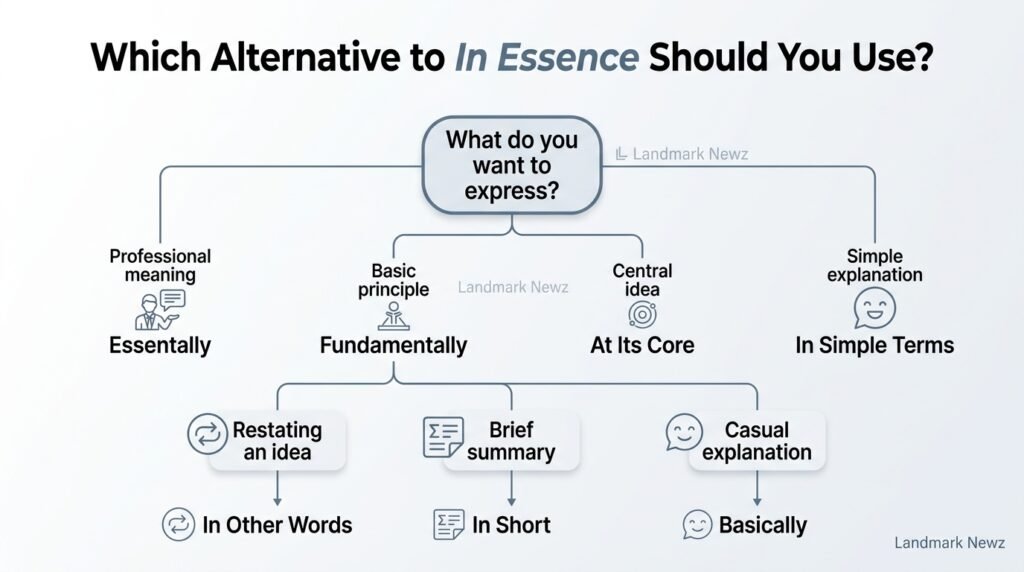
There are many natural ways to say “in essence,” and the best choice depends on your purpose and audience. Understanding the meaning of “in essence” can help you choose the right alternative. Essentially is the closest all-purpose replacement, making it a strong option for professional and everyday writing.
Fundamentally works better when you want to emphasize an underlying principle, while at its core highlights the central nature of an idea.
For simpler explanations, try “in simple terms” or “to put it simply.” When you are restating information, “in other words” is usually more precise. Meanwhile, “in short” is ideal for concise summaries.
The most important rule is to choose the phrase that preserves your intended meaning. A good synonym should make your writing clearer, not simply make it different.

Professional Writing & Workplace Communication Expert
Marcus Hale is a business communication specialist with 11 years of experience in corporate training and professional writing. He has worked with mid-sized companies and remote teams to improve clarity in emails, reports, performance reviews, and client-facing messages.
Marcus focuses on polished, professional alternatives that help readers sound confident without sounding stiff. His guides cover workplace phrases, resume language, leadership communication, and formal-to-natural transitions. He holds a background in business administration and technical writing, and has led workshops on effective professional English.
At LandmarkNewz, Marcus creates practical synonym lists and phrasing tips that professionals can apply immediately in emails, meetings, and career documents.