
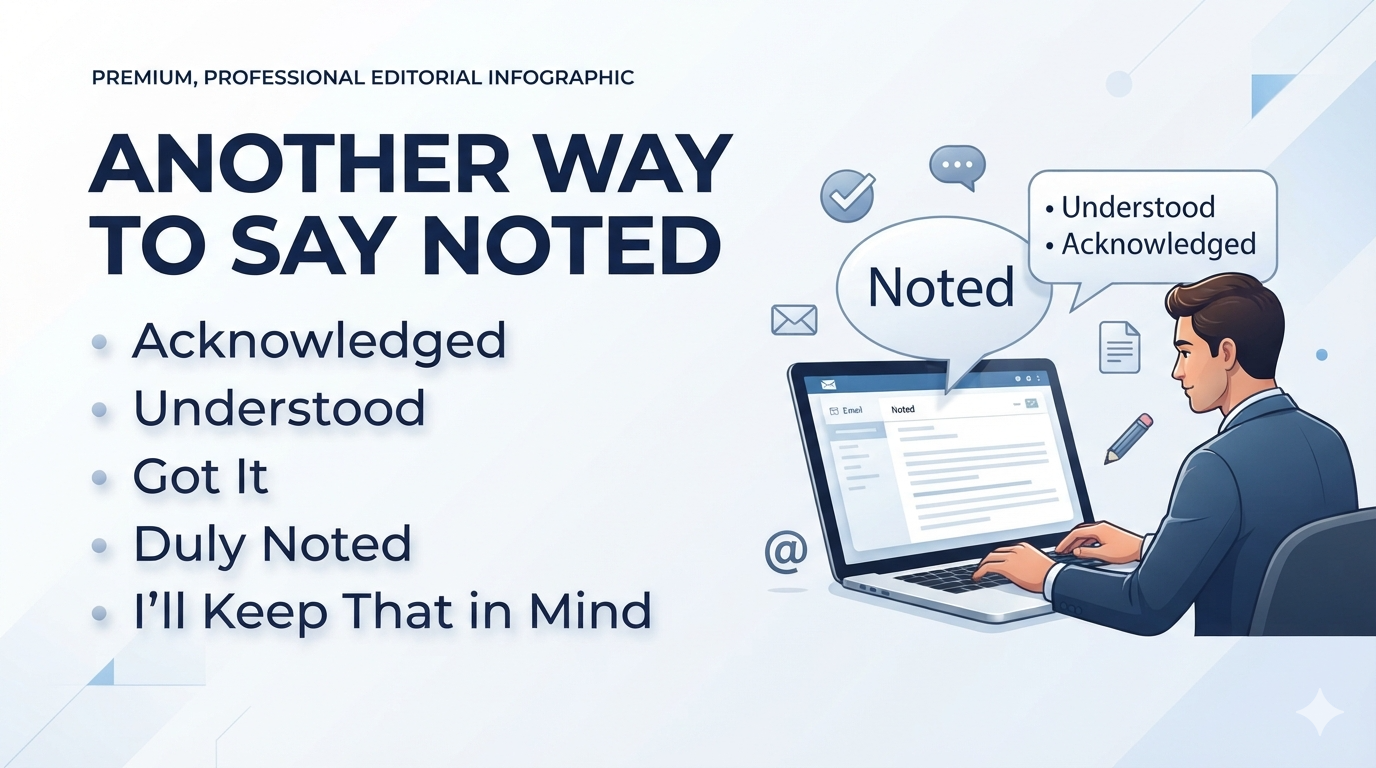
Finding another way to say noted can help your communication sound more natural, specific, and professional. Although “noted” is useful, repeating it in emails, texts, or workplace conversations can make your writing feel brief or impersonal.
The right alternative depends on what you actually mean. You might want to confirm that you received information, show that you understand an instruction, or politely acknowledge someone’s message.
What Does “Another Way to Say Noted” Mean?
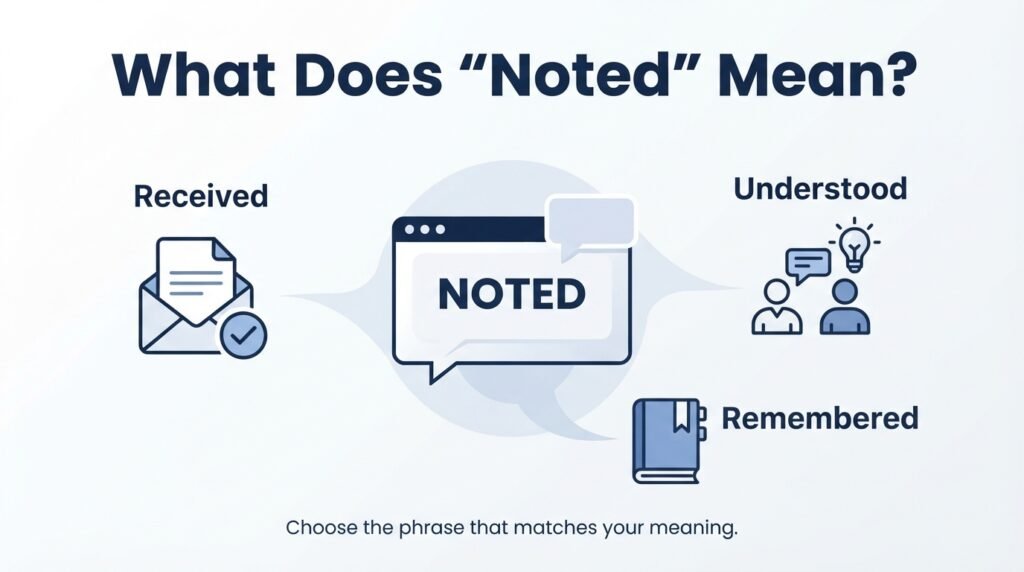
The phrase “another way to say noted” refers to alternative expressions that communicate the same basic idea as “noted.” In most situations, noted means that you have received, recognized, or recorded information.
For example, if a manager says, “Please submit the report by Friday,” replying “Noted” tells the manager that you have received the instruction.
People commonly search for alternatives to “noted” because the word can sometimes sound too brief, formal, or even slightly cold. Choosing a more specific phrase can make your response clearer and better suited to the situation.
You may need an alternative in a work email, business message, customer conversation, school setting, or casual text.
Why Use Other Ways to Say “Noted”?
Although “noted” is correct, it does not always communicate the exact tone you want. A more specific response can make your message sound warmer, clearer, or more professional.
Using alternatives can help you:
- Avoid repeating “noted” in emails and conversations.
- Show whether you received or understood information.
- Sound more natural in everyday communication.
- Choose a tone that fits the situation.
- Make professional responses feel more polished.
- Show appreciation when someone provides useful information.
For example, “Understood” emphasizes comprehension, while “Thanks for letting me know” adds appreciation. “Duly noted” sounds more formal and is best used when a professional tone is appropriate.
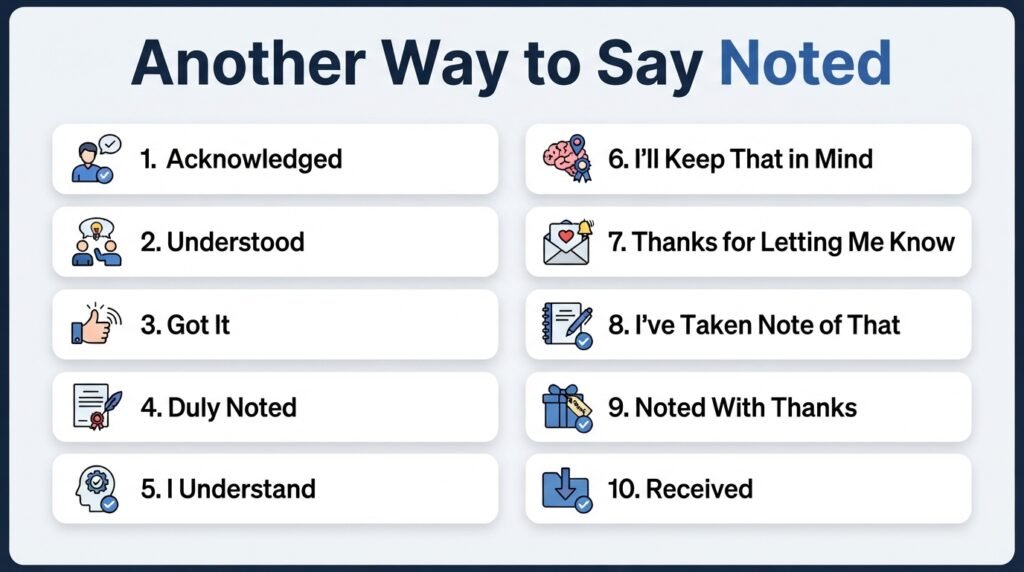
10 Best Other Ways to Say “Noted”
1. Acknowledged
Meaning
“Acknowledged” confirms that you have received and recognized information. It has a professional tone and works especially well when responding to instructions, updates, requests, or important messages.
Best For
- Professional
- Formal
- Polite
Example 1
Acknowledged. I’ll review the updated contract before tomorrow’s meeting.
Example 2
Your request has been acknowledged, and our team will follow up shortly.
Quick Tip
Use “acknowledged” when you want to sound professional and direct without adding unnecessary detail.
2. Understood
Meaning
“Understood” tells someone that you understand what they have said or what they want you to do. It is especially useful when someone gives you an instruction, correction, or expectation.
Best For
- Professional
- Formal
- Polite
Example 1
Understood. I’ll make the requested changes before submitting the final version.
Example 2
Understood, and I’ll make sure the team follows the new procedure.
Quick Tip
Choose “understood” when the main point is showing that you comprehend an instruction rather than simply receiving information.
3. Got It
Meaning
“Got it” is a natural and friendly alternative to “noted.” It usually means that you understand or have received what someone has told you.
Best For
- Casual
- Friendly
- Polite
Example 1
Got it. I’ll meet you at the front entrance at six.
Example 2
Got it—I’ll send you the updated photos tonight.
Quick Tip
“Got it” is ideal for texts, chats, and informal workplace conversations, but choose a more formal phrase for important business correspondence.
4. Duly Noted
Meaning
“Duly noted” is a more formal version of “noted.” It indicates that you have properly taken something into consideration or recorded the information.
Best For
- Formal
- Professional
- Polite
Example 1
Duly noted. We’ll include your concerns in the next project review.
Example 2
Duly noted, and we’ll take the scheduling issue into account.
Quick Tip
Use this phrase sparingly. In some situations, “duly noted” can sound stiff or overly formal.
5. I Understand
Meaning
“I understand” directly communicates that you comprehend the information or situation. It can also sound more considerate than a one-word response.
Best For
- Professional
- Friendly
- Polite
- Warm
Example 1
I understand your concern, and I appreciate you bringing it to my attention.
Example 2
I understand. We’ll adjust the timeline to reflect the new requirements.
Quick Tip
Use “I understand” when the other person is explaining a concern, expectation, or situation that requires acknowledgment.
6. I’ll Keep That in Mind
Meaning
“I’ll keep that in mind” shows that you have considered the information and intend to remember it. It often sounds more thoughtful and conversational than simply saying “noted.”
Best For
- Professional
- Friendly
- Warm
- Polite
Example 1
I’ll keep that in mind when preparing the presentation for next week.
Example 2
Thanks for the feedback. I’ll keep that in mind for future projects.
Quick Tip
This is a good choice when someone gives you advice, feedback, or a preference that you may need to remember later.
7. Thanks for Letting Me Know
Meaning
“Thanks for letting me know” acknowledges the information while also expressing appreciation. It creates a warmer response than the simple word “noted.”
Best For
- Professional
- Friendly
- Warm
- Polite
Example 1
Thanks for letting me know about the schedule change. I’ll plan accordingly.
Example 2
Thanks for letting me know. I’ll update the calendar with the new deadline.
Quick Tip
Use this phrase when someone has given you an update, especially when you want your response to sound courteous.
8. I’ve Taken Note of That
Meaning
“I’ve taken note of that” clearly states that you have recognized and remembered the information. It sounds professional without being as short as “noted.”
Best For
- Professional
- Formal
- Polite
Example 1
I’ve taken note of that and will include the changes in the next draft.
Example 2
I’ve taken note of your preferences and will share them with the design team.
Quick Tip
This phrase works well when you want to emphasize that the information has been considered rather than merely received.
9. Noted With Thanks
Meaning
“Noted with thanks” combines acknowledgment with appreciation. It is commonly suited to formal correspondence when you want to confirm receipt while remaining courteous.
Best For
- Formal
- Professional
- Polite
Example 1
Noted with thanks. We appreciate the additional information.
Example 2
Noted with thanks, and we’ll proceed according to the revised instructions.
Quick Tip
This phrase is best for formal written communication. In casual American English, “Thanks for letting me know” usually sounds more natural.
10. Received
Meaning
“Received” confirms that a message, document, file, or piece of information has reached you. It focuses more on receipt than understanding, so it is not always interchangeable with “noted.”
Best For
- Professional
- Formal
- Polite
Example 1
Received. I’ll review the attached proposal and respond by Friday.
Example 2
The signed documents have been received and added to the project file.
Quick Tip
Use “received” when confirming delivery of something. If you also need to show understanding, “understood” may be a better choice.
Comparison Table
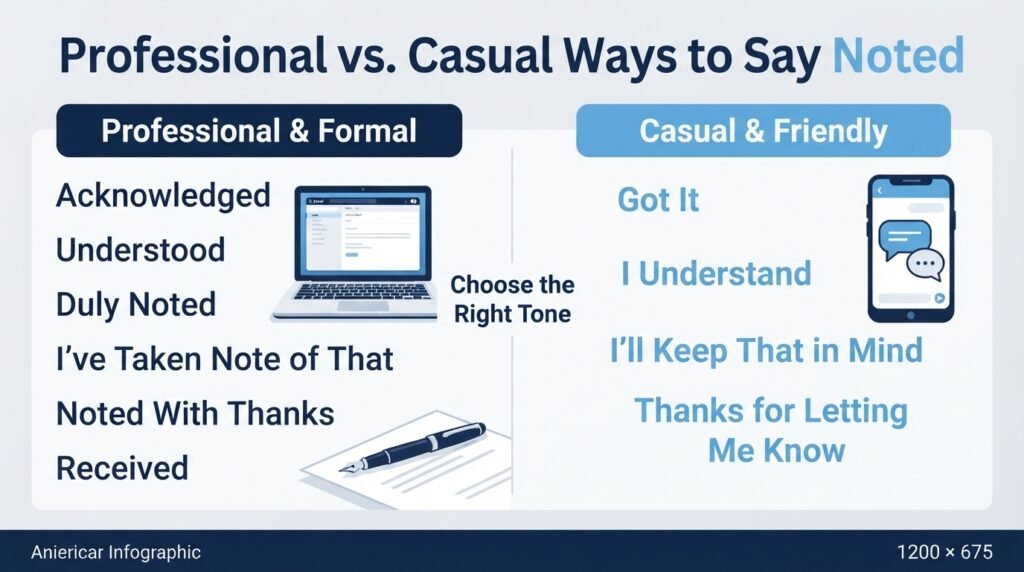
| Alternative | Best Used In | Tone |
| Acknowledged | Workplace emails, business communication | Professional |
| Understood | Instructions, requests, corrections | Clear and professional |
| Got It | Texts, chats, casual conversations | Casual and friendly |
| Duly Noted | Formal correspondence | Formal |
| I Understand | Concerns, explanations, instructions | Polite and considerate |
| I’ll Keep That in Mind | Feedback, advice, preferences | Warm and thoughtful |
| Thanks for Letting Me Know | Updates and announcements | Friendly and appreciative |
| I’ve Taken Note of That | Business communication | Professional |
| Noted With Thanks | Formal emails and correspondence | Formal and polite |
| Received | Documents, files, messages | Professional and direct |
Common Mistakes When Saying “Noted”
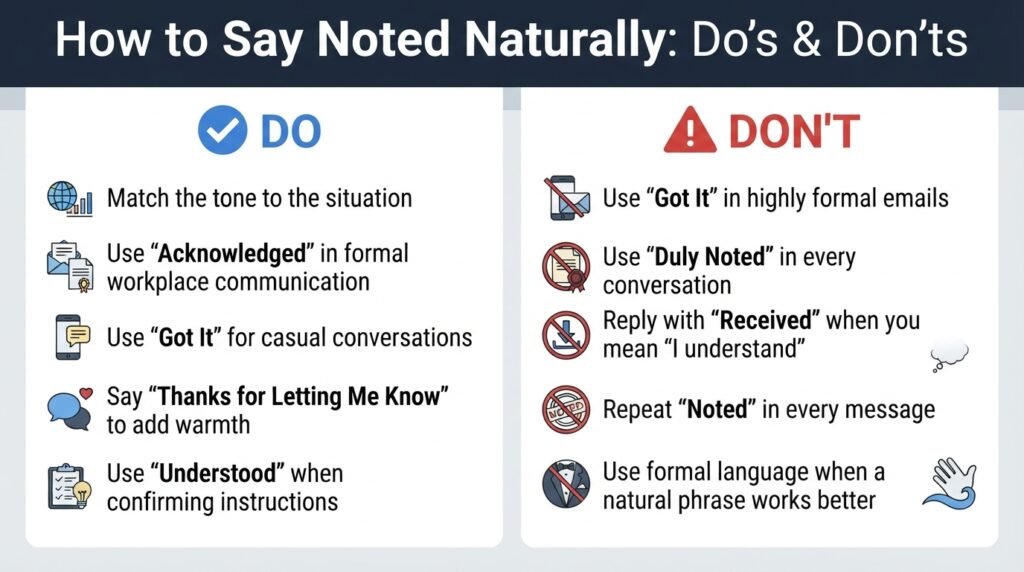
1. Using casual phrases in formal emails
“Got it” may sound perfectly natural in a team chat but can feel too casual in a formal business email. Match your wording to the relationship and setting.
2. Choosing overly formal language
“Duly noted” is correct, but using it in every conversation can make your communication sound stiff. In many everyday situations, “Got it” or “Thanks for letting me know” is more natural.
3. Repeating “noted” too often
A one-word acknowledgment can become repetitive when used throughout a long email thread. Vary your language when the context changes.
4. Forgetting the difference between receiving and understanding
“Received” confirms that something reached you, but it does not necessarily mean you understand it. When comprehension matters, use “understood” or “I understand.”
5. Sounding insincere
Some phrases can feel automatic if they do not match the situation. If someone shares useful feedback, adding “Thanks for letting me know” can sound more genuine than simply replying “Noted.”
Frequently Asked Questions
What is a professional way to say “noted”?
“Acknowledged” is one of the best professional alternatives to “noted.” You can also use “understood,” “I’ve taken note of that,” or “I’ll keep that in mind,” depending on the situation. For a business email, choose the phrase that clearly communicates whether you received, understood, or intend to act on the information.
What is a polite way to say “noted”?
“Thanks for letting me know” is a polite and natural alternative to “noted.” It acknowledges the information while showing appreciation. “I understand” and “I’ll keep that in mind” are also courteous options, especially when someone provides feedback, advice, an update, or an important request.
Is “acknowledged” better than “noted”?
“ Acknowledged” can sound more professional and deliberate than “noted,” particularly in workplace communication. However, neither phrase is always better. “Acknowledged” confirms recognition, while “noted” can simply mean that you have taken notice of something. Choose the phrase that best matches your intended meaning.
Is “duly noted” a good alternative to “noted”?
Yes, but “duly noted” is more formal. It works well in professional or official correspondence when you want to indicate that you have properly considered someone’s comment or request. In casual American conversations, however, it may sound unnecessarily formal, so “Got it” or “I understand” is often more natural.
What can I say instead of “noted” in an email?
Depending on the context, you can write “Acknowledged,” “Understood,” “Thanks for letting me know,” “I’ll keep that in mind,” or “I’ve taken note of that.” If you received a document, “Received” may be more precise. Select the phrase based on whether you are confirming receipt, understanding, or future action.
How do you say “noted” without sounding rude?
Add context or appreciation instead of using a short one-word response. For example, “Thanks for letting me know,” “I understand, and I’ll take care of it,” or “I’ll keep that in mind” can sound warmer. A brief “Noted” is not inherently rude, but its tone can feel cold depending on the situation.
What is a casual way to say “noted”?
“Got it” is one of the most natural casual alternatives. You can also say “Sure, I understand,” “Okay, got it,” or “I’ll keep that in mind.” These expressions work well in texts, instant messages, conversations with friends, and informal workplace chats.
What is the best alternative to “noted” for workplace communication?
“Understood” and “Acknowledged” are strong choices for workplace communication because they sound clear and professional. If someone gives you feedback or an update, “Thanks for letting me know” may be better because it adds a courteous and human touch to your response.
Conclusion
There are many useful alternatives to “noted,” and the best one depends on what you want to communicate. If you need a professional response, “acknowledged” is a reliable choice. For instructions or expectations, “understood” clearly shows comprehension. In casual conversations, “got it” sounds natural and friendly.
When someone gives you advice or feedback, “I’ll keep that in mind” feels thoughtful, while “thanks for letting me know” adds warmth and appreciation. For formal communication, “duly noted” or “noted with thanks” may fit better.
The key is to choose language that matches the situation instead of treating every alternative as interchangeable. A precise response can make even a short email or message sound clearer, more respectful, and more natural. Learning how to write effective acknowledgment email replies can also help you choose the right wording in professional communication.

Professional Writing & Workplace Communication Expert
Marcus Hale is a business communication specialist with 11 years of experience in corporate training and professional writing. He has worked with mid-sized companies and remote teams to improve clarity in emails, reports, performance reviews, and client-facing messages.
Marcus focuses on polished, professional alternatives that help readers sound confident without sounding stiff. His guides cover workplace phrases, resume language, leadership communication, and formal-to-natural transitions. He holds a background in business administration and technical writing, and has led workshops on effective professional English.
At LandmarkNewz, Marcus creates practical synonym lists and phrasing tips that professionals can apply immediately in emails, meetings, and career documents.