What Does “Another Way to Say Tips and Tricks” Mean?
The phrase “tips and tricks” describes useful pieces of advice, techniques, shortcuts, or small methods that help someone complete a task more easily or effectively.
It is common in tutorials, blogs, online courses, workplace training, social media posts, product guides, and everyday conversations. Because the phrase can sound casual or repetitive, writers often look for alternatives that better match their audience or situation.
For example, a professional report might use “best practices”, while a friendly tutorial could say “helpful hints.”
Why Use Other Ways to Say “Tips and Tricks”?
Using different expressions can make your writing clearer and more appropriate for the situation. Although “tips and tricks” is familiar and easy to understand, it may not always sound professional or specific enough.
Other phrases can help you:
- Avoid repeating the same expression.
- Make professional writing sound more polished.
- Choose language that fits your audience.
- Explain advice more precisely.
- Make tutorials and guides more engaging.
- Emphasize practical methods, strategies, or expertise.
The key is to choose a phrase that describes what you actually mean rather than replacing “tips and tricks” with a random synonym.
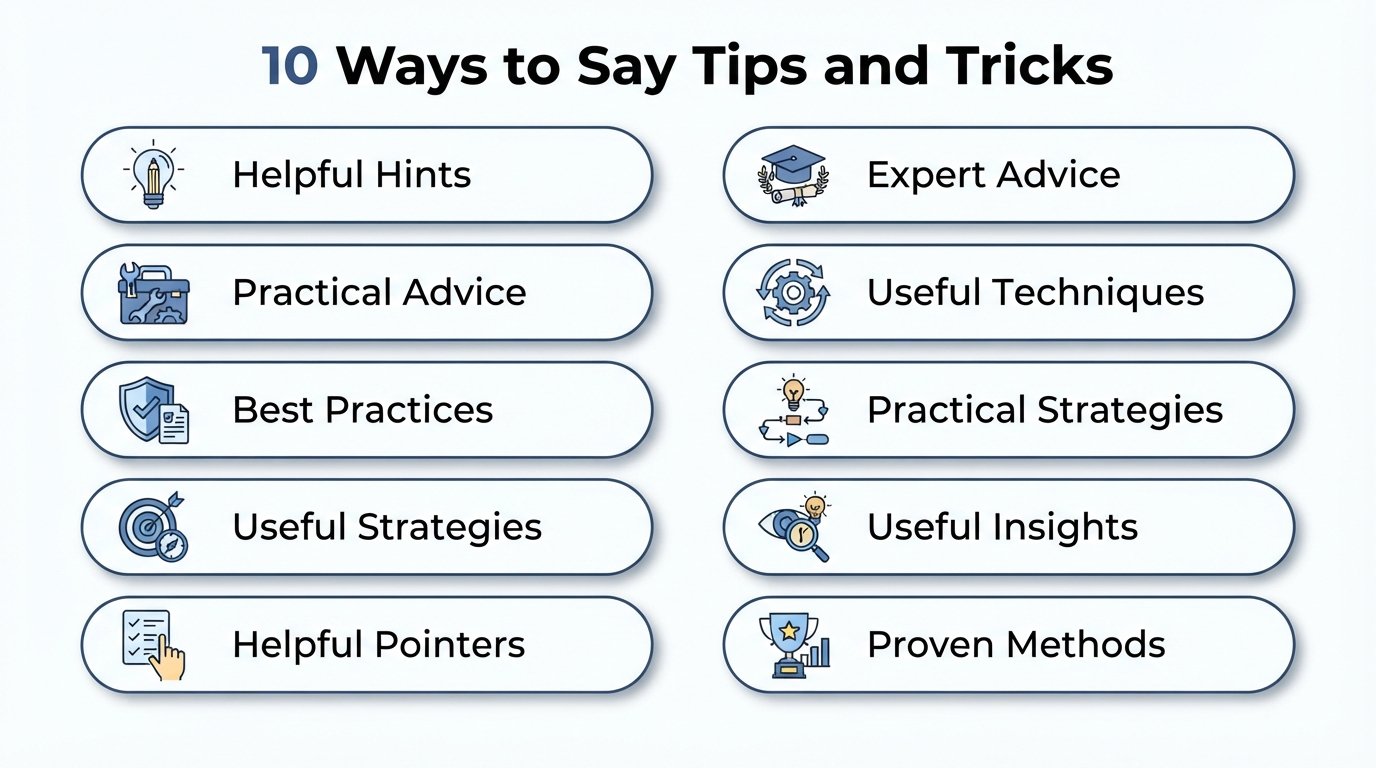
10 Best Other Ways to Say “Tips and Tricks”
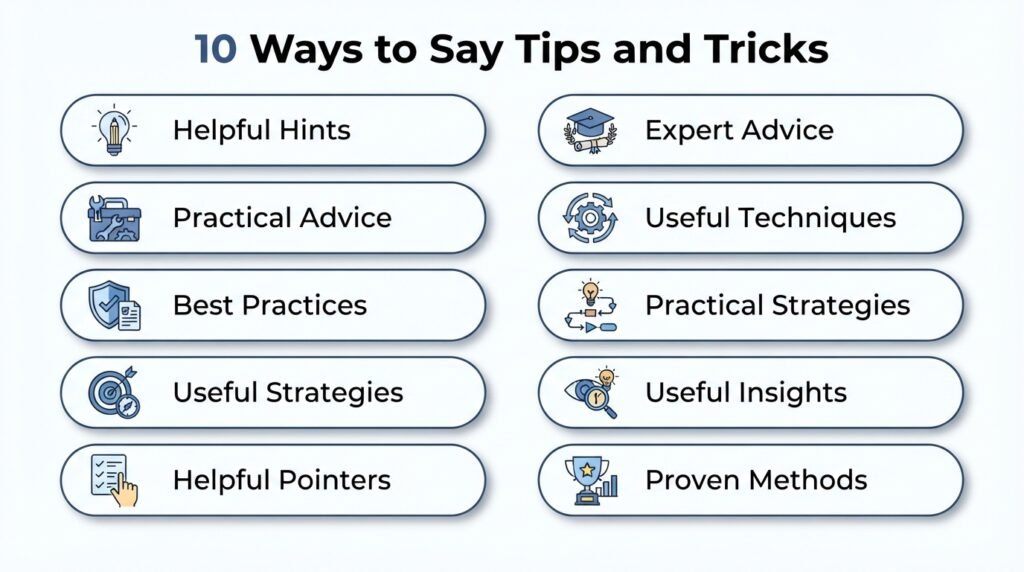
1. Helpful Hints
Mean]ing
“Helpful hints” refers to small pieces of advice that make a task easier or help someone avoid common problems. It has a friendly, approachable tone and works especially well when giving simple guidance.
Best For
- Casual
- Friendly
- Warm
- Polite
Example 1
Here are a few helpful hints for keeping your kitchen organized.
Example 2
The instructor shared some helpful hints for preparing for the exam.
Quick Tip
Use “helpful hints” when your advice is simple, practical, and intended to be easy to follow.
2. Practical Advice
Meaning
“Practical advice” describes guidance that someone can apply in a real situation. It sounds more purposeful than “tips and tricks” and is suitable when you want to emphasize useful, realistic recommendations.
Best For
- Professional
- Formal
- Friendly
- Polite
Example 1
The consultant offered practical advice for managing a growing team.
Example 2
This guide provides practical advice for saving money on everyday expenses.
Quick Tip
Choose this phrase when your recommendations focus on actions readers can realistically take.
3. Best Practices
Meaning
“Best practices” refers to methods or approaches that are generally considered effective within a particular field or situation. It is especially common in business, technology, education, management, and professional training.
Best For
- Professional
- Formal
Example 1
The workshop covers best practices for protecting sensitive customer information.
Example 2
Managers should understand the best practices for conducting employee evaluations.
Quick Tip
Use “best practices” when discussing established or recommended methods rather than casual shortcuts.
4. Useful Strategies
Meaning
“Useful strategies” focuses on planned approaches for achieving a particular goal. It sounds more intentional than “tips and tricks” and works well when the advice involves several steps or decisions.
Best For
- Professional
- Formal
- Polite
Example 1
The article explains useful strategies for improving customer retention.
Example 2
Students can learn useful strategies for managing their time during finals week.
Quick Tip
Use this option when your advice involves planning, problem-solving, or reaching a specific objective.
5. Helpful Pointers
Meaning
“Helpful pointers” means brief pieces of guidance that give someone direction. The phrase is natural and conversational while still sounding polished enough for many workplace and instructional settings.
Best For
- Professional
- Friendly
- Casual
- Polite
Example 1
My supervisor gave me a few helpful pointers before my first presentation.
Example 2
Here are some helpful pointers for choosing the right laptop for your needs.
Quick Tip
“Pointers” is a great choice when you want to sound helpful without being overly formal.
6. Expert Advice
Meaning
“Expert advice” refers to recommendations based on specialized knowledge, training, or experience. It emphasizes credibility rather than simple shortcuts or casual suggestions.
Best For
- Professional
- Formal
- Polite
Example 1
The article includes expert advice from experienced financial professionals.
Example 2
You can find expert advice on choosing the right equipment for your project.
Quick Tip
Use “expert advice” only when the guidance genuinely comes from someone with relevant expertise.
7. Useful Techniques
Meaning
“Useful techniques” refers to specific methods for performing a task or improving a result. It is a strong alternative when your “tips and tricks” involve skills that can be learned and practiced.
Best For
- Professional
- Formal
- Casual
Example 1
The trainer demonstrated useful techniques for handling difficult customer conversations.
Example 2
These useful techniques can help beginners improve their writing skills.
Quick Tip
Choose “techniques” when you are describing a specific way of doing something rather than general advice.
8. Practical Strategies
Meaning
“Practical strategies” describes realistic approaches designed to solve a problem or achieve a goal. It sounds professional and works particularly well in articles, presentations, reports, and educational content.
Best For
- Professional
- Formal
- Polite
Example 1
The program teaches practical strategies for reducing workplace stress.
Example 2
Small businesses can use these practical strategies to improve their online presence.
Quick Tip
This is one of the best choices when you want a professional replacement for “tips and tricks.”
9. Useful Insights
Meaning
“Useful insights” refers to valuable observations, ideas, or information that can improve someone’s understanding or decision-making. It suggests depth and knowledge rather than simple instructions.
Best For
- Professional
- Formal
- Friendly
Example 1
The interview provides useful insights into the challenges facing new entrepreneurs.
Example 2
The team meeting produced several useful insights about customer preferences.
Quick Tip
Use “insights” when the information helps people understand a subject more deeply.
10. Proven Methods
Meaning
“Proven methods” refers to approaches that have demonstrated their effectiveness through experience, testing, or repeated use. The phrase sounds confident and professional, but it should be used only when the methods have reasonable support behind them.
Best For
- Professional
- Formal
- Polite
Example 1
The course teaches proven methods for improving workplace productivity.
Example 2
These proven methods can help beginners build stronger study habits.
Quick Tip
Avoid calling a method “proven” unless you can reasonably support the claim with evidence, experience, or established results.
Comparison Tabl
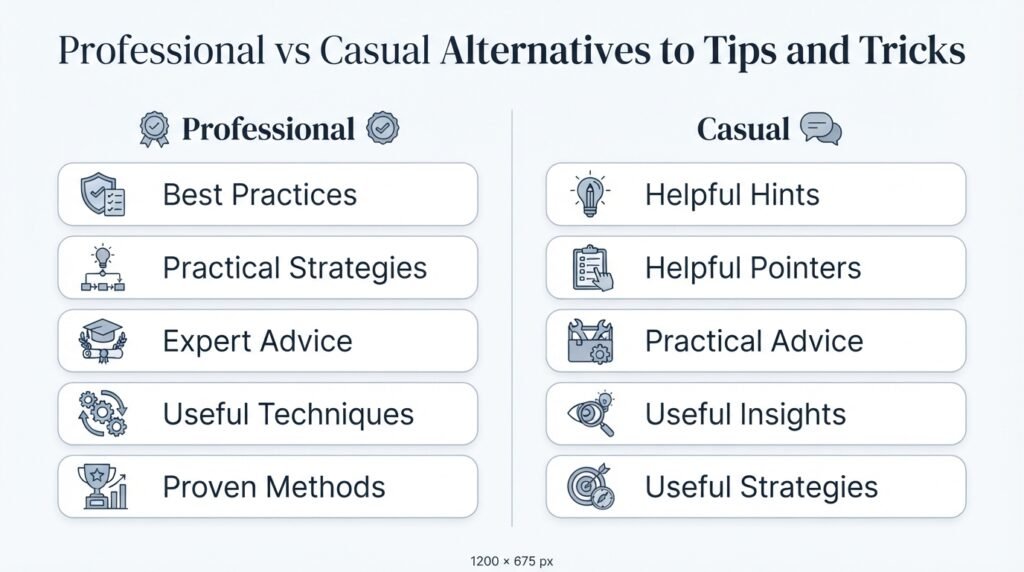
| Alternative | Best Used In | Tone |
| Helpful Hints | Guides, blogs, casual advice | Friendly |
| Practical Advice | Articles, conversations, professional guidance | Polite |
| Best Practices | Business, technology, workplace documents | Professional |
| Useful Strategies | Planning, education, business | Professional |
| Helpful Pointers | Tutorials, workplace conversations | Friendly |
| Expert Advice | Professional and specialized content | Formal |
| Useful Techniques | Training, education, skill-building | Professional |
| Practical Strategies | Business, education, problem-solving | Professional |
| Useful Insights | Reports, articles, discussions | Formal |
| Proven Methods | Training, professional guidance | Formal |
Common Mistakes1. Using Casual Phrases in Formal Writing
“Tips and tricks” can sound informal in a business report or academic document. In those settings, phrases such as best practices, practical strategies, or useful techniques may fit better.
2. Choosing a Phrase That Changes the Meaning
Not every alternative means exactly the same thing. For example, “expert advice” suggests specialized knowledge, while “helpful hints” may refer to simple suggestions.
3. Overusing “Best Practices”
“Best practices” sounds professional, but it can be too broad when you are simply offering personal suggestions. Use it when you are discussing recommended or established approaches.
4. Forgetting Your Audience
A beginner-friendly tutorial does not need highly formal language. Consider whether your readers would respond better to “helpful pointers” or “practical advice.”
5. Making Unsupported Claims
Be careful with terms such as “proven methods.” If you cannot support the claim that an approach has been demonstrated to work, choose a neutral phrase such as “useful techniques.”
Frequently Asked Questions
What is a professional way to say “tips and tricks”?
“Best practices,” “practical strategies,” and “useful techniques” are strong professional alternatives. “Best practices” works especially well in business and workplace settings, while “practical strategies” is better when discussing ways to achieve a specific goal. Choose the phrase that most accurately describes the type of guidance you are providing.
What is another word for “tips and tricks”?
Depending on the context, you can use advice, hints, pointers, strategies, techniques, methods, insights, or best practices. Each word has a slightly different meaning. “Hints” suggests simple guidance, while “strategies” implies a planned approach and “techniques” usually refers to a specific method or skill.
Is “tips and tricks” professional?
“Tips and tricks” is understandable and widely used, but it has a somewhat casual tone. It can work in newsletters, blogs, tutorials, and friendly workplace communication. For formal reports, presentations, or business documents, alternatives such as “best practices,” “practical strategies,” or “useful techniques” often sound more polished.
What is a formal way to say “tips and tricks”?
For formal writing, consider “recommended practices,” “effective techniques,” “practical strategies,” or “proven methods.” The right choice depends on the context. If you are discussing accepted approaches in a profession, “best practices” is often appropriate. If you are describing specific skills, “effective techniques” may be more precise.
What is a casual way to say “tips and tricks”?
For casual communication, “helpful hints,” “helpful pointers,” or simply “tips” work naturally. These expressions are easy to understand and do not sound overly formal. They are suitable for friendly conversations, personal blogs, beginner guides, social media content, and informal instructions.
Can I use “best practices” instead of “tips and tricks”?
Yes, but the two phrases are not always interchangeable. “Best practices” usually refers to recommended approaches that are recognized as effective within a particular field or situation. “Tips and tricks” is broader and can include personal suggestions, shortcuts, or small pieces of advice.
What is the best alternative for a business article?
“Best practices” is often the strongest choice for a business article, particularly when discussing established professional methods. However, “practical strategies” may be better when the article gives readers specific steps for solving a problem, increasing performance, or reaching a business goal.
How do I choose the right alternative to “tips and tricks”?
Start by identifying what your advice actually contains. Use helpful hints for simple suggestions, pointers for brief guidance, techniques for specific methods, strategies for goal-oriented plans, and best practices for established professional approaches. Matching the phrase to the meaning will make your writing more natural and precise.
Conclusion
There are many natural ways to say “tips and tricks,” and the best choice depends on your audience and purpose. For friendly content, helpful hints and helpful pointers sound approachable. For professional communication, best practices, practical advice, and practical strategies provide a more polished tone.
If you are teaching a specific skill, useful techniques may be the most accurate option. When specialized knowledge matters, expert advice emphasizes credibility, while useful insights highlights valuable understanding.
The goal is not simply to replace one phrase with another. Choose wording that tells readers exactly what kind of guidance you are offering. A precise phrase will make your writing clearer, more professional, and more useful for effective communication.

Professional Writing & Workplace Communication Expert
Marcus Hale is a business communication specialist with 11 years of experience in corporate training and professional writing. He has worked with mid-sized companies and remote teams to improve clarity in emails, reports, performance reviews, and client-facing messages.
Marcus focuses on polished, professional alternatives that help readers sound confident without sounding stiff. His guides cover workplace phrases, resume language, leadership communication, and formal-to-natural transitions. He holds a background in business administration and technical writing, and has led workshops on effective professional English.
At LandmarkNewz, Marcus creates practical synonym lists and phrasing tips that professionals can apply immediately in emails, meetings, and career documents.