
The phrase “piqued my interest” means that something attracted your attention and made you want to know more about it. For example, you might say, “The company’s new approach piqued my interest” when an idea makes you curious enough to explore it further.
The phrase is common in conversations, emails, essays, interviews, reviews, and professional writing. It is useful when simple words such as “interested” do not fully express the feeling of curiosity or attention.
One important spelling note: the correct expression is “piqued my interest,” not “peaked my interest.” The verb pique means to stimulate curiosity or interest.
Why Use Other Ways to Say “Piqued My Interest”?
Using different expressions can make your writing more natural and precise. While “piqued my interest” is perfectly correct, repeating it too often can make your writing sound predictable.
Other phrases can also help you match the exact feeling you want to express.
- Avoid repetition when writing essays, emails, or articles.
- Sound more natural in everyday conversations.
- Match different situations, from casual chats to professional communication.
- Show curiosity more clearly when discussing an idea or opportunity.
- Add variety and personality to your writing.
10 Best Other Ways to Say “Piqued My Interest”
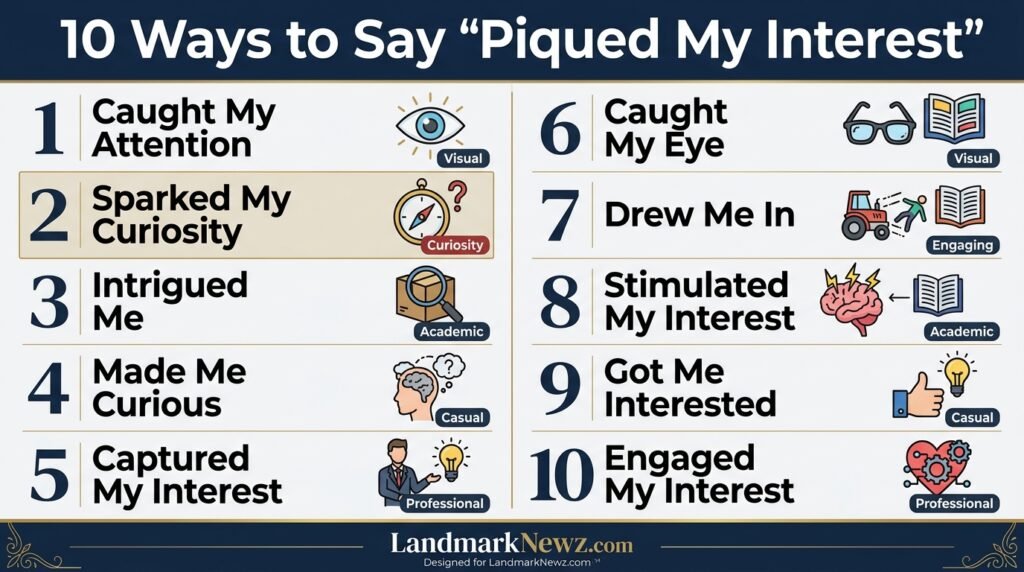
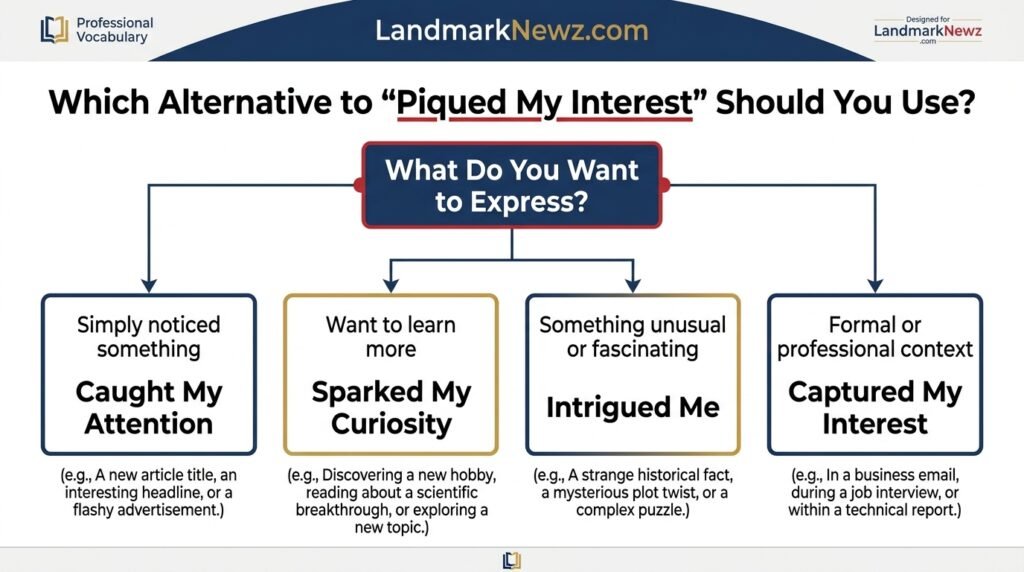
1. Caught My Attention
Meaning
“Caught my attention” means that something stood out enough to make you notice it. It is one of the most natural and flexible alternatives to “piqued my interest.”
Best For
- Professional
- Casual
- Friendly
- Polite
Example 1
The company’s commitment to sustainability immediately caught my attention.
Example 2
A headline about the new technology caught my attention while I was reading the news.
Quick Tip
Use this phrase when you want to emphasize notice or awareness rather than deep curiosity.\
2. Sparked My Curiosity
Meaning
“Sparked my curiosity” suggests that something made you want to investigate, learn, or discover more. It often communicates stronger curiosity than simply saying something caught your attention.
Best For
- Professional
- Formal
- Friendly
- Warm
Example 1
Her explanation of the research process sparked my curiosity about the field.
Example 2
The unusual results sparked my curiosity, so I decided to read the full report.
Quick Tip
Choose this phrase when you want to show that you are actively interested in learning more.
3. Intrigued Me
Meaning
“Intrigued me” means that something was unusual, interesting, or mysterious enough to make you curious. It is concise and polished without sounding overly formal.
Best For
- Professional
- Formal
- Casual
- Friendly
Example 1
The candidate’s creative solution intrigued me during the interview.
Example 2
The description of the remote village intrigued me enough to look up its history.
Quick Tip
Use “intrigued me” when the subject has an unusual, surprising, or compelling quality.
4. Made Me Curious
Meaning
“Made me curious” is a simple, direct way to say that something caused you to want more information. It sounds natural and conversational.
Best For
- Casual
- Friendly
- Warm
- Polite
Example 1
Your comment about the new project made me curious about how it works.
Example 2
The old photograph made me curious about the people in it.
Quick Tip
This is an excellent choice when writing for a general audience and you want to keep your language clear and easy to understand.
5. Captured My Interest
Meaning
“Captured my interest” means that something successfully attracted and held your attention. It can sound slightly more polished than “caught my attention.”
Best For
- Professional
- Formal
- Warm
- Polite
Example 1
The training program captured my interest because of its practical approach.
Example 2
Her proposal captured my interest from the very first page.
Quick Tip
Use this phrase in professional emails, applications, presentations, or formal writing when you want a polished tone.
6. Caught My Eye
Meaning
“Caught my eye” means that something immediately attracted your visual or general attention. It is especially natural when discussing an image, product, design, advertisement, or noticeable detail.
Best For
- Casual
- Friendly
- Warm
Example 1
That blue jacket caught my eye as soon as I walked into the store.
Example 2
The colorful design caught my eye while I was browsing the website.
Quick Tip
Use this expression when something stands out visually or immediately grabs your attention.
7. Drew Me In
Meaning
“Drew me in” suggests that something gradually or strongly attracted your attention and encouraged you to continue exploring it. It often works well for books, stories, presentations, and creative work.
Best For
- Casual
- Friendly
- Warm
Example 1
The opening paragraph drew me in and made me want to finish the article.
Example 2
The documentary’s mysterious beginning drew me in within the first few minutes.
Quick Tip
Choose this phrase when something does more than attract attention—it keeps you engaged.
8. Stimulated My Interest
Meaning
“Stimulated my interest” means that something encouraged or increased your interest in a particular subject. It has a more academic or formal feel than many alternatives.
Best For
- Professional
- Formal
Example 1
The guest lecture stimulated my interest in environmental engineering.
Example 2
Working with the research team stimulated my interest in data analysis.
Quick Tip
This phrase fits best in academic writing, professional statements, and formal discussions.
9. Got Me Interested
Meaning
“Got me interested” is an informal expression meaning that something caused you to become interested in a subject, activity, or opportunity. It is direct and conversational.
Best For
- Casual
- Friendly
Example 1
That podcast got me interested in learning more about personal finance.
Example 2
My friend’s recommendation got me interested in trying rock climbing.
Quick Tip
Use it in everyday conversation and informal writing, but choose a more polished phrase for formal documents.
10. Engaged My Interest
Meaning
“Engaged my interest” means that something held your attention and encouraged you to think about it more deeply. It has a formal, thoughtful tone and can work well in academic or professional contexts.
Best For
- Professional
- Formal
Example 1
The speaker’s analysis engaged my interest throughout the presentation.
Example 2
The article engaged my interest because it presented a different view of the issue.
Quick Tip
Use this phrase when you want to emphasize sustained attention or thoughtful engagement, rather than a brief moment of curiosity.
Comparison Table
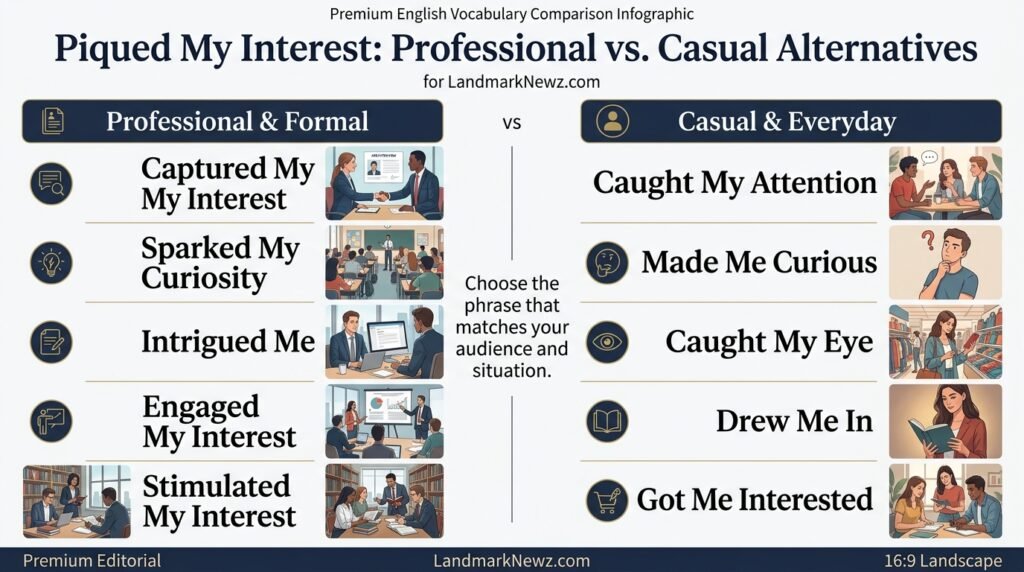
| Alternative | Best Used In | Tone |
| Caught my attention | Everyday and professional communication | Neutral |
| Sparked my curiosity | Essays, discussions, professional writing | Thoughtful |
| Intrigued me | Professional and casual writing | Polished |
| Made me curious | Conversations and simple writing | Conversational |
| Captured my interest | Emails, applications, formal writing | Professional |
| Caught my eye | Products, designs, visual content | Casual |
| Drew me in | Stories, articles, creative content | Engaging |
| Stimulated my interest | Academic and professional writing | Formal |
| Got me interested | Everyday conversations | Casual |
| Engaged my interest | Academic and formal writing | Formal |
Common Mistakes
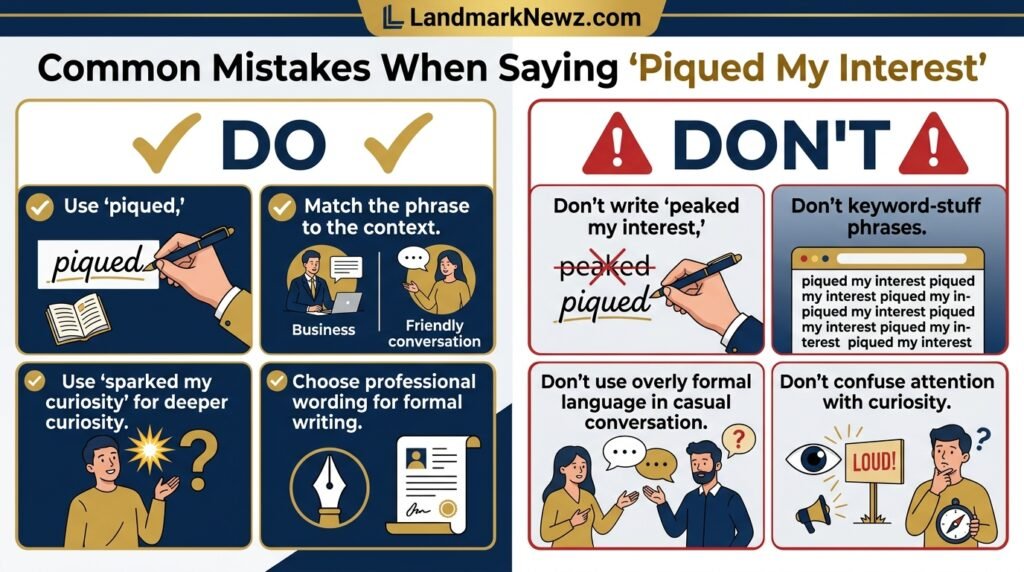
1. Using “Peaked My Interest” Instead of “Piqued My Interest”
The correct phrase is “piqued my interest.” Pique means to stimulate curiosity, while peak refers to reaching the highest point.
2. Choosing a Phrase That Is Too Formal
“Stimulated my interest” may sound unnatural in a casual text message. For everyday communication, “made me curious” or “got me interested” usually sounds better.
3. Ignoring the Difference Between Attention and Curiosity
“Caught my attention” focuses on noticing something, while “sparked my curiosity” suggests a desire to learn more. Choose the phrase that matches your intended meaning.
4. Repeating the Same Expression
Using “piqued my interest” several times in one article or essay can become repetitive. Varying your wording can make the writing smoother and more engaging.
5. Using “Caught My Eye” for Every Situation
“Caught my eye” often suggests visual attraction. It may sound strange when discussing an abstract idea, research topic, or complex argument.
Frequently Asked Questions
What is another way to say “piqued my interest”?
Common alternatives include “caught my attention,” “sparked my curiosity,” “intrigued me,” “made me curious,” and “captured my interest.” The best choice depends on context. “Caught my attention” is broadly useful, while “sparked my curiosity” is better when you want to emphasize a desire to learn more.
What is a professional way to say “piqued my interest”?
For professional writing, try “captured my interest,” “sparked my curiosity,” “intrigued me,” or “engaged my interest.” For example, “The position captured my interest because of its focus on innovation” sounds polished and appropriate for a professional email or application.
Is “caught my attention” the same as “piqued my interest”?
The meanings are similar, but they are not identical. “Caught my attention” mainly means something made you notice it. “Piqued my interest” goes a step further by suggesting that the subject made you curious or interested in learning more.
Is “sparked my curiosity” stronger than “piqued my interest”?
They are very close in meaning, but “sparked my curiosity” often emphasizes the desire to investigate or discover something. “Piqued my interest” can describe general interest, while “sparked my curiosity” more clearly suggests that you want additional information.
Can I use “intrigued me” instead of “piqued my interest”?
Yes. “Intrigued me” is a natural and concise alternative, especially when something is unusual, surprising, or mysterious. For example, “The unusual approach intrigued me” communicates that the approach attracted your attention and made you want to understand it better.
What is a casual way to say “piqued my interest”?
In casual conversation, you can say “made me curious,” “got me interested,” or “caught my eye.” The best option depends on what caused your interest. “Made me curious” is especially easy to use because it sounds natural in everyday American English.
Is “captured my interest” good for a resume or cover letter?
Yes. “Captured my interest” can work well in a cover letter or professional statement because it sounds polished without being overly complicated. For example, you could write, “The company’s commitment to community service captured my interest.”
What is the correct spelling: “piqued” or “peaked my interest”?
The correct expression is “piqued my interest.” The word “piqued” comes from the verb pique, meaning to stimulate curiosity or interest. “Peaked” means reached a highest point, so “peaked my interest” is considered an incorrect form of the expression.
Conclusion
There are many natural ways to say “piqued my interest,” and the right choice depends on the situation. For everyday communication, “caught my attention” and “made me curious” are clear and easy to use. If you want to emphasize curiosity, “sparked my curiosity” is a strong choice. For professional writing, “captured my interest,” “intrigued me,” and “engaged my interest” can sound more polished.
Remember that these alternatives are not always perfect substitutes. “Caught my eye” works especially well for visual things, while “drew me in” suggests that something kept you engaged. Choosing the phrase that matches your exact meaning will make your writing more precise, natural, and effective.
Choosing the phrase that matches your exact meaning will make your writing more precise, natural, and effective. For the exact meaning and usage of “pique,” see the Cambridge Dictionary definition of “pique.”

About Dr. Priya Nair
Dr. Priya Nair is a passionate Writer & Blogger at LandMarkNewz.com, dedicated to creating informative, engaging, and easy-to-understand content for readers. With a strong interest in research, current trends, lifestyle, and everyday topics, she focuses on presenting useful information in a clear and reader-friendly way.
Through her writing, Priya aims to help readers discover valuable insights, understand complex topics more easily, and stay informed about subjects that matter to them. Her approach combines thoughtful research with a simple and engaging writing style.
At LandMarkNewz.com, she contributes original articles designed to inform, educate, and provide practical value to readers.