
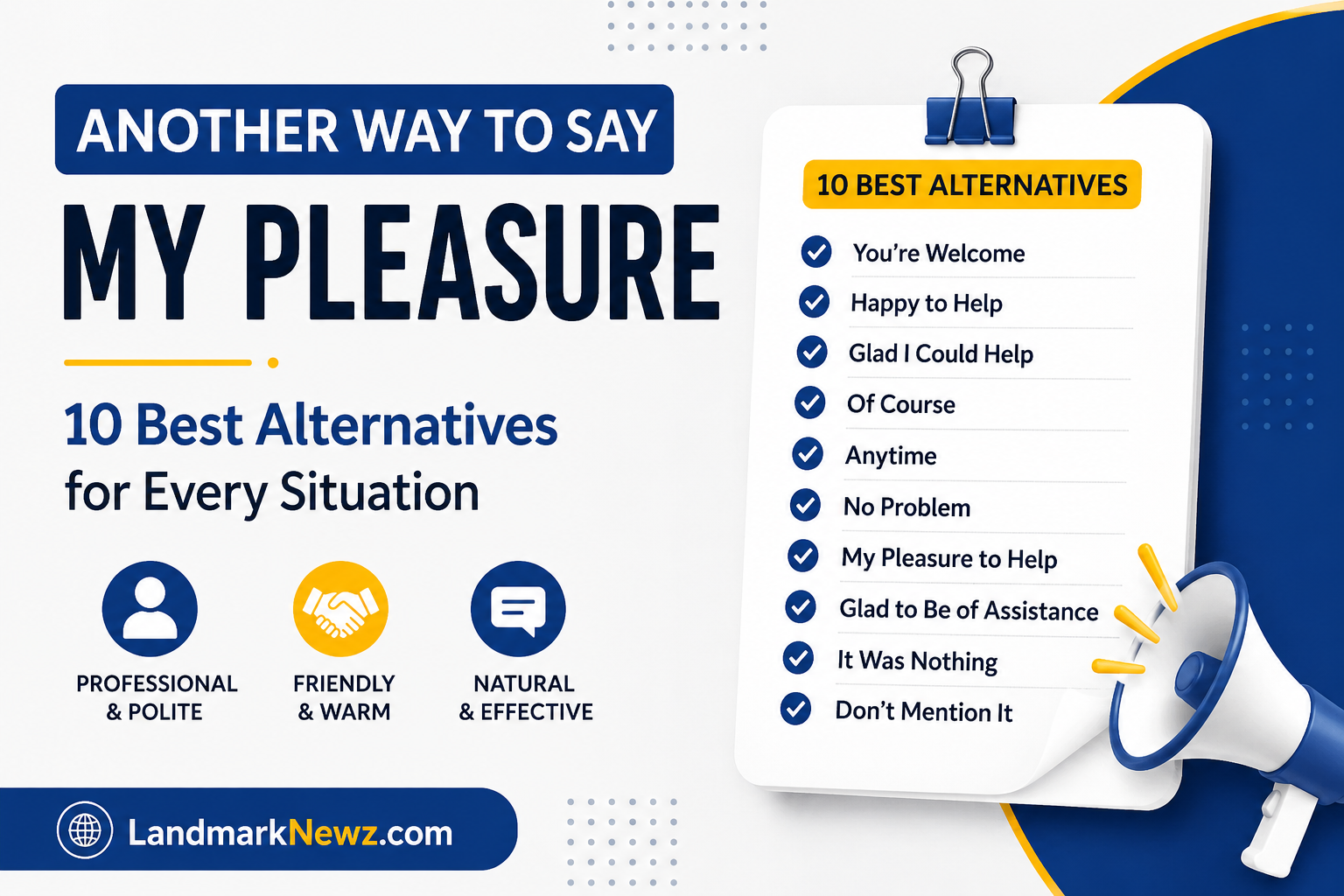
The phrase “another way to say my pleasure” refers to different expressions you can use instead of “my pleasure” when responding to someone who has thanked you.
“My pleasure” communicates that you were happy to help. It is polite, positive, and often sounds warmer than a simple “you’re welcome.” People commonly use it at work, in customer service, with friends, and in everyday conversations.
You may want another expression when you want to avoid repetition, sound more natural, or adjust your tone to fit a particular situation.
Why Use Other Ways to Say “My Pleasure”?
Although “my pleasure” is perfectly natural, using different expressions can make your communication more flexible and appropriate.
You might choose another phrase to:
- Avoid repeating the same response.
- Sound warmer or more friendly.
- Communicate professionally with customers or coworkers.
- Match a casual conversation.
- Show genuine appreciation for someone’s thanks.
- Make your response sound less formal.
The key is not to find one phrase that always replaces “my pleasure.” Instead, choose an expression that fits the person, setting, and relationship.
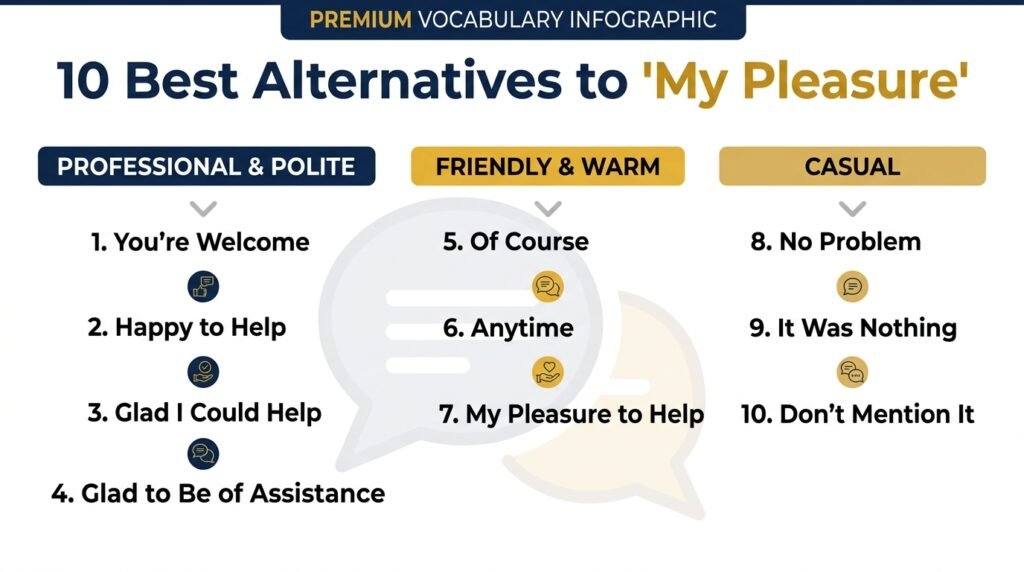
10 Best Other Ways to Say “My Pleasure”
1. You’re Welcome
Meaning
“You’re welcome” is the most common alternative to “my pleasure.” It is polite, clear, and appropriate in almost any situation where someone thanks you.
Best For
- Professional
- Formal
- Casual
- Polite
Example 1
“You’re welcome. I’m glad I could get the report to you before the meeting.”
Example 2
“Thanks for helping me find the right office.”
“You’re welcome!”
Quick Tip
Use “you’re welcome” when you want a dependable response that never feels out of place.
2. Happy to Help
Meaning
“Happy to help” tells the other person that you were pleased to assist them. It sounds friendly while remaining professional, making it especially useful at work.
Best For
- Professional
- Friendly
- Warm
- Polite
Example 1
“Thank you for walking me through the new software.”
“Happy to help.”
Example 2
“I appreciate you staying late to finish this.”
“Happy to help—we’re all working toward the same goal.”
Quick Tip
Choose this phrase when you want to sound helpful without being overly formal.
3. Glad I Could Help
Meaning
“Glad I could help” emphasizes satisfaction with being useful. It works well after you have solved a problem, answered a question, or provided assistance.
Best For
- Professional
- Friendly
- Warm
- Polite
Example 1
“Thanks for explaining the billing issue.”
“Glad I could help.”
Example 2
“Your instructions made the application process much easier.”
“I’m glad I could help.”
Quick Tip
This expression works particularly well when your assistance had a clear result.
4. Of Course
Meaning
“Of course” presents your help as something natural or expected. Depending on your tone, it can sound warm and reassuring rather than formal.
Best For
- Casual
- Friendly
- Warm
- Polite
Example 1
“Thanks for saving me a seat.”
“Of course!”
Example 2
“I really appreciate you checking on my dog.”
“Of course. I was happy to do it.”
Quick Tip
Use a friendly tone because “of course” can sound dismissive if said too abruptly.
5. Anytime
Meaning
“Anytime” suggests that you are willing to help again in the future. It creates a relaxed and welcoming tone, especially with people you know well.
Best For
- Casual
- Friendly
- Warm
Example 1
“Thanks for helping me move the boxes.”
“Anytime!”
Example 2
“I appreciate you giving me a ride home.”
“Anytime. Just let me know if you need another ride.”
Quick Tip
“Anytime” is best for informal conversations rather than highly formal business correspondence.
6. No Problem
Meaning
“No problem” tells someone that their request did not cause you difficulty or inconvenience. It is common in everyday American English and has a relaxed feel.
Best For
- Casual
- Friendly
- Polite
Example 1
“Thanks for sending me the address.”
“No problem.”
Example 2
“Sorry to bother you with that question.”
“No problem. I was happy to explain it.”
Quick Tip
This phrase is natural in casual settings, but “happy to help” may sound more polished in formal customer or business communication.
7. My Pleasure to Help
Meaning
“My pleasure to help” keeps the warmth of the original phrase while making the meaning more explicit. It shows that assisting someone was genuinely welcome.
Best For
- Formal
- Professional
- Warm
- Polite
Example 1
“Thank you for taking the time to answer all my questions.”
“It was my pleasure to help.”
Example 2
“We appreciate your assistance with the event.”
“It was my pleasure to help your team.”
Quick Tip
Use this variation when you want a polished and courteous response without sounding overly casual.
8. Glad to Be of Assistance
Meaning
“Glad to be of assistance” is a more formal expression that communicates willingness and professionalism. It fits service-oriented conversations particularly well.
Best For
- Professional
- Formal
- Polite
Example 1
“Thank you for helping me resolve this account issue.”
“I’m glad to be of assistance.”
Example 2
“I appreciate your guidance throughout the process.”
“I’m glad to be of assistance.”
Quick Tip
Save this phrase for professional or formal settings where a polished tone is appropriate.
9. It Was Nothing
Meaning
“It was nothing” minimizes the effort you made and reassures the other person that helping them was not a burden. It is generally used in informal conversations.
Best For
- Casual
- Friendly
- Warm
Example 1
“Thanks for carrying those groceries inside.”
“It was nothing.”
Example 2
“I really appreciate you picking up my package.”
“It was nothing. I was already in the neighborhood.”
Quick Tip
Use this with people you know well, since it can sound too casual for some professional situations.
10. Don’t Mention It
Meaning
“Don’t mention it” means the other person’s thanks are appreciated but unnecessary. It is a traditional, polite response that works best when you want to downplay the favor.
Best For
- Formal
- Friendly
- Polite
- Warm
Example 1
“Thank you for helping me prepare for the presentation.”
“Don’t mention it.”
Example 2
“I really appreciate you fixing that mistake for me.”
“Don’t mention it. We got everything sorted out.”
Quick Tip
Use it when you want to emphasize that helping was not a burden.
Comparison Table
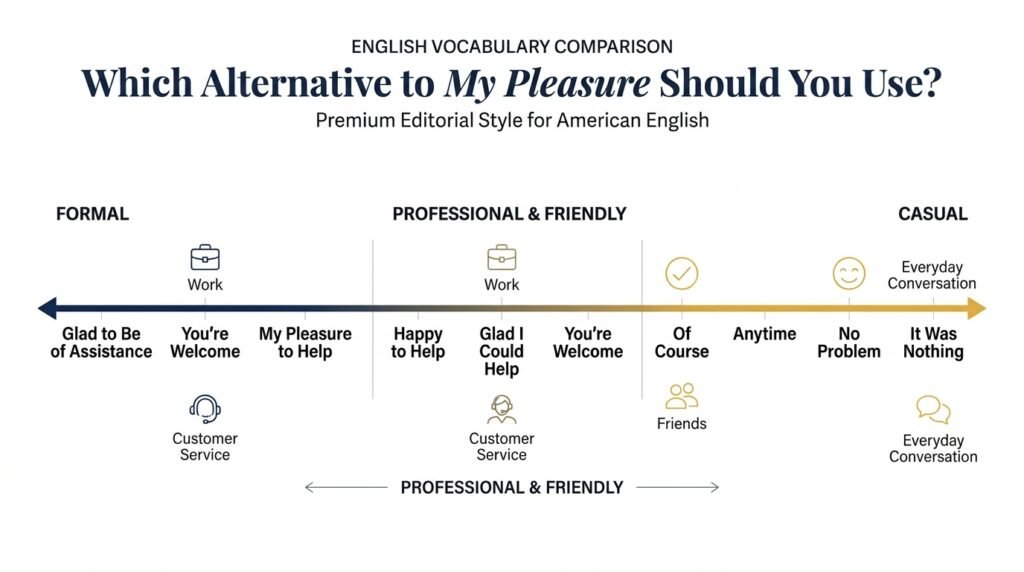
| Alternative | Best Used In | Tone |
| You’re welcome | Almost any situation | Polite, neutral |
| Happy to help | Work and service | Warm, professional |
| Glad I could help | Work and everyday situations | Friendly, positive |
| Of course | Casual conversations | Warm, relaxed |
| Anytime | Informal relationships | Friendly, casual |
| No problem | Everyday conversations | Casual, relaxed |
| My pleasure to help | Professional settings | Warm, polished |
| Glad to be of assistance | Formal or business settings | Formal, professional |
| It was nothing | Informal conversations | Casual, modest |
| Don’t mention it | Friendly or polite settings | Warm, courteous |
Common Mistakes
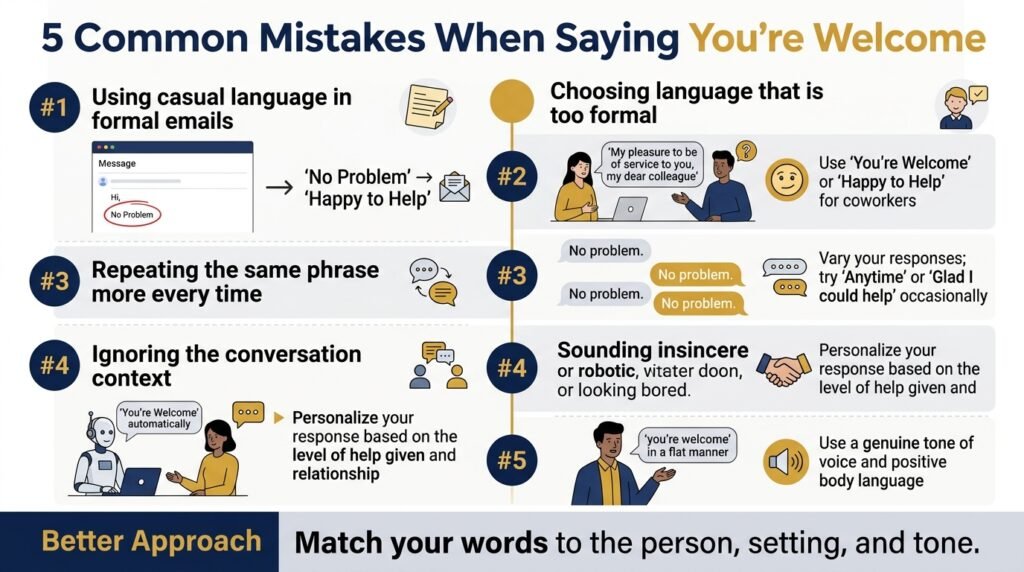
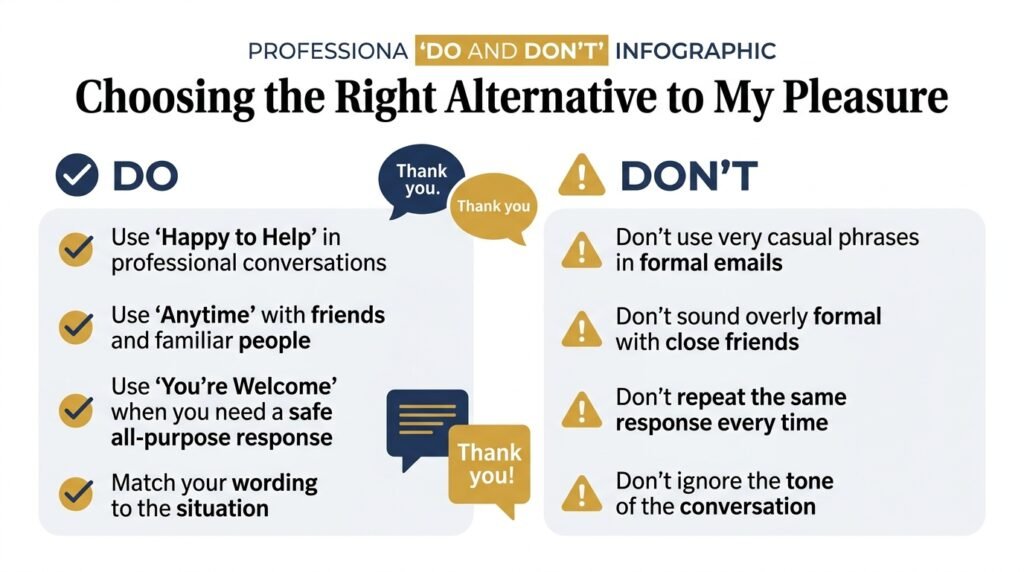
- Using casual phrases in formal emails
Expressions such as “no problem” and “anytime” may sound too relaxed in highly formal business communication. “You’re welcome” or “happy to help” is often safer. - Choosing overly formal language
“Glad to be of assistance” can sound stiff in a conversation with a close friend. Match the formality of your response to the relationship. - Repeating the same phrase
Saying “my pleasure” every time someone thanks you can make your responses feel automatic. Rotating between natural alternatives can make conversations sound more genuine. - Ignoring context
The best response depends on who you are speaking with. A customer, manager, friend, and family member may each call for a different expression. - Sounding insincere
Even a polite phrase can feel cold if your tone does not match your words. When appropriate, add a brief personal touch, such as “I’m glad I could help.”
Frequently Asked Questions
What is the best alternative to “my pleasure”?
The best general alternative is “you’re welcome.” It works in professional, formal, and casual situations and clearly acknowledges the other person’s thanks. If you want something warmer, “happy to help” is an excellent choice, especially at work or when providing customer service.
Is “happy to help” better than “my pleasure”?
Neither phrase is universally better. “Happy to help” sounds friendly and professional, while “my pleasure” can sound slightly warmer or more courteous. For workplace conversations, “happy to help” is often a natural choice because it communicates willingness without sounding overly formal.
What can I say instead of “my pleasure” professionally?
For professional communication, try “you’re welcome,” “happy to help,” “glad I could help,” or “glad to be of assistance.” “Happy to help” is particularly useful because it sounds polished but still conversational in emails, meetings, customer service conversations, and workplace chats.
Is “no problem” a good response to “thank you”?
Yes, “no problem” is common and natural in American English, especially in casual conversations. However, some professional settings may favor “you’re welcome” or “happy to help” because “no problem” can sound more informal.
Can I say “anytime” instead of “my pleasure”?
Yes. “Anytime” is a friendly way to respond to thanks, particularly when speaking with friends, family members, or familiar coworkers. It also suggests that you would be willing to help the person again if they need assistance.
What is a warm way to respond to “thank you”?
“Happy to help,” “glad I could help,” and “of course” are warm alternatives. Your tone matters as much as the words. A sincere response delivered naturally can communicate appreciation and kindness without sounding overly formal.
Is “my pleasure” formal or casual?
“My pleasure” can work in both formal and everyday settings, but it generally sounds more polished than “no problem.” It is common in customer service, hospitality, professional conversations, and polite social interactions.
What should I say instead of “my pleasure” in an email?
For most professional emails, “you’re welcome” or “happy to help” works well. If you want to acknowledge a specific task, “I’m glad I could help” can sound more personal. Choose the phrase that matches the tone of the rest of your email.
Conclusion
There are many natural ways to say “my pleasure,” and the right choice depends on the situation. “You’re welcome” is the safest all-purpose option, while “happy to help” adds warmth without losing professionalism.
For casual conversations, “anytime,” “of course,” and “no problem” feel relaxed and friendly. In more formal settings, “glad to be of assistance” provides a polished alternative. “Glad I could help” is useful when you want to show that you were pleased to solve a problem or provide support.
The most important rule is to match your response to the person and setting. A short, sincere expression usually sounds better than a complicated one. When in doubt, choose “you’re welcome” or “happy to help.”

Professional Writing & Workplace Communication Expert
Marcus Hale is a business communication specialist with 11 years of experience in corporate training and professional writing. He has worked with mid-sized companies and remote teams to improve clarity in emails, reports, performance reviews, and client-facing messages.
Marcus focuses on polished, professional alternatives that help readers sound confident without sounding stiff. His guides cover workplace phrases, resume language, leadership communication, and formal-to-natural transitions. He holds a background in business administration and technical writing, and has led workshops on effective professional English.
At LandmarkNewz, Marcus creates practical synonym lists and phrasing tips that professionals can apply immediately in emails, meetings, and career documents.