
The phrase “another way to say did you know” refers to alternative expressions you can use when introducing information, asking whether someone knows a fact, or starting an interesting conversation.
“Did you know?” is common in everyday speech, articles, presentations, emails, social media posts, and educational content. However, repeating it too often can make your writing feel predictable. Using alternatives lets you match your wording to the situation and create a more natural tone.
For example, a professional email might use “Were you aware?”, while a casual conversation could use “Have you heard?”
Why Use Other Ways to Say “Did You Know”?
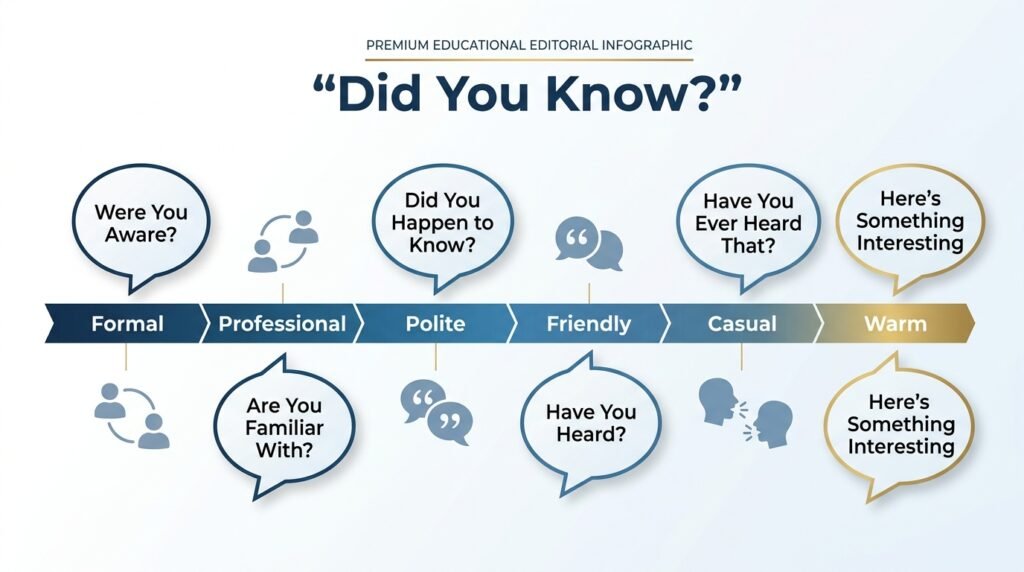
Finding another way to say “did you know” can make your communication more engaging without changing the basic meaning.
Using different expressions can help you:
- Avoid repeating the same phrase.
- Make your writing sound more natural.
- Adjust your tone for different audiences.
- Introduce facts more smoothly.
- Create curiosity and encourage readers to continue.
- Make professional communication sound polished.
- Add warmth or personality to casual conversations.
The key is not to replace “did you know?” every time. Instead, choose an alternative when it better fits your message.
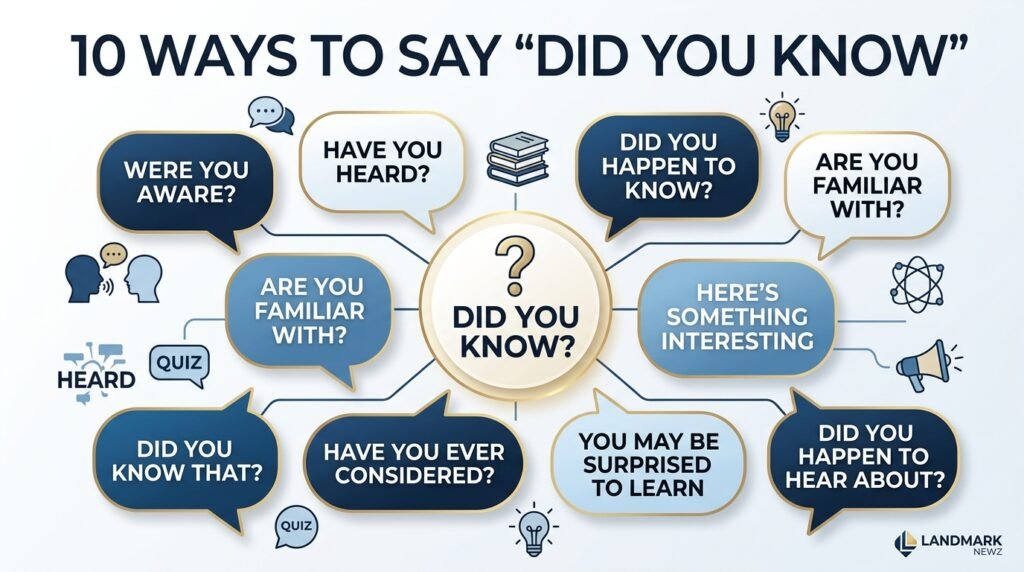
10 Best Other Ways to Say “Did You Know”
1. Were You Aware?
Meaning
“Were you aware?” politely asks whether someone already knows a particular fact or piece of information. It has a more professional and formal feel than “did you know?”
Best For
- Professional
- Formal
- Polite
Example 1
Were you aware that the company now offers flexible work schedules?
Example 2
Were you aware that your membership includes free access to the online training library?
Quick Tip
Use “were you aware?” when discussing useful information in workplace emails, presentations, or customer communication.
2. Have You Heard?
Meaning
“Have you heard?” is a natural way to introduce news, information, an announcement, or an interesting fact. It sounds friendly and conversational.
Best For
- Casual
- Friendly
- Warm
Example 1
Have you heard about the new restaurant that opened downtown?
Example 2
Have you heard that the city is hosting a free outdoor concert this weekend?
Quick Tip
Choose this phrase when you want the conversation to feel relaxed rather than formal.
3. Did You Happen to Know?
Meaning
“Did you happen to know?” is a softer version of “did you know?” It sounds less direct and can be useful when sharing information without assuming that the listener should already know it.
Best For
- Friendly
- Polite
- Casual
Example 1
Did you happen to know that the museum offers free admission on Sundays?
Example 2
Did you happen to know that you can renew your license online?
Quick Tip
This phrase works well when you want to sound helpful and non-assumptive.
4. Are You Familiar With?
Meaning
“Are you familiar with?” asks whether someone has knowledge or experience with a particular subject, service, place, or idea. It is more neutral and professional than “did you know?”
Best For
- Professional
- Formal
- Polite
Example 1
Are you familiar with the new employee scheduling system?
Example 2
Are you familiar with the basic rules for filing a small business tax return?
Quick Tip
Use this phrase when asking about someone’s familiarity with a topic rather than a single fact.
5. Have You Ever Heard That?
Meaning
“Have you ever heard that?” introduces a fact, belief, story, or surprising piece of information. It naturally creates curiosity and encourages the listener to respond.
Best For
- Casual
- Friendly
- Warm
Example 1
Have you ever heard that some plants can communicate through underground fungal networks?
Example 2
Have you ever heard that the original recipe for this dish dates back hundreds of years?
Quick Tip
This expression is especially effective when introducing an unusual or surprising fact.
6. Here’s Something Interesting
Meaning
“Here’s something interesting” does not directly ask whether someone already knows something. Instead, it smoothly introduces a fact or idea that you expect the audience will find useful or surprising.
Best For
- Friendly
- Casual
- Warm
Example 1
Here’s something interesting: the average honeybee colony can contain thousands of worker bees.
Example 2
Here’s something interesting about the property: it was originally built more than a century ago.
Quick Tip
Use this option in blog posts, newsletters, presentations, and social media content when you want to lead with information instead of a question.
7. Did You Know That…?
Meaning
“Did you know that…?” is a slightly expanded version of the original phrase. Adding “that” makes it particularly natural when introducing a specific fact or statement.
Best For
- Friendly
- Casual
- Educational
Example 1
Did you know that regular exercise can support better sleep?
Example 2
Did you know that many national parks offer free educational programs for visitors?
Quick Tip
This remains one of the best choices when you want a direct, simple introduction to a fact.
8. Have You Ever Considered?
Meaning
“Have you ever considered?” is useful when introducing an idea, option, or possibility rather than simply sharing a fact. It invites the reader to think about something from a new perspective.
Best For
- Professional
- Friendly
- Polite
Example 1
Have you ever considered switching to a four-day workweek?
Example 2
Have you ever considered using a budget app to track your monthly expenses?
Quick Tip
Use this phrase when your goal is to encourage reflection or action instead of simply sharing information.
9. You May Be Surprised to Learn
Meaning
“You may be surprised to learn” signals that the information coming next may be unexpected. It is useful for creating curiosity in articles, presentations, marketing copy, and educational material.
Best For
- Formal
- Professional
- Friendly
Example 1
You may be surprised to learn that the small town attracts thousands of visitors each year.
Example 2
You may be surprised to learn how much energy modern LED lighting can save.
Quick Tip
Use this phrase when the information has a surprising or counterintuitive element.
10. Did You Happen to Hear About…?
Meaning
“Did you happen to hear about…?” is a polite and conversational way to ask whether someone has received information about a particular event, announcement, or development.
Best For
- Casual
- Friendly
- Polite
Example 1
Did you happen to hear about the changes to the neighborhood parking rules?
Example 2
Did you happen to hear about Sarah’s promotion?
Quick Tip
This is a good choice when you want to ask about news without making the other person feel uninformed.
Comparison Table
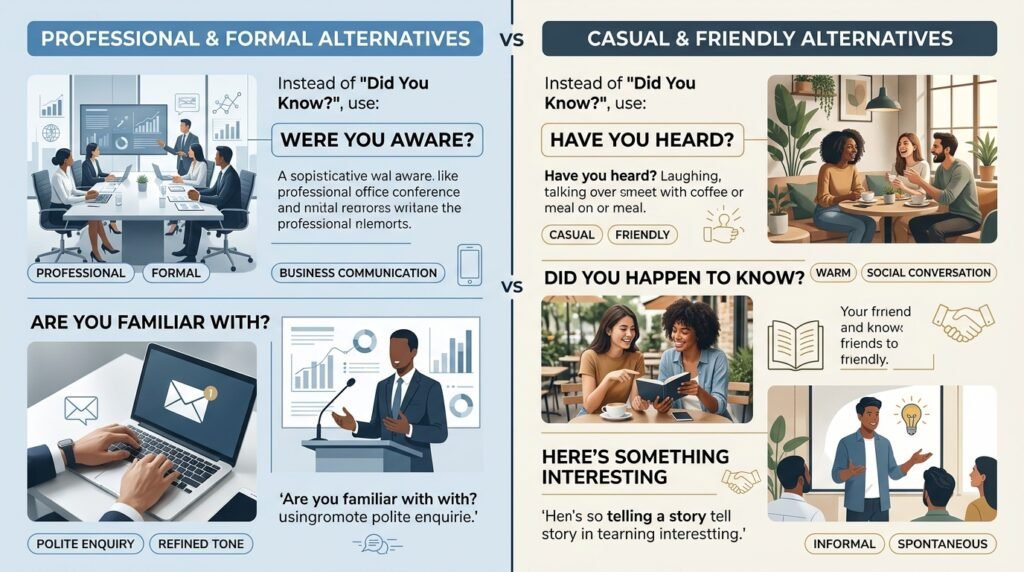
| Alternative | Best Used In | Tone |
| Were you aware? | Work, formal communication | Professional |
| Have you heard? | Conversations, social settings | Friendly |
| Did you happen to know? | Everyday conversations | Polite |
| Are you familiar with? | Business, education | Formal |
| Have you ever heard that? | Conversations, storytelling | Casual |
| Here’s something interesting | Blogs, presentations, social media | Warm |
| Did you know that…? | Education, general writing | Friendly |
| Have you ever considered? | Advice, business, discussion | Thoughtful |
| You may be surprised to learn | Articles, presentations | Engaging |
| Did you happen to hear about…? | News and personal conversations | Friendly |
Common Mistakes
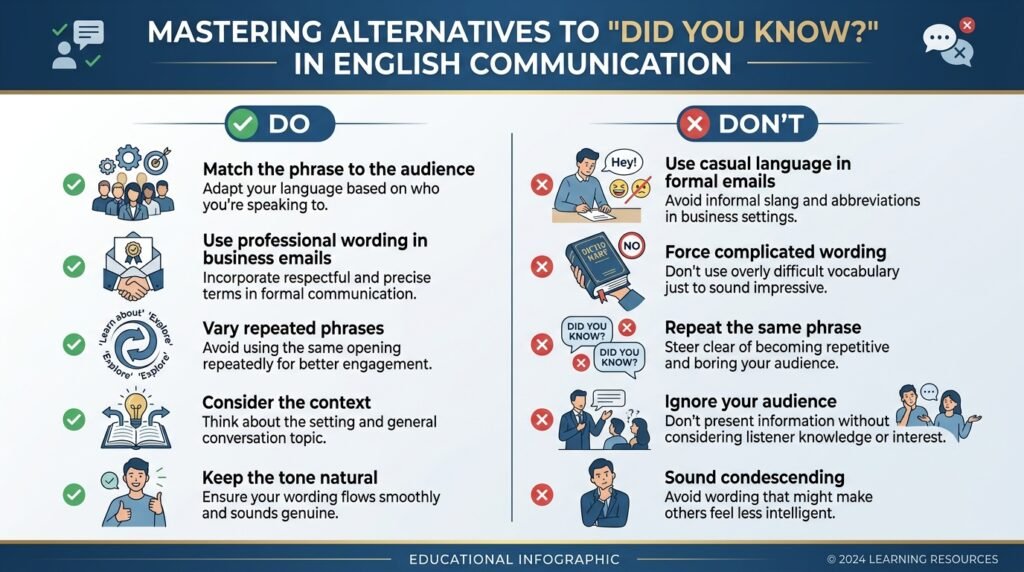
1. Using Casual Phrases in Professional Emails
Phrases such as “Have you heard?” can sound too conversational in some business situations. When communicating with clients, managers, or formal audiences, “Were you aware?” may be more appropriate.
2. Choosing Overly Formal Language
Not every conversation requires polished business language. Saying “Are you familiar with?” to a close friend may sound stiff when “Have you heard?” would feel more natural.
3. Repeating “Did You Know?” Too Often
Using the same phrase throughout an article can make your writing repetitive. Rotate between appropriate alternatives to keep readers interested.
4. Forgetting the Context
An alternative should match what follows it. “Have you ever considered?” introduces an idea or possibility, while “Were you aware?” generally introduces information or a fact.
5. Sounding Insincere or Condescending
Be careful with phrases that can imply someone should already know something. When you want to avoid that impression, “Did you happen to know?” offers a softer approach.
Frequently Asked Questions

What is another way to say “did you know” professionally?
“Were you aware?” is one of the best professional alternatives to “did you know?” It sounds respectful and works well in emails, presentations, reports, and workplace conversations. “Are you familiar with?” is another strong option when you are asking about someone’s knowledge or experience with a particular subject.
What is a casual way to say “did you know”?
“Have you heard?” is a natural casual alternative. You can also use “Have you ever heard that?” or “Did you happen to know?” depending on the situation. These expressions work well with friends, family members, coworkers you know well, and informal conversations.
How can I introduce an interesting fact without saying “did you know”?
Try “Here’s something interesting,” “You may be surprised to learn,” or “One interesting fact is…” These alternatives focus on the information rather than asking a direct question. They are particularly useful in blog posts, presentations, newsletters, educational content, and social media captions.
Is “were you aware” rude?
No. “Were you aware?” is generally polite and professional, but context matters. If the wording suggests that someone should have known the information, it can sound critical. A softer option such as “Did you happen to know?” may be better when you want to avoid sounding judgmental.
What is a better phrase than “did you know” in an essay?
For an essay, consider “It is interesting to note that,” “Research shows that,” or “One important fact is…” However, the best option depends on your writing style. Academic writing usually benefits from direct statements and evidence rather than repeatedly asking the reader questions.
What can I say instead of “did you know” in a presentation?
In a presentation, you can say “Here’s an interesting fact,” “You may be surprised to learn,” or “Consider this.” These phrases can capture attention without sounding repetitive. Choose the wording based on whether your presentation is educational, professional, persuasive, or casual.
What is the difference between “did you know” and “were you aware”?
Both phrases ask whether someone knows something, but their tones differ. “Did you know?” sounds more conversational and engaging, while “Were you aware?” sounds more formal and professional. The second phrase is especially common in workplace communication and situations where you want to sound respectful.
How do I avoid repeating “did you know” in an article?
Use different sentence structures instead of replacing every occurrence with a synonym. For example, introduce some facts with “Research shows,” others with “Interestingly,” and others with “You may be surprised to learn.” This creates variety while keeping the article clear and natural.
Conclusion
Knowing another way to say “did you know” gives you more control over your tone and writing style. The best alternative depends on what you are trying to accomplish. Use “Were you aware?” for professional communication, “Have you heard?” for casual conversations, and “Here’s something interesting” when introducing a fact without asking a direct question.
The goal is not to eliminate “did you know?” from your vocabulary but to use it alongside natural alternatives. Choose the phrase that fits your audience, context, and message, and your communication will sound more polished and engaging. Learning how to create curiosity in your writing can also help you introduce facts and ideas in a more engaging way.

Language & Everyday Communication Specialist
Elena Voss is a language enthusiast and communication coach with over 9 years of experience helping people express themselves more naturally in English. She previously worked as an ESL instructor and corporate language trainer, guiding professionals and students on clearer everyday conversations, polite alternatives, and natural phrasing.
Elena specializes in practical synonym guides and “another way to say…” content that feels conversational rather than textbook. Her writing focuses on real-life situations — emails to friends, casual workplace chat, social media, and daily interactions. She believes the best language advice is simple, useful, and easy to remember.
When she’s not creating content for LandmarkNewz, Elena enjoys analyzing modern slang trends and testing new phrases in real conversations.