

Looking for another way to say “so that”? Several alternatives can make your writing clearer, smoother, or more precise. Depending on the context, you can use phrases such as “in order to,” “to,” “so,” or “with the goal of” to express purpose or intended results.
What Does “Another Way to Say So That” Mean?
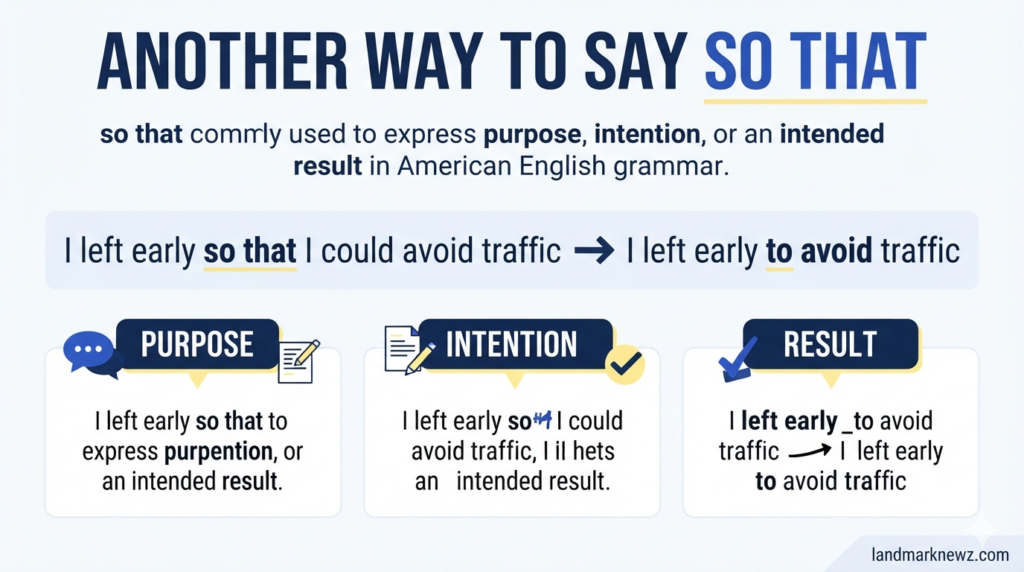
The phrase “so that” is commonly used to show purpose or explain the intended result of an action. For example, “I left early so that I could avoid traffic” explains why the person left early.
When people search for another way to say “so that,” they usually want a synonym or alternative that makes their writing more varied, concise, formal, or natural. Common options include “to,” “in order to,” “so as to,” and “to ensure that.”
You will often see these alternatives in emails, essays, business writing, academic work, instructions, and everyday conversations.
Why Use Other Ways to Say “So That”?
Repeating the same phrase can make writing feel predictable. Choosing a suitable alternative can make your sentences clearer and better suited to your audience.
Other benefits include:
- Avoiding repetition: Keep paragraphs from sounding repetitive.
- Improving clarity: Choose wording that expresses the exact relationship between an action and its purpose.
- Matching the tone: Use casual, professional, or formal language as needed.
- Making writing concise: Replace longer constructions with simpler wording.
- Strengthening professional communication: Select precise expressions for workplace messages and documents.
The key is not to replace “so that” automatically. Some alternatives work only with certain sentence structures.
10 Best Other Ways to Say “So That”
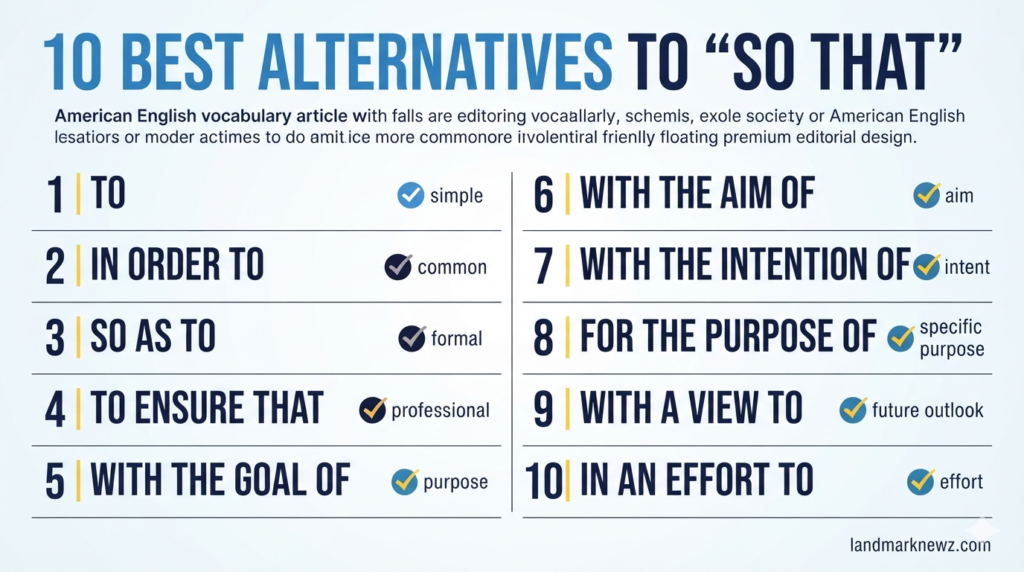
1. To
Meaning
“To” is one of the simplest alternatives to “so that” when you are expressing purpose. It usually makes a sentence shorter without changing its basic meaning.
For example, “She studied hard so that she could pass” can become “She studied hard to pass.”
Best For
- Professional
- Casual
- Friendly
- Formal
Example 1
I set an alarm to make sure I arrived at the airport on time.
Example 2
He saved money to buy a new laptop.
Quick Tip
Use “to” when the subject performing the first action is also the person performing the purpose action.
2. In Order To
Meaning
“In order to” expresses purpose and is slightly more formal or deliberate than simply saying “to.” It can be useful when you want the purpose of an action to stand out clearly.
Best For
- Professional
- Formal
Example 1
We updated the software in order to improve system security.
Example 2
She reviewed the contract carefully in order to identify any hidden fees.
Quick Tip
Use this phrase when you want to emphasize the reason behind an action, but avoid overusing it when simple “to” would be clearer.
3. So As To
Meaning
“So as to” also expresses purpose, much like “in order to.” It has a more formal tone and is more common in careful writing than casual conversation.
Best For
- Formal
- Professional
Example 1
The company changed its schedule so as to reduce delays.
Example 2
Please speak clearly so as to avoid confusion during the presentation.
Quick Tip
This phrase is best suited to formal writing. In everyday conversation, “to” usually sounds more natural.
4. To Ensure That
Meaning
“To ensure that” emphasizes making sure that a particular result happens. Unlike a simple purpose phrase, it highlights reliability, prevention, or a desired outcome.
Best For
- Professional
- Formal
- Polite
Example 1
Please double-check the address to ensure that the package reaches the correct location.
Example 2
We added another review step to ensure that every report meets our standards.
Quick Tip
Choose this alternative when your sentence focuses on guaranteeing or protecting a specific result.
5. With the Goal of
Meaning
“With the goal of” directly states the objective behind an action. It works especially well when discussing projects, plans, strategies, or long-term objectives.
Best For
- Professional
- Formal
Example 1
The team redesigned the website with the goal of improving the customer experience.
Example 2
The city expanded public transportation with the goal of reducing traffic congestion.
Quick Tip
Use this phrase when the purpose is a clear objective rather than a simple reason for an everyday action.
6. With the Aim of
Meaning
“With the aim of” means that someone performs an action because they want to achieve a particular result. It has a polished and formal tone.
Best For
- Formal
- Professional
Example 1
The organization launched the campaign with the aim of increasing voter awareness.
Example 2
The researchers changed the testing method with the aim of producing more accurate results.
Quick Tip
This expression fits reports, proposals, academic writing, and other situations where you want to emphasize an objective.
7. With the Intention of
Meaning
“With the intention of” focuses on what someone plans or intends to accomplish. It can describe a deliberate action and is useful when the person’s purpose matters.
Best For
- Formal
- Professional
Example 1
She contacted the manager with the intention of resolving the complaint.
Example 2
He enrolled in the course with the intention of developing stronger leadership skills.
Quick Tip
Use this phrase when you want to highlight a person’s deliberate intention rather than simply state a practical purpose.
8. For the Purpose of
Meaning
“For the purpose of” clearly identifies the reason something is done. It has a formal, official tone and is more common in policies, legal documents, procedures, and formal explanations.
Best For
- Formal
- Professional
Example 1
The information was collected for the purpose of evaluating the program.
Example 2
Employees must complete the form for the purpose of confirming their contact details.
Quick Tip
Because it sounds formal, avoid using it in casual conversation when “to” would communicate the same idea more naturally.
9. With a View to
Meaning
“With a view to” means that an action is taken with a particular future result in mind. It is especially useful when discussing plans, improvements, or future objectives.
Best For
- Formal
- Professional
Example 1
The company revised its policies with a view to improving employee retention.
Example 2
The committee changed the process with a view to making approvals more efficient.
Quick Tip
This phrase is most appropriate for formal or business-oriented writing and can sound too stiff in casual conversation.
10. In an Effort to
Meaning
“In an effort to” shows that someone is taking action because they are trying to achieve a particular outcome. It can suggest that the result may require work rather than being guaranteed.
Best For
- Professional
- Formal
- Friendly
Example 1
The school added more tutoring sessions in an effort to improve student performance.
Example 2
I reorganized my schedule in an effort to spend more time with my family.
Quick Tip
Choose this expression when you want to emphasize an attempt or ongoing effort rather than a guaranteed result.
Comparison Table
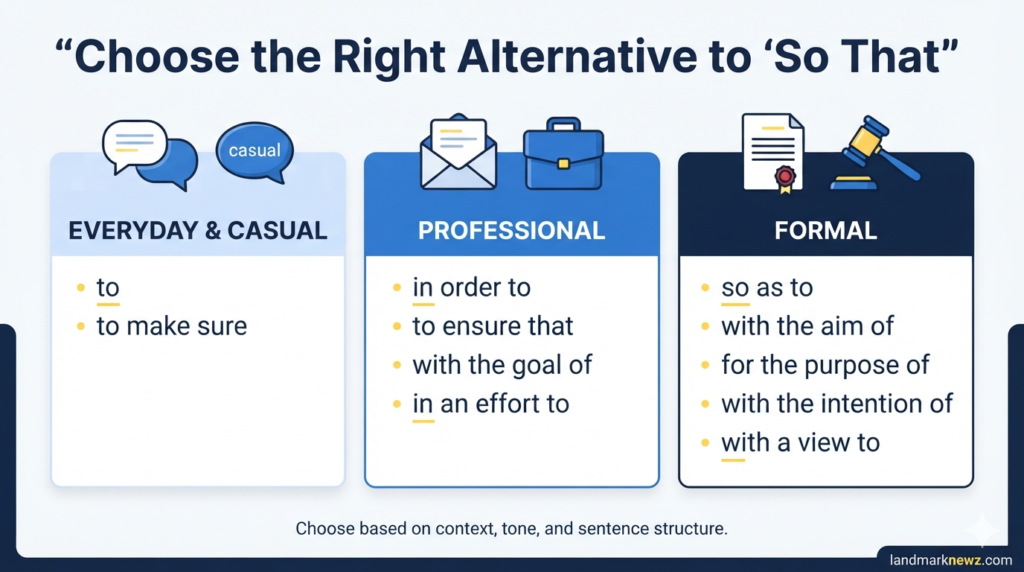
| Alternative | Best Used In | Tone |
| To | Everyday writing, emails, conversation | Natural, direct |
| In order to | Professional and formal writing | Clear, formal |
| So as to | Formal writing | Formal |
| To ensure that | Business, instructions, professional writing | Precise, reassuring |
| With the goal of | Business, strategy, reports | Professional |
| With the aim of | Academic and professional writing | Formal |
| With the intention of | Formal explanations | Deliberate, formal |
| For the purpose of | Policies, legal and official writing | Very formal |
| With a view to | Business and formal writing | Formal |
| In an effort to | Professional and general writing | Purposeful, natural |
Common Mistakes
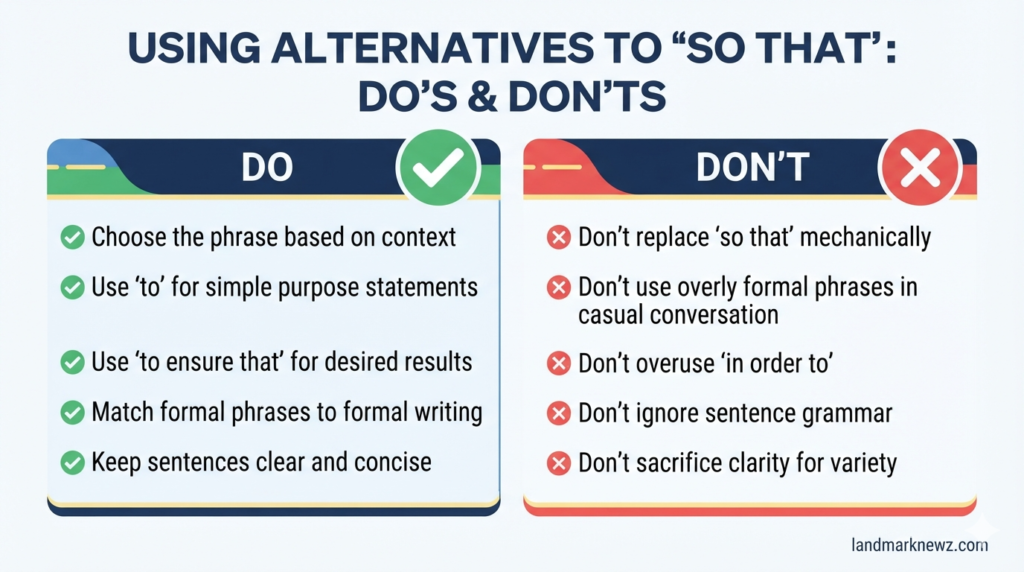
1. Using a Formal Phrase in Casual Conversation
Expressions such as “for the purpose of” can sound unnecessarily stiff in everyday speech. In many casual situations, “to” is a much more natural choice.
2. Replacing “So That” Without Checking the Grammar
Not every sentence can use “to” as a direct replacement. “So that” can introduce a clause with a different subject, while “to” generally works best with an infinitive construction.
3. Using “In Order To” Too Often
“In order to” is grammatically correct, but it can make simple sentences longer than necessary. If “to” expresses the same idea clearly, it is usually the cleaner option.
4. Ignoring the Intended Meaning
“So that” can sometimes emphasize a specific result, while alternatives such as “to ensure that” add the idea of making something certain. Choose the phrase based on the exact meaning you want.
5. Making Writing Sound Overly Complicated
Using several formal expressions in one paragraph can make otherwise simple writing difficult to read. Clear communication is usually more effective than unnecessarily sophisticated wording.
Frequently Asked Questions
1. What is another way to say “so that”?
Common alternatives include “to,” “in order to,” “so as to,” “to ensure that,” “with the goal of,” and “in an effort to.” The best choice depends on the sentence. For everyday writing, “to” is usually the simplest option, while longer alternatives work better when you need a formal or more specific tone.
2. What is the simplest replacement for “so that”?
“To” is usually the simplest replacement when you are expressing purpose. For example, “She exercised so that she could stay healthy” can become “She exercised to stay healthy.” This version is shorter, natural, and easy to understand.
3. Is “in order to” the same as “so that”?
They can express a similar purpose, but their grammar differs. “In order to” is normally followed by a verb, while “so that” is generally followed by a clause containing a subject and verb. For example, “I left early in order to arrive on time” differs structurally from “I left early so that I could arrive on time.”
4. Is “so as to” formal?
Yes. “So as to” generally sounds more formal than “to.” It is appropriate in reports, instructions, professional documents, and formal writing. In casual conversation, native speakers often prefer “to” because it is shorter and more conversational.
5. What can I use instead of “so that” in an essay?
For an essay, you can use “in order to,” “with the aim of,” “with the goal of,” or “to ensure that,” depending on the meaning. However, you do not need to avoid “so that.” It is grammatically correct and often the clearest choice.
6. How do I use “to” instead of “so that”?
Use “to” when the purpose can be expressed with an infinitive phrase. For example, “He took notes so that he could remember the details” can become “He took notes to remember the details.” The shorter version works because the same person performs both actions.
7. What is a professional way to say “so that”?
“In order to” and “to ensure that” are common professional alternatives. “In order to” simply states a purpose, while “to ensure that” emphasizes a desired or reliable outcome. Choose the one that matches your intended meaning.
8. Can “so that” and “so as to” always be used interchangeably?
No. Although both can express purpose, their sentence structures are different. “So as to” is normally followed by a base verb, while “so that” introduces a clause. Always check the grammar and meaning rather than replacing one phrase mechanically.
Conclusion
There are many ways to say “so that,” but the best alternative depends on your sentence and audience. For simple, natural writing, “to” is usually the strongest choice because it is concise and easy to understand.
If you are writing a professional document, “in order to” can provide a more formal tone. When you want to emphasize a desired outcome, “to ensure that” is more precise. Meanwhile, expressions such as “with the goal of,” “with the aim of,” and “in an effort to” work well when discussing objectives or deliberate efforts.
The most important rule is to prioritize clarity over variety. You do not need to replace “so that” every time it appears. Choose an alternative only when it makes the sentence more natural, precise, or appropriate for the context. Writing with clarity and precision can help you choose wording that communicates your meaning more effectively.

About Dr. Priya Nair
Dr. Priya Nair is a passionate Writer & Blogger at LandMarkNewz.com, dedicated to creating informative, engaging, and easy-to-understand content for readers. With a strong interest in research, current trends, lifestyle, and everyday topics, she focuses on presenting useful information in a clear and reader-friendly way.
Through her writing, Priya aims to help readers discover valuable insights, understand complex topics more easily, and stay informed about subjects that matter to them. Her approach combines thoughtful research with a simple and engaging writing style.
At LandMarkNewz.com, she contributes original articles designed to inform, educate, and provide practical value to readers.