
Finding the right phrase for subject matter expert can make your writing sound more natural, precise, and professional. While “subject matter expert” is widely used in business and technical settings, it can sometimes feel repetitive or overly formal.
The best alternative depends on what you want to emphasize. You may want to highlight specialized knowledge, professional experience, industry recognition, technical skills, or the ability to advise others.
What Does “Another Way to Say Subject Matter Expert” Mean?
“Another way to say subject matter expert” means looking for a different word or phrase that describes someone with advanced knowledge and experience in a particular field.
A subject matter expert, often called an SME, may provide advice, train employees, review information, solve complex problems, or guide important decisions. The term is common in business, technology, education, healthcare, consulting, and project management.
For example, instead of saying, “She is a subject matter expert in cybersecurity,” you could say, “She is a cybersecurity specialist” or “She is an authority in cybersecurity.”
Why Use Other Ways to Say “Subject Matter Expert”?
Using different expressions helps you communicate expertise without repeating the same phrase. It also lets you choose wording that better fits a resume, email, job description, presentation, or professional profile.
Consider an alternative when you want to:
- Avoid repetitive professional language.
- Make your writing sound more natural.
- Highlight a specific type of expertise.
- Match the tone of your audience.
- Strengthen a resume or LinkedIn profile.
- Distinguish technical expertise from general experience.
10 Best Other Ways to Say “Subject Matter Expert”
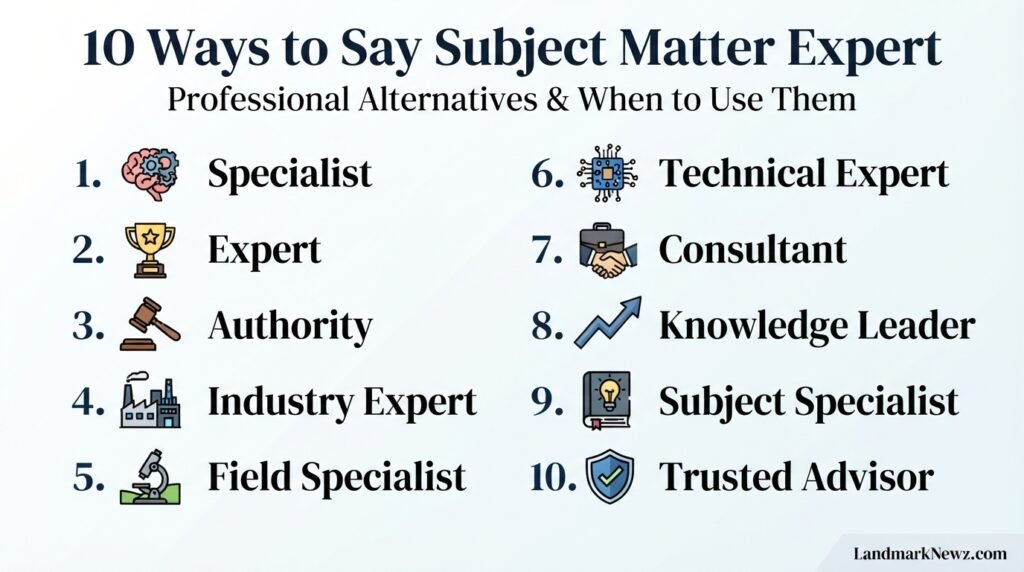
1. Specialist
Meaning
“Specialist” describes someone who focuses on a particular subject, skill, or area of work. It is one of the most natural replacements for “subject matter expert” because it clearly communicates specialized knowledge without sounding exaggerated.
Best For
- Professional
- Formal
Example 1
Maria is a marketing specialist with extensive experience in B2B campaigns.
Example 2
Our software specialist helped the team resolve the integration issue.
Quick Tip
Use “specialist” when you want a professional, straightforward alternative that works well on resumes and in workplace communication.
2. Expert
Meaning
“Expert” is a simple and direct way to describe someone with extensive knowledge or skill. It is less corporate than “subject matter expert” and is easy for almost any audience to understand.
Best For
- Professional
- Formal
- Casual
Example 1
David is an expert in supply chain optimization.
Example 2
We asked an experienced expert to review the technical proposal.
Quick Tip
Use “expert” when clarity matters more than corporate terminology.
3. Authority
Meaning
“Authority” suggests that someone has advanced knowledge and is respected within a particular field. It can imply more than expertise because it often suggests professional recognition or influence.
Best For
- Professional
- Formal
Example 1
Dr. Lee is widely regarded as an authority on renewable energy policy.
Example 2
The company consulted an industry authority before launching the new product.
Quick Tip
Use “authority” when the person has established credibility rather than simply having practical knowledge.
4. Industry Expert
Meaning
“Industry expert” identifies someone with substantial knowledge and experience within a particular industry. It works especially well when discussing business, market trends, professional standards, or industry developments.
Best For
- Professional
- Formal
Example 1
The company invited an industry expert to speak about changing consumer behavior.
Example 2
As an industry expert, James regularly advises organizations on compliance issues.
Quick Tip
Use this phrase when you want to emphasize broad industry knowledge rather than expertise in one narrow task.
5. Field Specialist
Meaning
“Field specialist” emphasizes focused knowledge within a specific professional area. It sounds polished and works particularly well when describing technical, scientific, educational, or specialized roles.
Best For
- Professional
- Formal
Example 1
The hospital hired a field specialist to evaluate the new diagnostic equipment.
Example 2
Our field specialist provides training to regional sales teams.
Quick Tip
Pair “field specialist” with the specific area of expertise when you want maximum clarity.
6. Technical Expert
Meaning
“Technical expert” focuses on advanced knowledge of systems, tools, processes, or technology. It is especially useful in IT, engineering, software development, manufacturing, and other technical industries.
Best For
- Professional
- Formal
Example 1
The technical expert reviewed the network architecture before implementation.
Example 2
We brought in a technical expert to troubleshoot the software problem.
Quick Tip
Choose this phrase when the expertise involves technical skills rather than general business knowledge.
7. Consultant
Meaning
“Consultant” describes someone who provides professional advice or specialized guidance. Unlike “expert,” the word focuses more on the person’s role and service than simply their level of knowledge.
Best For
- Professional
- Formal
Example 1
The company hired a cybersecurity consultant to assess its security policies.
Example 2
Our financial consultant recommended several ways to reduce operating costs.
Quick Tip
Use “consultant” only when the person actually advises or supports clients, teams, or organizations.
8. Knowledge Leader
Meaning
“Knowledge leader” highlights someone who guides others through their expertise and understanding. It is useful when the person shares knowledge, influences decisions, or helps establish best practices within an organization.
Best For
- Professional
- Formal
Example 1
As a knowledge leader, Priya developed training resources for new employees.
Example 2
The organization relies on him as a knowledge leader in data management.
Quick Tip
This phrase works best when the person’s expertise includes mentoring, training, or guiding others.
9. Subject Specialist
Meaning
“Subject specialist” is a close alternative to “subject matter expert.” It refers to someone who has focused knowledge of a particular topic and is often used in education, research, libraries, and professional environments.
Best For
- Professional
- Formal
Example 1
The university hired a subject specialist to support its research department.
Example 2
Please ask our subject specialist if you need help with the technical documentation.
Quick Tip
Use “subject specialist” when you want to preserve the original meaning while using a less common phrase.
10. Trusted Advisor
Meaning
“Trusted advisor” emphasizes both expertise and reliability. It describes someone whose knowledge is valued and whose recommendations are trusted when making important professional decisions.
Best For
- Professional
- Formal
- Warm
Example 1
Over the years, Jennifer became a trusted advisor to several technology companies.
Example 2
His role as a trusted advisor allows him to guide clients through complex decisions.
Quick Tip
Use “trusted advisor” when credibility, judgment, and long-term relationships matter as much as technical knowledge.
Comparison Table
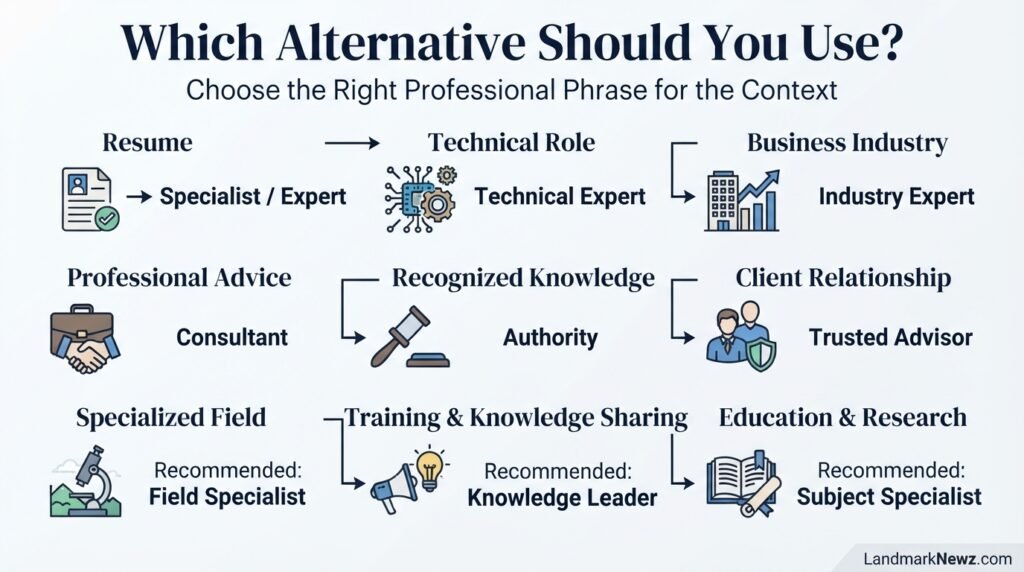
| Alternative | Best Used In | Tone |
| Specialist | Resumes, workplace communication | Professional |
| Expert | General professional writing | Professional |
| Authority | Bios, articles, presentations | Formal |
| Industry Expert | Business and industry content | Professional |
| Field Specialist | Technical and specialized roles | Formal |
| Technical Expert | IT, engineering, technology | Professional |
| Consultant | Advisory and client-facing roles | Professional |
| Knowledge Leader | Training and organizational roles | Formal |
| Subject Specialist | Education, research, professional settings | Formal |
| Trusted Advisor | Consulting and client relationships | Professional/Warm |
Common Mistakes
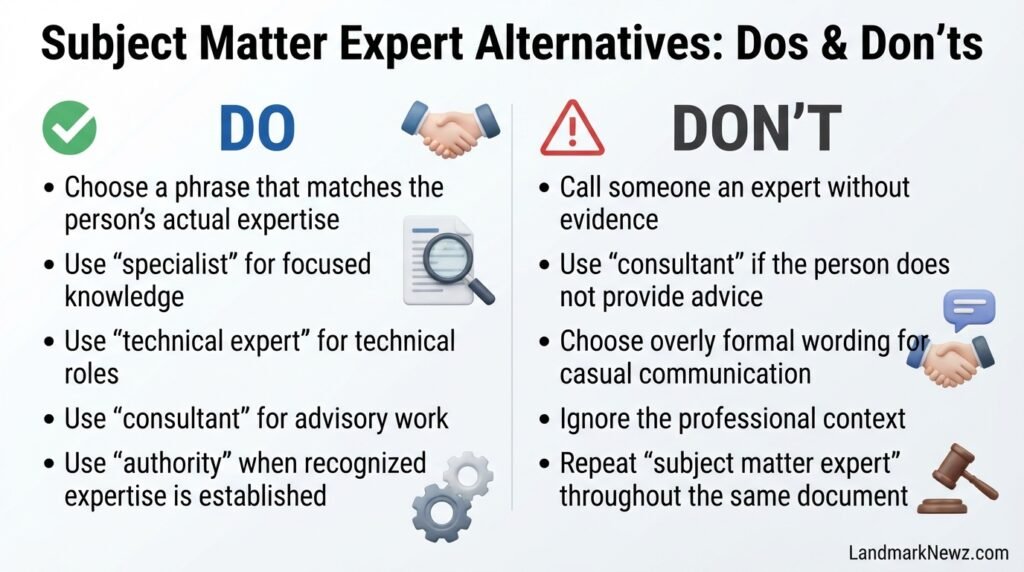
1. Using “Expert” Without Evidence
Calling someone an expert can sound vague if you do not explain their experience or accomplishments. Support the claim with relevant skills, years of experience, certifications, or measurable results.
2. Using “Consultant” Incorrectly
A consultant normally provides advice or specialized services. If someone simply has advanced knowledge but does not advise clients or organizations, “specialist” or “expert” may be more accurate.
3. Choosing Overly Formal Language
Words such as “authority” can sound impressive but may be too strong for casual workplace communication. Match the phrase to the audience and situation.
4. Ignoring Context
A technical expert, industry expert, and trusted advisor do not communicate exactly the same idea. Select the phrase that reflects what the person actually does.
5. Repeating the Same Term
Using “subject matter expert” several times in a resume, report, or article can make the writing feel repetitive. Alternate between accurate terms when the context allows it.
Frequently Asked Questions
What is a professional way to say subject matter expert?
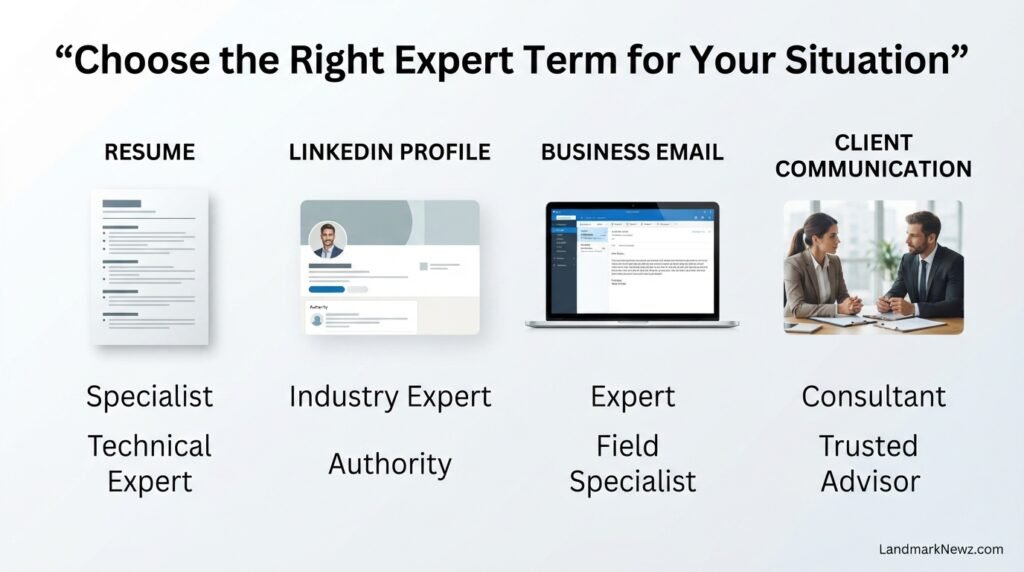
“Specialist,” “expert,” “industry expert,” and “field specialist” are strong professional alternatives. The best option depends on the person’s role. For a resume, “specialist” often sounds natural and precise, while “industry expert” can work well when describing broad professional knowledge and experience.
What is another word for subject matter expert on a resume?
Good resume alternatives include specialist, expert, technical expert, industry expert, consultant, and field specialist. Choose the term that accurately reflects your responsibilities. For example, an IT professional could use “technical expert,” while someone who advises clients may be better described as a “consultant.”
Is “SME” another way to say subject matter expert?
Yes. SME is the common abbreviation for “subject matter expert.” It is widely used in business, technology, training, and project management. However, spelling out “subject matter expert” may be clearer in resumes, applications, or documents intended for readers who may not know the abbreviation.
Is “specialist” better than “subject matter expert”?
Not always, but “specialist” is often shorter and more natural. “Subject matter expert” emphasizes deep knowledge that others rely on, while “specialist” mainly indicates focused expertise. Choose “specialist” for simplicity and “subject matter expert” when the person’s advisory or knowledge-sharing role is important.
What is a stronger word than subject matter expert?
“Authority” can be stronger because it may imply recognized expertise within a field. “Trusted advisor” can also be powerful when the person influences important decisions. However, stronger wording should reflect real experience and professional recognition rather than simply making a title sound impressive.
Can I use “expert” on my LinkedIn profile?
Yes. “Expert” is widely understood and can work well on LinkedIn when supported by specific experience, accomplishments, or skills. Instead of relying only on the label, explain what you know, what problems you solve, and what results you have achieved.
What is the best alternative to subject matter expert for a formal document?
“Subject specialist,” “field specialist,” and “authority” can work well in formal documents. The right choice depends on the context. “Authority” suggests recognized expertise, while “subject specialist” stays closer to the original meaning without using the exact phrase.
What should I use instead of subject matter expert in an email?
For most professional emails, specialist, expert, or technical expert sounds natural. For example, instead of saying, “I will connect you with our subject matter expert,” you could write, “I’ll connect you with our technical specialist.” This keeps the message clear and professional without sounding overly corporate.
Conclusion
There are many effective alternatives to subject matter expert, but the best choice depends on the person’s role and the context. Specialist is a versatile option for resumes and workplace writing, while expert is simple and widely understood.
If the person has recognized authority in a field, “authority” may be more appropriate. For technical roles, “technical expert” clearly communicates specialized knowledge, while “consultant” works when the person provides professional advice.
For more context on what a subject matter expert does, see this guide to subject matter experts. “Trusted advisor” is a strong choice when reliability and long-term guidance are important.
The key is accuracy. Choose a phrase that reflects the person’s actual expertise, responsibilities, and level of recognition. The right wording should make professional communication clearer—not simply sound more impressive.
About Dr. Priya Nair
Dr. Priya Nair is a passionate Writer & Blogger at LandMarkNewz.com, dedicated to creating informative, engaging, and easy-to-understand content for readers. With a strong interest in research, current trends, lifestyle, and everyday topics, she focuses on presenting useful information in a clear and reader-friendly way.
Through her writing, Priya aims to help readers discover valuable insights, understand complex topics more easily, and stay informed about subjects that matter to them. Her approach combines thoughtful research with a simple and engaging writing style.
At LandMarkNewz.com, she contributes original articles designed to inform, educate, and provide practical value to readers.