Sometimes, “time flies” feels too familiar or repetitive. Whether you’re writing an email, talking with friends, reflecting on a milestone, or commenting on how quickly a year has passed, a fresh expression can make your message sound more natural.
What Does “Another Way to Say Time Flies” Mean?
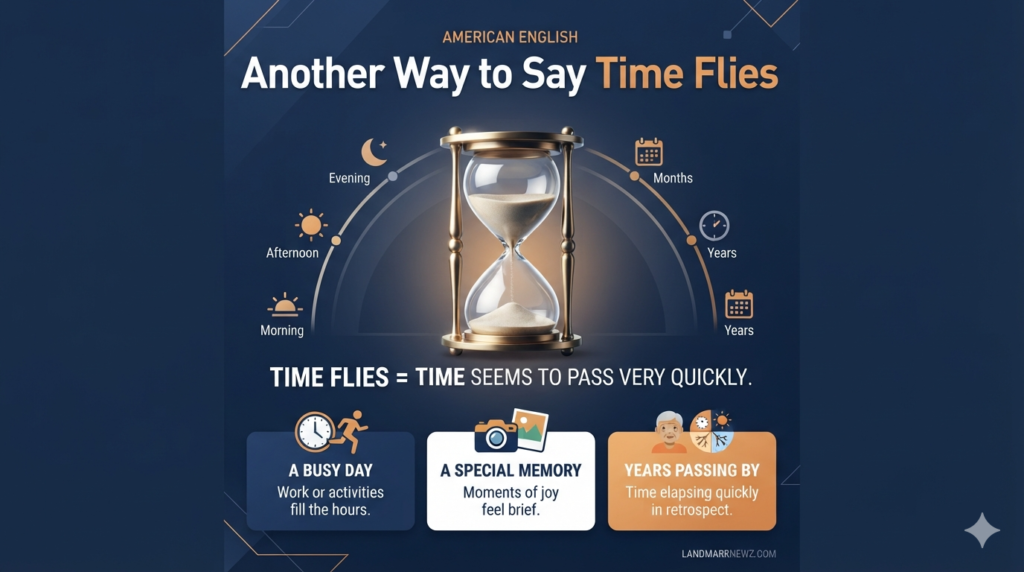
“Time flies” is an expression used when you feel that time has passed surprisingly quickly. It often describes moments when you look back and realize that hours, months, or even years seem to have disappeared.
For example, you might say, “Time flies when you’re having fun” after spending an enjoyable afternoon with friends. People also use the phrase when discussing birthdays, holidays, childhood memories, careers, and major life changes.
The alternatives below let you express the same idea while adjusting the tone to fit the situation.
Why Use Other Ways to Say “Time Flies”?
Using different expressions can make your writing and conversations more natural and expressive. The best phrase depends on whether you’re being casual, professional, nostalgic, or emotional.
- Avoid repetition: Don’t use “time flies” in every conversation.
- Sound more natural: Choose wording that fits the specific situation.
- Show emotion: Some alternatives express surprise or nostalgia more clearly.
- Match the setting: A professional message may need a more neutral expression.
- Add personality: A conversational phrase can make a message feel warmer.
10 Best Other Ways to Say “Time Flies”
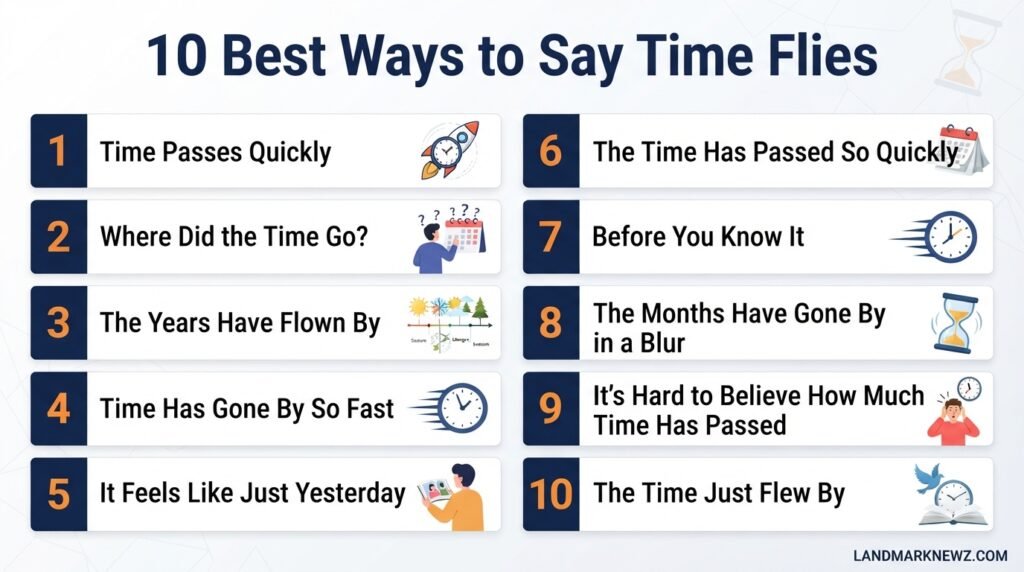
1. Time Passes Quickly
Meaning
“Time passes quickly” is a straightforward and neutral way to express the idea behind “time flies.” It works especially well when you want to sound clear without using an idiom.
Best For
- Professional
- Formal
- Polite
Example 1
Time passes quickly when you’re focused on an important project.
Example 2
It is amazing how quickly time passes when you look back over the past year.
Quick Tip
Use this option when you want a simple replacement that works in both writing and conversation.
2. Where Did the Time Go?
Meaning
“Where did the time go?” expresses surprise that so much time has passed. It is usually rhetorical and has a friendly, conversational feel.
Best For
- Casual
- Friendly
- Warm
Example 1
We started talking after lunch, and now it’s almost dinner. Where did the time go?
Example 2
The kids were just starting school, and now they’re graduating. Where did the time go?
Quick Tip
Use this phrase when you want to show genuine surprise about how quickly time has passed.
3. The Years Have Flown By
Meaning
“The years have flown by” is a more expressive alternative that usually refers to a longer period. It often carries a nostalgic or emotional feeling.
Best For
- Friendly
- Warm
- Casual
Example 1
The years have flown by since we first opened the family business.
Example 2
The years have flown by, and our youngest is already heading off to college.
Quick Tip
Choose this expression when you’re talking about months or years rather than a few hours or days.
4. Time Has Gone by So Fast
Meaning
“Time has gone by so fast” is a natural conversational expression that emphasizes how quickly a period has passed. It sounds personal and genuine.
Best For
- Casual
- Friendly
- Warm
Example 1
Time has gone by so fast since we moved into this neighborhood.
Example 2
I can’t believe graduation is already here. Time has gone by so fast.
Quick Tip
This is a good choice when you want your sentence to sound natural in everyday American conversation.
5. It Feels Like Just Yesterday
Meaning
“It feels like just yesterday” suggests that something happened recently, even though considerable time has actually passed. The phrase often creates a nostalgic or sentimental tone.
Best For
- Warm
- Friendly
- Casual
Example 1
It feels like just yesterday that we brought our daughter home from the hospital.
Example 2
It feels like just yesterday that I started my first job at the company.
Quick Tip
Use this phrase when reflecting on a meaningful memory, milestone, or personal experience.
6. The Time Has Passed So Quickly
Meaning
“The time has passed so quickly” directly communicates that a period ended sooner than expected. It sounds slightly more polished than the casual phrase “time flies.”
Best For
- Professional
- Formal
- Polite
Example 1
The time has passed so quickly during my first year with the organization.
Example 2
As we prepare for the final meeting, it’s clear that the time has passed quickly.
Quick Tip
This option works well when you need a polished expression for workplace or formal writing.
7. Before You Know It
Meaning
“Before you know it” describes something that seems to happen sooner than expected. It can refer to future events as well as how quickly circumstances change.
Best For
- Casual
- Friendly
- Warm
Example 1
Keep enjoying these little moments because before you know it, the kids will be grown.
Example 2
Before you know it, summer will be over and everyone will be back at school.
Quick Tip
Use this phrase when you’re looking ahead and want to emphasize how quickly the future can arrive.
8. The Months Have Gone By in a Blur
Meaning
“The months have gone by in a blur” suggests that events happened so quickly or intensely that the period feels difficult to remember clearly. It can express excitement, busyness, or nostalgia.
Best For
- Casual
- Friendly
- Warm
Example 1
The months have gone by in a blur since we welcomed our new baby.
Example 2
With the new job and the house renovation, the months have gone by in a blur.
Quick Tip
This phrase is especially useful when a busy or eventful period seems to have passed almost unnoticed.
9. It’s Hard to Believe How Much Time Has Passed
Meaning
This expression emphasizes surprise at the amount of time that has elapsed. It is more descriptive than “time flies” and works well when discussing important memories or milestones.
Best For
- Friendly
- Warm
- Polite
Example 1
It’s hard to believe how much time has passed since our college graduation.
Example 2
It’s hard to believe how much time has passed since we last visited our hometown.
Quick Tip
Use this phrase when you want to combine surprise with a reflective or sentimental tone.
10. The Time Just Flew By
Meaning
“The time just flew by” is a close alternative to “time flies” and usually refers to a specific event or period. It suggests that you enjoyed yourself or became so involved that you barely noticed the time.
Best For
- Casual
- Friendly
- Warm
Example 1
We had so much fun at the reunion that the time just flew by.
Example 2
The afternoon just flew by while we were catching up over coffee.
Quick Tip
Use “the time just flew by” when describing a particular experience that seemed to end sooner than expected.
Comparison Table
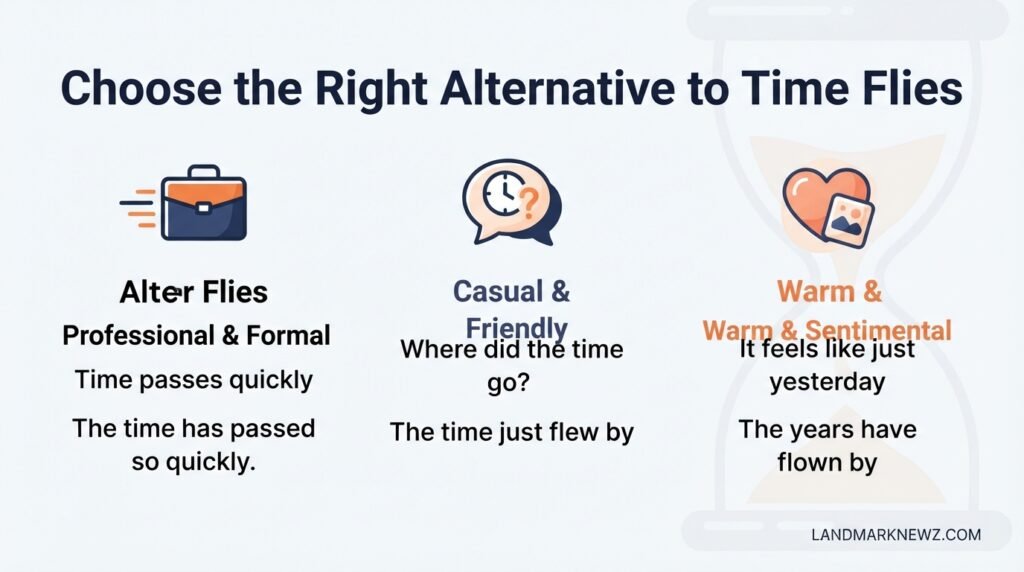
| Alternative | Best Used In | Tone |
| Time passes quickly | Professional, formal writing | Neutral |
| Where did the time go? | Everyday conversations | Casual, friendly |
| The years have flown by | Memories and milestones | Warm, nostalgic |
| Time has gone by so fast | Everyday conversation | Casual, personal |
| It feels like just yesterday | Personal memories | Warm, sentimental |
| The time has passed so quickly | Workplace and formal writing | Polished, neutral |
| Before you know it | Future events and advice | Friendly, conversational |
| The months have gone by in a blur | Busy periods and life changes | Casual, reflective |
| It’s hard to believe how much time has passed | Milestones and memories | Warm, reflective |
| The time just flew by | Specific enjoyable experiences | Casual, upbeat |
Common Mistakes
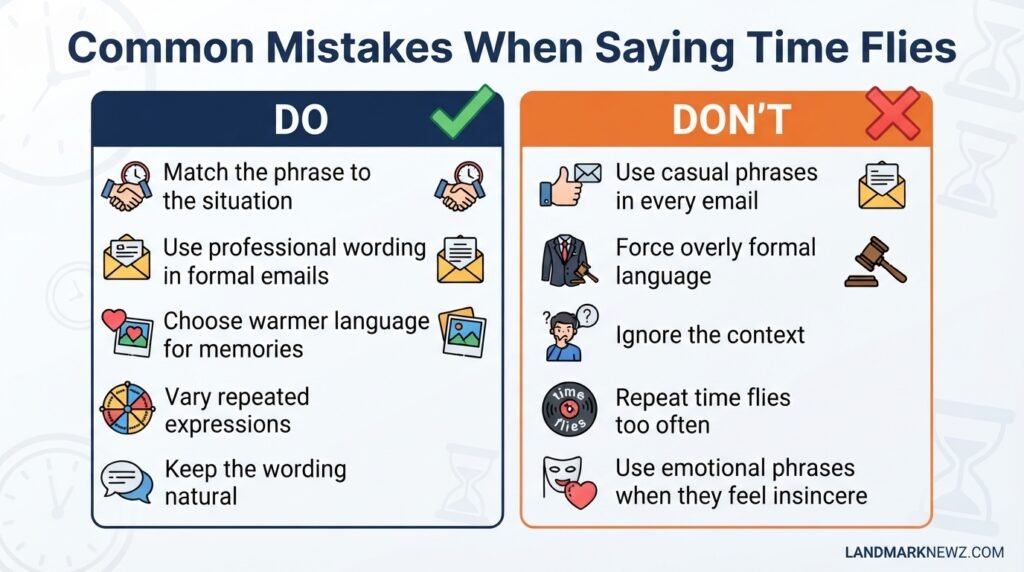
1. Using Casual Phrases in Professional Emails
Expressions such as “Where did the time go?” may sound too conversational in some workplace messages. Use “time has passed quickly” when you need a more professional tone.
2. Choosing Overly Formal Language
Not every situation requires polished wording. A phrase like “the time has passed so quickly” may feel stiff when you’re simply chatting with a close friend.
3. Repeating the Same Phrase
Using “time flies” repeatedly can make your writing sound predictable. Vary your wording when discussing several milestones or periods of time.
4. Forgetting the Context
Some alternatives work better for years, while others describe a single afternoon. “The years have flown by” makes more sense for a long period than for a two-hour meeting.
5. Sounding Insincere
Emotional phrases such as “it feels like just yesterday” should fit the situation. If the moment isn’t meaningful, a simple expression like “time passes quickly” may sound more genuine.
Frequently Asked Questions
What is another way to say “time flies”?
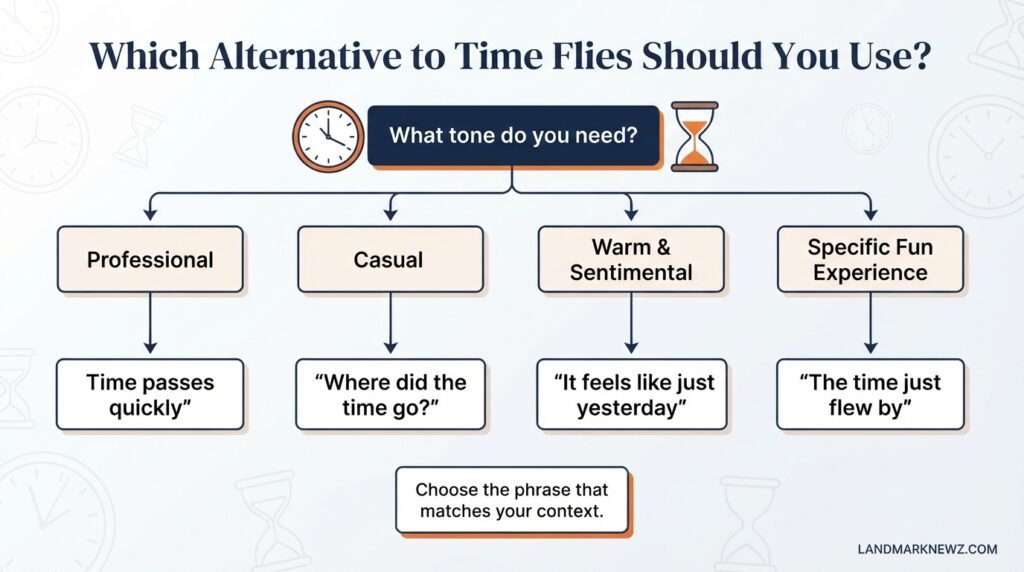
Common alternatives include “time passes quickly,” “where did the time go?” “the years have flown by,” and “it feels like just yesterday.” The best option depends on your context. For professional writing, choose a neutral phrase such as “time passes quickly.” For personal conversations, warmer expressions can sound more natural.
What is a professional way to say “time flies”?
A professional alternative is “time passes quickly” or “the time has passed so quickly.” These expressions communicate the same idea without sounding overly casual. They can work well in business emails, presentations, reports, and workplace conversations when you’re reflecting on a project, year, or period of employment.
What is a casual way to say “time flies”?
“Where did the time go?” is one of the most natural casual alternatives. You can also say, “Time has gone by so fast” or “The time just flew by.” These expressions fit everyday conversations with friends, family members, coworkers, and people you know well.
How do you say “time flies” in a sentimental way?
For a sentimental tone, try “It feels like just yesterday” or “It’s hard to believe how much time has passed.” These expressions work particularly well when talking about children growing up, anniversaries, graduations, friendships, or other meaningful milestones.
What is another way to say “time flies when you’re having fun”?
You could say, “The time just flew by,” “We lost track of time,” or “The afternoon went by so quickly.” These alternatives highlight how enjoyable an experience was and suggest that you were so engaged that you barely noticed the passing time.
Can I use “time flies” in a professional email?
Yes, but context matters. “Time flies” is grammatically correct and widely understood, but it has a conversational tone. If you’re writing a formal business email, “It’s hard to believe how quickly the year has passed” may sound more polished and appropriate.
What does “where did the time go?” mean?
“Where did the time go?” is a rhetorical question used when you’re surprised by how quickly time has passed. You aren’t literally asking where time went. Instead, you’re expressing surprise, often with a sense of enjoyment, nostalgia, or disbelief.
Which alternative to “time flies” is best for a memory?
“It feels like just yesterday” is often the strongest choice for a meaningful memory. It suggests that an event happened a long time ago but still feels recent. For a more neutral option, “It’s hard to believe how much time has passed” also works well.
Conclusion
Finding another way to say “time flies” can help you express the same idea with more personality and precision. If you want to understand the meaning of “time flies” and how the expression is used, Cambridge Dictionary provides a clear explanation.
For professional writing, “time passes quickly” and “the time has passed so quickly” are safe, polished choices. In casual conversations, “where did the time go?” and “the time just flew by” feel more natural. When you’re reflecting on important memories, “it feels like just yesterday” or “the years have flown by” adds warmth and emotion.
You don’t need to avoid “time flies” altogether. Instead, use it when it feels natural and switch to another expression when you want a different tone, stronger emotion, or more variety. The best wording is always the one that fits the moment.

Professional Writing & Workplace Communication Expert
Marcus Hale is a business communication specialist with 11 years of experience in corporate training and professional writing. He has worked with mid-sized companies and remote teams to improve clarity in emails, reports, performance reviews, and client-facing messages.
Marcus focuses on polished, professional alternatives that help readers sound confident without sounding stiff. His guides cover workplace phrases, resume language, leadership communication, and formal-to-natural transitions. He holds a background in business administration and technical writing, and has led workshops on effective professional English.
At LandmarkNewz, Marcus creates practical synonym lists and phrasing tips that professionals can apply immediately in emails, meetings, and career documents.