
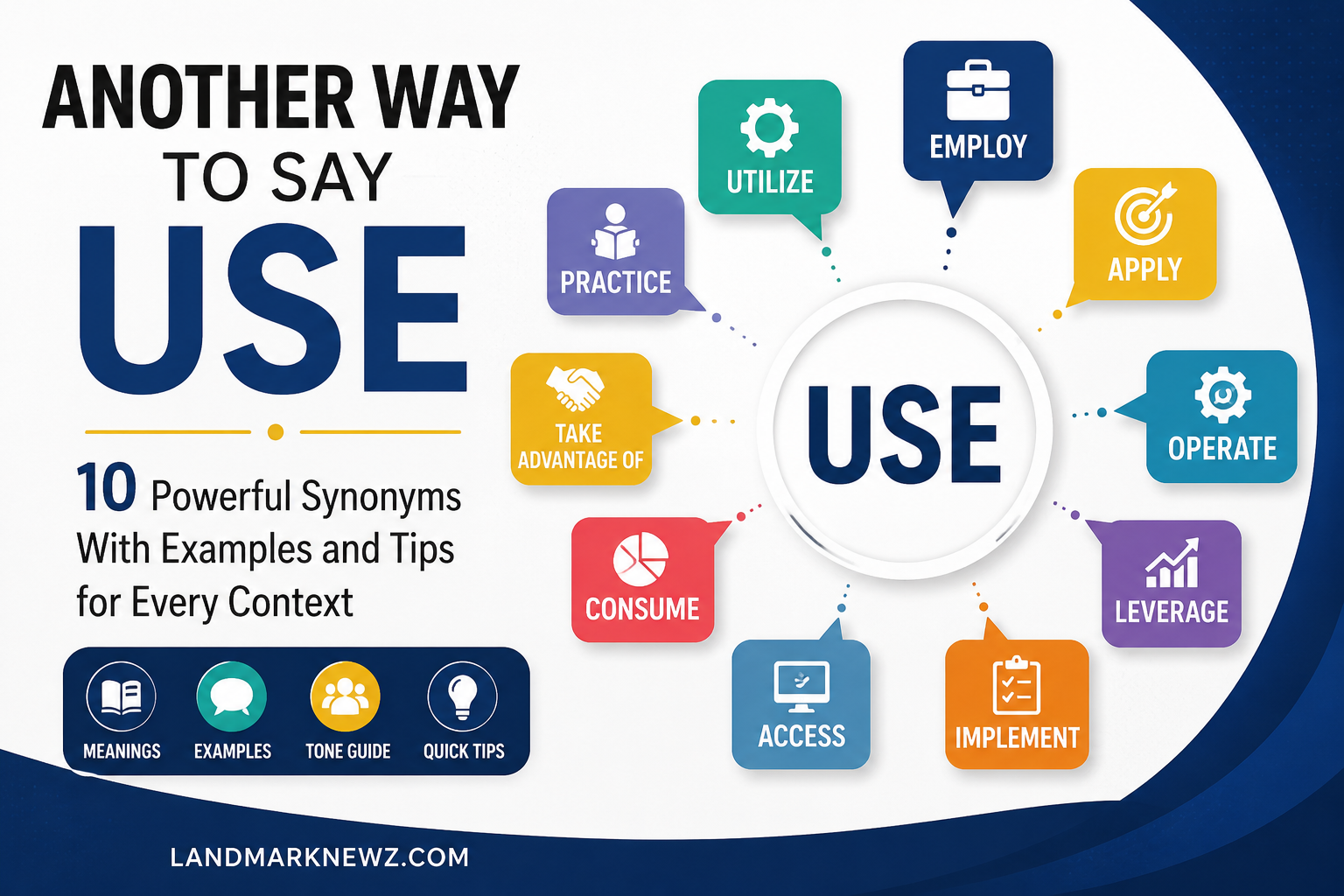
The word use is one of the most common verbs in English, but repeating it too often can make your writing sound plain or repetitive. Fortunately, English offers many alternatives, and each one carries a slightly different meaning or tone.
Choosing the right synonym is not simply about replacing one word with another. The best alternative should fit the object, purpose, sentence, and level of formality.
What Does “Another Way to Say Use” Mean?
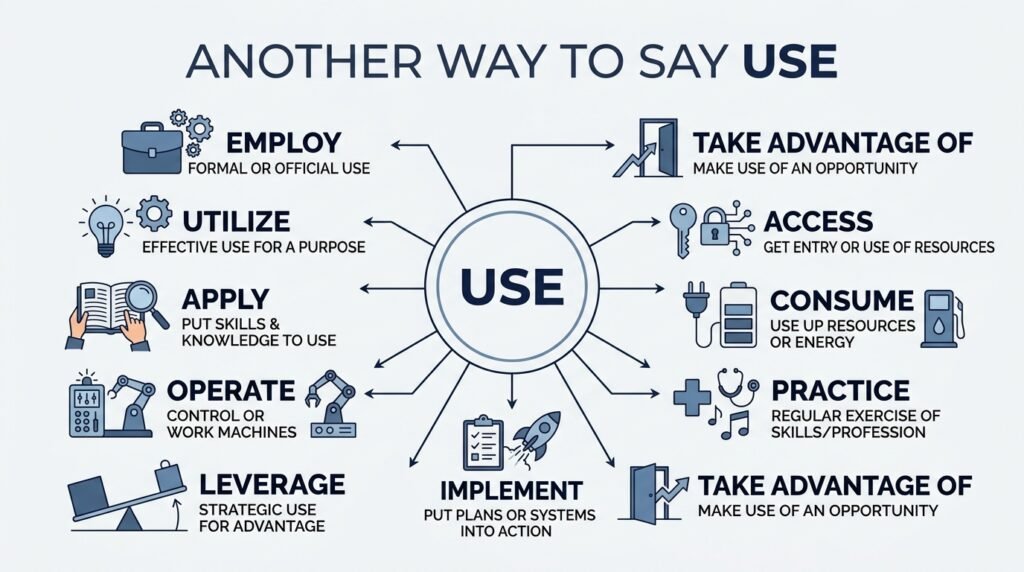
“Another way to say use” means a different word or phrase that communicates the idea of using, applying, operating, consuming, or taking advantage of something.
For example, instead of saying, “We use new software,” you could write, “We employ new software” in a formal context or “We work with new software” in a more conversational setting.
People commonly search for alternatives to “use” when writing essays, resumes, emails, reports, business documents, and everyday messages. The right choice depends on the intended meaning.
Why Use Other Ways to Say “Use”?
Finding alternatives to “use” can make your writing more precise and varied. However, not every synonym works in every situation.
Other ways to say “use” can help you:
- Avoid unnecessary repetition.
- Make professional writing more polished.
- Choose a word that fits the exact meaning.
- Make academic or formal writing more precise.
- Sound more natural in everyday conversation.
- Describe specific actions, such as operating equipment or applying knowledge.
- Add variety to resumes, reports, and business communication.
The key is to choose a synonym because it improves the sentence—not simply because it sounds more sophisticated.
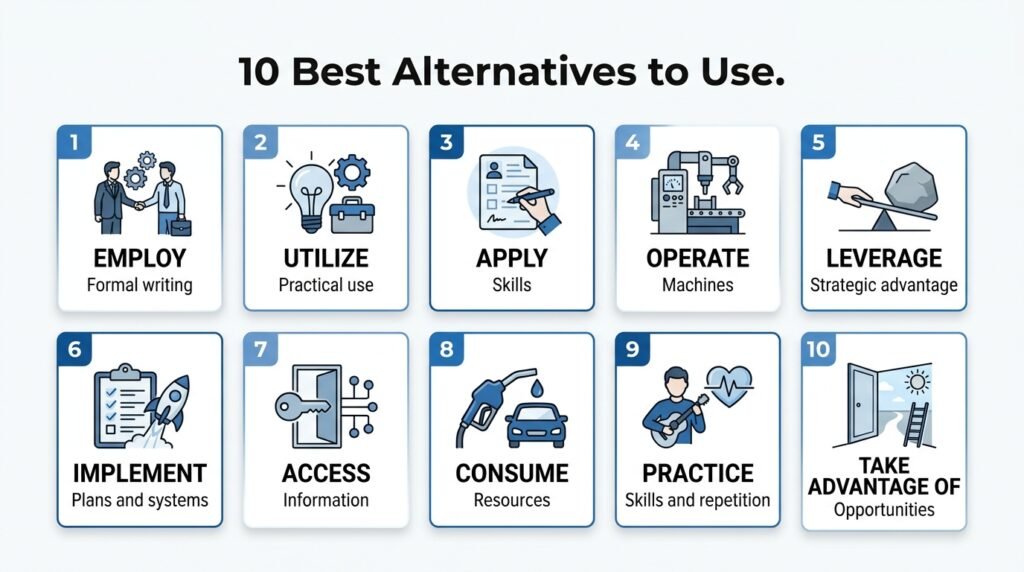
10 Best Other Ways to Say “Use”
1. Employ
Meaning
Employ means to use something for a particular purpose. It often sounds more formal than “use” and is especially common in academic, professional, and business writing.
Best For
- Professional
- Formal
Example 1
The research team employed several methods to collect reliable data.
Example 2
Our company employs advanced software to manage customer records.
Quick Tip
Choose employ when you want a polished alternative to “use” in formal writing.
2. Utilize
Meaning
Utilize means to make practical or effective use of something. It is common in professional and technical writing, although “use” is often more natural when no special emphasis is needed.
Best For
- Professional
- Formal
Example 1
The hospital utilizes digital records to improve patient communication.
Example 2
Teachers can utilize online resources to support classroom instruction.
Quick Tip
Use utilize when you want to emphasize putting something to a practical purpose, but avoid using it merely to make simple sentences sound more formal.
3. Apply
Meaning
Apply means to put something into practice or use it for a particular situation. It works especially well with knowledge, skills, methods, rules, principles, and techniques.
Best For
- Professional
- Formal
- Academic
Example 1
Students can apply these grammar rules when writing their essays.
Example 2
She applied her marketing experience to the new campaign.
Quick Tip
Use apply when the thing being used is a skill, method, idea, rule, or piece of knowledge.
4. Operate
Meaning
Operate means to control or run a machine, device, system, or piece of equipment. It is more specific than “use” because it focuses on how something is controlled or run.
Best For
- Professional
- Formal
Example 1
Only trained employees may operate the manufacturing equipment.
Example 2
I learned how to operate the company’s new scheduling system.
Quick Tip
Choose operate for machinery, equipment, vehicles, software systems, or technical devices rather than general objects.
5. Leverage
Meaning
Leverage means to use something strategically to achieve an advantage or desired result. It is especially common in business, technology, marketing, and professional communication.
Best For
- Professional
- Formal
Example 1
The startup leveraged social media to reach a larger audience.
Example 2
She leveraged her industry experience to build strong client relationships.
Quick Tip
Use leverage when the idea involves gaining a benefit or advantage from a resource, skill, relationship, or opportunity.
6. Implement
Meaning
Implement means to put a plan, policy, strategy, system, or idea into action. It is not a direct synonym for every meaning of “use,” but it is an excellent alternative when “use” means putting something into practice.
Best For
- Professional
- Formal
Example 1
The company implemented a new training program for employees.
Example 2
The school implemented stricter safety procedures this semester.
Quick Tip
Use implement for plans, policies, procedures, strategies, and systems—not ordinary physical objects.
7. Access
Meaning
Access means to reach, enter, or retrieve something, especially information, files, websites, systems, or digital resources. It can replace “use” when the main idea is gaining entry or availability.
Best For
- Professional
- Formal
- Casual
Example 1
Employees can access their schedules through the mobile app.
Example 2
You can access the report from the company’s online portal.
Quick Tip
Choose access when “use” really means opening, reaching, retrieving, or obtaining information.
8. Consume
Meaning
Consume means to use up a resource, especially food, fuel, energy, time, or media. Unlike the general verb “use,” it often suggests that the resource becomes depleted.
Best For
- Professional
- Formal
- Casual
Example 1
This appliance consumes less electricity than the older model.
Example 2
The vehicle consumes a significant amount of fuel on long trips.
Quick Tip
Use consume when something is gradually used up rather than simply handled or operated.
9. Practice
Meaning
Practice means to regularly perform an activity or apply a skill to improve it. It can replace “use” when discussing skills, techniques, habits, or behaviors.
Best For
- Casual
- Friendly
- Professional
Example 1
She practices her Spanish with coworkers every week.
Example 2
The athletes practice these techniques before every competition.
Quick Tip
Use practice when the action involves repetition, training, or developing a skill.
10. Take Advantage of
Meaning
Take advantage of means to make beneficial use of an opportunity, resource, service, or situation. It often sounds natural in everyday American English and can suggest making the most of something.
Best For
- Casual
- Friendly
- Professional
Example 1
You should take advantage of the free training offered by the company.
Example 2
We took advantage of the sunny weather and went for a hike.
Quick Tip
Use this phrase when you want to emphasize getting a benefit from an available opportunity or resource.
Comparison Table
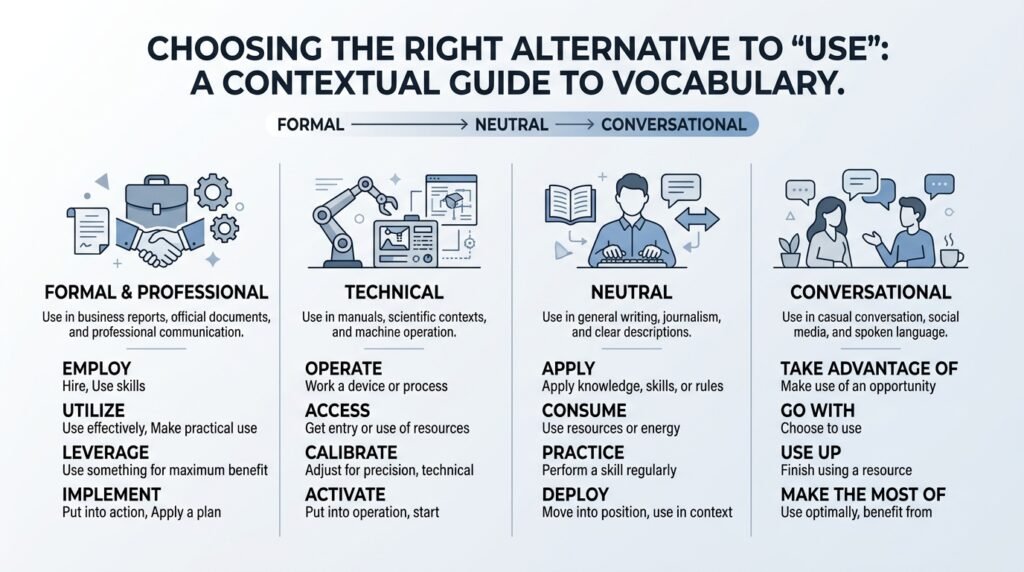
| Alternative | Best Used In | Tone |
| Employ | Academic and professional writing | Formal |
| Utilize | Business and technical writing | Formal |
| Apply | Skills, knowledge, methods, and rules | Professional |
| Operate | Machines, equipment, and systems | Technical |
| Leverage | Business, strategy, and marketing | Professional |
| Implement | Plans, policies, and systems | Formal |
| Access | Information, files, and digital systems | Neutral |
| Consume | Food, fuel, energy, and resources | Neutral |
| Practice | Skills and repeated activities | Casual/Professional |
| Take advantage of | Opportunities and resources | Conversational |
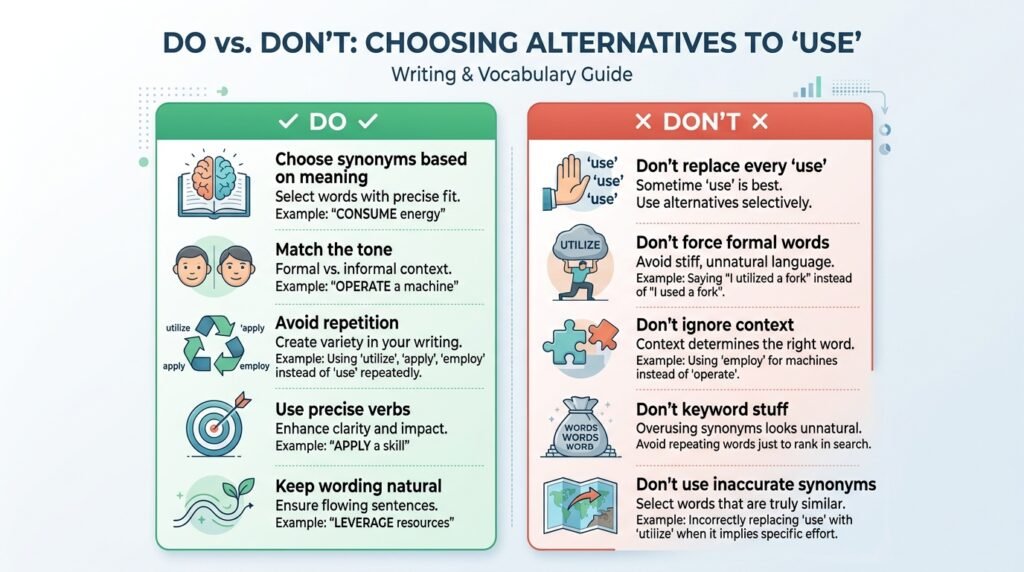
Common Mistakes
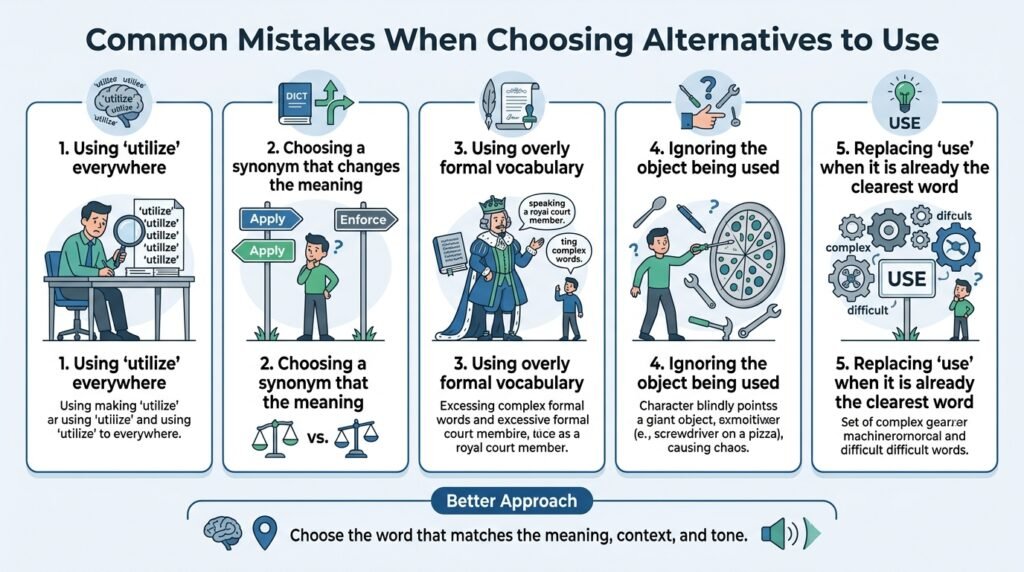
1. Replacing “use” with “utilize” everywhere
Utilize is not automatically better than “use.” In simple sentences, “use” is often clearer and more natural.
2. Choosing a synonym that changes the meaning
“Operate,” “consume,” and “apply” have specific meanings. Replacing “use” with one of them without checking the context can make a sentence inaccurate.
3. Using overly formal vocabulary
Words such as employ and utilize may sound unnatural in a casual text message. Sometimes the simplest word is the strongest choice.
4. Ignoring the object being used
Consider what follows the verb. You can operate a machine, apply knowledge, consume energy, and access information. These verbs are not interchangeable.
5. Adding synonyms just to avoid repetition
Repetition is not always a problem. If “use” is the clearest word, keep it instead of forcing an unusual alternative into the sentence.
Frequently Asked Questions
What is another word for “use”?
Common alternatives include employ, utilize, apply, operate, leverage, implement, access, consume, and practice. The best choice depends on the meaning. For example, “apply” works well with knowledge or skills, while “operate” is appropriate for machines and “consume” describes resources that are used up.
What is a professional way to say “use”?
Employ, utilize, and leverage can work well in professional writing. However, the best choice depends on context. “Employ” is a broad formal alternative, “utilize” emphasizes practical use, and “leverage” suggests using something strategically to gain an advantage.
What is a formal synonym for “use”?
Employ is one of the most reliable formal synonyms for “use.” Utilize can also work in professional or technical contexts. However, formal writing should prioritize accuracy and clarity rather than replacing common words with longer alternatives.
Is “utilize” better than “use”?
Not necessarily. “Utilize” can be useful when you want to emphasize practical or effective use, but “use” is usually simpler and more natural. In most everyday sentences, there is no need to replace “use” with “utilize simply to sound more sophisticated.
What can I say instead of “use” on a resume?
On a resume, choose a verb that describes the specific action. Depending on the context, employed, operated, applied, leveraged, implemented, or utilized may work. For example, “Operated inventory management software” is more specific and informative than simply saying “Used software.”
What is another way to say “use a method”?
Apply, employ, or implement may work depending on the sentence. “Apply a method” emphasizes putting it into practice, while “employ a method” sounds more formal. “Implement” is better when the method is a planned system, process, or strategy being put into action.
What is another way to say “use resources”?
You can say leverage resources, employ resources, utilize resources, or make use of resources. “Leverage resources” is especially common in business because it suggests using available resources strategically to achieve a goal.
What is a natural alternative to “use” in everyday English?
In everyday English, use is usually the most natural choice. Depending on the sentence, you can also say work with, try, apply, access, or take advantage of. The best option should sound natural rather than unnecessarily formal.
Conclusion
There are many ways to say use, but the right alternative depends on what you are trying to express. Employ and utilize are useful for formal or professional writing, while apply works especially well for skills, knowledge, and methods. Operate is more precise for machines and systems, and consume fits resources that are used up.
For business writing, leverage can communicate strategic use, while implement works for plans, policies, and systems. In everyday situations, access, practice, and take advantage of may sound more natural.
The most important rule is simple: don’t replace “use” just for the sake of variety. Choosing the right word depends on meaning, context, audience, and clarity.

About Dr. Priya Nair
Dr. Priya Nair is a passionate Writer & Blogger at LandMarkNewz.com, dedicated to creating informative, engaging, and easy-to-understand content for readers. With a strong interest in research, current trends, lifestyle, and everyday topics, she focuses on presenting useful information in a clear and reader-friendly way.
Through her writing, Priya aims to help readers discover valuable insights, understand complex topics more easily, and stay informed about subjects that matter to them. Her approach combines thoughtful research with a simple and engaging writing style.
At LandMarkNewz.com, she contributes original articles designed to inform, educate, and provide practical value to readers.