Alternatives to Say Strengths and Weaknesses Mean
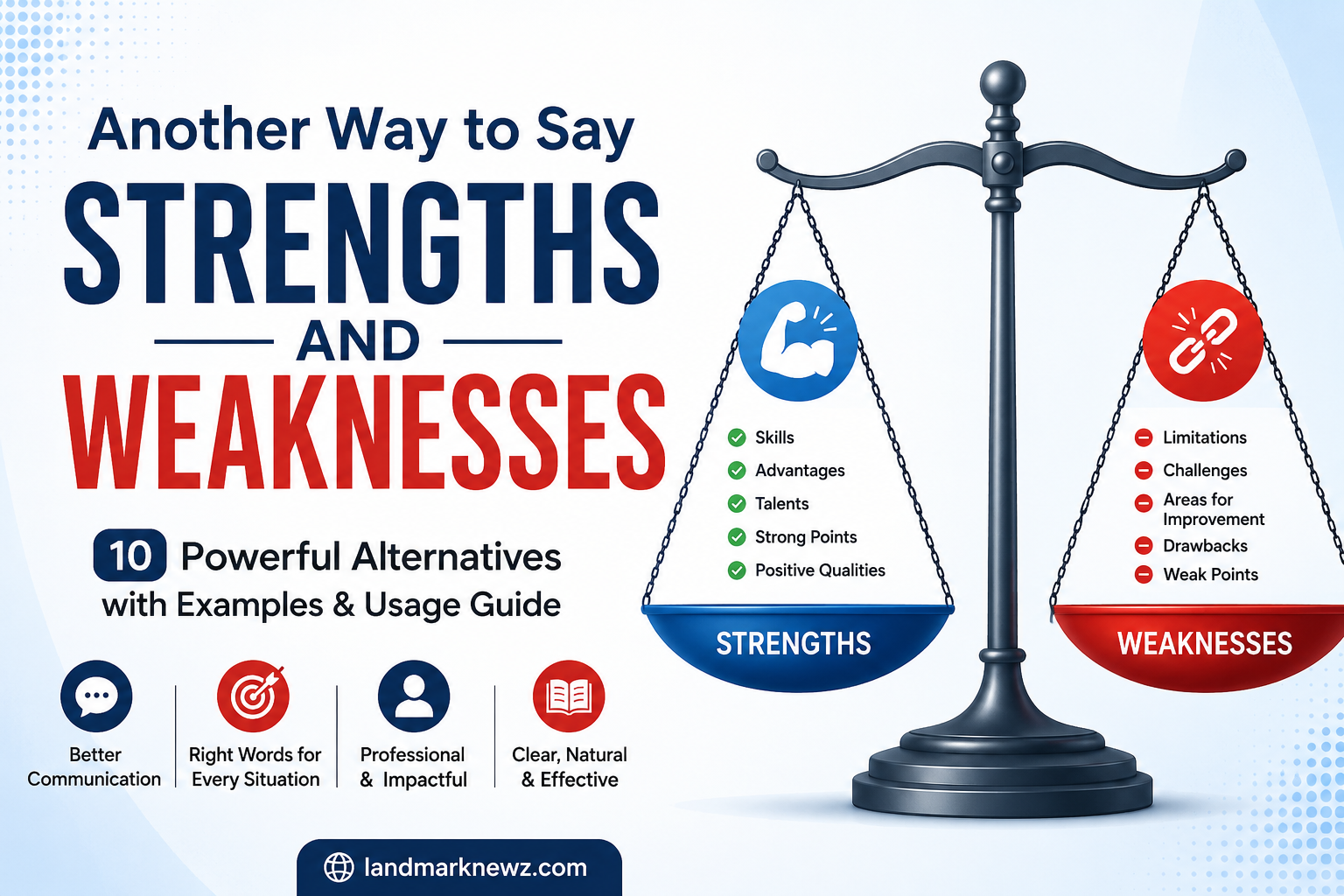
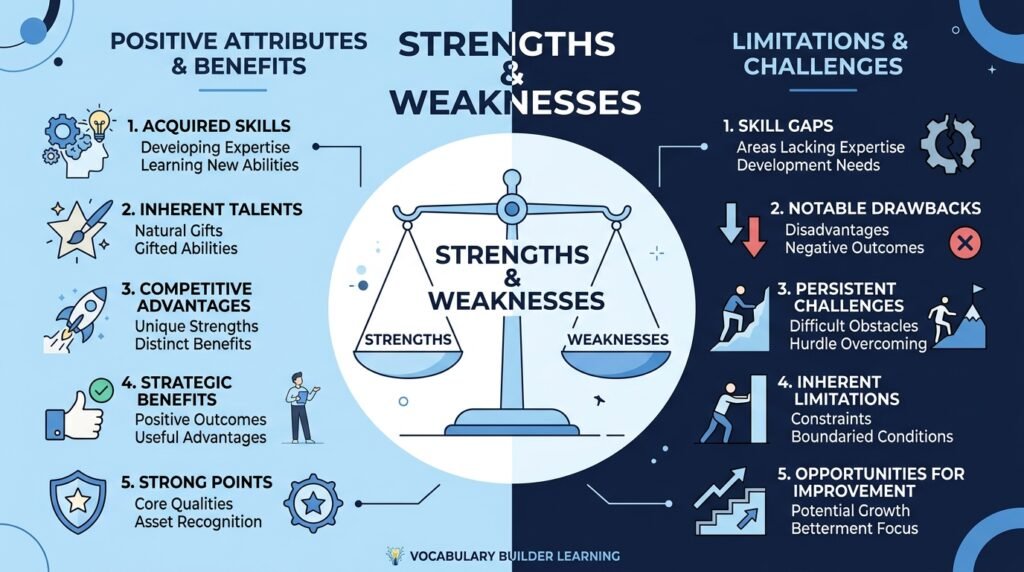
The phrase “strengths and weaknesses” refers to the positive qualities, skills, benefits, limitations, or areas for improvement of a person, organization, idea, product, or situation.
People commonly use it in job interviews, performance reviews, SWOT analysis, academic writing, business discussions, and personal development. Looking for another way to say strengths and weaknesses helps you avoid repetition and choose language that better fits a specific situation.
For example, a hiring manager might ask about a candidate’s strengths and weaknesses, while a business report may use capabilities and limitations instead.
Why Use Other Ways to Say “Strengths and Weaknesses”?
Using different expressions can make your communication more precise and natural. The best alternative depends on whether you are speaking casually, writing professionally, or analyzing something objectively.
Using synonyms can help you:
- Avoid repeating the same phrase.
- Make professional writing more polished.
- Match your language to the situation.
- Describe positive and negative qualities more precisely.
- Sound more natural during interviews and conversations.
- Present criticism in a constructive way.
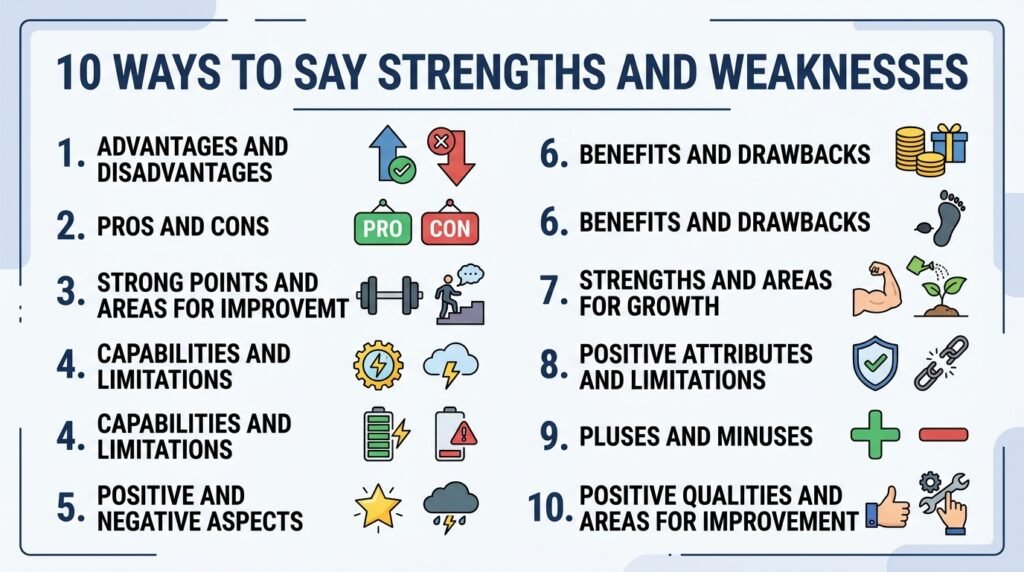
10 Best Other Ways to Say “Strengths and Weaknesses”
1. Advantages and Disadvantages
Meaning
Advantages and disadvantages refers to the benefits and drawbacks of something. It is a clear, neutral expression that works well when evaluating a decision, product, strategy, or situation.
Best For
- Professional
- Formal
- Academic
Example 1
The report examines the advantages and disadvantages of adopting a four-day workweek.
Example 2
Before choosing the software, compare its advantages and disadvantages.
Quick Tip
Use this phrase when you are objectively weighing both sides of an issue.
2. Pros and Cons
Meaning
Pros and cons is a simple way to describe the positive and negative sides of something. It is shorter and more conversational than “advantages and disadvantages.”
Best For
- Casual
- Friendly
- Professional
Example 1
Let’s make a list of the pros and cons before we make a final decision.
Example 2
She explained the pros and cons of working from home.
Quick Tip
Choose “pros and cons” for everyday conversations and less formal writing.
3. Strong Points and Areas for Improvement
Meaning
Strong points and areas for improvement presents a more constructive view of strengths and weaknesses. It emphasizes what someone does well while framing weaknesses as opportunities for growth.
Best For
- Professional
- Formal
- Warm
Example 1
The manager discussed my strong points and areas for improvement during the review.
Example 2
The teacher identified each student’s strong points and areas for improvement.
Quick Tip
This is an excellent choice for performance reviews, feedback, and employee development.
4. Capabilities and Limitations
Meaning
Capabilities and limitations focuses on what a person, system, organization, or product can and cannot do. It sounds analytical and is especially useful when discussing performance or technical potential.
Best For
- Professional
- Formal
Example 1
The research team documented the capabilities and limitations of the new testing method.
Example 2
Understanding the software’s capabilities and limitations can prevent costly mistakes.
Quick Tip
Use this phrase when discussing systems, technology, processes, or professional performance.
5. Positive and Negative Aspects
Meaning
Positive and negative aspects refers broadly to the favorable and unfavorable parts of something. It is flexible enough for people, decisions, experiences, policies, and ideas.
Best For
- Formal
- Academic
- Professional
Example 1
The study considers the positive and negative aspects of social media use.
Example 2
We discussed the positive and negative aspects of the proposed policy.
Quick Tip
Use this expression when you want a neutral phrase that does not sound overly critical.
6. Benefits and Drawbacks
Meaning
Benefits and drawbacks describes what is useful or valuable about something and what problems or disadvantages it may create. It is especially effective when evaluating choices or proposals.
Best For
- Professional
- Formal
- Academic
Example 1
The presentation outlines the benefits and drawbacks of remote work.
Example 2
We need to consider the benefits and drawbacks before expanding the program.
Quick Tip
“Benefits and drawbacks” works particularly well in reports, recommendations, and decision-making discussions.
7. Strengths and Areas for Growth
Meaning
Strengths and areas for growth keeps the positive meaning of “strengths” while replacing the more negative-sounding “weaknesses.” It suggests that improvement is possible.
Bes t For
- Professional
- Warm
- Friendly
Example 1
The interview focused on my strengths and areas for growth as a team leader.
Example 2
The mentor helped me identify my strengths and areas for growth.
Quick Tip
Use this phrase when discussing people and want your feedback to sound encouraging.
8. Positive Attributes and Limitations
Meaning
Positive attributes and limitations provides a more polished way to discuss favorable qualities and restrictions. “Attributes” works especially well when describing people, products, or organizations.
Best For
- Formal
- Professional
Example 1
The evaluation highlights the candidate’s positive attributes and limitations.
Example 2
The review considers the product’s positive attributes and limitations.
Quick Tip
This option is useful when you want a professional tone without sounding overly negative.
9. Pluses and Minuses
Meaning
Pluses and minuses is an informal expression for positive and negative qualities. It has a straightforward tone and is easy to understand.
Best For
- Casual
- Friendly
Example 1
We talked about the pluses and minuses of moving to a larger apartment.
Example 2
Every career choice has its own pluses and minuses.
Quick Tip
Use “pluses and minuses” mainly in casual speech rather than formal reports.
10. Positive Qualities and Areas for Improvement
Meaning
Positive qualities and areas for improvement focuses on what someone does well and where they can develop further. It is particularly appropriate for constructive feedback about a person’s skills, behavior, or performance.
Best For
- Professional
- Formal
- Warm
Example 1
The supervisor identified my positive qualities and areas for improvement.
Example 2
The coaching session helped employees recognize their positive qualities and areas for improvement.
Quick Tip
Choose this phrase when you want to discuss weaknesses without making the person feel defined by them.
Comparison Table
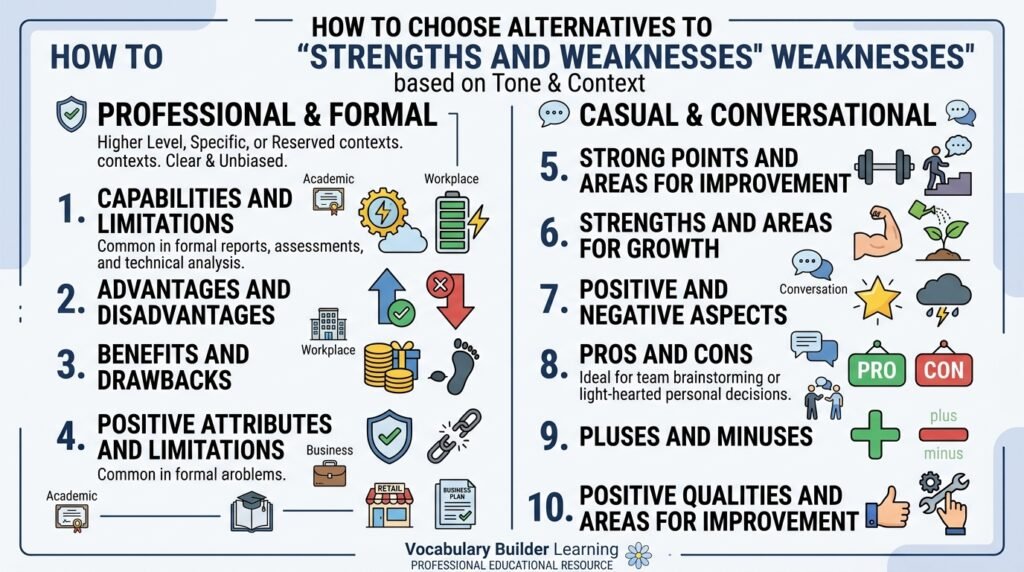
| Alternative | Best Used In | Tone |
| Advantages and disadvantages | Business, academic writing | Neutral |
| Pros and cons | Everyday conversation | Casual |
| Strong points and areas for improvement | Performance reviews | Constructive |
| Capabilities and limitations | Technical and professional contexts | Analytical |
| Positive and negative aspects | Academic and general writing | Neutral |
| Benefits and drawbacks | Business and decision-making | Professional |
| Strengths and areas for growth | Coaching and development | Encouraging |
| Positive attributes and limitations | Formal evaluations | Polished |
| Pluses and minuses | Casual conversation | Informal |
| Positive qualities and areas for improvement | Feedback and evaluations | Supportive |
Common Mistakes
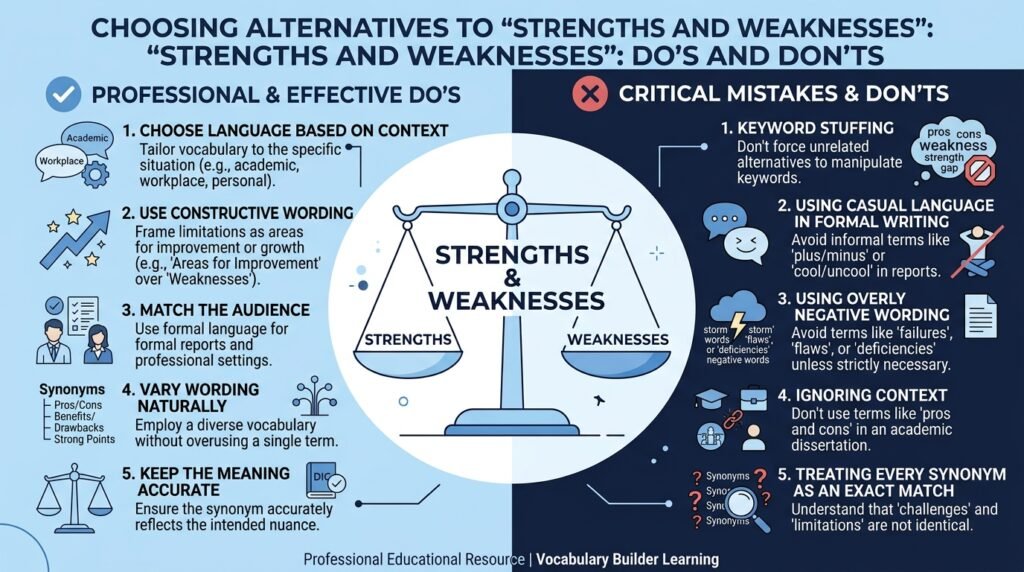
1. Using Casual Phrases in Formal Writing
Expressions such as “pluses and minuses” may sound too informal in an academic paper or business report. Choose “advantages and disadvantages” or “benefits and drawbacks” instead.
2. Treating Every Alternative as an Exact Synonym
Not every phrase has exactly the same meaning. For example, “capabilities and limitations” focuses on what something can and cannot do, while “strengths and areas for growth” is more suitable for people.
3. Choosing Overly Negative Language
Calling someone’s qualities “weaknesses” can sometimes sound harsh. In a workplace or coaching setting, “areas for improvement” may communicate the same idea more constructively.
4. Ignoring the Audience
The right wording depends on who will read or hear it. “Pros and cons” may work perfectly in a conversation, but “positive and negative aspects” is often better for formal writing.
5. Using the Same Alternative Repeatedly
Replacing “strengths and weaknesses” with one synonym does not solve repetition if you use that synonym in every paragraph. Vary your wording naturally while keeping the meaning clear.
Frequently Asked Questions
What is a professional way to say strengths and weaknesses?
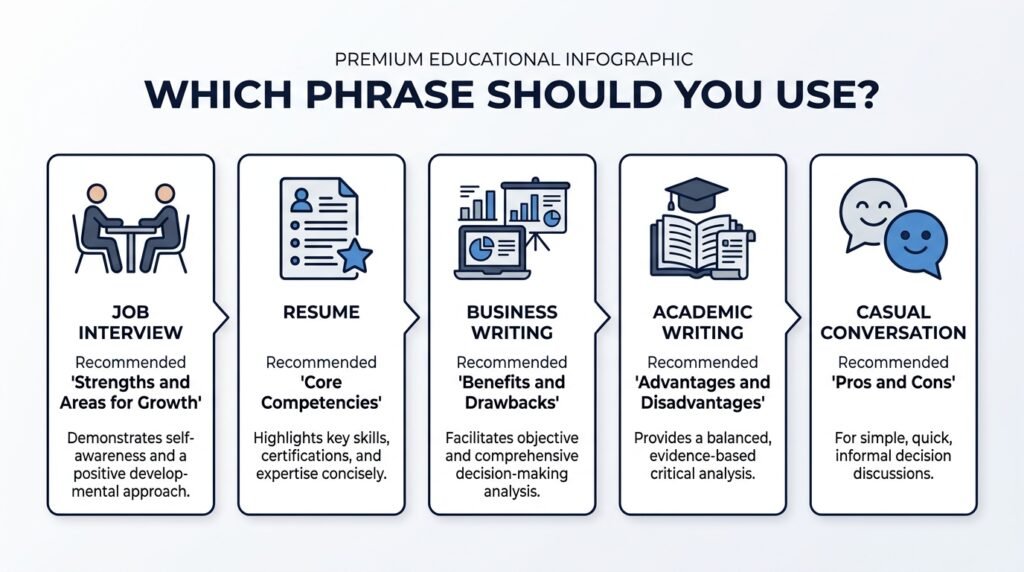
A professional way to say strengths and weaknesses is “capabilities and limitations,” “strong points and areas for improvement,” or “positive qualities and areas for improvement.”
The best choice depends on context. For employee feedback, “areas for improvement” sounds constructive, while “capabilities and limitations” works well in technical or analytical discussions.
What is another way to say strengths and weaknesses in an interview?
In an interview, you can say “strengths and areas for growth,” “strong points and areas for improvement,” or simply “key strengths and development areas.” These alternatives can make your answer sound thoughtful and constructive. They also help you discuss weaknesses without presenting them as permanent flaws.
What is a formal synonym for strengths and weaknesses?
Formal alternatives include “advantages and disadvantages,” “positive and negative aspects,” “capabilities and limitations,” and “positive attributes and limitations.” “Advantages and disadvantages” is particularly versatile, while “capabilities and limitations” is better for technical, organizational, or analytical contexts.
Is “pros and cons” the same as “strengths and weaknesses”?
“Pros and cons” and “strengths and weaknesses” are closely related, but they are not always interchangeable. “Pros and cons” usually evaluates the positive and negative sides of a decision, choice, or situation. “Strengths and weaknesses” more often describes the qualities or limitations of a person, organization, product, or system.
How do you say strengths and weaknesses in a positive way?
You can use phrases such as “strengths and areas for growth” or “positive qualities and areas for improvement.” These expressions shift attention from shortcomings to development. They are especially useful in interviews, performance reviews, coaching sessions, and educational settings where constructive language matters.
What is another way to say strengths and weaknesses in a resume?
A resume usually does not need a section literally called “strengths and weaknesses.” Instead, use headings such as “Core Competencies,” “Key Skills,” “Professional Strengths,” or “Areas of Expertise.” Resumes generally emphasize relevant skills and accomplishments rather than listing weaknesses.
What is the best synonym for strengths and weaknesses in business?
“Advantages and disadvantages” is a strong general choice for business writing. Depending on the subject, “benefits and drawbacks” or “capabilities and limitations” may be more precise. For a business strategy, “benefits and drawbacks” sounds natural; for a technology or system, “capabilities and limitations” is often better.
Can I use “areas for improvement” instead of weaknesses?
Yes. “Areas for improvement” is often a better choice when discussing a person’s performance because it sounds constructive and forward-looking. However, it is not a perfect synonym in every situation. A weakness can be a limitation, flaw, or disadvantage, while an area for improvement specifically suggests that development is possible.
Conclusion
Finding another way to say strengths and weaknesses can make your writing more precise, professional, and natural. The best alternative depends on what you are describing and who will read it.
For general comparisons, “advantages and disadvantages” is clear and versatile. If you are having a casual conversation, “pros and cons” is usually the most natural choice. In professional feedback, “strong points and areas for improvement” or “strengths and areas for growth” creates a more constructive tone.
For technical or analytical writing, “capabilities and limitations” is often the strongest option. The key is not simply to replace one phrase with another, but to choose wording that accurately reflects your meaning and audience. A well-chosen alternative can make even simple communication sound clearer and more polished.

Language & Everyday Communication Specialist
Elena Voss is a language enthusiast and communication coach with over 9 years of experience helping people express themselves more naturally in English. She previously worked as an ESL instructor and corporate language trainer, guiding professionals and students on clearer everyday conversations, polite alternatives, and natural phrasing.
Elena specializes in practical synonym guides and “another way to say…” content that feels conversational rather than textbook. Her writing focuses on real-life situations — emails to friends, casual workplace chat, social media, and daily interactions. She believes the best language advice is simple, useful, and easy to remember.
When she’s not creating content for LandmarkNewz, Elena enjoys analyzing modern slang trends and testing new phrases in real conversations.