

What Does “Another Way to Say As Previously Mentioned” Mean?
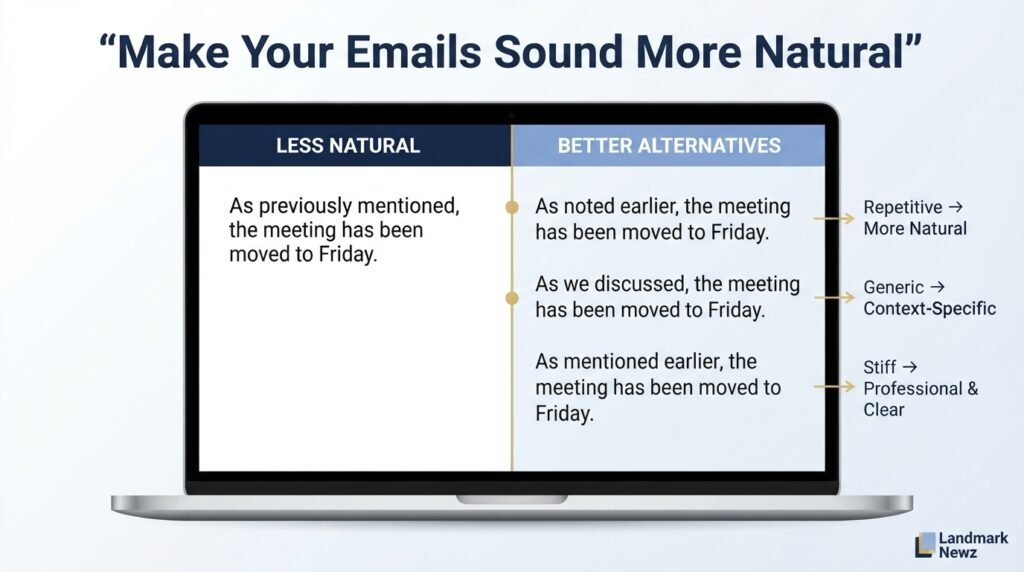
The phrase “another way to say as previously mentioned” means you want a different expression for referring to information that you have already shared.
“As previously mentioned” is common in emails, reports, essays, presentations, and workplace communication. It reminds the reader that a point appeared earlier without repeating the full explanation.
For example:
As previously mentioned, the deadline has been moved to Friday.
You can make the sentence sound more natural or fit the context better by using alternatives such as “as noted earlier,” “as discussed previously,” or “as stated above.”
Why Use Other Ways to Say “As Previously Mentioned”?
Although “as previously mentioned” is correct, repeating it too often can make your writing feel mechanical. Using suitable alternatives gives you more flexibility while keeping your meaning clear.
Other expressions can help you:
- Avoid repeating the same phrase.
- Make professional writing sound more natural.
- Match formal, casual, or conversational situations.
- Refer to earlier information more precisely.
- Create smoother transitions between ideas.
- Keep emails, reports, and documents engaging.
The best alternative depends on what you are referring to and where it appeared. For example, “as stated above” points to earlier written material, while “as discussed earlier” usually refers to a conversation or meeting.
10 Best Other Ways to Say “As Previously Mentioned”
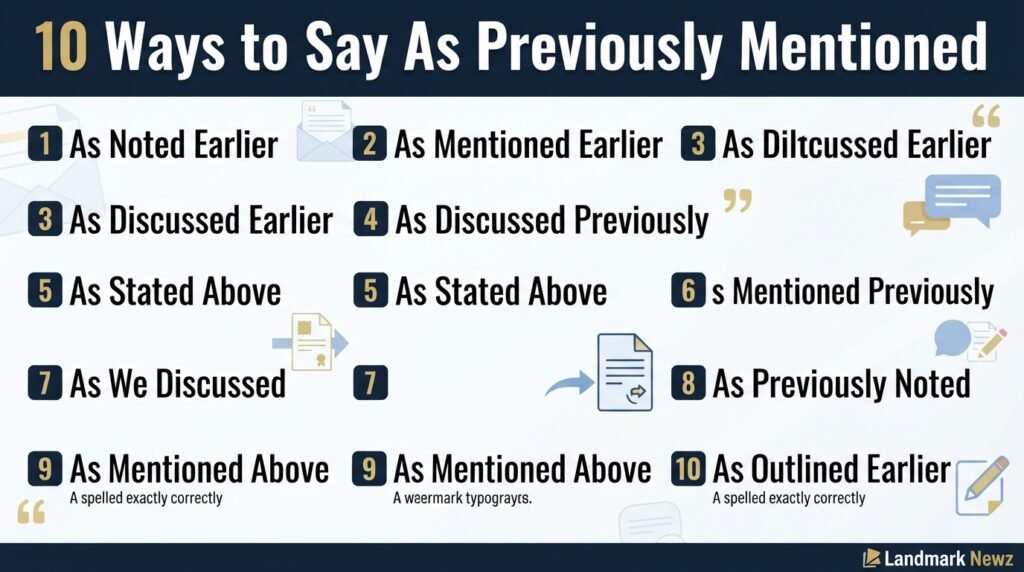
1. As Noted Earlier
Meaning
“As noted earlier” refers to a fact, detail, or point that you already presented. It is concise and professional without sounding excessively formal.
Best For
- Professional
- Formal
- Polite
Example 1
As noted earlier, the revised schedule will begin next Monday.
Example 2
As noted earlier, all applicants must submit their documents before the deadline.
Quick Tip
Use this phrase when you want a clean, professional reference to information mentioned earlier in the same document or conversation.
2. As Mentioned Earlier
Meaning
“As mentioned earlier” is one of the closest natural alternatives to “as previously mentioned.” It simply reminds the reader that you have already discussed the information.
Best For
- Professional
- Casual
- Friendly
- Polite
Example 1
As mentioned earlier, the office will close at 3 p.m. on Friday.
Example 2
As mentioned earlier, we are waiting for the client’s final approval.
Quick Tip
Choose this option when you want a familiar expression that works in both everyday and professional communication.
3. As Discussed Earlier
Meaning
“As discussed earlier” works best when the information came from a previous conversation, meeting, call, or discussion. It creates a stronger connection to a specific interaction.
Best For
- Professional
- Formal
- Polite
Example 1
As discussed earlier, I’ll send the updated proposal by Thursday.
Example 2
As discussed earlier, the marketing team will handle the product launch.
Quick Tip
Use this phrase when you are referring specifically to something you and the reader or listener talked about before.
4. As Discussed Previously
Meaning
“As discussed previously” has a slightly more formal tone than “as discussed earlier.” It is useful when referring to a prior conversation or exchange.
Best For
- Professional
- Formal
Example 1
As discussed previously, the contract requires both parties to approve the changes.
Example 2
As discussed previously, we will review the project after the first quarter.
Quick Tip
This is a strong choice for business emails, reports, and other workplace communication where a polished tone matters.
5. As Stated Above
Meaning
“As stated above” points directly to information appearing earlier in a written document. It is especially common in formal, academic, legal, and technical writing.
Best For
- Formal
- Professional
Example 1
As stated above, the policy applies to all full-time employees.
Example 2
As stated above, the research included participants from three different regions.
Quick Tip
Use “as stated above” for written material, especially when the reader can easily look back at the earlier section.
6. As Mentioned Previously
Meaning
“As mentioned previously” is a direct variation of the original phrase. It keeps the meaning intact while slightly changing the wording.
Best For
- Professional
- Formal
- Polite
Example 1
As mentioned previously, the updated files are available in the shared folder.
Example 2
As mentioned previously, we need your signature before processing the request.
Quick Tip
This option works well when you want a simple replacement without changing the overall tone of your sentence.
7. As We Discussed
Meaning
“As we discussed” sounds more conversational and personal than many formal alternatives. It clearly connects the current message to a previous conversation between you and the reader.
Best For
- Professional
- Friendly
- Casual
- Polite
Example 1
As we discussed, I’ll make the final changes before submitting the report.
Example 2
As we discussed, your interview has been scheduled for Wednesday morning.
Quick Tip
Use this phrase in emails when you want to sound professional but still natural and approachable.
8. As Previously Noted
Meaning
“As previously noted” refers to information that has already been pointed out or recorded. It has a polished, concise tone and works particularly well in formal writing.
Best For
- Formal
- Professional
Example 1
As previously noted, the project remains within the approved budget.
Example 2
As previously noted, customers must provide valid identification at check-in.
Quick Tip
Use this expression when referring to an important fact or observation that has already appeared in a report or formal document.
9. As Mentioned Above
Meaning
“As mentioned above” tells the reader that the information appeared earlier in the same written material. It is straightforward and easy to understand.
Best For
- Professional
- Formal
- Polite
Example 1
As mentioned above, the first phase must be completed before testing begins.
Example 2
As mentioned above, the application process includes three required steps.
Quick Tip
This phrase is best for documents with clear sections where “above” gives the reader a useful direction.
10. As Outlined Earlier
Meaning
“As outlined earlier” works particularly well when referring to a plan, process, proposal, or set of details that you explained before. It suggests that the earlier information was organized or structured.
Best For
- Professional
- Formal
- Polite
Example 1
As outlined earlier, the project will proceed in three stages.
Example 2
As outlined earlier, each department will have a specific role during implementation.
Quick Tip
Choose this option when referring to a plan, strategy, process, or framework rather than a single casual remark.
Comparison Table
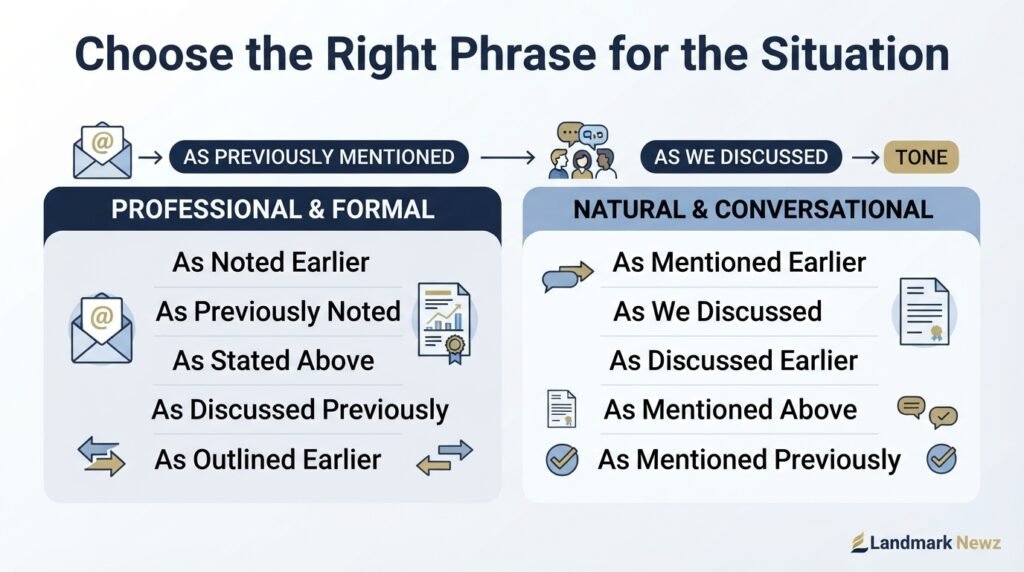
| Alternative | Best Used In | Tone |
| As Noted Earlier | Emails, reports, business writing | Professional |
| As Mentioned Earlier | Emails, conversations, general writing | Neutral |
| As Discussed Earlier | Meetings, calls, emails | Professional |
| As Discussed Previously | Business documents, formal emails | Formal |
| As Stated Above | Reports, academic and legal writing | Formal |
| As Mentioned Previously | Emails, documents | Professional |
| As We Discussed | Workplace emails, conversations | Friendly/Professional |
| As Previously Noted | Reports, formal documents | Formal |
| As Mentioned Above | Structured documents | Neutral/Formal |
| As Outlined Earlier | Plans, proposals, reports | Professional |
Common Mistakes
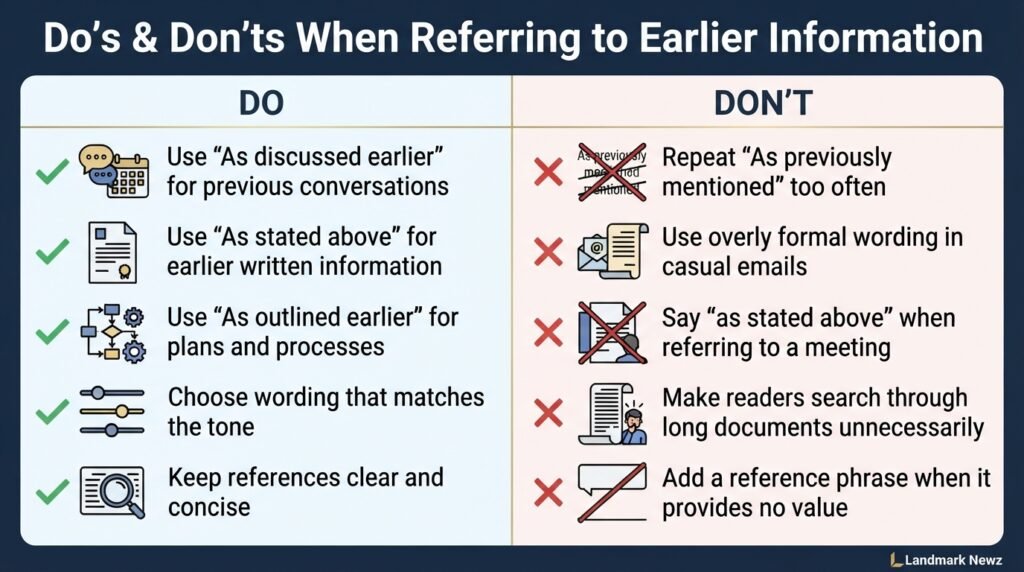
1. Using the Same Phrase Repeatedly
Writing “as previously mentioned” several times on the same page can sound repetitive. Rotate between natural alternatives when the context allows it.
2. Using “As Stated Above” for a Conversation
“As stated above” normally refers to written content. If you are referring to a meeting or phone call, “as discussed earlier” is more appropriate.
3. Choosing an Overly Formal Expression
Phrases such as “as previously noted” may sound too formal in a casual email. For everyday workplace communication, “as we discussed” can feel more natural.
4. Referring to Information That Is Too Far Away
A phrase such as “as mentioned above” is less helpful when the referenced information is several pages earlier. Make the connection clear instead of forcing the reader to search.
5. Using the Phrase When Repetition Is Unnecessary
Sometimes you do not need a reference phrase at all. If repeating the information briefly makes the sentence clearer, simply state the key point again.
Frequently Asked Questions
What is a professional way to say “as previously mentioned”?
“As noted earlier” is one of the best professional alternatives to “as previously mentioned.” It is concise, clear, and suitable for emails, reports, and workplace documents. “As discussed earlier” is another strong option when you are referring to something covered during a previous meeting, call, or conversation.
What is a more formal way to say “as previously mentioned”?
For formal writing, consider “as previously noted,” “as stated above,” or “as mentioned previously.” The best choice depends on the context. “As stated above” works particularly well when the information appears earlier in a document, while “as previously noted” has a polished professional tone.
How can I say “as previously mentioned” in an email?
In an email, you can write “as mentioned earlier,” “as we discussed,” or “as discussed previously.” “As we discussed” is especially natural when referring to a conversation or meeting. If you are pointing back to information in the same email, “as noted earlier” is a concise choice.
Is “as previously mentioned” professional?
Yes. “As previously mentioned” is grammatically correct and professional. However, using it repeatedly can make your writing sound stiff or repetitive. Alternatives such as “as noted earlier” and “as discussed earlier” can create more variety while preserving a professional tone.
What is the difference between “as mentioned earlier” and “as discussed earlier”?
“As mentioned earlier” can refer to any information you previously shared, while “as discussed earlier” usually suggests that you talked about the subject with someone. For example, use “as mentioned earlier” for a detail in an email and “as discussed earlier” for something covered during a meeting.
Can I use “as stated above” in an email?
Yes, but it is most useful when referring to written information located earlier in the email. It can sound somewhat formal, so “as mentioned earlier” or “as noted above” may feel more natural in many workplace emails.
What is the best alternative for academic writing?
“As stated above,” “as previously noted,” and “as mentioned above” can work well in academic writing. However, strong academic writing should avoid unnecessary repetition. When possible, connect the earlier point directly to your current argument instead of relying too heavily on transitional phrases.
How do I avoid repeating “as previously mentioned”?
Choose an alternative based on the source of the earlier information. Use “as we discussed” for conversations, “as stated above” for written material, “as outlined earlier” for plans, and “as noted earlier” for general professional references.
Conclusion
There are many natural ways to say “as previously mentioned,” and the best choice depends on your audience and context. For everyday professional communication, “as noted earlier” and “as mentioned earlier” are simple, flexible options. When referring to a meeting or conversation, “as discussed earlier” or “as we discussed” sounds more natural.
For formal documents, “as previously noted” and “as stated above” provide a polished tone. If you are referring to a plan or process, “as outlined earlier” may be more precise.
The key is not to replace every instance mechanically. Good sentence clarity helps readers connect previously discussed information with the point being made. Choose the phrase that tells your reader exactly where the earlier information came from and keeps your writing clear, natural, and easy to follow.

About Dr. Priya Nair
Dr. Priya Nair is a passionate Writer & Blogger at LandMarkNewz.com, dedicated to creating informative, engaging, and easy-to-understand content for readers. With a strong interest in research, current trends, lifestyle, and everyday topics, she focuses on presenting useful information in a clear and reader-friendly way.
Through her writing, Priya aims to help readers discover valuable insights, understand complex topics more easily, and stay informed about subjects that matter to them. Her approach combines thoughtful research with a simple and engaging writing style.
At LandMarkNewz.com, she contributes original articles designed to inform, educate, and provide practical value to readers.