
What Does “Another Way to Say Idea” Mean?
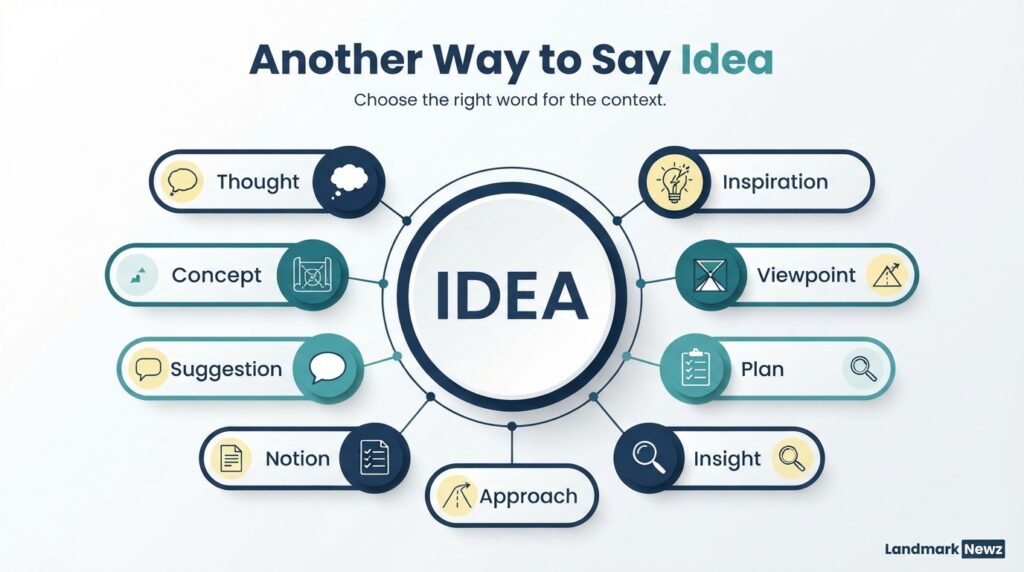
The phrase “another way to say idea” refers to different words or expressions that can replace idea without changing the basic meaning. Depending on context, you might use words such as thought, concept, suggestion, notion, or proposal.
People often search for alternatives to avoid repetition or find a word that better matches their intended meaning. These alternatives are useful in emails, essays, business communication, presentations, conversations, and creative writing.
For example, an idea can be a simple thought, a detailed business proposal, or a creative concept. Because these meanings are slightly different, choosing a precise synonym can make your sentence stronger.
Why Use Other Ways to Say “Idea”?

Using alternatives to idea can make your communication more precise and natural. The right word can also show whether you are discussing a casual thought, a serious plan, or a creative concept.
You may want another way to say idea to:
- Avoid repeating the same word.
- Make professional writing more polished.
- Express a specific meaning more accurately.
- Adapt your language to formal or casual situations.
- Make presentations, essays, and emails more engaging.
- Give greater weight to an important suggestion or plan.
10 Best Other Ways to Say “Idea”
1. Thought
Meaning
Thought refers to something that comes to your mind or something you have considered. It is one of the most natural alternatives to idea in everyday American English.
Best For
- Casual
- Friendly
- Professional
- Warm
Example 1
“I had a thought about how we could improve the customer experience.”
Example 2
“That’s an interesting thought, and I think we should discuss it further.”
Quick Tip
Use thought when you want your wording to sound conversational rather than overly formal.
2. Concept
Meaning
Concept describes a general idea, principle, or plan, especially when discussing something that may be developed further. It often sounds more polished and professional than idea.
Best For
- Professional
- Formal
Example 1
“The design team presented a new concept for the company’s website.”
Example 2
“This concept could help us create a simpler customer onboarding process.”
Quick Tip
Choose concept when the idea is part of a project, design, strategy, or larger plan.
3. Suggestion
Meaning
A suggestion is an idea offered for someone to consider. It is especially useful when you want to recommend an action without making your statement sound forceful.
Best For
- Professional
- Polite
- Friendly
- Casual
Example 1
“May I make a suggestion about the meeting schedule?”
Example 2
“Your suggestion could help us reduce the amount of time spent on paperwork.”
Quick Tip
Use suggestion when you are presenting an idea as advice or a possible solution.
4. Notion
Meaning
Notion means a belief, impression, or thought about something. It can sometimes suggest that the idea is uncertain, general, or not fully developed.
Best For
- Formal
- Professional
- Casual
Example 1
“She rejected the notion that the project needed a complete redesign.”
Example 2
“I had a notion that the store would be busy before the holiday weekend.”
Quick Tip
Use notion when referring to a belief or general thought rather than a concrete plan.
5. Proposal
Meaning
A proposal is an idea or plan formally presented for consideration or approval. It is stronger and more specific than the general word idea.
Best For
- Professional
- Formal
Example 1
“Our team submitted a proposal for expanding the company’s services.”
Example 2
“The manager reviewed my proposal before approving the new workflow.”
Quick Tip
Use proposal when the idea includes a specific plan and is being presented to decision-makers.
6. Plan
Meaning
A plan is an organized set of actions designed to achieve a particular goal. While every plan may begin as an idea, the word plan suggests that the concept has become more concrete.
Best For
- Professional
- Casual
- Formal
Example 1
“We developed a plan to launch the new product by October.”
Example 2
“My plan is to contact the clients before the end of the week.”
Quick Tip
Choose plan when your idea includes specific steps, goals, or actions.
7. Insight
Meaning
Insight refers to a useful or meaningful understanding of a situation. Unlike a basic idea, an insight often comes from observation, experience, research, or careful analysis.
Best For
- Professional
- Formal
Example 1
“Her research provided valuable insight into customer buying habits.”
Example 2
“The survey gave us an important insight into why users leave the website.”
Quick Tip
Use insight when the idea reflects useful understanding rather than simply being a suggestion.
8. Approach
Meaning
An approach is a particular method or way of dealing with a problem or situation. It works well when your “idea” involves how something should be done.
Best For
- Professional
- Formal
Example 1
“We need a different approach to handling customer complaints.”
Example 2
“His approach to training new employees has produced excellent results.”
Quick Tip
Use approach when you are describing a method, strategy, or way of solving a problem.
9. Viewpoint
Meaning
Viewpoint means a person’s perspective, opinion, or way of looking at an issue. It is a good alternative when idea refers to what someone believes rather than a proposed action.
Best For
- Professional
- Formal
- Polite
Example 1
“I understand your viewpoint, even though I see the situation differently.”
Example 2
“The article presents an interesting viewpoint on remote work.”
Quick Tip
Use viewpoint for opinions and perspectives, not for physical plans or proposed projects.
10. Inspiration
Meaning
Inspiration refers to something that stimulates creativity, motivation, or the creation of a new idea. It is especially suitable for artistic, creative, and personal contexts.
Best For
- Friendly
- Warm
- Casual
- Creative
Example 1
“The city’s architecture gave me inspiration for my next design.”
Example 2
“Her story was the inspiration behind the community project.”
Quick Tip
Choose inspiration when an idea comes from something that motivates creativity or action.
Comparison Table
| Alternative | Best Used In | Tone |
| Thought | Conversations, emails, everyday writing | Natural, conversational |
| Concept | Business, design, projects | Professional |
| Suggestion | Advice, recommendations, discussions | Polite, helpful |
| Notion | Opinions, beliefs, general thoughts | Neutral, formal |
| Proposal | Business plans, formal requests | Professional, formal |
| Plan | Goals, projects, action steps | Practical |
| Insight | Research, analysis, professional discussions | Intelligent, professional |
| Approach | Strategies, methods, problem-solving | Professional |
| Viewpoint | Opinions, perspectives, discussions | Neutral, thoughtful |
| Inspiration | Creative and personal contexts | Warm, creative |
Common Mistakes
1. Using the Same Word Repeatedly
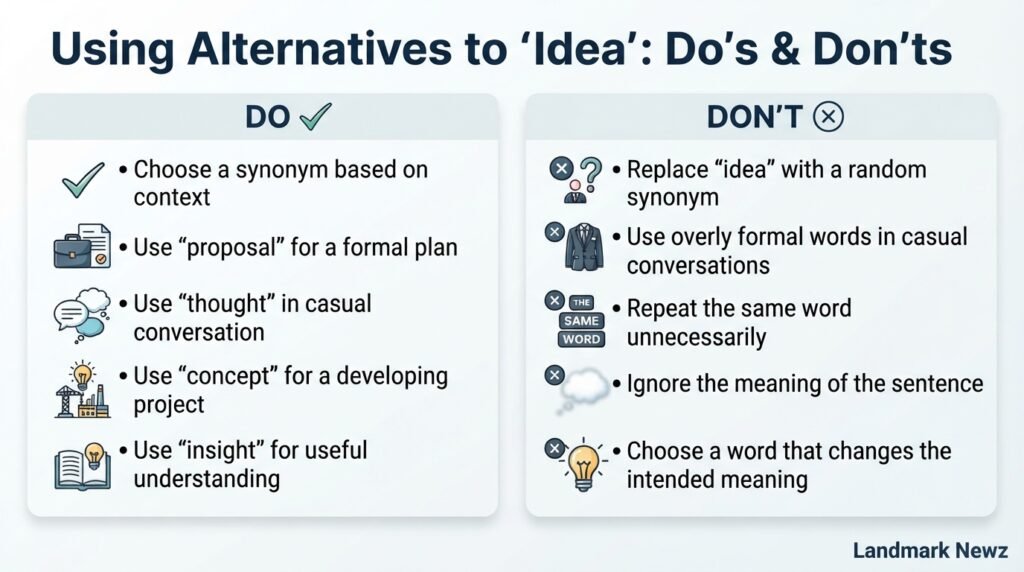
Repeating idea throughout an article, email, or presentation can make your writing feel monotonous. Choose a synonym that accurately reflects the specific meaning.
2. Using a Formal Word in a Casual Conversation
Words such as proposal and concept can sound too formal in simple conversations. In everyday situations, thought or suggestion may sound more natural.
3. Treating Every Synonym as Interchangeable
Not every alternative means exactly the same thing. For example, a viewpoint is an opinion, while a plan involves intended actions.
4. Choosing a Word That Changes the Meaning
Replacing idea with inspiration may change your sentence because inspiration is usually the source of creativity rather than the finished thought itself.
5. Ignoring the Audience
The best synonym depends on who you are addressing. A business proposal may require precise professional language, while a conversation with a friend usually calls for simpler wording.
Frequently Asked Questions
What is the best professional word for “idea”?
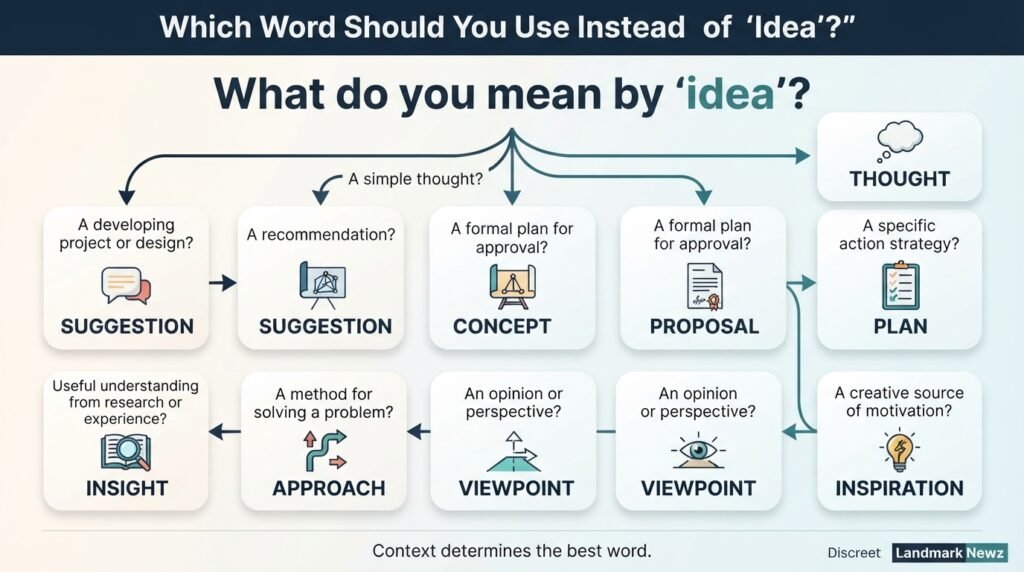
Concept, proposal, and suggestion are strong professional alternatives, but the best choice depends on context. Use concept for a developing idea, proposal for a formal plan presented for approval, and suggestion for a recommendation. These words help make business emails, reports, presentations, and workplace discussions more precise.
What is another word for “idea” in a sentence?
Common alternatives include thought, concept, suggestion, notion, proposal, plan, insight, approach, viewpoint, and inspiration. The correct choice depends on what idea means in your sentence. For example, use thought for a casual mental impression and proposal when referring to a formal plan.
What is a synonym for “idea” in formal writing?
In formal writing, concept, proposal, notion, insight, and viewpoint can work well. However, each has a different meaning. Concept usually refers to a general principle or developing idea, while proposal suggests a specific plan that someone wants others to consider or approve.
What is a casual way to say “idea”?
Thought is one of the most natural casual alternatives to idea. You might say, “I have a thought about that” instead of “I have an idea about that.” It sounds relaxed and conversational while still clearly communicating that you have something you want to share.
Can “suggestion” replace “idea”?
Yes, but only when the idea is being offered for someone else to consider. For example, “I have a suggestion” works when you are recommending a possible solution. If you are simply describing something that came to mind, thought may be a more accurate choice.
What is another word for “idea” in business?
In business communication, useful alternatives include concept, proposal, approach, plan, and insight. The best word depends on the situation. A proposal works for a formal business plan, while an approach describes a method and an insight describes useful understanding based on information or experience.
What is a better word than “idea” for an essay?
The best replacement depends on what you mean. Concept works for a central principle, viewpoint works for an opinion, argument can describe a position being supported, and insight works for a meaningful observation. Using precise terms can make academic writing clearer and more specific.
What is the difference between an idea and a concept?
An idea can be any thought, suggestion, or possibility that comes to mind. A concept is usually a broader or more developed idea, often connected to a project, theory, design, or principle. Therefore, concept often sounds more structured and deliberate than the general word idea.
Conclusion
Finding another way to say idea is useful when you want clearer, more natural, or more precise communication. The best alternative depends on what you actually mean. Use thought for everyday conversations, concept for developing projects or designs, and suggestion when offering advice.
For formal business communication, proposal, plan, and approach can communicate specific actions or strategies. If you are discussing understanding gained from research or experience, insight is often the strongest choice. For opinions, viewpoint is more precise, while inspiration fits creative situations.
Instead of replacing idea with a random synonym, consider the meaning, audience, and tone first. The right word choice does more than avoid repetition—it makes your message clearer and more effective. Purdue OWL explains that intentional word choice can shape meaning, tone, and the reader’s experience, making it important to choose language that fits your purpose and audience.

About Dr. Priya Nair
Dr. Priya Nair is a passionate Writer & Blogger at LandMarkNewz.com, dedicated to creating informative, engaging, and easy-to-understand content for readers. With a strong interest in research, current trends, lifestyle, and everyday topics, she focuses on presenting useful information in a clear and reader-friendly way.
Through her writing, Priya aims to help readers discover valuable insights, understand complex topics more easily, and stay informed about subjects that matter to them. Her approach combines thoughtful research with a simple and engaging writing style.
At LandMarkNewz.com, she contributes original articles designed to inform, educate, and provide practical value to readers.