What Does “At This Point” Mean?
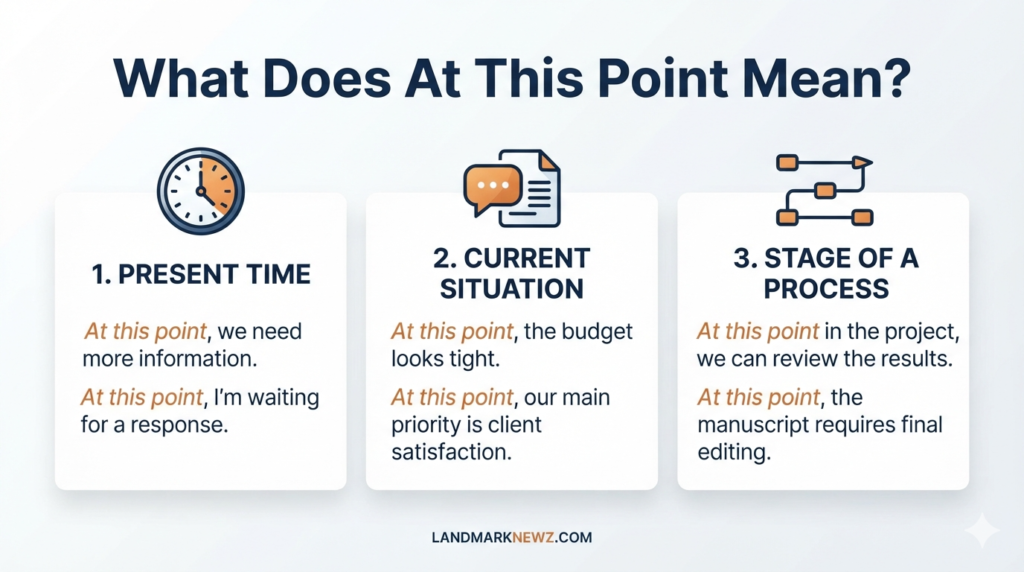
“At this point” is a common English phrase used to describe the current time, situation, or stage of something. Depending on context, it can mean “right now,” “at this stage,” or “under the current circumstances.”
For example, you might say, “At this point, we need more information before making a decision.” Here, the phrase refers to the current situation rather than a specific moment on a clock.
The expression appears frequently in conversations, emails, reports, business communication, academic writing, and everyday speech. However, repeating it too often can make your writing sound predictable.
Why Use Other Ways to Say “At This Point”?
Finding another way to say “at this point” can make your writing more precise and natural. Different alternatives can also clarify whether you mean time, progress, circumstances, or urgency.
Using varied expressions can help you:
- Avoid unnecessary repetition.
- Make sentences sound more natural.
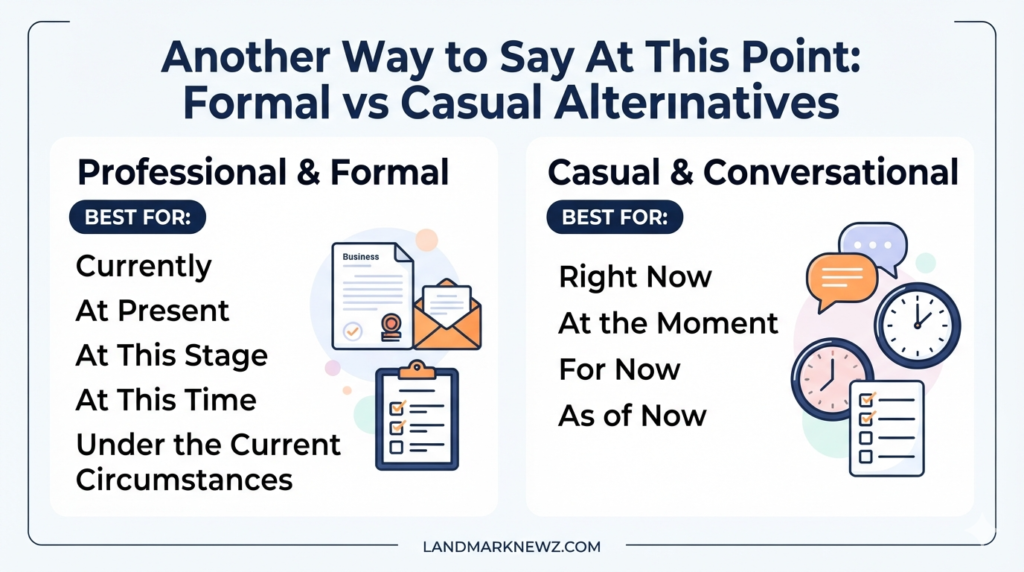
- Match formal and casual situations.
- Improve professional and academic writing.
- Communicate the exact meaning more clearly.
- Add variety to emails, reports, and everyday conversations.
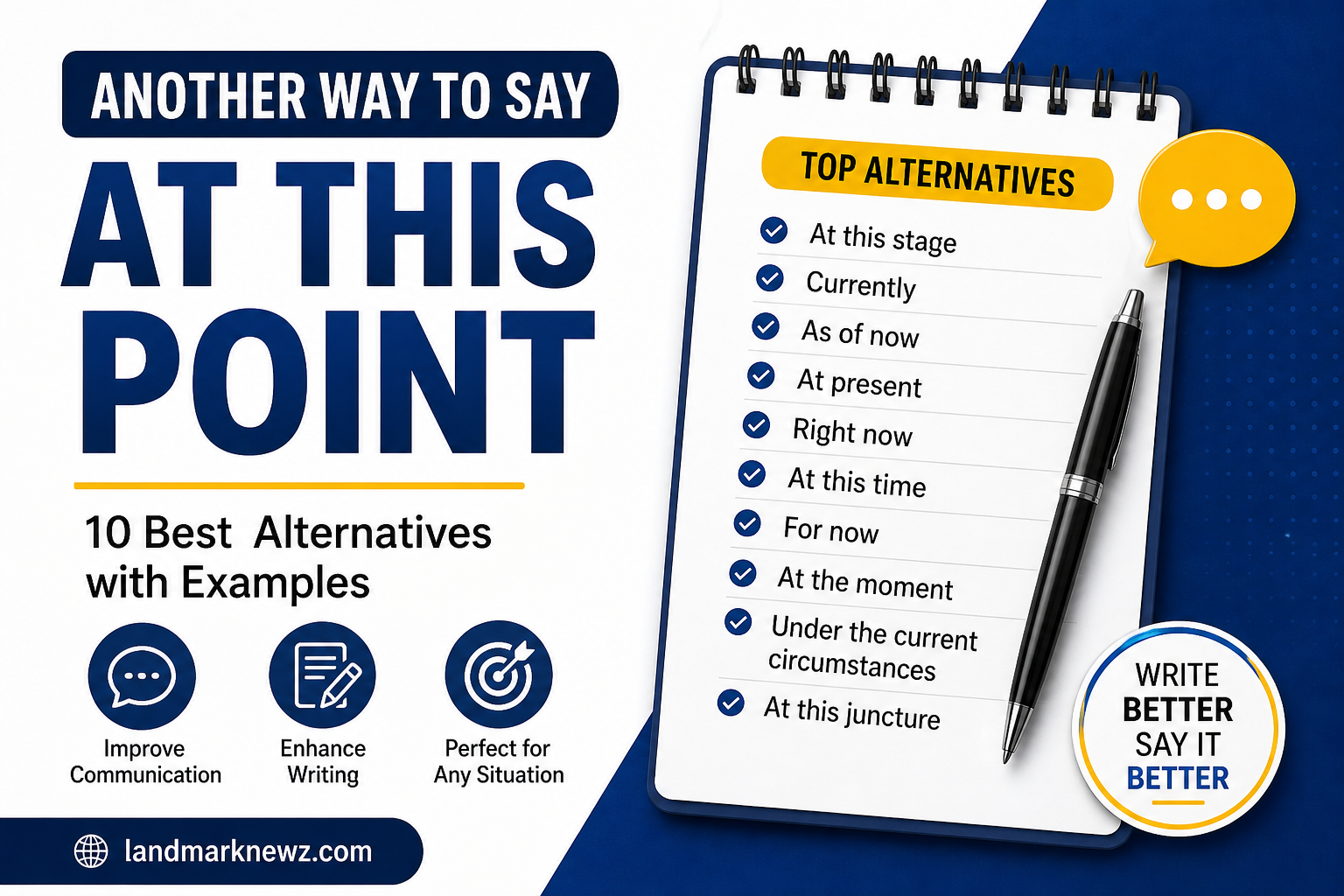
10 Best Other Ways to Say “At This Point”
1. At This Stage
Meaning
“At this stage” refers to a particular point in a process, project, or development. It is especially useful when something is progressing through several steps.
Best For
- Professional
- Formal
Example 1
At this stage, we have completed the initial testing and can begin reviewing the results.
Example 2
At this stage of the project, changing the design could create unnecessary delays.
Quick Tip
Use “at this stage” when you are talking about progress rather than simply the current time.
2. Currently
Meaning
“Currently” means something is happening or is true now. It is concise and works particularly well in professional, academic, and business writing.
Best For
- Professional
- Formal
Example 1
We are currently reviewing applications for the open position.
Example 2
The company is currently evaluating several options for its new office.
Quick Tip
Choose “currently” when you want a short, polished replacement for “at this point” meaning “now.”
3. As of Now
Meaning
“As of now” means something is true up to the present moment. It often emphasizes that circumstances may change later.
Best For
- Professional
- Casual
- Polite
Example 1
As of now, we have received confirmation from three vendors.
Example 2
As of now, there are no plans to change the scheduled meeting.
Quick Tip
Use “as of now” when you want to emphasize the current status of a situation.
4. At Present
Meaning
“At present” is a slightly more formal way to refer to the current time or circumstances. It is common in professional and written communication.
Best For
- Formal
- Professional
Example 1
At present, the department does not have enough staff to support the additional workload.
Example 2
At present, we are focusing on improving customer service.
Quick Tip
“At present” is a strong choice for reports, formal emails, and business documents.
5. Right Now
Meaning
“Right now” refers directly to the current moment. It sounds natural and conversational, making it more suitable for everyday speech than formal reports.
Best For
- Casual
- Friendly
- Warm
Example 1
I can’t talk right now, but I’ll call you after the meeting.
Example 2
We don’t have enough information to make a decision right now.
Quick Tip
Use “right now” for conversations, texts, and informal messages rather than highly formal documents.
6. At This Time
Meaning
“At this time” refers to the present period or current circumstances. It can sound neutral and professional without being overly formal.
Best For
- Professional
- Formal
- Polite
Example 1
We are unable to provide a final answer at this time.
Example 2
At this time, the position is no longer available.
Quick Tip
Use this expression when communicating a current status, especially when the situation could change later.
7. For Now
Meaning
“For now” means something applies temporarily or only during the present situation. It often suggests that a different decision may be made later.
Best For
- Casual
- Friendly
- Professional
Example 1
Let’s keep the original schedule for now and reassess it next week.
Example 2
For now, the team will continue working with the existing system.
Quick Tip
Choose “for now” when you want to communicate that a situation is temporary.
8. At the Moment
Meaning
“At the moment” means “currently” or “right now.” It is common in everyday American English and can also work in less formal professional communication.
Best For
- Casual
- Friendly
- Polite
Example 1
I’m working on another assignment at the moment.
Example 2
The website is unavailable at the moment while we perform maintenance.
Quick Tip
“At the moment” sounds more conversational than “currently,” so consider your audience before using it in formal writing.
9. Under the Current Circumstances
Meaning
“Under the current circumstances” focuses on the conditions affecting a decision or situation. It is useful when “at this point” refers to more than just time.
Best For
- Formal
- Professional
Example 1
Under the current circumstances, postponing the launch is the most practical option.
Example 2
Under the current circumstances, we cannot guarantee delivery by Friday.
Quick Tip
Use this phrase when external conditions or existing facts are influencing what happens next.
10. At This Juncture
Meaning
“At this juncture” means at this particular stage or moment in a process. It has a formal tone and is most appropriate for serious professional or written communication.
Best For
- Formal
- Professional
Example 1
At this juncture, the committee needs additional evidence before reaching a conclusion.
Example 2
At this juncture, we recommend waiting until the financial review is complete.
Quick Tip
Although correct, “at this juncture” can sound more formal than necessary. Use it when the context calls for a polished, formal tone.
Comparison Table
| Alternative | Best Used In | Tone |
| At this stage | Projects, processes, business | Professional |
| Currently | Emails, reports, business writing | Professional |
| As of now | Status updates, conversations | Neutral |
| At present | Formal writing, reports | Formal |
| Right now | Conversations, texts | Casual |
| At this time | Business communication | Professional |
| For now | Temporary decisions | Casual/Neutral |
| At the moment | Everyday communication | Casual |
| Under the current circumstances | Decisions and explanations | Formal |
| At this juncture | Formal discussions and reports | Formal |
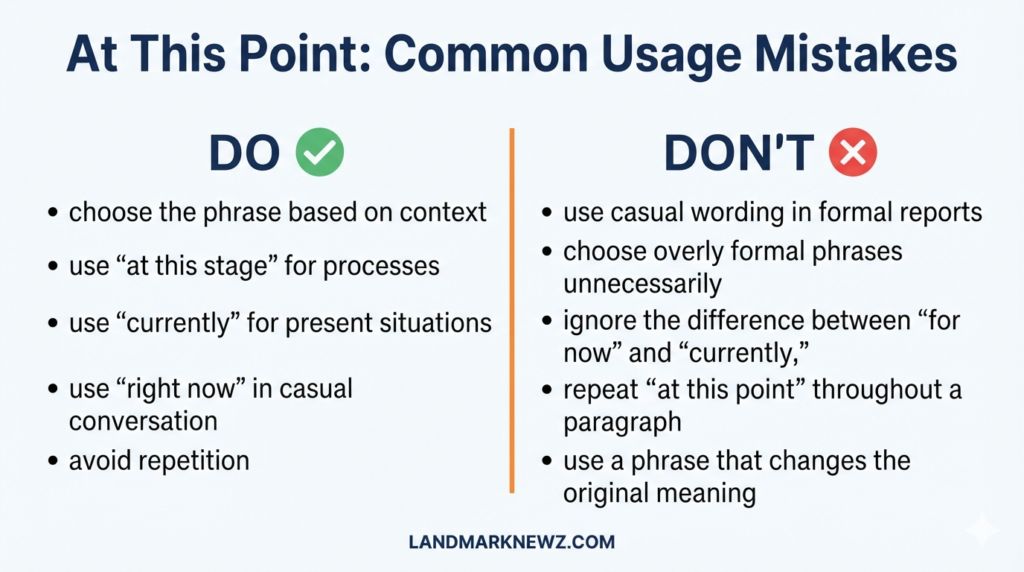
Common Mistakes
1. Using Casual Phrases in Formal Writing
Phrases such as “right now” and “at the moment” can sound too conversational in certain reports or formal documents. Consider “currently” or “at present” when you need a more professional tone.
2. Choosing an Overly Formal Expression
“At this juncture” is grammatically correct, but it may sound unnecessarily formal in a simple email. Use the simplest phrase that communicates your meaning clearly.
3. Ignoring the Context
“At this stage” and “currently” are not always interchangeable. “At this stage” focuses on progress, while “currently” usually focuses on what is happening now.
4. Repeating “At This Point” Too Often
Using the same expression throughout an article, report, or email can make the writing feel repetitive. Replace it with a suitable alternative when the meaning remains clear.
5. Using a Phrase That Changes the Meaning
Some alternatives imply temporary conditions. For example, “for now” suggests that something may change later, while “currently” simply describes the present situation.
Frequently Asked Questions
What is a professional way to say “at this point”?
“Currently,” “at present,” “at this stage,” and “at this time” are strong professional alternatives. The best choice depends on what you mean. Use “currently” for something happening now, “at this stage” for progress in a process, and “at present” for a more formal written tone.
What is another way to say “at this point in time”?
You can say “currently,” “at present,” “as of now,” “at this time,” or “right now.” In most cases, “at this point in time” is longer than necessary, so “currently” or “at present” can make the sentence cleaner and more direct.
Is “at this stage” the same as “at this point”?
They can have similar meanings, but they are not always interchangeable. “At this stage” usually refers to a specific phase in a process or development. “At this point” can refer to a stage, the current time, or the circumstances surrounding a decision.
What is a casual way to say “at this point”?
“Right now,” “at the moment,” and “for now” are natural casual alternatives. However, each has a slightly different meaning. “Right now” focuses on the present moment, “at the moment” means currently, and “for now” often suggests a temporary situation.
How can I say “at this point” in an email?
For a professional email, try “currently,” “at this time,” “at present,” or “as of now.” For example, instead of saying, “At this point, we are reviewing your request,” you could write, “We are currently reviewing your request.”
What is the most formal alternative to “at this point”?
“At this juncture” is one of the more formal alternatives, while “under the current circumstances” is useful when discussing conditions that affect a decision. However, formal does not always mean better. Choose the clearest expression for your audience.
Is “as of now” professional?
Yes. “As of now” can work well in professional communication, especially when giving a status update. It emphasizes that the information is accurate up to the present moment and could potentially change as new information becomes available.
What should I use instead of “at this point” in an essay?
For academic writing, “currently,” “at present,” “at this stage,” or “at this time” may work depending on the context. Avoid choosing an alternative simply to sound sophisticated. The clearest and most precise wording is usually the strongest choice.
Conclusion
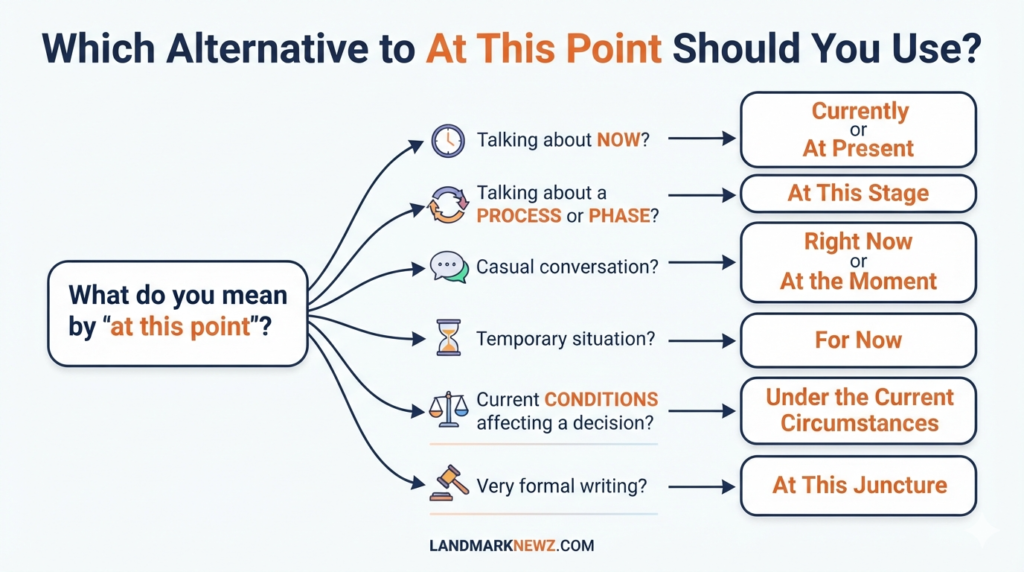
There are many useful ways to say “at this point,” but the right alternative depends on what you want to emphasize. If you are discussing a process, “at this stage” is usually the clearest choice.
For professional writing, “currently” and “at present” offer concise alternatives. For a clear definition and examples of “currently,” see the Cambridge Dictionary entry for currently. In casual conversations, “right now” or “at the moment” sounds more natural.
When circumstances are driving a decision, “under the current circumstances” provides more detail. Meanwhile, “for now” works best when you want to show that a situation is temporary.
The key is not simply to replace words. Choose an expression that matches your meaning, audience, and tone. Clear language will always be more effective than wording that sounds unnecessarily complicated.

About Dr. Priya Nair
Dr. Priya Nair is a passionate Writer & Blogger at LandMarkNewz.com, dedicated to creating informative, engaging, and easy-to-understand content for readers. With a strong interest in research, current trends, lifestyle, and everyday topics, she focuses on presenting useful information in a clear and reader-friendly way.
Through her writing, Priya aims to help readers discover valuable insights, understand complex topics more easily, and stay informed about subjects that matter to them. Her approach combines thoughtful research with a simple and engaging writing style.
At LandMarkNewz.com, she contributes original articles designed to inform, educate, and provide practical value to readers.