
What Does “Another Way to Say Well Said” Mean?
The phrase “well said” is used to show approval of something another person has expressed. It usually means that their idea was clear, accurate, thoughtful, or expressed in an effective way.
People commonly say “well said” during conversations, meetings, presentations, online discussions, and written communication. However, using the same phrase repeatedly can sound predictable, so having several alternatives helps you respond more naturally.
The right replacement depends on what you want to communicate. You might want to show agreement, praise someone’s wording, recognize a strong idea, or simply encourage the speaker.
Why Use Other Ways to Say “Well Said”?
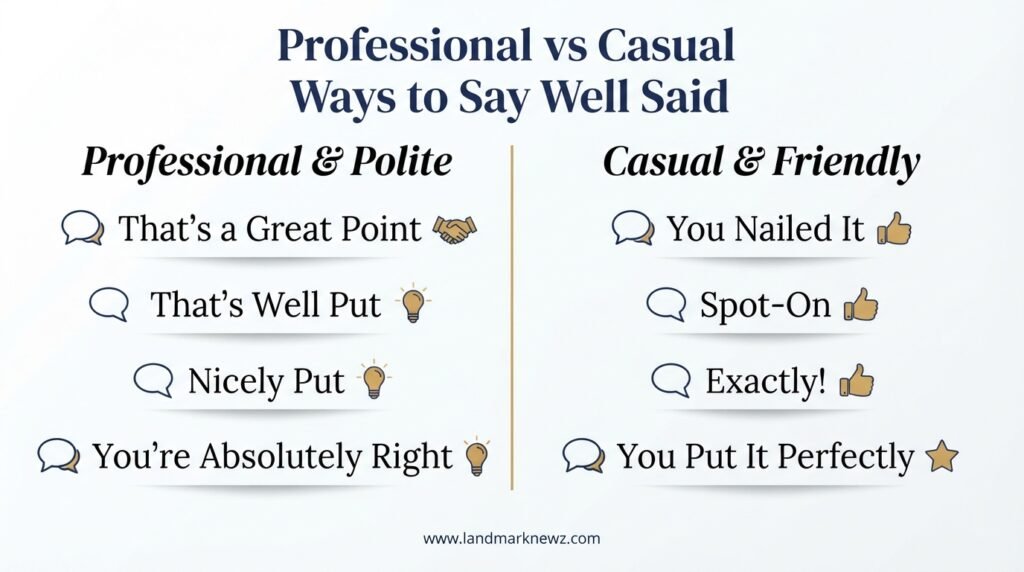
Finding another way to say well said can make your communication more natural and specific. Instead of giving the same response every time, you can choose words that better match your relationship with the speaker and the situation.
Using alternatives can help you:
- Avoid repeating the same expression.
- Sound more conversational and natural.
- Show stronger agreement when appropriate.
- Give specific praise for someone’s idea or wording.
- Communicate professionally without sounding stiff.
- Add warmth and personality to everyday conversations.
10 Best Other Ways to Say “Well Said”
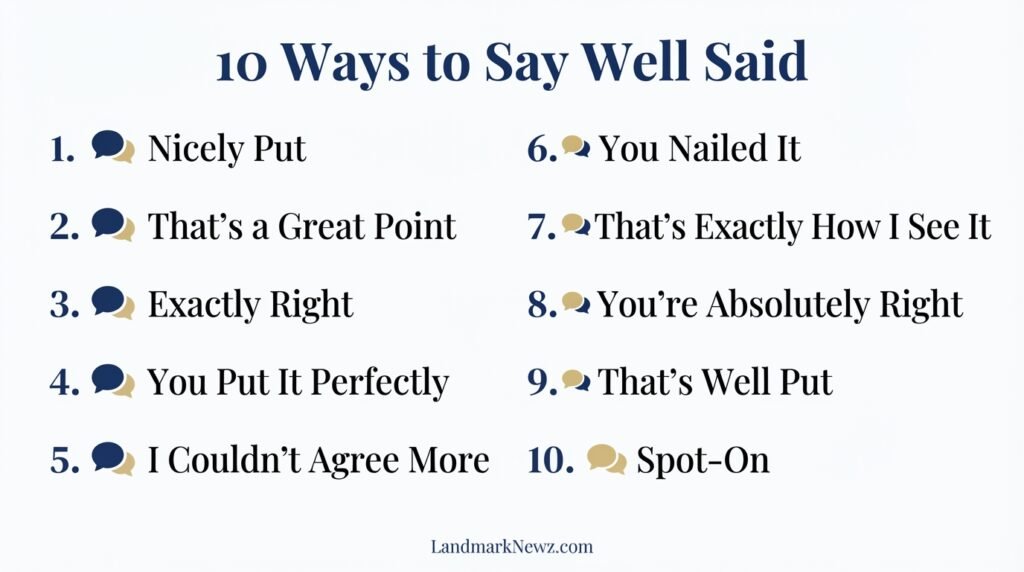
1. Nicely Put
Meaning
“Nicely put” praises the way someone expressed an idea. It suggests that their words were clear, effective, or especially well chosen.
Best For
- Professional
- Friendly
- Polite
- Warm
Example 1
“Nicely put. I think that explains the issue better than anything else we’ve discussed.”
Example 2
“You made a complicated topic much easier to understand. Nicely put.”
Quick Tip
Use “nicely put” when you specifically want to praise someone’s wording or explanation.
2. That’s a Great Point
Meaning
“That’s a great point” recognizes that someone has made a valuable or insightful observation. It often signals agreement while showing that you have considered what they said.
Best For
- Professional
- Friendly
- Polite
Example 1
“That’s a great point, and we should consider it before making the final decision.”
Example 2
“That’s a great point about customer expectations. I hadn’t looked at it from that angle.”
Quick Tip
This is one of the safest choices for meetings, workplace conversations, and professional emails.
3. Exactly Right
Meaning
“Exactly right” communicates strong agreement with someone’s statement. It tells the other person that their understanding or conclusion matches your own.
Best For
- Professional
- Casual
- Friendly
- Polite
Example 1
“Exactly right. The main challenge isn’t cost; it’s finding enough qualified staff.”
Example 2
“You’re exactly right about the timing. Waiting another week could create unnecessary problems.”
Quick Tip
Choose this phrase when you want to emphasize agreement rather than simply praise how someone spoke.
4. You Put It Perfectly
Meaning
“You put it perfectly” means someone expressed an idea in exactly the right way. It is a stronger and more personal compliment than simply saying “well said.”
Best For
- Friendly
- Warm
- Polite
- Casual
Example 1
“You put it perfectly when you said that good leadership starts with listening.”
Example 2
“I couldn’t have explained my concerns better. You put it perfectly.”
Quick Tip
Use this when someone’s exact wording captures an idea that you also believe or understand.
5. I Couldn’t Agree More
Meaning
“I couldn’t agree more” expresses very strong agreement. It works when you want to make it clear that you completely support what someone has said.
Best For
- Professional
- Friendly
- Warm
- Polite
Example 1
“I couldn’t agree more. Clear communication should always come before quick decisions.”
Example 2
“You’re right that quality matters more than speed here. I couldn’t agree more.”
Quick Tip
Reserve this phrase for strong agreement because it sounds more emphatic than a simple “well said.”
6. You Nailed It
Meaning
“You nailed it” is a casual way to say that someone got something exactly right. It can praise an answer, explanation, observation, or description.
Best For
- Casual
- Friendly
Example 1
“You nailed it. That’s exactly why the campaign wasn’t connecting with customers.”
Example 2
“Your description of the movie was spot-on. You nailed it.”
Quick Tip
This expression is best for friends, coworkers you know well, and relaxed conversations rather than formal business writing.
7. That’s Exactly How I See It
Meaning
This phrase tells someone that their opinion closely matches your own. It combines agreement with a personal statement about your perspective.
Best For
- Professional
- Friendly
- Polite
- Warm
Example 1
“That’s exactly how I see it. We need to solve the underlying problem instead of treating the symptoms.”
Example 2
“I agree with your assessment. That’s exactly how I see it as well.”
Quick Tip
Use this when you want to connect your own viewpoint directly to what another person has said.
8. You’re Absolutely Right
Meaning
“You’re absolutely right” gives direct and confident agreement. It can also reassure someone that their judgment or observation is valid.
Best For
- Professional
- Friendly
- Polite
- Warm
Example 1
“You’re absolutely right about the need to simplify the onboarding process.”
Example 2
“We should have asked for feedback sooner. You’re absolutely right.”
Quick Tip
This works in both professional and personal conversations, but use it sincerely rather than as an automatic response.
9. That’s Well Put
Meaning
“That’s well put” is a polished alternative to “well said.” It compliments someone for expressing an idea clearly and effectively.
Best For
- Professional
- Formal
- Polite
- Friendly
Example 1
“That’s well put. The proposal needs to focus on long-term value rather than short-term gains.”
Example 2
“That’s well put, especially your explanation of why the team needs more flexibility.”
Quick Tip
Choose “that’s well put” when you want a professional-sounding response without making it overly formal.
10. Spot-On
Meaning
“Spot-on” means completely accurate or exactly correct. It is a concise way to praise someone’s observation or conclusion.
Best For
- Casual
- Friendly
- Professional
Example 1
“Your assessment of the market is spot-on.”
Example 2
“That description is spot-on. The new system does feel much easier to use.”
Quick Tip
“Spot-on” is especially natural in American English when responding to an accurate observation in an informal or moderately professional setting.
Comparison Table
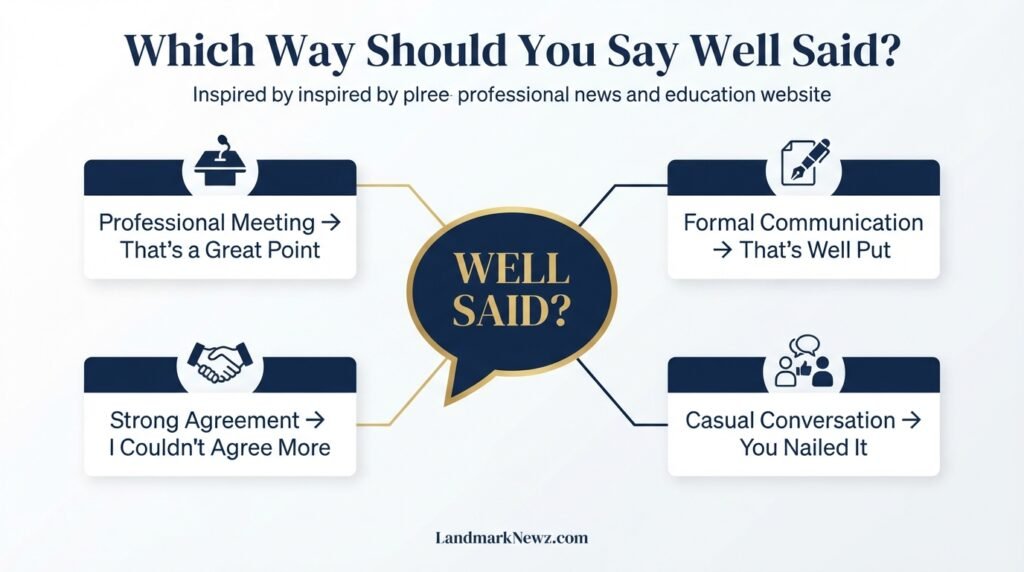
| Alternative | Best Used In | Tone |
| Nicely put | Work, conversations | Warm, polite |
| That’s a great point | Meetings, discussions | Professional, friendly |
| Exactly right | Discussions, feedback | Direct, confident |
| You put it perfectly | Personal conversations | Warm, appreciative |
| I couldn’t agree more | Strong agreement | Emphatic, supportive |
| You nailed it | Casual conversations | Relaxed, enthusiastic |
| That’s exactly how I see it | Discussions, meetings | Professional, personal |
| You’re absolutely right | Work, everyday conversations | Confident, supportive |
| That’s well put | Professional communication | Polished, polite |
| Spot-on | Casual, workplace conversations | Casual, positive |
Common Mistakes
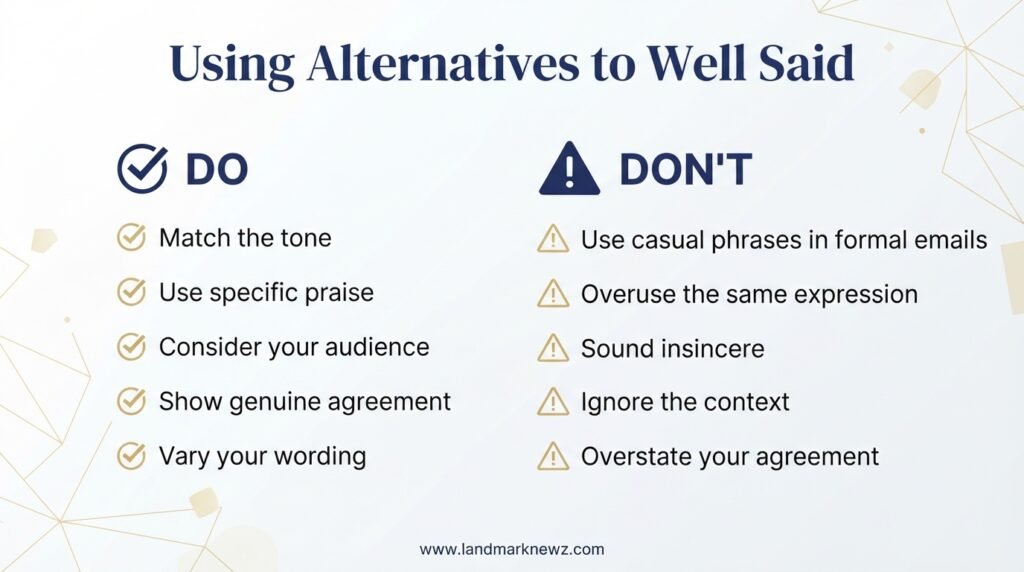
- Using casual phrases in formal settings
Expressions such as “you nailed it” may sound too relaxed in a formal email or business presentation. Choose “that’s well put” or “that’s a great point” instead. - Choosing overly formal language
You do not need complicated wording to sound professional. A simple phrase like “nicely put” can feel more natural than an unusually formal compliment. - Repeating the same phrase
Saying “well said” after every useful comment can make your responses feel automatic. Rotate between alternatives that genuinely fit the situation. - Forgetting the context
Some phrases express agreement, while others praise someone’s wording. Make sure your response matches what you actually mean. - Sounding insincere
Avoid using strong phrases such as “I couldn’t agree more” unless you truly agree. A thoughtful response is more effective than exaggerated praise.
Frequently Asked Questions
What is another way to say “well said” professionally?
Professional alternatives include “that’s a great point,” “nicely put,” “that’s well put,” and “you’re absolutely right.” “That’s a great point” is especially useful in meetings because it recognizes the value of someone’s idea without sounding overly formal. Choose “that’s well put” when you specifically want to praise the person’s wording or explanation.
What is a polite way to say “well said”?
“Nicely put” and “that’s well put” are both polite alternatives. They acknowledge that someone communicated an idea clearly and effectively. “That’s a great point” is another strong choice when you want to recognize the value of the idea itself rather than the way it was expressed.
What is a casual way to say “well said”?
For casual conversations, try “You nailed it,” “Exactly!”, “Spot-on,” or “You put it perfectly.” These expressions feel more relaxed and energetic than “well said.” The best choice depends on how strongly you agree and how familiar you are with the person you’re speaking to.
Can I say “well said” in a professional email?
Yes. “Well said” is perfectly acceptable in many professional emails, especially when responding to a thoughtful comment or opinion. However, alternatives such as “That’s a great point” or “That’s well put” can make your response more specific and polished when the context calls for it.
Is “nicely put” the same as “well said”?
“Nicely put” is very close in meaning to “well said.” Both phrases praise how someone has expressed an idea. The slight difference is that “nicely put” focuses more directly on the person’s wording, while “well said” can praise both the wording and the idea behind it.
What can I say instead of “well said” in a meeting?
In a meeting, “That’s a great point,” “You’re absolutely right,” and “That’s well put” are excellent choices. If you strongly support the speaker’s position, “I couldn’t agree more” works well. These phrases sound natural while showing that you are actively listening and responding to the discussion.
What is a stronger way to say “well said”?
“I couldn’t agree more” is stronger when you want to express complete agreement. “You put it perfectly” is stronger when you want to praise someone’s wording. “You’re absolutely right” also adds emphasis while making your agreement very clear.
What is another way to say “well said” in a text?
For a text message, you can say “Exactly!”, “So true,” “You nailed it,” “Spot-on,” or “I couldn’t agree more.” Choose based on your relationship with the person. For a close friend, “You nailed it” feels natural, while “I couldn’t agree more” works when you want to emphasize strong agreement.
Conclusion
Knowing another way to say well said gives you more flexibility in conversations, emails, meetings, and everyday communication. While “well said” is simple and effective, alternatives let you express exactly what you mean. The phrase “well put” is also commonly used to praise how clearly or effectively someone has expressed an idea.
Use “nicely put” or “that’s well put” when you want to praise someone’s wording. Choose “that’s a great point” or “you’re absolutely right” for professional discussions. When you strongly agree, “I couldn’t agree more” adds emphasis. For relaxed conversations, “you nailed it” and “spot-on” sound friendly and natural.
The key is to match the phrase with your intended tone. Instead of choosing a synonym automatically, think about whether you are praising the idea, agreeing with the speaker, or complimenting their delivery. That small distinction can make your communication sound much more genuine.

Language & Everyday Communication Specialist
Elena Voss is a language enthusiast and communication coach with over 9 years of experience helping people express themselves more naturally in English. She previously worked as an ESL instructor and corporate language trainer, guiding professionals and students on clearer everyday conversations, polite alternatives, and natural phrasing.
Elena specializes in practical synonym guides and “another way to say…” content that feels conversational rather than textbook. Her writing focuses on real-life situations — emails to friends, casual workplace chat, social media, and daily interactions. She believes the best language advice is simple, useful, and easy to remember.
When she’s not creating content for LandmarkNewz, Elena enjoys analyzing modern slang trends and testing new phrases in real conversations.