What Does “Another Way to Say Black and White Thinking” Mean?
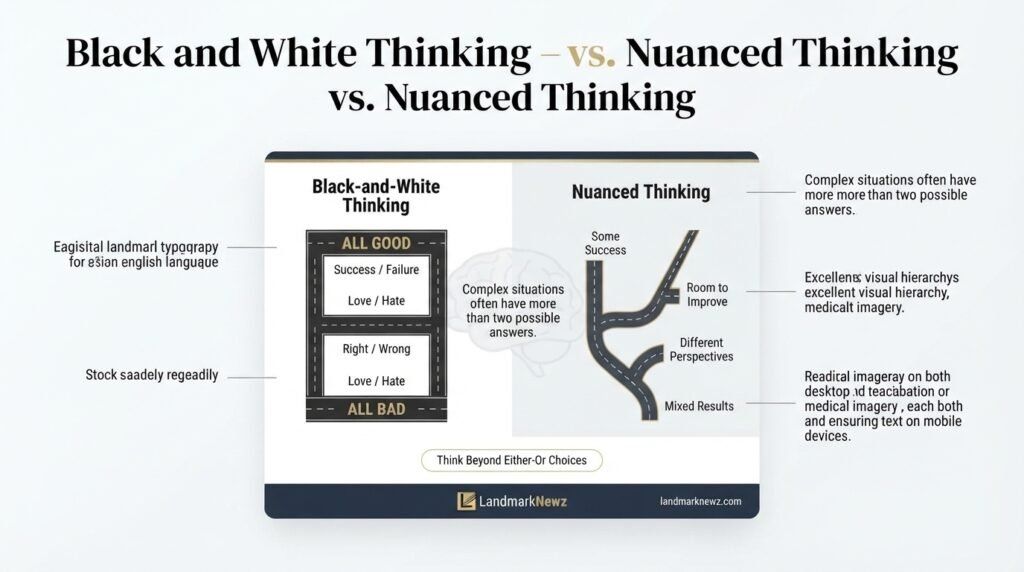
“Black and white thinking” describes a way of viewing situations as having only two extreme possibilities, such as right or wrong, success or failure, or good or bad. It leaves little room for uncertainty, mixed outcomes, exceptions, or middle-ground solutions.
People often search for another way to say black and white thinking when they want a more precise, professional, academic, or natural expression. The phrase commonly appears in psychology, education, workplace communication, personal development, and everyday conversations.
Depending on the context, all-or-nothing thinking is usually the closest natural alternative, while dichotomous thinking sounds more technical.
Why Use Other Ways to Say “Black and White Thinking”?
Using different expressions can make your writing more accurate and prevent repetition. It can also help you choose language that fits a professional, academic, casual, or psychological context.
Other advantages include:
- Avoiding repetitive wording.
- Making your meaning more precise.
- Choosing a term that matches your audience.
- Improving professional and academic communication.
- Describing extreme or rigid viewpoints more clearly.
- Making explanations sound more natural.
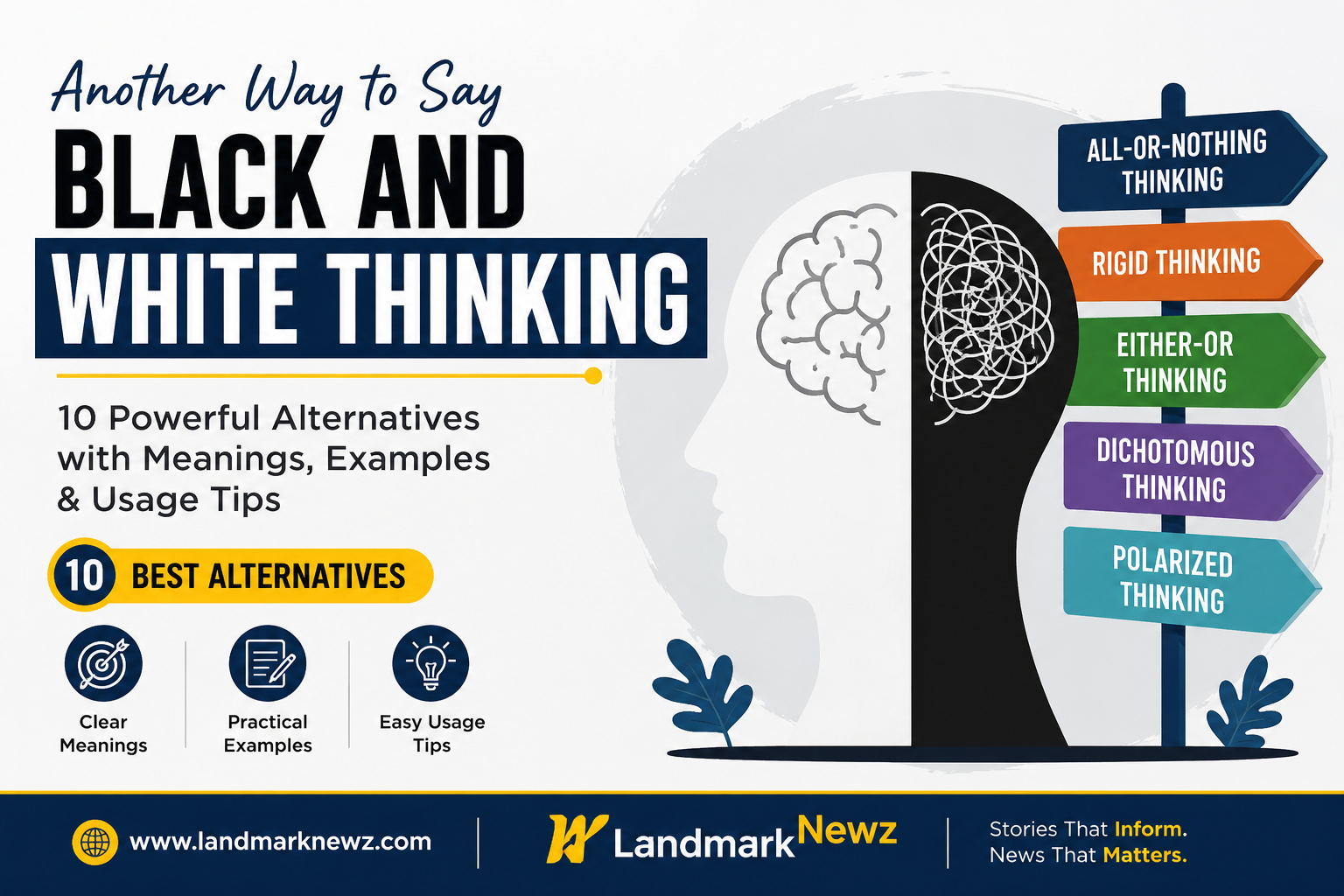
10 Best Other Ways to Say “Black and White Thinking”
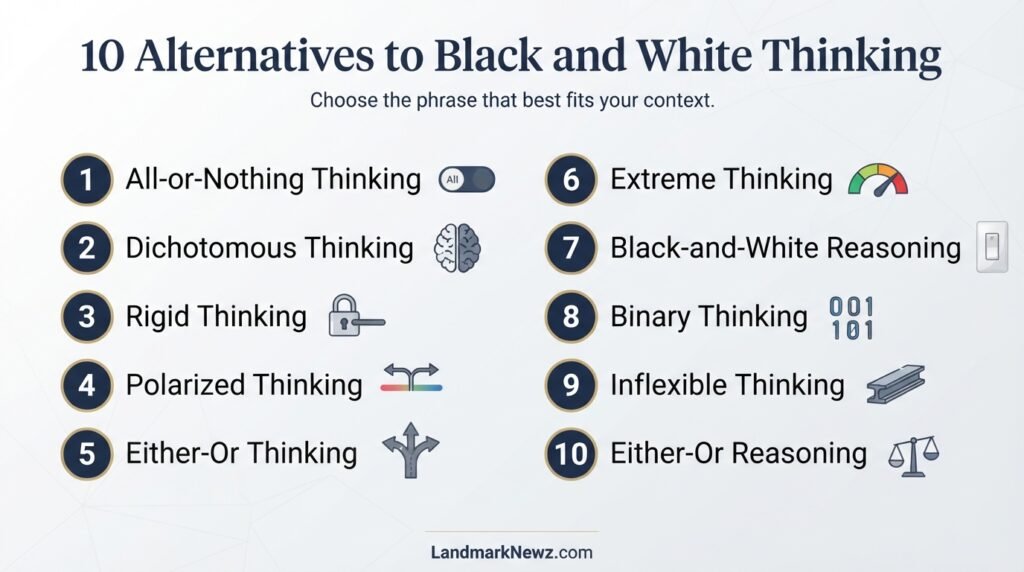
1. All-or-Nothing Thinking
Meaning
All-or-nothing thinking means viewing something in absolute terms, with no consideration for partial success or middle-ground outcomes. It is one of the most natural and widely understood alternatives to black and white thinking.
Best For
- Professional
- Formal
- Casual
- Educational
Example 1
“Her all-or-nothing thinking made one small mistake feel like a complete failure.”
Example 2
“Try to avoid all-or-nothing thinking when evaluating your progress.”
Quick Tip
Use this phrase when you want a clear, everyday expression that most readers will immediately understand.
2. Dichotomous Thinking
Meaning
Dichotomous thinking refers to dividing an issue into two opposing categories while overlooking possibilities between them. It is a more technical expression often used in psychology, research, and academic writing.
Best For
- Formal
- Professional
Example 1
“The study examined how dichotomous thinking can influence decision-making.”
Example 2
“Dichotomous thinking may cause people to overlook reasonable alternatives.”
Quick Tip
Choose this term when writing for an academic or professional audience.
3. Rigid Thinking
Meaning
Rigid thinking describes a limited approach to ideas in which someone has difficulty considering alternative perspectives or adapting to new information. Unlike all-or-nothing thinking, it can involve more than two categories.
Best For
- Professional
- Formal
- Educational
Example 1
“Rigid thinking can make it difficult to adapt when circumstances change.”
Example 2
“The manager encouraged the team to move beyond rigid thinking and consider other solutions.”
Quick Tip
Use “rigid thinking” when the main issue is inflexibility rather than strictly seeing two choices.
4. Polarized Thinking
Meaning
Polarized thinking describes a situation in which opinions or judgments fall toward opposite extremes. It is particularly useful when discussing disagreements, political views, social issues, or strongly divided opinions.
Best For
- Professional
- Formal
- Academic
Example 1
“Polarized thinking can make productive conversations more difficult.”
Example 2
“The discussion became unproductive because participants adopted increasingly polarized thinking.”
Quick Tip
Use this phrase when you want to emphasize opposing sides rather than personal perfectionism or failure.
5. Either-Or Thinking
Meaning
Either-or thinking presents two options as if they are the only possibilities available. It is a straightforward phrase that highlights the false assumption that a person must choose one side or the other.
Best For
- Casual
- Friendly
- Professional
Example 1
“Effective leadership requires more than either-or thinking.”
Example 2
“You don’t have to choose between these two options; that’s an example of either-or thinking.”
Quick Tip
This is a strong choice when explaining the concept to a general audience.
6. Extreme Thinking
Meaning
Extreme thinking refers to interpreting situations, beliefs, or outcomes at the far ends of a spectrum. It focuses more on the intensity of a viewpoint than on the specific two-category structure.
Best For
- Casual
- Friendly
- Professional
Example 1
“Extreme thinking can prevent you from seeing a practical compromise.”
Example 2
“Recognizing extreme thinking can help you evaluate a difficult situation more fairly.”
Quick Tip
Use this expression when you want simple language without sounding overly technical.
7. Black-and-White Reasoning
Meaning
Black-and-white reasoning is another close alternative that focuses on the way someone reaches a conclusion. It suggests that an issue is being evaluated as completely one thing or completely another.
Best For
- Professional
- Formal
- Educational
Example 1
“Black-and-white reasoning can overlook important details in complex situations.”
Example 2
“The article challenges black-and-white reasoning by presenting several possible explanations.”
Quick Tip
Choose this phrase when discussing someone’s reasoning process rather than simply describing their attitude.
8. Binary Thinking
Meaning
Binary thinking treats an issue as having two distinct choices, categories, or outcomes. It is concise and useful in technical, business, academic, and analytical contexts.
Best For
- Professional
- Formal
Example 1
“Binary thinking can oversimplify complex business decisions.”
Example 2
“The team moved away from binary thinking and evaluated several possible outcomes.”
Quick Tip
“Binary thinking” works especially well when discussing decisions, systems, data, or analytical problems.
9. Inflexible Thinking
Meaning
Inflexible thinking describes difficulty changing one’s viewpoint or considering new approaches. It emphasizes a lack of mental flexibility rather than the specific tendency to see things in two categories.
Best For
- Professional
- Formal
- Polite
Example 1
“Inflexible thinking may prevent employees from responding effectively to unexpected problems.”
Example 2
“The coach encouraged the players to avoid inflexible thinking during the competition.”
Quick Tip
Use this term when adaptability is the main concern.
10. Either-or Reasoning
Meaning
Either-or reasoning describes the belief that only two opposing answers or choices exist. It is especially useful when explaining how an argument creates a false choice between alternatives.
Best For
- Formal
- Professional
- Educational
Example 1
“The proposal relies on either-or reasoning instead of considering several workable options.”
Example 2
“Good decision-making requires questioning either-or reasoning when more choices are available.”
Quick Tip
This phrase is particularly effective when analyzing arguments, debates, or decision-making.
Comparison Table
| Alternative | Best Used In | Tone |
| All-or-nothing thinking | Everyday, professional, educational | Clear |
| Dichotomous thinking | Psychology, academic writing | Technical |
| Rigid thinking | Workplace, education | Professional |
| Polarized thinking | Debates, social issues | Formal |
| Either-or thinking | Everyday explanations | Conversational |
| Extreme thinking | General discussions | Simple |
| Black-and-white reasoning | Analysis, education | Professional |
| Binary thinking | Business, technical contexts | Concise |
| Inflexible thinking | Workplace, personal development | Polite |
| Either-or reasoning | Arguments, analysis | Formal |
Common Mistakes
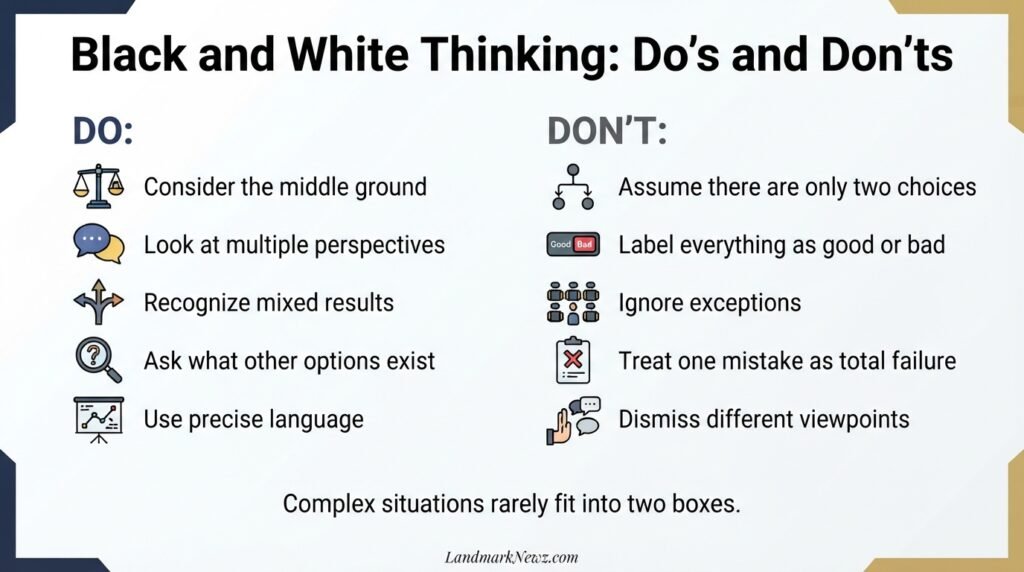
1. Using a Technical Term With a Casual Audience
Words such as “dichotomous” may sound unnecessarily complicated in everyday conversation. When clarity matters most, “all-or-nothing thinking” is often a better choice.
2. Treating Every Alternative as an Exact Synonym
These expressions overlap, but they are not identical. For example, rigid thinking focuses on inflexibility, while polarized thinking focuses more strongly on opposing extremes.
3. Using the Phrase Without Context
Calling someone’s viewpoint “extreme thinking” can sound judgmental if you do not explain why. Give enough context to make your meaning clear and fair.
4. Choosing Language That Sounds Too Harsh
Words such as “extreme” can feel critical when describing another person’s behavior. In sensitive conversations, “inflexible thinking” or “either-or thinking” may sound more neutral.
5. Ignoring the Intended Audience
Academic writing may benefit from “dichotomous thinking,” while a general blog may be easier to understand with “all-or-nothing thinking.” Always choose the expression your readers are most likely to understand.
Frequently Asked Questions
What is the best synonym for black and white thinking?
The best general synonym is all-or-nothing thinking. It clearly describes the tendency to see situations in absolute terms, such as completely good or completely bad. For academic or psychological writing, dichotomous thinking is another strong option because it sounds more technical and precise.
Is all-or-nothing thinking the same as black and white thinking?
Yes, the two phrases are generally used to describe the same basic pattern of thinking. Both involve viewing situations in extremes while overlooking middle-ground possibilities. “All-or-nothing thinking” is often more conversational, while “black and white thinking” is familiar in everyday speech.
What is a professional way to say black and white thinking?
Professional alternatives include dichotomous thinking, polarized thinking, binary thinking, and rigid thinking. The right choice depends on your meaning. For example, “dichotomous thinking” works well in formal writing, while “rigid thinking” is useful when describing an inability to consider alternative perspectives.
What is a psychological term for black and white thinking?
Dichotomous thinking and all-or-nothing thinking are commonly used terms for this pattern. They describe viewing situations in absolute categories rather than recognizing degrees, uncertainty, or mixed outcomes. The exact terminology can vary depending on the psychological framework and context.
What is another way to say someone thinks in extremes?
You can say that someone uses extreme thinking, polarized thinking, all-or-nothing thinking, or black-and-white reasoning. The best option depends on the situation. “Polarized thinking” emphasizes opposing viewpoints, while “all-or-nothing thinking” emphasizes absolute judgments.
What is the opposite of black and white thinking?
The opposite is generally nuanced thinking, flexible thinking, balanced thinking, or open-minded thinking. These approaches allow someone to recognize multiple perspectives, degrees of possibility, uncertainty, and exceptions rather than dividing every situation into two absolute categories.
Is “binary thinking” a synonym for black and white thinking?
“Binary thinking” can be a synonym, especially when an issue is reduced to two choices or categories. However, the term is also used in technical and computing contexts, so its meaning depends on the subject. In general writing, “all-or-nothing thinking” is usually clearer.
How can I avoid black and white thinking in writing?
Try to acknowledge exceptions, degrees, and alternative explanations. Instead of describing something as completely successful or completely unsuccessful, consider phrases such as “partially successful,” “mixed results,” or “several factors contributed.” This creates a more balanced and accurate explanation.
Conclusion
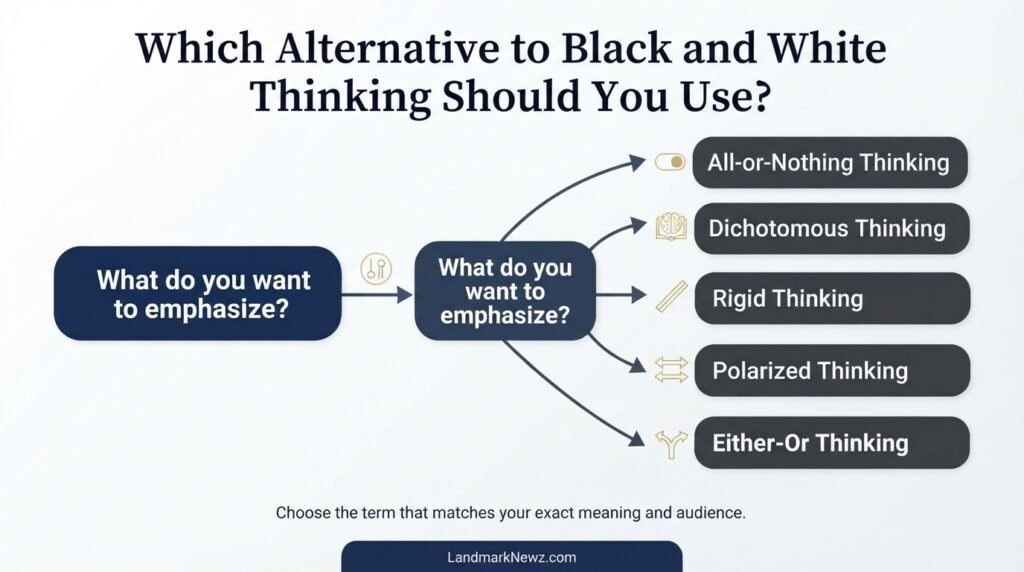
There are many useful alternatives to black and white thinking, but the best choice depends on what you want to emphasize. All-or-nothing thinking is the clearest everyday option, while dichotomous thinking is better suited to academic or psychological contexts.
If you are discussing opposing opinions, polarized thinking may be more precise. For workplace or personal situations involving a lack of flexibility, rigid thinking or inflexible thinking can communicate the idea more accurately.
The key is to consider your audience and the exact meaning you want to convey. A good synonym should not simply sound different—it should make your writing clearer, more natural, and more precise. When in doubt, all-or-nothing thinking is a safe and widely understood choice.

Professional Writing & Workplace Communication Expert
Marcus Hale is a business communication specialist with 11 years of experience in corporate training and professional writing. He has worked with mid-sized companies and remote teams to improve clarity in emails, reports, performance reviews, and client-facing messages.
Marcus focuses on polished, professional alternatives that help readers sound confident without sounding stiff. His guides cover workplace phrases, resume language, leadership communication, and formal-to-natural transitions. He holds a background in business administration and technical writing, and has led workshops on effective professional English.
At LandmarkNewz, Marcus creates practical synonym lists and phrasing tips that professionals can apply immediately in emails, meetings, and career documents.