

What Does “Another Way to Say Decision Making” Mean?
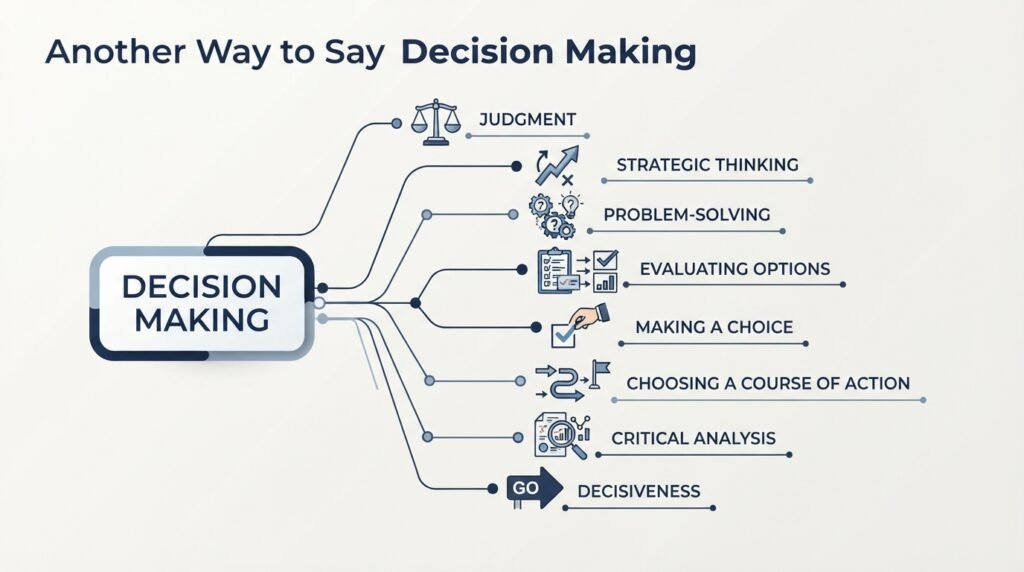
“Another way to say decision making” refers to alternative words or phrases that describe the process of evaluating choices and selecting what to do. Depending on the context, you might use judgment, choice, strategic thinking, problem-solving, or determining the best option.
People often search for alternatives to avoid repetition or to make their writing more precise. These expressions are especially useful in resumes, cover letters, workplace communication, business writing, academic work, and everyday conversations.
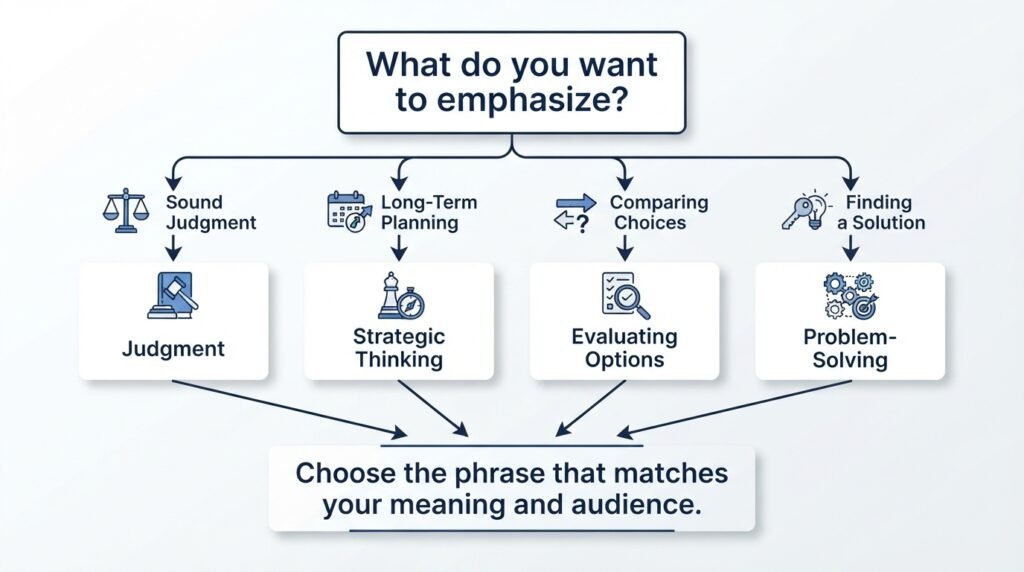
The best replacement depends on what you want to emphasize. For example, “judgment” highlights the quality of a decision, while “strategic thinking” focuses on planning and long-term results.
Why Use Other Ways to Say “Decision Making”?
Using different expressions can make your writing clearer and more natural. It also lets you choose a phrase that fits the exact situation instead of repeating “decision making.”
Other wording can help you:
- Avoid unnecessary repetition.
- Sound more polished and professional.
- Describe a specific decision-making skill.
- Strengthen resumes and professional profiles.
- Communicate complex ideas more clearly.
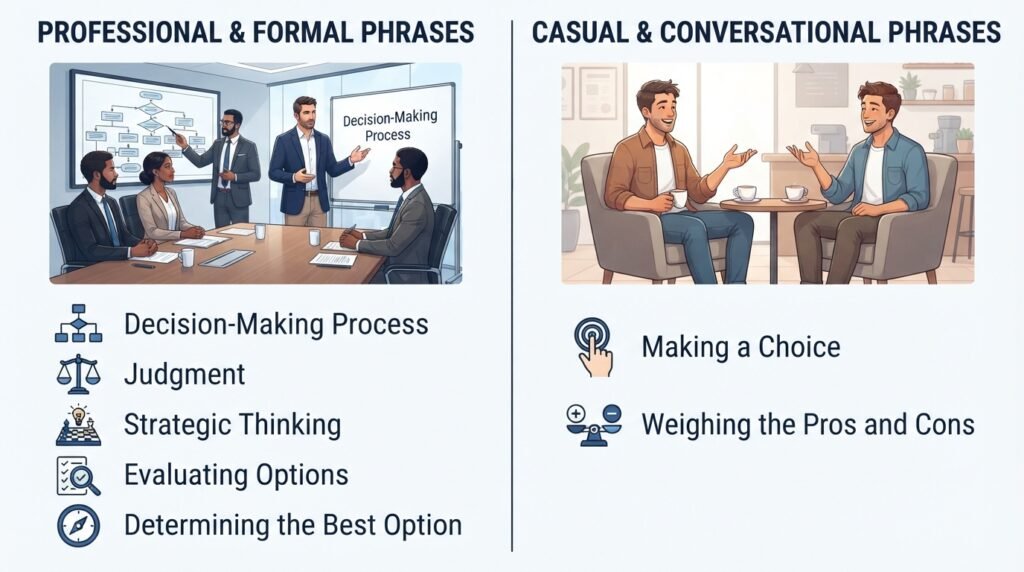
- Match your tone to formal or casual situations.
For example, a resume might benefit from “strategic thinking”, while an everyday conversation may sound more natural with “making a choice.”
10 Best Other Ways to Say “Decision Making”
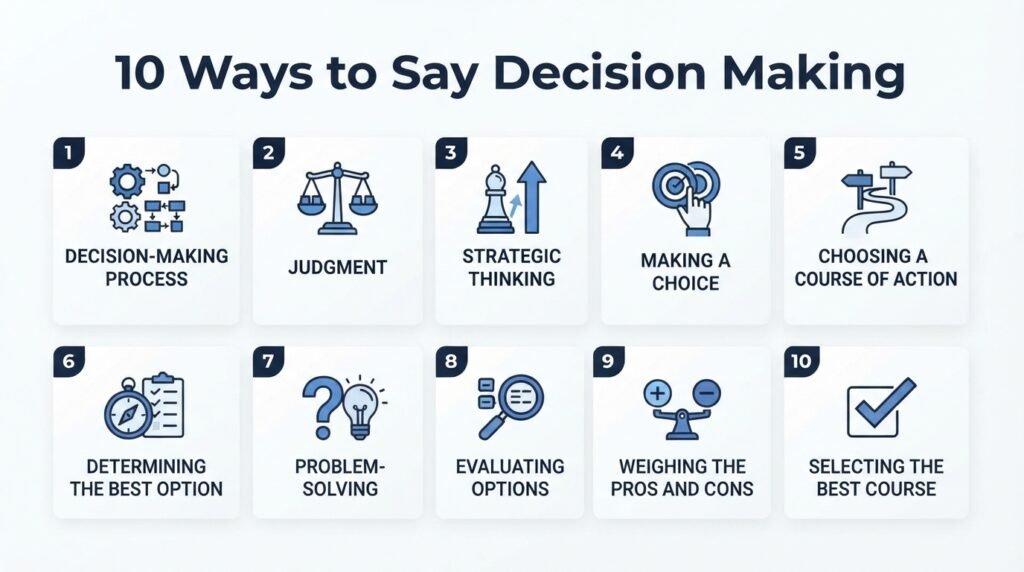
1. Decision-Making Process
Meaning
“Decision-making process” is the closest direct alternative to “decision making.” It describes the steps a person or group takes to evaluate information, compare options, and reach a conclusion.
Best For
- Professional
- Formal
Example 1
Our team improved its decision-making process by reviewing customer feedback before approving major changes.
Example 2
The manager explained the decision-making process so everyone understood how the final recommendation was reached.
Quick Tip
Use this phrase when you want to emphasize how a decision is made rather than the final decision itself.
2. Judgment
Meaning
“Judgment” refers to the ability to assess a situation and make a sensible choice. It often suggests experience, reasoning, and the ability to recognize the best course of action.
Best For
- Professional
- Formal
Example 1
Her strong judgment helped the company avoid unnecessary expenses during a difficult quarter.
Example 2
The position requires excellent judgment when handling sensitive customer concerns.
Quick Tip
Choose “judgment” when you want to highlight someone’s ability to make sound decisions, especially in professional settings.
3. Strategic Thinking
Meaning
“Strategic thinking” describes the ability to consider goals, risks, resources, and future outcomes before choosing a direction. It is particularly useful when decisions involve long-term planning.
Best For
- Professional
- Formal
Example 1
His strategic thinking helped the department identify new opportunities for growth.
Example 2
The role requires strategic thinking and a strong understanding of market trends.
Quick Tip
Use this phrase on resumes and in leadership contexts when decisions involve planning and long-term objectives.
4. Making a Choice
Meaning
“Making a choice” is a simple and natural way to describe selecting one option from several possibilities. It has a conversational feel and works well when the situation is straightforward.
Best For
- Casual
- Friendly
- Polite
Example 1
Making a choice became easier once we compared the costs of both options.
Example 2
Sometimes making a choice is difficult when every option has advantages.
Quick Tip
Use “making a choice” for everyday conversations rather than highly formal business documents.
5. Choosing a Course of Action
Meaning
“Choosing a course of action” means deciding what steps to take in response to a situation. It is more specific than simply saying “decision making” because it focuses on selecting a practical response.
Best For
- Professional
- Formal
Example 1
After reviewing the evidence, the committee began choosing a course of action.
Example 2
Leaders must remain calm when choosing a course of action during unexpected problems.
Quick Tip
This phrase works particularly well when discussing workplace problems, policies, strategies, or difficult situations.
6. Determining the Best Option
Meaning
“Determining the best option” emphasizes evaluating multiple possibilities and identifying the one that most effectively meets a specific goal. It clearly communicates comparison and careful consideration.
Best For
- Professional
- Formal
- Polite
Example 1
The purchasing team spent several days determining the best option for the new equipment.
Example 2
We need more information before determining the best option for our customers.
Quick Tip
Use this expression when your writing needs to show that a decision is based on careful comparison or evidence.
7. Problem-Solving
Meaning
“Problem-solving” focuses on finding solutions to challenges. Although it is not an exact synonym for decision making, the two skills often overlap because solving a problem frequently requires evaluating alternatives and selecting an effective solution.
Best For
- Professional
- Formal
- Casual
Example 1
Strong problem-solving skills helped the technician resolve the issue without delaying production.
Example 2
The position calls for creative problem-solving and the ability to work under pressure.
Quick Tip
Use “problem-solving” when the decision involves fixing a specific challenge, rather than simply choosing between unrelated options.
8. Evaluating Options
Meaning
“Evaluating options” describes the process of examining different possibilities before making a final choice. It places more emphasis on analysis than on the decision itself.
Best For
- Professional
- Formal
Example 1
We are currently evaluating options for expanding our customer support team.
Example 2
The committee spent the afternoon evaluating options before voting on the proposal.
Quick Tip
This phrase is useful when the decision has not been finalized yet and you want to emphasize the review stage.
9. Weighing the Pros and Cons
Meaning
“Weighing the pros and cons” means comparing the advantages and disadvantages of different choices. It is a clear, familiar expression that works well in everyday and semi-professional communication.
Best For
- Casual
- Friendly
- Polite
Example 1
After weighing the pros and cons, I decided to accept the new position.
Example 2
We’re still weighing the pros and cons of moving the office to a larger location.
Quick Tip
Use this expression when you want to make the idea of comparing benefits and drawbacks easy for the reader to understand.
10. Selecting the Best Course
Meaning
“Selecting the best course” refers to choosing the most appropriate direction after considering available information and possible outcomes. It has a polished, professional tone.
Best For
- Professional
- Formal
Example 1
The leadership team met to discuss selecting the best course for the company’s next phase.
Example 2
Careful research is essential when selecting the best course for a complex project.
Quick Tip
This phrase is best suited to formal writing where you want to present decision making as a deliberate and thoughtful process.
Comparison Table
| Alternative | Best Used In | Tone |
| Decision-making process | Business, workplace, reports | Professional |
| Judgment | Resumes, leadership, evaluations | Formal |
| Strategic thinking | Resumes, management, business | Professional |
| Making a choice | Everyday conversations | Casual |
| Choosing a course of action | Workplace, policies, problem situations | Formal |
| Determining the best option | Business, recommendations | Professional |
| Problem-solving | Resumes, interviews, workplace | Professional |
| Evaluating options | Reports, business discussions | Formal |
| Weighing the pros and cons | Everyday and workplace communication | Casual |
| Selecting the best course | Business, leadership, formal writing | Formal |
Common Mistakes
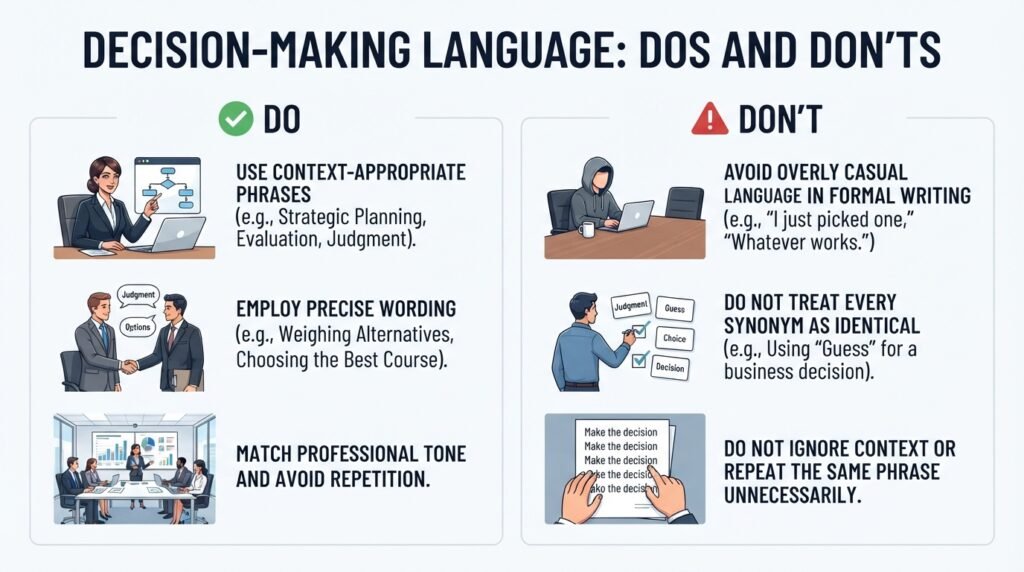
1. Using Casual Phrases in Professional Writing
Expressions such as “making a choice” may sound too informal on a resume or executive report. Choose “judgment,” “strategic thinking,” or “decision-making process” when the setting requires a professional tone.
2. Treating Every Alternative as an Exact Synonym
Not every phrase has exactly the same meaning. For example, “problem-solving” involves finding solutions, while “evaluating options” focuses on comparing possibilities.
3. Choosing Overly Formal Language
Formal wording is not always better. If you’re writing a simple email to a coworker, “making a choice” may sound more natural than “selecting the best course.”
4. Ignoring Context
Consider what part of decision making you want to emphasize. Use “judgment” for sound choices, “strategic thinking” for long-term planning, and “weighing the pros and cons” for comparing advantages and disadvantages.
5. Repeating the Same Phrase
Using “decision making” several times in the same paragraph can make your writing feel repetitive. Replace some instances with precise alternatives while keeping the original phrase where it communicates the idea most clearly.
Frequently Asked Questions
What is a professional way to say “decision making”?
A professional way to say “decision making” is “decision-making process,” “judgment,” or “strategic thinking.” The best option depends on the intended meaning. “Decision-making process” describes the steps involved, “judgment” highlights the ability to make sound choices, and “strategic thinking” emphasizes long-term planning and business goals.
What is another word for decision making on a resume?
Strong resume alternatives include judgment, strategic thinking, problem-solving, evaluating options, and choosing a course of action. Choose the phrase that matches the skill you actually want to highlight. For example, “strategic thinking” works well for leadership roles, while “problem-solving” is useful for positions that require resolving workplace challenges.
Is “judgment” the same as decision making?
“Judgment” and “decision making” are closely related but not identical. Decision making describes the process of selecting an option, while judgment refers more specifically to the ability to assess information and reach a sensible conclusion. Therefore, “judgment” is especially useful when describing someone’s decision-making ability.
What is a formal synonym for decision making?
Formal alternatives include “decision-making process,” “evaluating options,” “determining the best option,” and “choosing a course of action.” These expressions work well in business reports, professional correspondence, academic writing, and workplace discussions because they clearly describe analysis and choice without sounding overly casual.
What is another way to say “good decision making”?
You can say “sound judgment,” “strong decision-making skills,” “effective judgment,” or “strategic thinking.” “Sound judgment” is especially useful when you want to emphasize consistently sensible choices. On a resume, “strong decision-making skills” can also communicate the ability directly without changing the original meaning.
What is another way to say decision making skills?
Useful alternatives include “judgment skills,” “strategic thinking skills,” “problem-solving abilities,” and “analytical skills.” Each phrase highlights a slightly different strength. If the job involves leadership and long-term planning, strategic thinking may be the strongest choice; for resolving challenges, problem-solving may be more appropriate.
Can “problem-solving” replace “decision making”?
Sometimes, but not always. Problem-solving usually involves identifying an issue and developing a solution, while decision making can occur even when there is no problem to solve. For example, choosing between two strong candidates is decision making, whereas finding a way to fix a customer complaint is problem-solving.
What is the best alternative to “decision making”?
There is no single best alternative for every situation. “Decision-making process” is the closest general replacement, while “judgment” works well for professional ability and “strategic thinking” fits leadership and business contexts. Choose the expression that reflects the specific part of decision making you want to communicate.
Conclusion
Finding another way to say decision making can make your writing more precise, professional, and natural. The best alternative depends on the meaning you want to communicate and the audience you’re addressing.
For business and workplace writing, “decision-making process” is a reliable choice when you want to describe how someone evaluates options and reaches a conclusion. If you’re describing someone’s ability to make sound choices, “judgment” works well, while “strategic thinking” is stronger for leadership and long-term planning.
For everyday communication, “making a choice” or “weighing the pros and cons” sounds more conversational.
The key is to choose a phrase that matches the context instead of replacing words simply for variety. When the wording accurately reflects the action, your writing becomes clearer and more credible.

About Dr. Priya Nair
Dr. Priya Nair is a passionate Writer & Blogger at LandMarkNewz.com, dedicated to creating informative, engaging, and easy-to-understand content for readers. With a strong interest in research, current trends, lifestyle, and everyday topics, she focuses on presenting useful information in a clear and reader-friendly way.
Through her writing, Priya aims to help readers discover valuable insights, understand complex topics more easily, and stay informed about subjects that matter to them. Her approach combines thoughtful research with a simple and engaging writing style.
At LandMarkNewz.com, she contributes original articles designed to inform, educate, and provide practical value to readers.