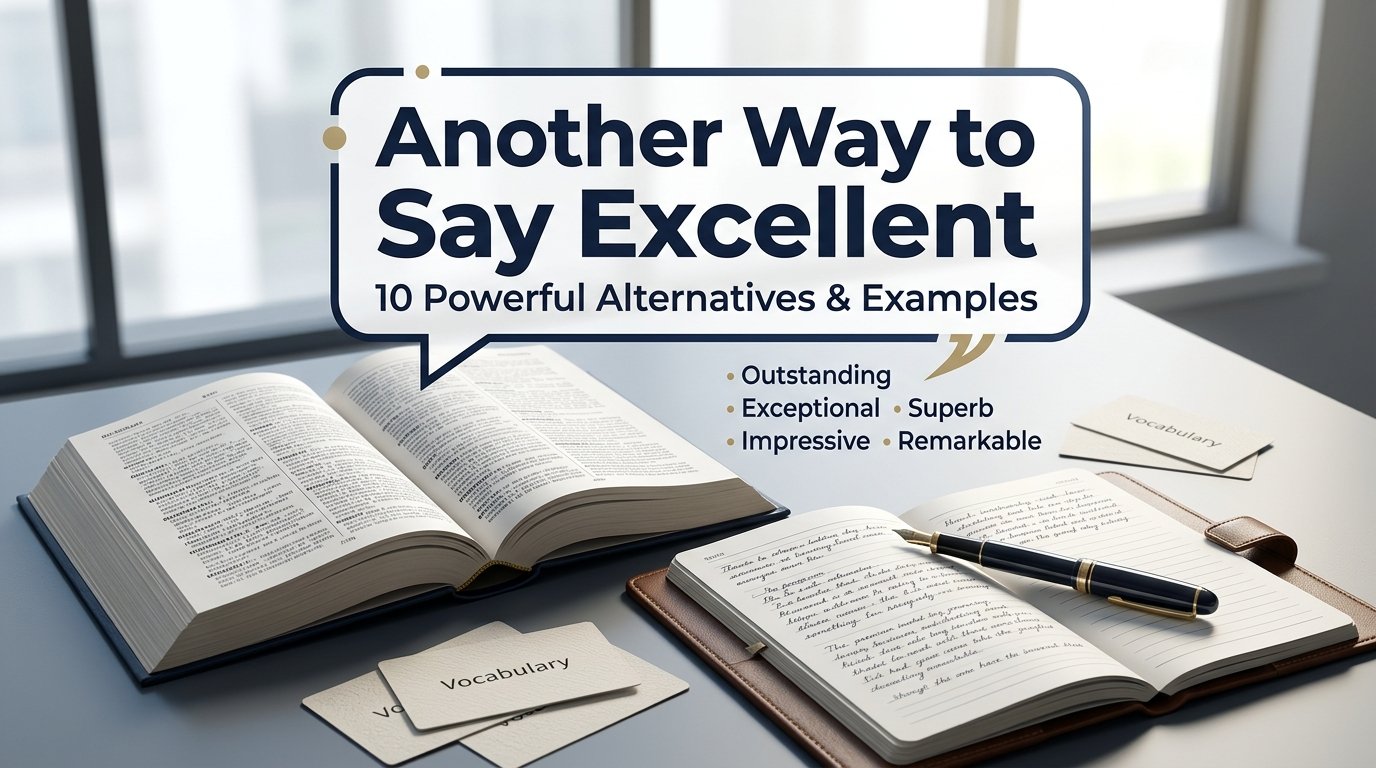
Finding another way to say excellent can make your writing more precise, natural, and engaging. Although “excellent” is a strong and useful adjective, repeating it too often can make descriptions feel predictable.
The right synonym can also change the feeling of a sentence. For example, “outstanding” highlights impressive performance, while “superb” focuses more on quality. Below are practical alternatives you can use in emails, reviews, conversations, school writing, and professional communication.
What Does “Another Way to Say Excellent” Mean?
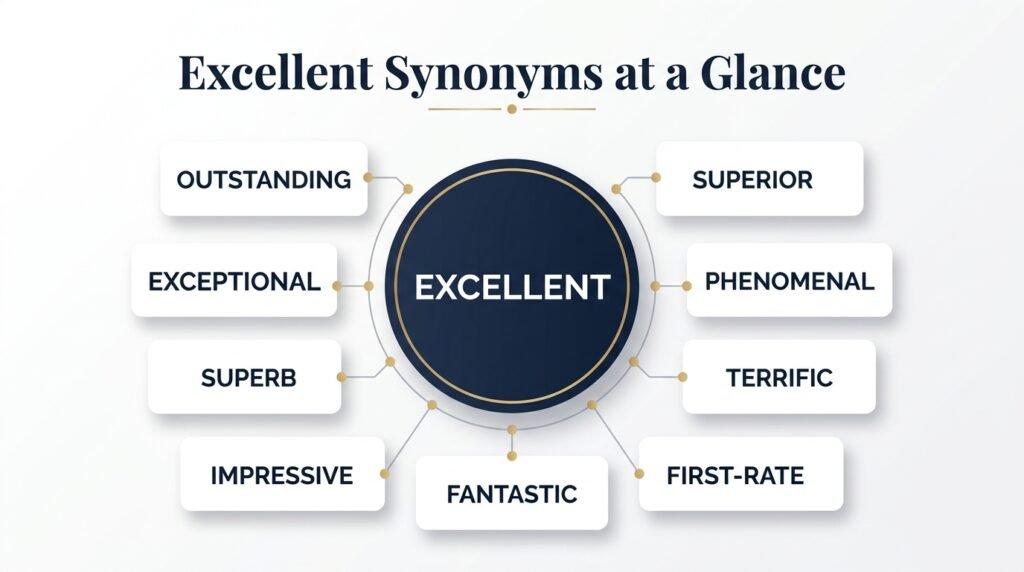
“Another way to say excellent” means looking for a different word or phrase that expresses the idea of something being exceptionally good, high-quality, impressive, or successful.
People often search for alternatives to “excellent” when they want to avoid repetition or make their language more specific. These alternatives are commonly used in professional reviews, academic writing, resumes, customer feedback, everyday conversations, and business communication.
Why Use Other Ways to Say “Excellent”?
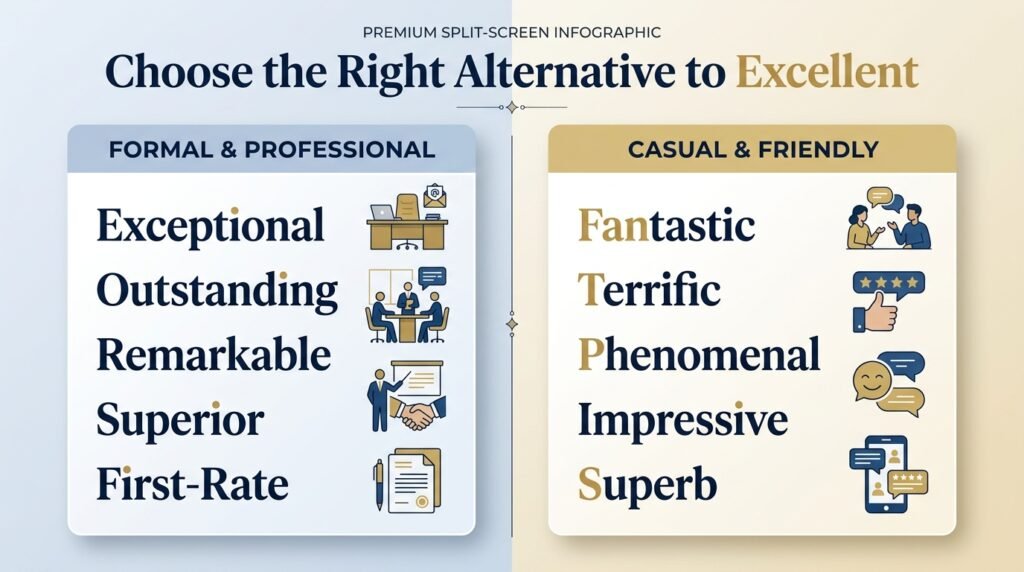
Using different words instead of “excellent” helps your writing sound more natural and precise. It also lets you match your word choice to the situation.
Here are some key benefits:
- Avoid repetition: Keep your writing from sounding predictable.
- Sound more natural: Choose words that fit the conversation.
- Match different situations: Some alternatives are formal, while others are casual.
- Improve professional communication: Stronger vocabulary can make praise more specific.
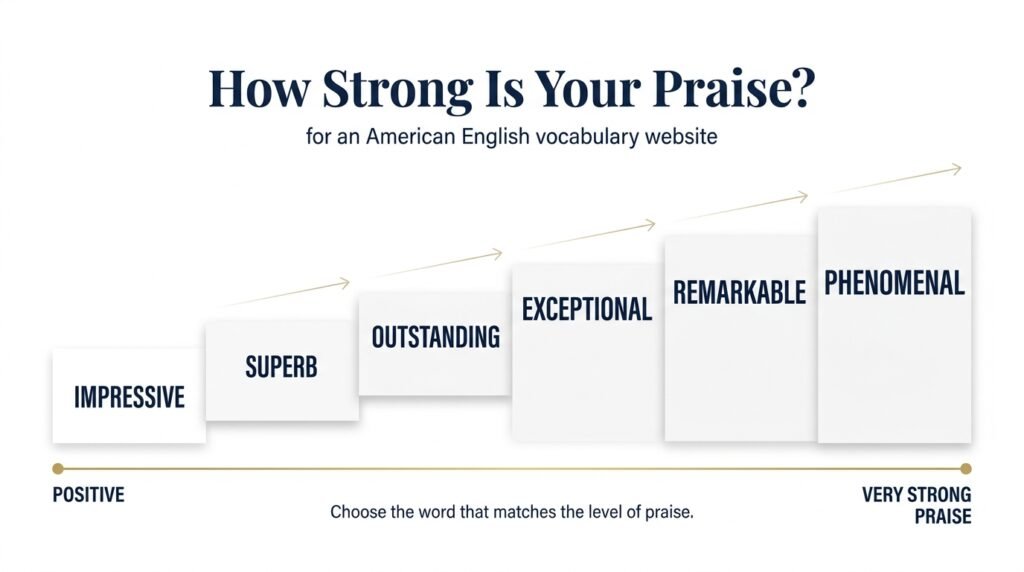
- Express the right level of enthusiasm: “Outstanding” and “phenomenal” carry different levels of emphasis.
10 Best Other Ways to Say “Excellent”
1. Outstanding
Meaning
“Outstanding” describes something that is noticeably better than average. It often suggests that a person, performance, product, or result stands out from others.
Best For
- Professional
- Formal
- Polite
Example 1
She delivered an outstanding presentation to the executive team.
Example 2
The restaurant received outstanding reviews for its service.
Quick Tip
Use “outstanding” when you want to give strong praise while keeping a professional tone.
2. Exceptional
Meaning
“Exceptional” means unusually good or far above the normal standard. It is especially useful when you want to suggest that something is rare or impressive.
Best For
- Professional
- Formal
- Polite
Example 1
His exceptional leadership helped the team finish the project early.
Example 2
The hotel provides exceptional service to its guests.
Quick Tip
Choose “exceptional” when “excellent” does not feel strong enough.
3. Superb
Meaning
“Superb” means extremely good or of very high quality. It is a polished alternative that works especially well when describing skills, work, food, service, or performance.
Best For
- Formal
- Professional
- Friendly
Example 1
The chef prepared a superb meal using fresh local ingredients.
Example 2
Her writing skills are superb and continue to improve.
Quick Tip
Use “superb” when you want to emphasize quality without sounding overly enthusiastic.
4. Impressive
Meaning
“Impressive” describes something that causes admiration because of its quality, size, skill, or results. It focuses on the effect something has on the observer.
Best For
- Professional
- Casual
- Friendly
Example 1
Your progress during the training program is impressive.
Example 2
The team achieved an impressive sales increase this quarter.
Quick Tip
“Impressive” is a flexible choice when you want to praise results or achievements.
5. Remarkable
Meaning
“Remarkable” describes something worthy of attention because it is unusually good, surprising, or memorable. It can add more emphasis than a basic compliment.
Best For
- Professional
- Formal
- Warm
Example 1
The researchers made remarkable progress during the study.
Example 2
She showed remarkable patience while helping the new employees.
Quick Tip
Use “remarkable” when the quality or achievement is especially noteworthy.
6. First-Rate
Meaning
“First-rate” means excellent in quality or performance. It has a confident, positive tone and is often used to describe services, products, skills, or experiences.
Best For
- Professional
- Casual
- Friendly
Example 1
We received first-rate customer service throughout our stay.
Example 2
He is a first-rate mechanic who takes pride in his work.
Quick Tip
“First-rate” is a great option when you want to praise quality in a straightforward way.
7. Fantastic
Meaning
“Fantastic” means extremely good, enjoyable, or exciting. It is common in everyday American English and usually sounds more enthusiastic than “excellent.”
Best For
- Casual
- Friendly
- Warm
Example 1
You did a fantastic job organizing the community event.
Example 2
We had a fantastic time at the concert last night.
Quick Tip
Use “fantastic” in friendly conversations, informal messages, and enthusiastic praise.
8. Terrific
Meaning
“Terrific” is a friendly way to say that something is very good or enjoyable. It sounds natural in everyday American conversations and positive workplace interactions.
Best For
- Casual
- Friendly
- Warm
Example 1
That is a terrific idea for the next team meeting.
Example 2
You did a terrific job explaining the new process.
Quick Tip
“Terrific” is a good choice when you want your praise to feel upbeat and approachable.
9. Phenomenal
Meaning
“Phenomenal” describes something exceptionally impressive or extraordinary. It is a strong word that communicates a high level of enthusiasm.
Best For
- Casual
- Friendly
- Warm
Example 1
The athlete had a phenomenal performance in the championship game.
Example 2
Your team has made phenomenal progress this year.
Quick Tip
Save “phenomenal” for achievements that genuinely deserve very strong praise.
10. Superior
Meaning
“Superior” means better in quality, performance, or value than something else. Unlike many alternatives, it often implies a comparison between two or more things.
Best For
- Professional
- Formal
Example 1
This material offers superior durability compared with standard options.
Example 2
The updated system provides superior performance under heavy workloads.
Quick Tip
Use “superior” when you are making a clear comparison, rather than simply giving general praise.
Comparison Table
| Alternative | Best Used In | Tone |
| Outstanding | Professional settings, reviews | Strong and professional |
| Exceptional | Business, academic, formal writing | Highly positive |
| Superb | Reviews, professional praise | Polished and positive |
| Impressive | Work, achievements, conversations | Positive and flexible |
| Remarkable | Achievements, formal writing | Strong and thoughtful |
| First-rate | Services, skills, products | Confident and positive |
| Fantastic | Everyday conversations | Enthusiastic and casual |
| Terrific | Friendly conversations, workplace praise | Warm and upbeat |
| Phenomenal | Major achievements, strong praise | Very enthusiastic |
| Superior | Comparisons, product descriptions | Formal and comparative |
Common Mistakes
1. Using casual phrases in professional emails
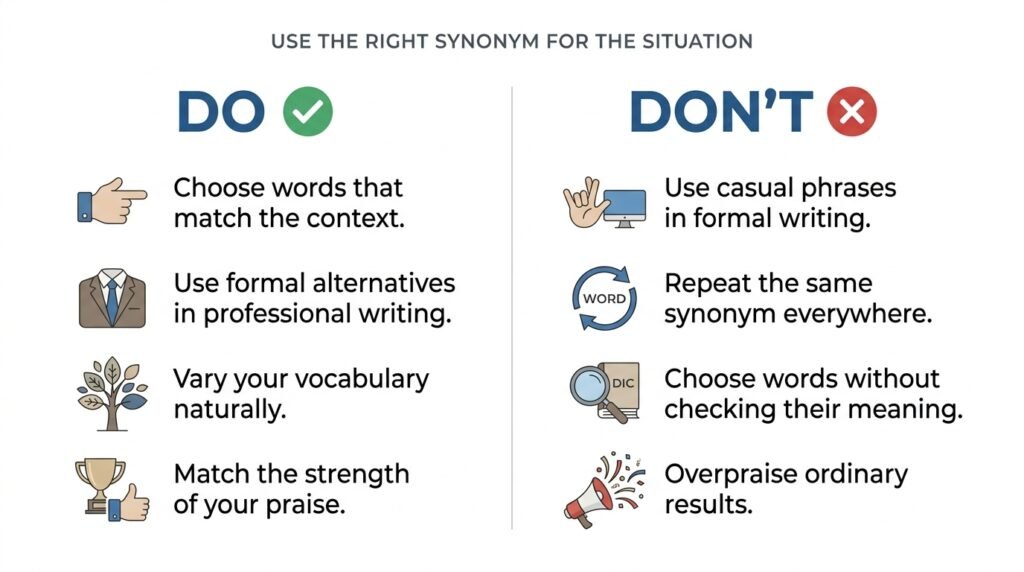
Words such as “fantastic” and “terrific” can work in friendly workplaces, but they may feel too casual in formal business communication. Choose “outstanding” or “exceptional” when you need a more polished tone.
2. Choosing overly formal language
Not every situation requires sophisticated vocabulary. Calling a friend’s dinner “exceptional” may sound stiff when “fantastic” or “amazing” would feel more natural.
3. Repeating the same alternative
Replacing “excellent” with “outstanding” in every sentence does not solve the repetition problem. Vary your vocabulary based on the exact meaning and context.
4. Forgetting context
Some words have specific uses. For example, “superior” usually suggests comparison, while “phenomenal” expresses very strong enthusiasm.
5. Sounding insincere
Strong praise can lose its impact when used for ordinary results. Match the strength of your word to the achievement so your compliment sounds genuine.
Frequently Asked Questions
What is a professional way to say excellent?
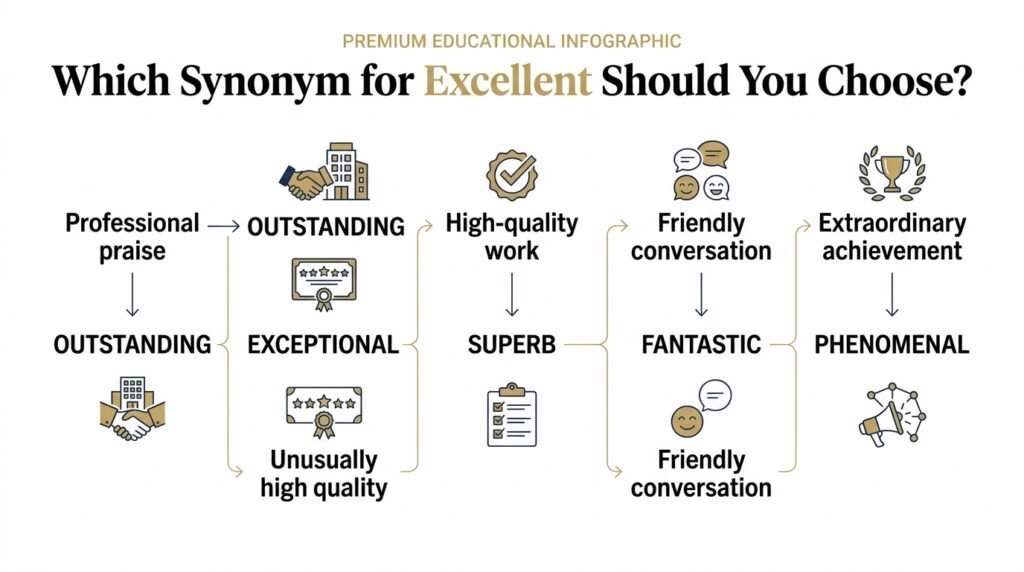
“Outstanding” and “exceptional” are two of the best professional alternatives to “excellent.” Both communicate strong praise without sounding overly casual. “Exceptional” can suggest that something is unusually good, while “outstanding” often emphasizes performance, results, or quality that stands above expectations.
What is a stronger word than excellent?
Words such as “exceptional,” “phenomenal,” and “extraordinary” can sound stronger than “excellent.” The best choice depends on context. “Exceptional” works well in professional writing, while “phenomenal” expresses greater enthusiasm and is more common in conversational or promotional language.
What is another word for excellent in a resume?
For a resume, consider words such as “outstanding,” “exceptional,” “high-performing,” or “superior,” depending on the sentence. However, specific achievements are usually more persuasive than general praise. Instead of simply saying you have “excellent communication skills,” describe a measurable result that demonstrates those skills.
What is a formal synonym for excellent?
“Exceptional,” “outstanding,” and “superb” can all work as formal synonyms for “excellent.” Among them, “exceptional” is especially useful when describing unusually strong performance, skills, service, or results in business, academic, or professional writing.
What is a casual way to say excellent?
“Fantastic,” “terrific,” and “amazing” are common casual alternatives to “excellent.” They sound natural in conversations, texts, social media posts, and friendly workplace messages. “Fantastic” is especially useful when you want to show enthusiasm about an experience, idea, result, or achievement.
Can “impressive” replace “excellent”?
Yes, “impressive” can replace “excellent” in many situations, but the meanings are not identical. “Excellent” focuses on very high quality, while “impressive” emphasizes the admiration or strong reaction something creates. For example, an achievement can be impressive because it is difficult, even if you are not judging its overall quality.
Is “superb” better than “excellent”?
Neither word is always better. “Superb” is a strong synonym that can sound polished and slightly more expressive, while “excellent” is more common and versatile. Choose “superb” when you want variety or want to place extra emphasis on quality.
What is the best synonym for excellent?
There is no single best synonym for every situation. “Outstanding” is an excellent all-purpose option for professional writing, “exceptional” works well for unusually high quality, and “fantastic” fits casual conversation. The strongest choice depends on your audience, purpose, and desired tone.
Conclusion
Knowing another way to say excellent gives you more control over your writing and helps you express praise with greater precision. Instead of using “excellent” repeatedly, choose a word that matches what you actually want to communicate.
For professional settings, outstanding, exceptional, and impressive are reliable choices. If you want to emphasize quality, superb and first-rate work well. For casual and enthusiastic conversations, fantastic, terrific, and phenomenal can sound more natural.
Remember that synonyms are not always interchangeable. Consider the audience, context, and strength of your compliment before choosing a replacement. The best word is the one that communicates your meaning clearly while sounding natural in the sentence. Choosing the right synonym can make your praise more precise and effective.

Professional Writing & Workplace Communication Expert
Marcus Hale is a business communication specialist with 11 years of experience in corporate training and professional writing. He has worked with mid-sized companies and remote teams to improve clarity in emails, reports, performance reviews, and client-facing messages.
Marcus focuses on polished, professional alternatives that help readers sound confident without sounding stiff. His guides cover workplace phrases, resume language, leadership communication, and formal-to-natural transitions. He holds a background in business administration and technical writing, and has led workshops on effective professional English.
At LandmarkNewz, Marcus creates practical synonym lists and phrasing tips that professionals can apply immediately in emails, meetings, and career documents.