
The phrase “another way to say fun facts” means looking for alternative words or phrases that describe interesting, entertaining, unusual, or lesser-known information.
People commonly use “fun facts” in articles, presentations, classroom activities, social media posts, quizzes, conversations, and marketing content. While the phrase is friendly and easy to understand, repeating it too often can make your writing feel predictable.
For example, instead of writing, “Here are some fun facts about space,” you could write, “Here are some fascinating facts about space” or “Here are some surprising things you may not know about space.”
Why Use Other Ways to Say “Fun Facts”?
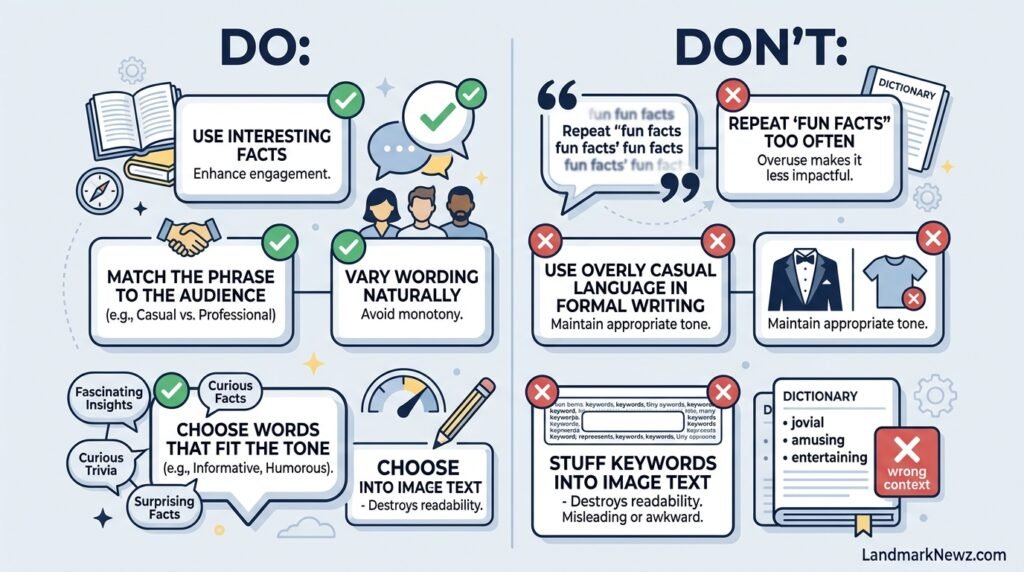
Using different expressions can make your writing more natural and engaging. The right alternative can also help you match the tone of your audience.
- Avoid repetition: Keep articles and presentations from sounding repetitive.
- Sound more natural: Choose wording that fits the surrounding sentence.
- Match different situations: Some phrases work better in classrooms, while others suit casual conversations.
- Improve professional communication: More polished terms can work better in business or educational content.
- Create curiosity: Words such as “surprising” and “little-known” can encourage readers to keep reading.
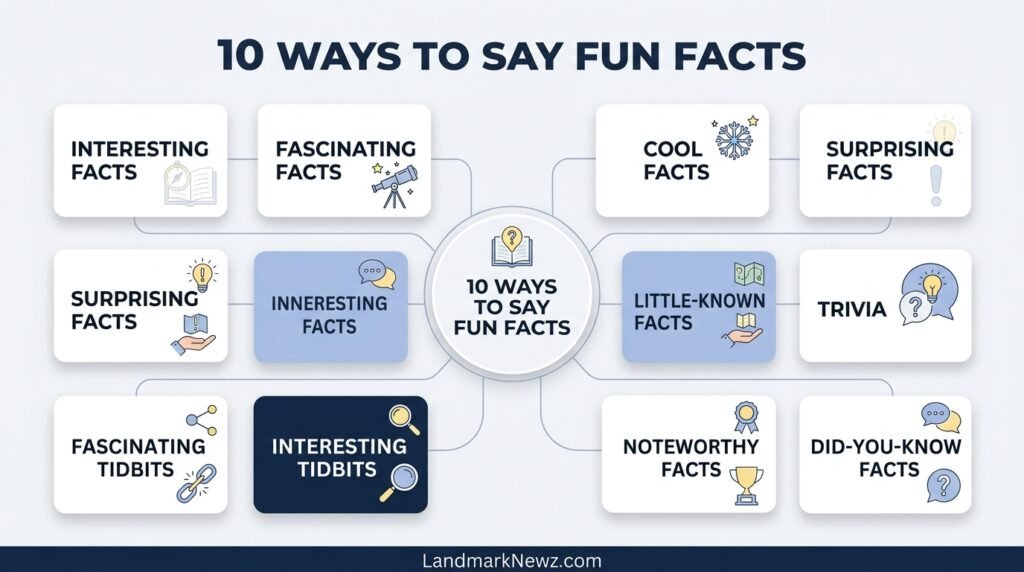
10 Best Other Ways to Say “Fun Facts”
1. Interesting Facts
Meaning
“Interesting facts” is the most versatile alternative to “fun facts.” It describes information that catches someone’s attention without making the tone overly casual or playful.
Best For
- Professional
- Formal
- Casual
- Educational
Example 1
The presentation includes several interesting facts about how cities have changed over time.
Example 2
I found some interesting facts about the history of the national park.
Quick Tip
Use “interesting facts” when you need a neutral phrase that works in almost any setting.
2. Fascinating Facts
Meaning
“Fascinating facts” suggests that the information is especially compelling or remarkable. It creates a stronger sense of curiosity than the simple word “interesting.”
Best For
- Friendly
- Educational
- Formal
- Casual
Example 1
The museum display shares fascinating facts about ancient Egyptian medicine.
Example 2
She opened the lecture with fascinating facts about the human brain.
Quick Tip
Choose this phrase when the information is likely to genuinely surprise or captivate your audience.
3. Cool Facts
Meaning
“Cool facts” is a relaxed and conversational alternative. It works particularly well when talking to friends, younger audiences, or people interested in entertainment and pop culture.
Best For
- Casual
- Friendly
Example 1
We learned some cool facts about how astronauts sleep in space.
Example 2
Check out these cool facts about classic video games.
Quick Tip
Avoid “cool facts” in highly formal reports because it can sound too informal.
4. Surprising Facts
Meaning
“Surprising facts” focuses on information that challenges expectations or reveals something people may not have predicted.
Best For
- Friendly
- Casual
- Educational
- Marketing
Example 1
Here are five surprising facts about the history of chocolate.
Example 2
The documentary revealed several surprising facts about ocean life.
Quick Tip
Use this phrase when the main appeal of the information is its unexpected nature.
5. Little-Known Facts
Meaning
“Little-known facts” highlights information that is not widely known. It is particularly useful when you want to create a sense of discovery.
Best For
- Professional
- Educational
- Friendly
- Formal
Example 1
The article explores little-known facts about the city’s early settlers.
Example 2
These little-known facts about famous inventions may change how you view them.
Quick Tip
Use this expression only when the information is genuinely not widely known; otherwise, it may overpromise.
6. Trivia
Meaning
“Trivia” refers to pieces of information that are interesting, obscure, or useful for entertainment, especially in quizzes and games.
Best For
- Casual
- Friendly
- Educational
Example 1
The team tested its knowledge with sports trivia.
Example 2
We spent the evening answering movie trivia questions.
Quick Tip
“Trivia” is especially natural when the information is presented as questions, games, or quiz material.
7. Fascinating Tidbits
Meaning
“Fascinating tidbits” describes small pieces of interesting information. The phrase has a warm, conversational feel and suggests that each fact is a small discovery.
Best For
- Casual
- Friendly
- Warm
Example 1
The guide shared fascinating tidbits about the neighborhood’s history.
Example 2
Her book is filled with fascinating tidbits about famous musicians.
Quick Tip
Use “tidbits” when discussing short pieces of information rather than detailed explanations.
8. Interesting Tidbits
Meaning
“Interesting tidbits” is a softer and more casual expression for small pieces of useful or entertaining information.
Best For
- Casual
- Friendly
- Warm
Example 1
The podcast offers interesting tidbits about everyday science.
Example 2
He added a few interesting tidbits to the company’s history page.
Quick Tip
This phrase works well when the information is brief and secondary to the main topic.
9. Noteworthy Facts
Meaning
“Noteworthy facts” emphasizes information that deserves attention because it is important, unusual, or particularly relevant.
Best For
- Professional
- Formal
- Educational
Example 1
The report highlights several noteworthy facts about consumer behavior.
Example 2
Students recorded the most noteworthy facts from the historical documentary.
Quick Tip
Choose this phrase when you want a more polished alternative to “fun facts.”
10. Did-You-Know Facts
Meaning
“Did-you-know facts” refers to information presented in a way that sparks curiosity. It often invites readers to learn something they may not have known before.
Best For
- Friendly
- Casual
- Educational
- Marketing
Example 1
Our newsletter includes did-you-know facts about local wildlife.
Example 2
The teacher used did-you-know facts to make the lesson more engaging.
Quick Tip
This format works especially well for social media, newsletters, quizzes, and educational content.
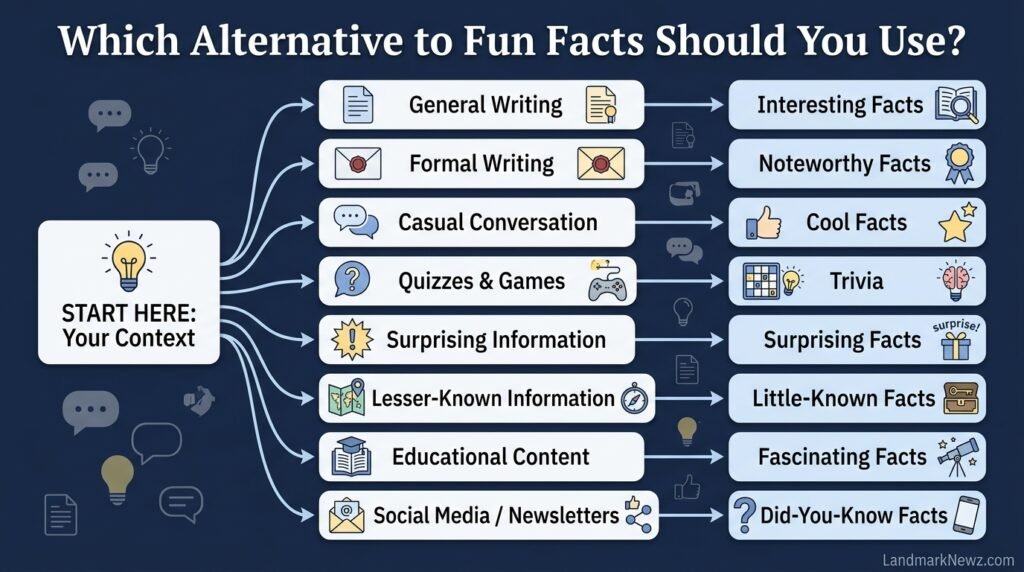
Comparison Table
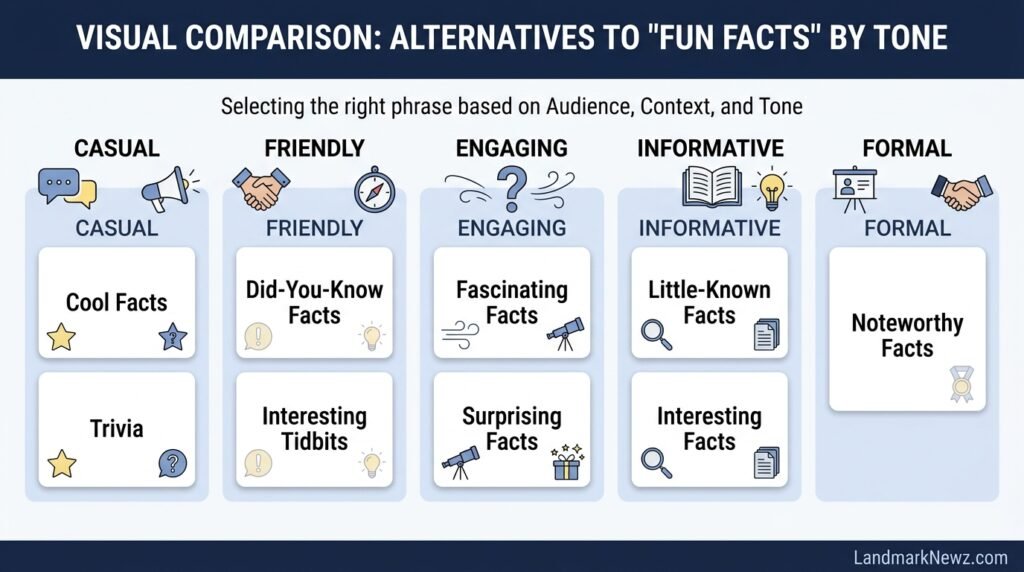
| Alternative | Best Used In | Tone |
| Interesting Facts | General writing, education, work | Neutral |
| Fascinating Facts | Articles, presentations, education | Engaging |
| Cool Facts | Social media, conversations | Casual |
| Surprising Facts | Articles, marketing, education | Curious |
| Little-Known Facts | Research, articles, education | Informative |
| Trivia | Quizzes, games, entertainment | Playful |
| Fascinating Tidbits | Stories, articles, conversations | Warm |
| Interesting Tidbits | Blogs, conversations | Casual |
| Noteworthy Facts | Reports, presentations, professional writing | Formal |
| Did-You-Know Facts | Social media, newsletters, classrooms | Friendly |
Common Mistakes
- Using casual phrases in professional writing
“Cool facts” can sound too relaxed in a formal report. “Noteworthy facts” or “interesting facts” may be a better fit. - Choosing an overly formal expression
Using “noteworthy facts” in a playful social media post may make the content feel stiff. - Repeating the same phrase
Using “fun facts” in every heading can make an article feel repetitive. Rotate suitable alternatives naturally. - Ignoring context
“Trivia” usually suggests games or quizzes, while “little-known facts” focuses on information that people may not know. - Making information sound more impressive than it is
Words such as “fascinating” and “surprising” create expectations. Make sure the facts actually support those descriptions.
Frequently Asked Questions
What is a professional way to say “fun facts”?
A professional way to say “fun facts” is “interesting facts,” “noteworthy facts,” or “key facts.” “Interesting facts” is the most flexible because it sounds natural without being too casual or formal. For business reports, presentations, and educational materials, “noteworthy facts” can provide a more polished tone.
What is another word for “fun facts”?
Several alternatives can replace “fun facts,” including interesting facts, fascinating facts, trivia, surprising facts, little-known facts, and interesting tidbits. The best option depends on the context. “Trivia” works well for games, while “little-known facts” is better when you want to emphasize information that readers may not already know.
Is “interesting facts” the same as “fun facts”?
“Interesting facts” and “fun facts” have nearly the same basic meaning, but their tone differs slightly. “Fun facts” sounds more playful and informal, while “interesting facts” is more neutral. Because of this, “interesting facts” can be used in a wider range of professional, academic, and casual situations.
What is a catchy way to say “fun facts”?
Catchy alternatives include “Did You Know?”, “Surprising Facts,” “Things You Didn’t Know,” and “Little-Known Facts.” These expressions can create curiosity and encourage people to continue reading. “Did You Know?” is especially effective for social media posts, newsletters, classroom materials, and short educational content.
Can I use “trivia” instead of “fun facts”?
Yes, but the context matters. “Trivia” usually refers to interesting or obscure information used for entertainment, games, quizzes, or casual discussion. If you’re simply introducing factual information in an article, “interesting facts” or “fascinating facts” may sound more natural than “trivia.”
What is a formal way to say “fun facts”?
“Noteworthy facts” is one of the most formal alternatives. Depending on the context, you can also use “interesting facts,” “relevant facts,” or “notable information.” The best choice depends on whether you want to emphasize entertainment, importance, relevance, or unusual details.
What can I say instead of “fun facts” in a presentation?
For a presentation, try “interesting facts,” “key facts,” “noteworthy facts,” “surprising facts,” or “Did You Know?” Choose the wording based on your audience. A business presentation may benefit from “noteworthy facts,” while a school presentation can use “interesting facts” or “Did You Know?” for a friendlier tone.
What is another way to introduce fun facts?
You can introduce them with phrases such as “Here’s something interesting,” “Did you know?”, “A surprising fact is,” “Here’s a little-known fact,” or “One interesting detail is.” These introductions sound more natural when you vary them throughout an article, presentation, or conversation.
Conclusion
There are many natural ways to say “fun facts,” and the best choice depends on your audience and purpose. For general writing, “interesting facts” is the safest and most flexible option. If you want stronger curiosity, try “fascinating facts” or “surprising facts.” For information that readers may not already know, “little-known facts” works especially well.
For casual conversations and games, “cool facts” and “trivia” are better choices. Meanwhile, professional content can benefit from “noteworthy facts.” The key is not simply finding a synonym but choosing a phrase that matches the tone and meaning you want. When you vary your wording thoughtfully, your content becomes clearer, more engaging, and less repetitive.

About Dr. Priya Nair
Dr. Priya Nair is a passionate Writer & Blogger at LandMarkNewz.com, dedicated to creating informative, engaging, and easy-to-understand content for readers. With a strong interest in research, current trends, lifestyle, and everyday topics, she focuses on presenting useful information in a clear and reader-friendly way.
Through her writing, Priya aims to help readers discover valuable insights, understand complex topics more easily, and stay informed about subjects that matter to them. Her approach combines thoughtful research with a simple and engaging writing style.
At LandMarkNewz.com, she contributes original articles designed to inform, educate, and provide practical value to readers.