
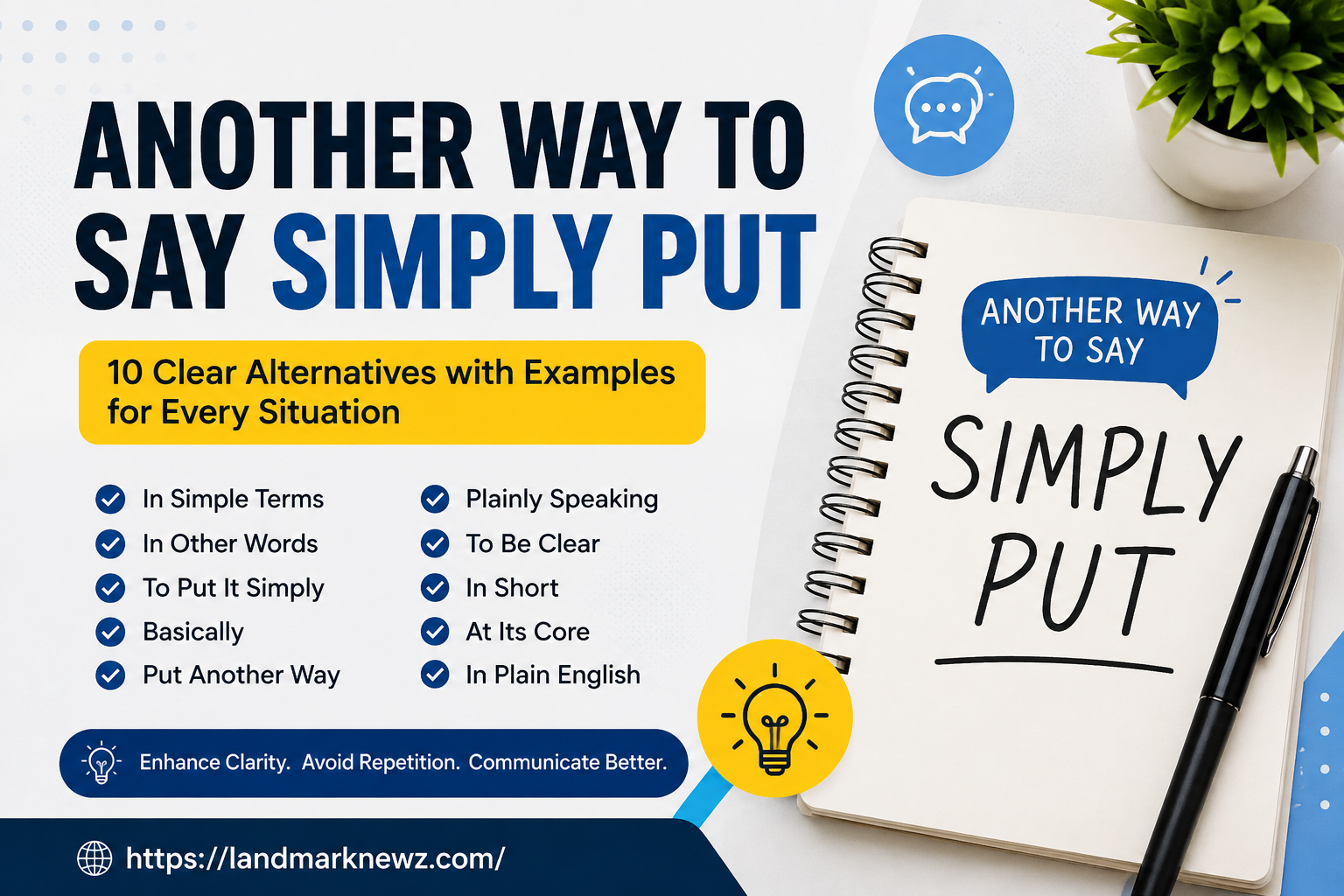
“Simply put” is a common English phrase used to make an explanation easier to understand. If you use it often, however, choosing another way to say “simply put” can make your writing more varied, natural, and appropriate for different situations.
Whether you are writing an email, explaining a complex topic, creating educational content, or having a casual conversation, the right alternative can make your message clearer.
What Does “Another Way to Say Simply Put” Mean?
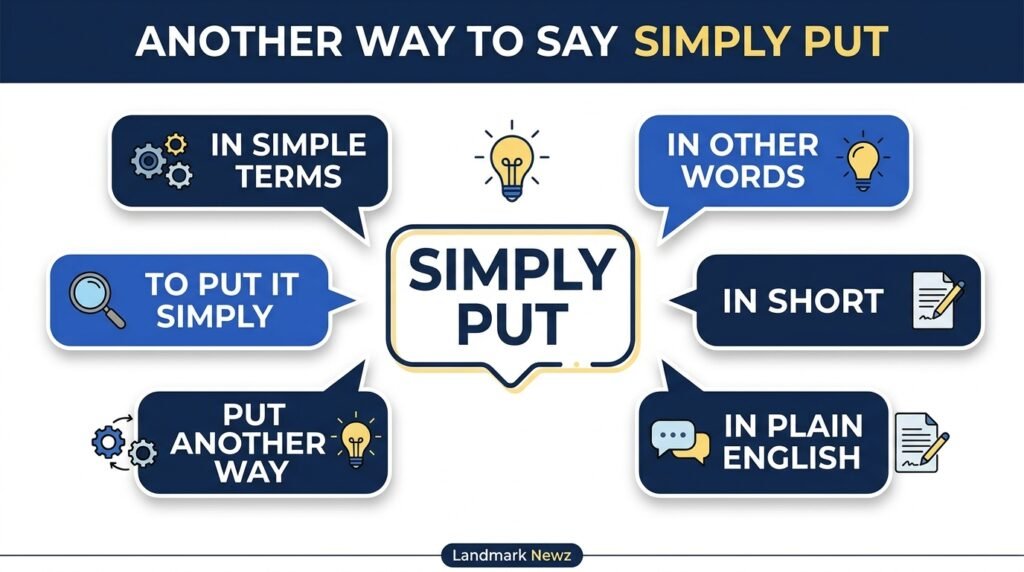
The phrase “another way to say simply put” refers to alternative expressions that communicate the same basic idea: explaining something clearly, directly, or in easier language.
For example, instead of saying, “Simply put, the project needs more time,” you could write, “In simple terms, the project needs more time.”
People commonly use “simply put” when they want to summarize a complicated idea, clarify a previous statement, or present the main point without unnecessary detail. It appears often in professional writing, educational content, presentations, articles, and everyday conversation.
Why Use Other Ways to Say “Simply Put”?
Using alternatives can help you avoid repetition while matching your language to the situation. Although “simply put” is clear and useful, it may not always be the best choice for every audience.
Other expressions can help you:
- Make complicated ideas easier to understand.
- Sound more natural and conversational.
- Create variety in articles and professional documents.
- Adjust your tone from casual to formal.
- Emphasize a summary or key point.
- Communicate clearly without sounding repetitive.
The key is to choose an expression based on what you want the reader or listener to understand.
10 Best Other Ways to Say “Simply Put”
1. In Simple Terms
Meaning
“In simple terms” tells the reader that you are about to explain an idea using easier or more accessible language. It is especially useful when the original subject involves technical, academic, or complicated information.
Best For
- Professional
- Formal
- Polite
- Educational
Example 1
In simple terms, the new policy gives employees more flexibility over their schedules.
Example 2
In simple terms, inflation means that prices are rising over time.
Quick Tip
Use “in simple terms” when your main goal is to make complex information easier to understand.
2. In Other Words
Meaning
“In other words” signals that you are restating something in a different way. It works particularly well when the second statement explains or clarifies the first one.
Best For
- Professional
- Formal
- Casual
- Friendly
Example 1
The deadline cannot be extended. In other words, we need to submit everything by Friday.
Example 2
She wants more independence. In other words, she prefers to handle the project herself.
Quick Tip
Choose this phrase when you are rephrasing an idea rather than simply summarizing it.
3. To Put It Simply
Meaning
“To put it simply” has almost the same meaning as “simply put.” It introduces a straightforward explanation and can make a complicated statement feel more accessible.
Best For
- Professional
- Casual
- Friendly
- Polite
Example 1
To put it simply, the company needs to reduce expenses before expanding.
Example 2
To put it simply, good communication prevents many workplace problems.
Quick Tip
Use this option when you want a close substitute that preserves the original meaning and tone.
4. Basically
Meaning
“Basically” presents the main idea without going into every detail. It is common in everyday American English and works well in conversations and informal writing.
Best For
- Casual
- Friendly
Example 1
Basically, we need more information before we can make a final decision.
Example 2
Basically, the app helps users organize all their appointments in one place.
Quick Tip
Avoid relying on “basically” too much in formal or highly polished writing because it can sound conversational.
5. Put Another Way
Meaning
“Put another way” introduces a different explanation of the same idea. It is useful when you want to make a statement clearer without suggesting that the original wording was incorrect.
Best For
- Professional
- Formal
- Polite
- Educational
Example 1
The results were below expectations. Put another way, the campaign did not attract enough customers.
Example 2
The contract limits outside work. Put another way, employees need approval before taking certain freelance jobs.
Quick Tip
Use this phrase when the second version provides a helpful interpretation of the first.
6. Plainly Speaking
Meaning
“Plainly speaking” emphasizes direct and uncomplicated communication. It can sound confident and straightforward, although it may feel slightly stronger than “in simple terms.”
Best For
- Formal
- Professional
- Polite
Example 1
Plainly speaking, the proposal is too expensive for our current budget.
Example 2
Plainly speaking, the evidence does not support that conclusion.
Quick Tip
Use it when you want to stress honesty and directness rather than just simplicity.
7. To Be Clear
Meaning
“To be clear” signals that you want to remove possible confusion or highlight exactly what you mean. It is particularly useful when correcting a misunderstanding or emphasizing an important point.
Best For
- Professional
- Formal
- Polite
Example 1
To be clear, the new schedule applies only to part-time employees.
Example 2
To be clear, we are asking for feedback, not final approval.
Quick Tip
Choose “to be clear” when accuracy or avoiding misunderstanding matters more than simplifying a complex idea.
8. In Short
Meaning
“In short” introduces a brief summary of the most important information. Unlike some alternatives, it focuses more on reducing information than explaining something in simpler language.
Best For
- Professional
- Formal
- Casual
- Polite
Example 1
In short, the team completed the work ahead of schedule and under budget.
Example 2
In short, the proposal offers greater value with fewer long-term costs.
Quick Tip
Use “in short” when you are summarizing several points rather than explaining one difficult concept.
9. At Its Core
Meaning
“At its core” identifies the central idea or most important part of a subject. It is useful when you want to strip away secondary details and focus on the underlying point.
Best For
- Professional
- Formal
- Educational
Example 1
At its core, the program is designed to help small businesses manage cash flow.
Example 2
At its core, the disagreement is about how the budget should be allocated.
Quick Tip
Use this phrase when you want to highlight the fundamental idea rather than simply make language easier.
10. In Plain English
Meaning
“In plain English” means that you are translating complicated, technical, or formal language into language that ordinary readers can easily understand. It is especially useful for explaining policies, legal concepts, technology, or business information.
Best For
- Professional
- Casual
- Friendly
- Polite
Example 1
In plain English, the agreement means you can cancel the service with 30 days’ notice.
Example 2
In plain English, the software stores your information so you can access it later.
Quick Tip
Use “in plain English” when your audience may not be familiar with specialized terminology.
Comparison Table
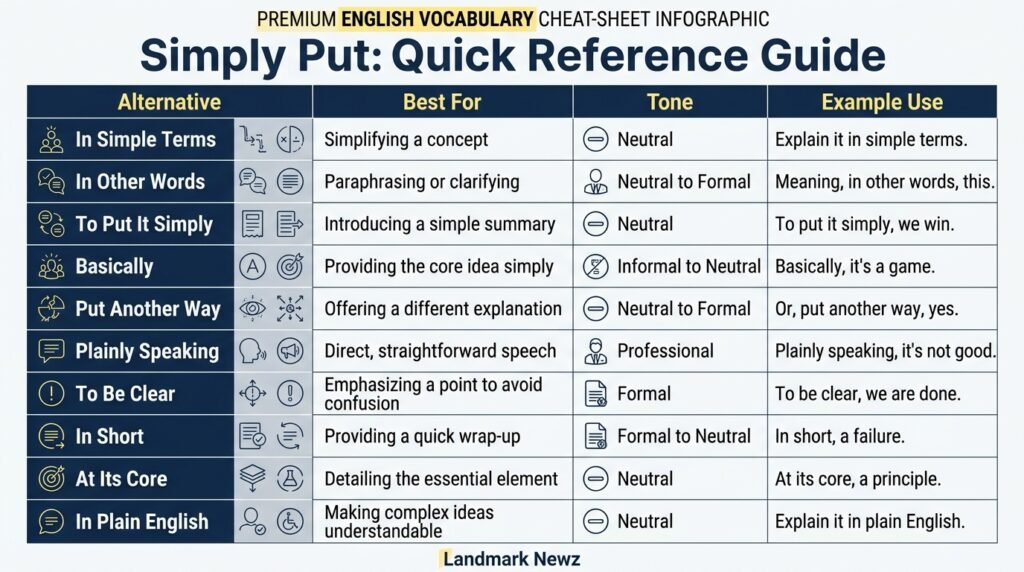
| Alternative | Best Used In | Tone |
| In simple terms | Professional, educational | Clear |
| In other words | Most situations | Neutral |
| To put it simply | Professional, casual | Clear and natural |
| Basically | Casual conversation | Informal |
| Put another way | Professional, formal | Neutral |
| Plainly speaking | Formal, professional | Direct |
| To be clear | Professional communication | Precise |
| In short | Summaries and conclusions | Concise |
| At its core | Analytical writing | Thoughtful |
| In plain English | Technical or complex topics | Accessible |
How to Choose the Right Alternative
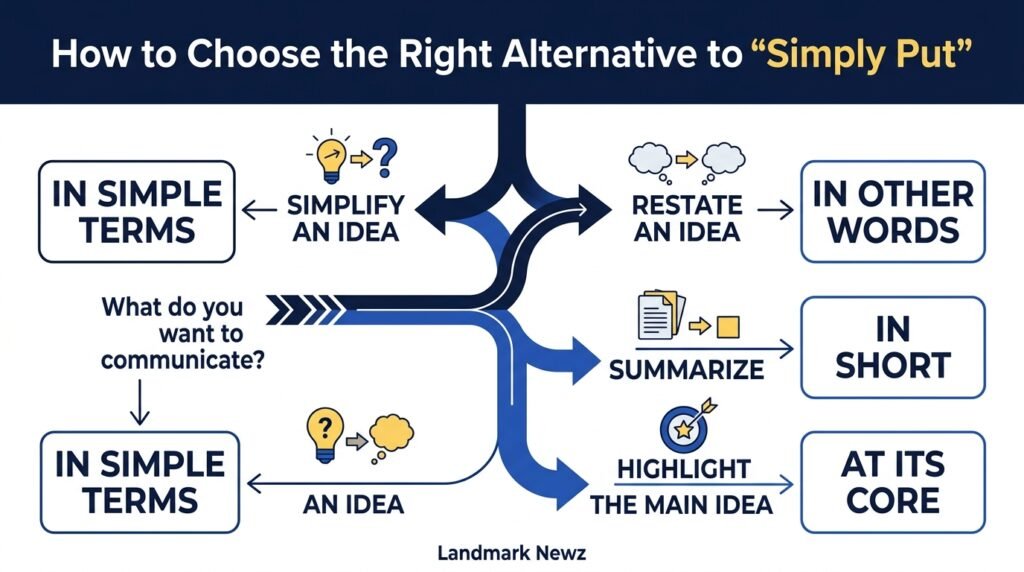
The best replacement depends on what you want the phrase to accomplish.
If you are explaining a difficult concept, “in simple terms” and “in plain English” are strong choices. If you are restating something, “in other words” or “put another way” sounds more natural.
For a short summary, use “in short.” When you want to emphasize the central idea, “at its core” works better. In casual conversation, “basically” can sound relaxed and natural.
For professional emails, reports, and presentations, avoid choosing an alternative simply because it sounds sophisticated. Clear language is usually more effective than unnecessarily formal wording.
Common Mistakes
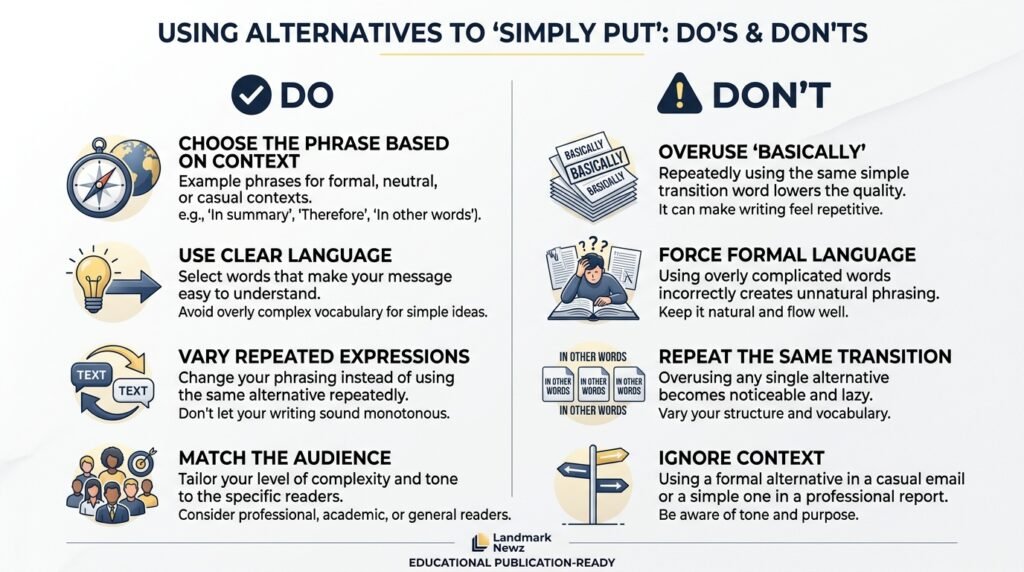
1. Using “Basically” in Formal Writing
“Basically” is common in conversation, but repeated use can make formal writing sound less polished. Consider “in simple terms” or “in short” instead.
2. Using Every Alternative the Same Way
These expressions overlap, but they are not identical. “In short” summarizes, while “in other words” restates and “at its core” highlights the central idea.
3. Ignoring the Audience
A technical audience may understand specialized terminology without extra explanation. A general audience may benefit from “in plain English” or “in simple terms.”
4. Overusing Transitional Phrases
Adding “simply put” or an alternative to every paragraph can become repetitive. Use these expressions only when the transition genuinely helps the reader.
5. Choosing a Phrase That Changes the Meaning
Be careful with context. “Plainly speaking” emphasizes directness, while “in short” emphasizes brevity. Select the phrase that matches your actual purpose.
Frequently Asked Questions
What is another way to say “simply put”?
Common alternatives include “in simple terms,” “in other words,” “to put it simply,” “basically,” “put another way,” and “in plain English.” The best choice depends on context. “In simple terms” is especially useful for professional or educational writing, while “basically” sounds more natural in casual conversation.
What is a professional way to say “simply put”?
“In simple terms,” “in other words,” and “put another way” are strong professional alternatives. They sound clear without being overly formal. For business emails, reports, and presentations, “in simple terms” is often the safest choice because it signals that you are making an explanation easier to understand.
Is “in other words” the same as “simply put”?
The phrases have similar functions, but they are not always identical. “Simply put” usually introduces a simplified version of an idea, while “in other words” more directly signals a restatement. Both can improve clarity, but “in other words” is often better when you are rephrasing a previous statement.
What is a casual way to say “simply put”?
“Basically” is one of the most natural casual alternatives. You can also use “to put it simply” in relaxed conversations. For example, instead of saying, “Simply put, we need more time,” you could say, “Basically, we need more time.”
What can I say instead of “simply put” in an essay?
For an essay, consider “in simple terms,” “put another way,” “in other words,” or “at its core.” The best option depends on the sentence. Academic writing should prioritize precision, so choose an expression that accurately describes whether you are simplifying, restating, summarizing, or identifying a central idea.
Is “in plain English” professional?
Yes. “In plain English” can be professional when you are explaining complicated information to a general audience. It is especially useful in business, technology, legal, financial, and public-facing content. However, it may be less appropriate if your audience already understands the technical terminology.
What is a formal synonym for “simply put”?
“Put another way,” “in simple terms,” and “plainly speaking” can work in formal contexts. “At its core” is another option when you are identifying the fundamental idea. The most appropriate phrase depends on whether you want to simplify, restate, summarize, or emphasize the main point.
How do I avoid repeating “simply put”?
First, identify why you are using the phrase. If you are simplifying an idea, use “in simple terms.” If you are restating it, use “in other words.” If you are summarizing, use “in short.” Varying the expression according to its purpose makes your writing sound more natural.
Conclusion
There are many useful alternatives to “simply put,” but the best choice depends on your message and audience. “In simple terms” works well when explaining a difficult idea, while “in other words” is ideal for restating information. “In short” is better for summaries, and “basically” fits casual conversation.
For professional and educational writing, prioritize clarity over complexity. A phrase should help readers understand your point, not distract them from it. Using clarity in writing can make your message easier to understand and more effective.
Before choosing an alternative, ask what you are trying to do: simplify, restate, summarize, clarify, or highlight the main idea. Once you identify that purpose, selecting the right expression becomes much easier. The simplest wording is often the strongest choice.

Language & Everyday Communication Specialist
Elena Voss is a language enthusiast and communication coach with over 9 years of experience helping people express themselves more naturally in English. She previously worked as an ESL instructor and corporate language trainer, guiding professionals and students on clearer everyday conversations, polite alternatives, and natural phrasing.
Elena specializes in practical synonym guides and “another way to say…” content that feels conversational rather than textbook. Her writing focuses on real-life situations — emails to friends, casual workplace chat, social media, and daily interactions. She believes the best language advice is simple, useful, and easy to remember.
When she’s not creating content for LandmarkNewz, Elena enjoys analyzing modern slang trends and testing new phrases in real conversations.