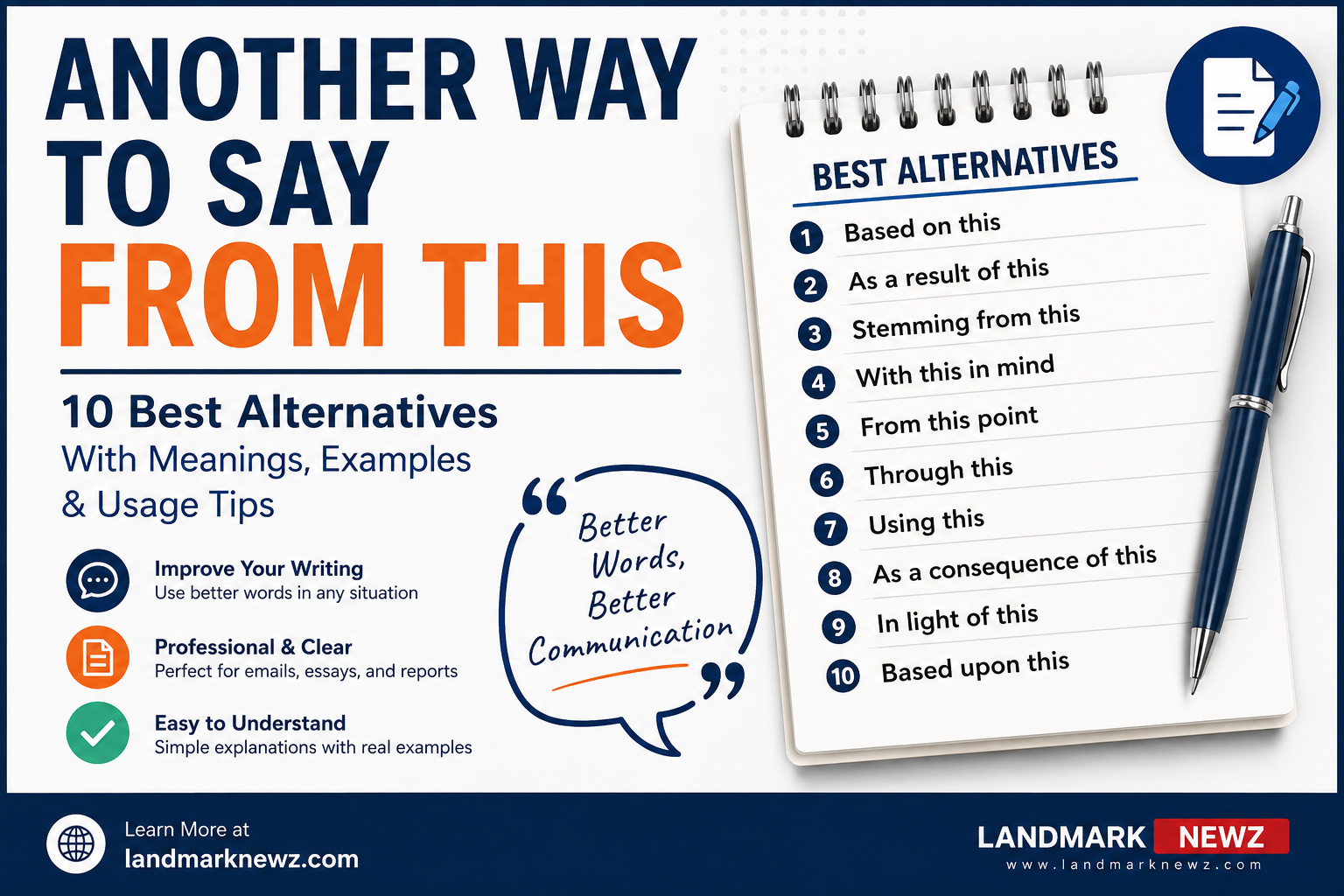
Finding another way to say “from this” can make your writing clearer, more precise, and less repetitive. Although “from this” is grammatically correct, its meaning can change depending on the sentence.
For example, “from this” may refer to a source, a cause, a result, an experience, or information that supports a conclusion. Choosing a more specific phrase helps readers understand exactly what you mean.
What Does “Another Way to Say From This” Mean?
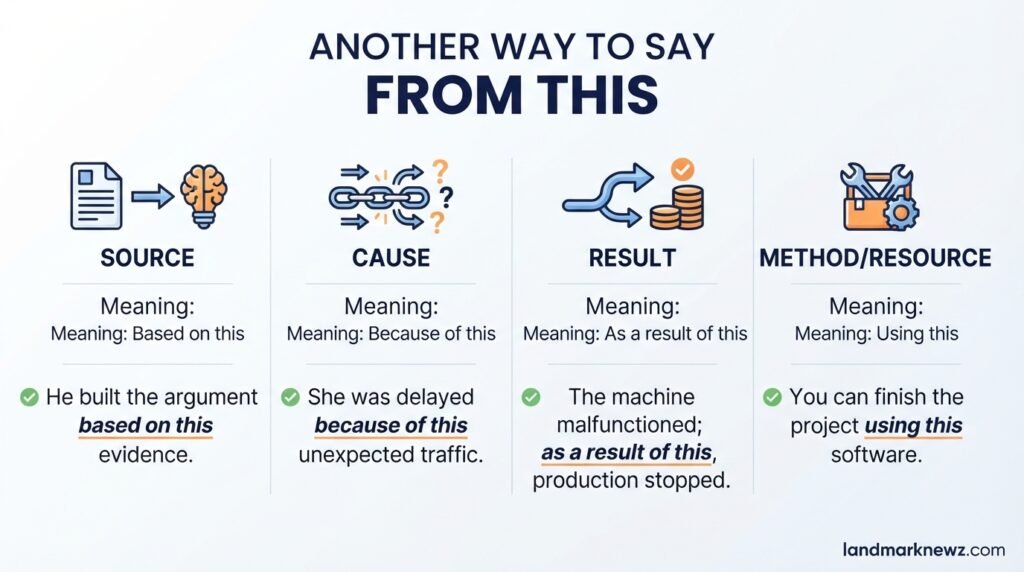
The phrase “another way to say from this” refers to alternative expressions that can replace “from this” without changing the intended meaning.
For instance, if you write, “From this information, we can conclude that the plan will work,” you could say, “Based on this information, we can conclude that the plan will work.”
People commonly search for alternatives to “from this” when writing emails, essays, reports, professional documents, or everyday messages. The right replacement depends on whether you are describing a source, reason, process, or outcome.
Why Use Other Ways to Say “From This”?
Using alternatives to “from this” can improve your writing in several ways:
- Avoid repetition: Prevent the same expression from appearing too often.
- Improve clarity: Show the exact relationship between two ideas.
- Sound more natural: Choose wording that fits the situation.
- Strengthen professional writing: Use precise language in reports and emails.
- Show cause and effect: Make connections between events easier to understand.
- Add variety: Give your sentences a smoother and more engaging style.
The key is not to replace “from this” automatically. Instead, select an alternative that accurately communicates your intended meaning.
10 Best Other Ways to Say “From This”
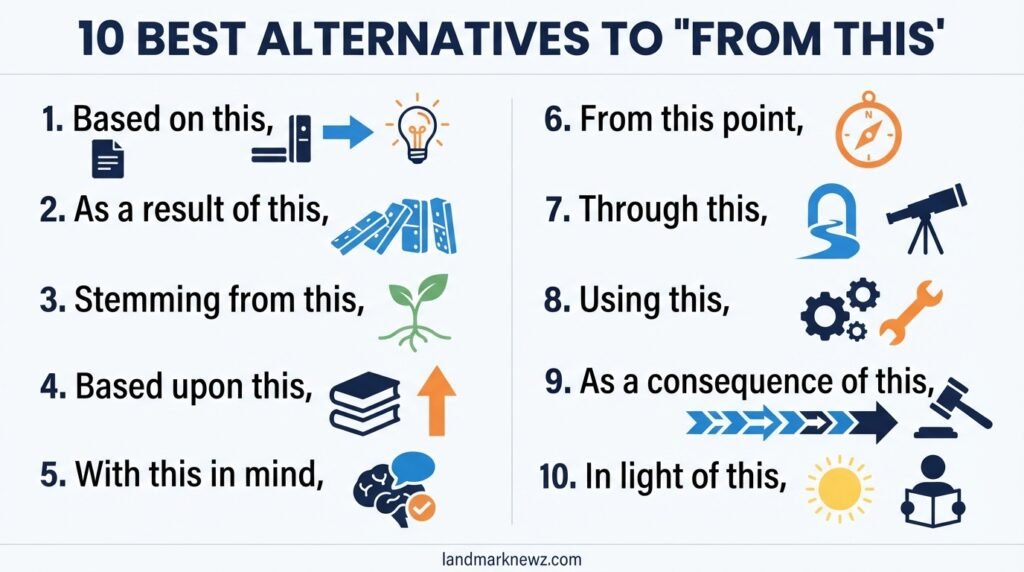
1. Based on This
Meaning
“Based on this” means that an idea, decision, opinion, or conclusion comes from the information currently being discussed. It is one of the most natural replacements for “from this” when referring to evidence or facts.
Best For
- Professional
- Formal
- Polite
Example 1
Based on this information, we recommend extending the project deadline.
Example 2
Based on this feedback, the team decided to revise the proposal.
Quick Tip
Use “based on this” when something is supported by information, evidence, observations, or feedback.
2. As a Result of This
Meaning
“As a result of this” highlights a direct consequence or outcome. It works best when one event or situation causes something else to happen.
Best For
- Professional
- Formal
Example 1
As a result of this delay, the shipment will arrive on Friday.
Example 2
As a result of this change, customers will have more payment options.
Quick Tip
Choose this phrase when you want to emphasize cause and effect rather than simply identify a source.
3. Stemming From This
Meaning
“Stemming from this” describes something that originates from a particular event, situation, or issue. It is especially useful when discussing problems, decisions, concerns, or developments.
Best For
- Professional
- Formal
Example 1
Several questions stemming from this announcement remain unanswered.
Example 2
The new procedures address concerns stemming from this incident.
Quick Tip
Use “stemming from this” when the idea or situation you are describing developed because of something previously mentioned.
4. Based Upon This
Meaning
“Based upon this” has essentially the same meaning as “based on this.” It indicates that a judgment, conclusion, or action relies on particular information.
Best For
- Formal
- Professional
Example 1
Based upon this analysis, the company should reconsider its pricing strategy.
Example 2
The committee made its recommendation based upon this year’s performance data.
Quick Tip
“Based on this” is generally more concise and conversational, while “based upon this” can sound slightly more formal.
5. With This in Mind
Meaning
“With this in mind” means that you are considering previously mentioned information when making a decision, suggestion, or observation. It creates a smooth connection between ideas.
Best For
- Professional
- Friendly
- Polite
Example 1
With this in mind, we should focus our efforts on improving customer support.
Example 2
With this in mind, please review the updated schedule before Friday.
Quick Tip
Use this expression when moving from an earlier point to a related recommendation, action, or conclusion.
6. From This Point
Meaning
“From this point” refers to a starting moment or stage from which something continues or changes. It is useful when discussing future actions or progress.
Best For
- Professional
- Formal
- Casual
Example 1
From this point, all requests should be submitted through the online portal.
Example 2
We can build a stronger strategy from this point forward.
Quick Tip
Use “from this point” when you are talking about a specific stage, moment, or transition.
7. Through This
Meaning
“Through this” suggests that something happens by means of an experience, process, action, or situation. It can also describe something learned or achieved as a result of an experience.
Best For
- Professional
- Formal
- Warm
Example 1
Through this experience, I learned how important clear communication can be.
Example 2
Through this process, the team identified several opportunities for improvement.
Quick Tip
Use “through this” when emphasizing the process or experience that leads to an outcome.
8. Using This
Meaning
“Using this” means employing something as a tool, resource, example, or method. It is a strong alternative when “from this” refers to something being used to accomplish a task.
Best For
- Professional
- Casual
- Friendly
Example 1
Using this report, we can identify the areas that need immediate attention.
Example 2
Using this template will help you organize your information more efficiently.
Quick Tip
Choose “using this” when the original phrase refers to an object, document, system, method, or resource.
9. As a Consequence of This
Meaning
“As a consequence of this” emphasizes that something happened because of a previous event or condition. It is more formal than simply saying “from this.”
Best For
- Formal
- Professional
Example 1
As a consequence of this policy change, employees must complete additional training.
Example 2
As a consequence of this decision, the project timeline was adjusted.
Quick Tip
Use this expression when you want to clearly emphasize an outcome, especially in formal writing.
10. In Light of This
Meaning
“In light of this” means considering new information, circumstances, or evidence. It is particularly useful when introducing a decision, response, or conclusion based on something recently discussed.
Best For
- Professional
- Formal
- Polite
Example 1
In light of this new information, we have decided to postpone the meeting.
Example 2
In light of this feedback, the manager revised the training program.
Quick Tip
Use “in light of this” when new evidence or circumstances have changed how you view or approach a situation.
Comparison Table
| Alternative | Best Used In | Tone |
| Based on this | Evidence and conclusions | Professional |
| As a result of this | Cause and effect | Formal |
| Stemming from this | Origins and consequences | Formal |
| Based upon this | Evidence and decisions | Formal |
| With this in mind | Recommendations | Professional |
| From this point | Starting points | Neutral |
| Through this | Experiences and processes | Warm |
| Using this | Tools and resources | Neutral |
| As a consequence of this | Outcomes | Formal |
| In light of this | New information | Professional |
Common Mistakes When Replacing “From This”
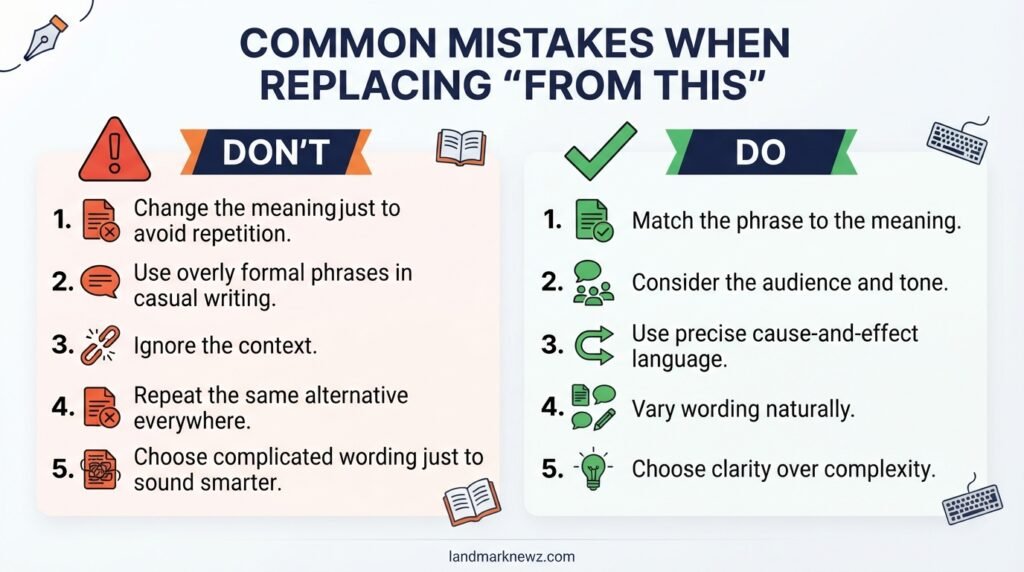
1. Choosing a Phrase That Changes the Meaning
Not every alternative has the same meaning. “Using this” suggests a method or resource, while “as a result of this” suggests a consequence.
2. Using Overly Formal Language
Expressions such as “as a consequence of this” may sound too formal in a casual conversation. For everyday writing, simpler choices like “because of this” or “based on this” may work better.
3. Ignoring Context
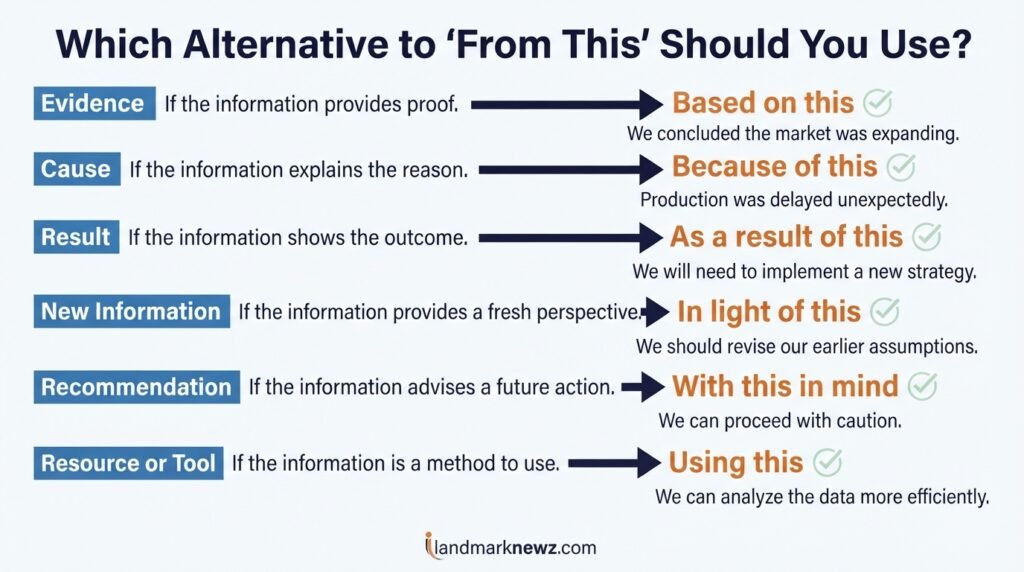
Always consider what “this” refers to. If it points to evidence, use “based on this.” If it identifies a cause, consider “because of this” or “as a result of this.”
4. Repeating the Same Alternative
Replacing every instance of “from this” with “based on this” can create another form of repetition. Vary your wording only when the meaning remains accurate.
5. Trying to Sound Too Sophisticated
Complex wording does not automatically make writing better. The strongest alternative is usually the one that communicates your meaning clearly and naturally.
Frequently Asked Questions
What is the best alternative to “from this”?
The best alternative depends on the sentence. “Based on this” is usually the strongest choice when referring to information or evidence. If you are describing a consequence, “as a result of this” is more accurate. For a recommendation based on new circumstances, “in light of this” works especially well.
Is “based on this” a good replacement for “from this”?
Yes. “Based on this” is a natural and widely used replacement when you are referring to information, evidence, observations, or feedback. For example, “From this information, we can decide” can become “Based on this information, we can decide.” The second version often sounds more precise.
How can I say “from this” professionally?
Professional alternatives include “based on this,” “in light of this,” “with this in mind,” and “as a result of this.” The best option depends on your intended meaning. “Based on this” works well for evidence, while “in light of this” is useful when new information affects a decision.
What is another way to say “from this information”?
Good alternatives include “based on this information,” “in light of this information,” and “using this information.” Choose “based on” when drawing a conclusion, “in light of” when responding to new information, and “using” when the information serves as a resource for completing a task.
What is another way to say “from this point”?
You can use “from this point forward,” “starting from here,” “going forward,” or “from this stage onward.” “Going forward” is particularly common in professional communication. For example, “From this point, all requests must be approved” could become “Going forward, all requests must be approved.”
Can I use “in light of this” instead of “from this”?
Yes, when the meaning involves considering information or circumstances. “In light of this” often introduces a decision, recommendation, or response. It does not work as a direct replacement when “from this” refers to a physical source, location, or starting point.
Is “stemming from this” formal?
Yes. “Stemming from this” has a professional and somewhat formal tone. It is especially useful for describing issues, developments, concerns, or consequences that originated from a previous event. It may sound unnecessarily formal in casual conversation, where “because of this” could be more natural.
How do I choose the right alternative to “from this”?
First, identify what “from this” means in your sentence. When it refers to evidence, “based on this” is usually the best choice. A consequence may be clearer with “as a result of this,” while “using this” works when the phrase describes a method. Matching the replacement to the intended meaning produces clearer and more precise writing.
Conclusion
There are many useful alternatives to “from this,” but the best choice depends on what you want the phrase to communicate. “Based on this” is ideal for evidence and conclusions, while “as a result of this” clearly shows cause and effect. For new information, “in light of this” is a polished professional option.
If you are referring to an experience or process, “through this” may sound more natural. When something serves as a tool or resource, “using this” is usually the clearest choice. Meanwhile, “with this in mind” works well when moving from information to a recommendation.
The most important rule is simple: choose the alternative that preserves your exact meaning rather than choosing the most formal-sounding phrase. For more guidance on connecting ideas clearly, see this resource on using transitions effectively.

Professional Writing & Workplace Communication Expert
Marcus Hale is a business communication specialist with 11 years of experience in corporate training and professional writing. He has worked with mid-sized companies and remote teams to improve clarity in emails, reports, performance reviews, and client-facing messages.
Marcus focuses on polished, professional alternatives that help readers sound confident without sounding stiff. His guides cover workplace phrases, resume language, leadership communication, and formal-to-natural transitions. He holds a background in business administration and technical writing, and has led workshops on effective professional English.
At LandmarkNewz, Marcus creates practical synonym lists and phrasing tips that professionals can apply immediately in emails, meetings, and career documents.