
Finding another way to say “not only but also” can make your writing smoother, more varied, and easier to read. The original construction is useful for emphasis, but repeating it too often can make your sentences feel predictable.
Fortunately, English offers several alternatives, including “both…and,” “as well as,” “in addition to,” “along with,” and “not merely…but also.” The right choice depends on whether you want your sentence to sound professional, formal, conversational, or strongly emphatic.
What Does “Another Way to Say Not Only But Also” Mean?

The phrase “another way to say not only but also” refers to alternative expressions that communicate the same general idea as “not only…but also.”
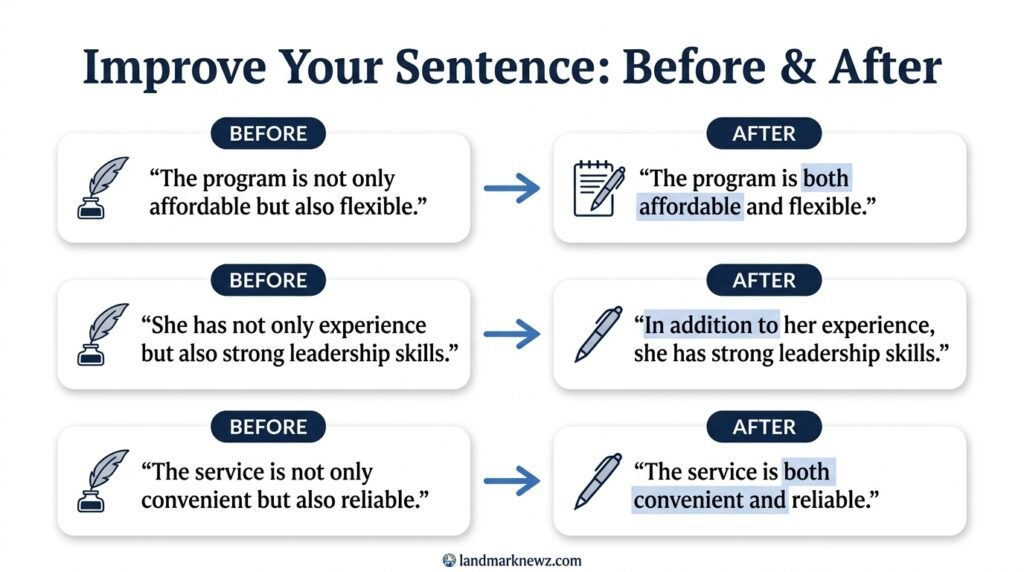
“Not only…but also” connects two things and often adds emphasis to the second one. For example: “The course is not only affordable but also flexible.”
People look for alternatives when they want to avoid repetition, simplify a sentence, or choose wording that better matches a particular context. These alternatives are common in professional emails, academic writing, resumes, essays, reports, and everyday conversations.
Why Use Other Ways to Say “Not Only But Also”?
Using different constructions can improve your writing without changing the core meaning.
- Avoid repetition: Prevent the same sentence pattern from appearing too often.
- Sound more natural: Some alternatives create a smoother conversational flow.
- Match the situation: Choose wording that fits formal, professional, or casual writing.
- Improve clarity: Simpler structures can make your point easier to understand.
- Add the right emphasis: Some alternatives highlight two ideas equally, while others emphasize addition.
10 Best Other Ways to Say “Not Only But Also”
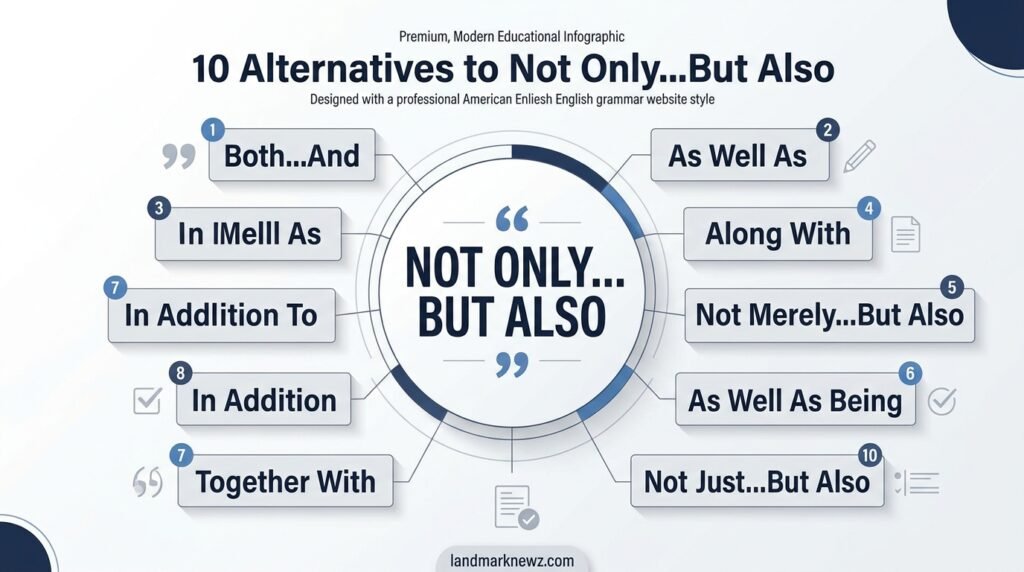
1. Both…and
Meaning
“Both…and” connects two things that are true or important at the same time. It is one of the simplest and most natural alternatives to “not only…but also.”
Best For
- Professional
- Casual
- Friendly
- Formal
Example 1
The new software is both affordable and easy to use.
Example 2
She is both an experienced manager and an excellent communicator.
Quick Tip
Use “both…and” when you want to give equal weight to two ideas without adding strong emphasis.
2. As well as
Meaning
“As well as” means that something is true or included in addition to another thing. It often sounds smoother and less emphatic than “not only…but also.”
Best For
- Professional
- Polite
- Formal
- Casual
Example 1
The position requires strong writing skills as well as attention to detail.
Example 2
The hotel offers free breakfast as well as high-speed Wi-Fi.
Quick Tip
Use “as well as” when the second idea is additional information rather than the main point of emphasis.
3. In addition to
Meaning
“In addition to” clearly introduces something extra. It is especially useful when you want a professional or formal alternative that makes the relationship between two ideas obvious.
Best For
- Professional
- Formal
- Polite
Example 1
In addition to managing the team, Carlos oversees the department budget.
Example 2
In addition to her degree, she has several years of industry experience.
Quick Tip
“In addition to” is particularly effective in business writing, reports, resumes, and academic work.
4. Along with
Meaning
“Along with” shows that one person, thing, or quality accompanies another. It provides a natural way to combine related information without the emphasis created by “not only…but also.”
Best For
- Professional
- Casual
- Friendly
- Polite
Example 1
The package includes installation along with a one-year warranty.
Example 2
Along with technical knowledge, the candidate brings strong leadership skills.
Quick Tip
Use “along with” when the two elements naturally belong together or occur together.
5. Not merely…but also
Meaning
“Not merely…but also” is a more formal variation of “not only…but also.” It emphasizes that something goes beyond the first quality, action, or result mentioned.
Best For
- Formal
- Professional
Example 1
The policy is not merely practical but also financially beneficial.
Example 2
Her research is not merely informative but also highly influential.
Quick Tip
Choose this construction for formal essays, reports, presentations, and polished professional writing.
6. As well as being
Meaning
“As well as being” is useful when both parts of your sentence describe a person, object, or situation. It can make descriptive sentences sound more fluid.
Best For
- Professional
- Formal
- Friendly
Example 1
As well as being a talented designer, Maya is an effective project manager.
Example 2
As well as being comfortable, the office is conveniently located.
Quick Tip
Use this form when the second idea describes the same subject rather than introducing a completely separate action.
7. Together with
Meaning
“Together with” indicates that two people, things, or factors are considered or involved at the same time. It works well in professional and formal contexts.
Best For
- Professional
- Formal
- Polite
Example 1
The proposal, together with the supporting documents, was submitted on Monday.
Example 2
Her experience, together with her training, makes her a strong candidate.
Quick Tip
“Together with” can sound more formal than “along with,” making it a good choice for reports and business documents.
8. In addition
Meaning
“In addition” introduces another point or fact that supports what you have already said. Unlike “not only…but also,” it can work particularly well across two separate sentences.
Best For
- Professional
- Formal
- Polite
Example 1
The service is affordable. In addition, customers can cancel at any time.
Example 2
The office is close to public transportation. In addition, it offers free parking.
Quick Tip
Use “in addition” when you want to separate two ideas into clear, easy-to-read sentences.
9. Besides
Meaning
“Besides” adds another fact, reason, or consideration. It is shorter and more conversational than many of the formal alternatives.
Best For
- Casual
- Friendly
- Polite
Example 1
Besides saving money, cooking at home can be a relaxing activity.
Example 2
Besides being reliable, the car is surprisingly comfortable.
Quick Tip
“Besides” is natural in everyday communication, but choose a more formal option for highly formal academic or business writing.
10. Not just…but also
Meaning
“Not just…but also” has almost the same structure and meaning as “not only…but also.” It sounds slightly more conversational while still providing emphasis.
Best For
- Casual
- Friendly
- Professional
Example 1
The workshop is not just informative but also highly practical.
Example 2
He is not just a skilled programmer but also a thoughtful team leader.
Quick Tip
Use “not just…but also” when you want to preserve the original emphasis while making the sentence sound a little more conversational.
Comparison Table
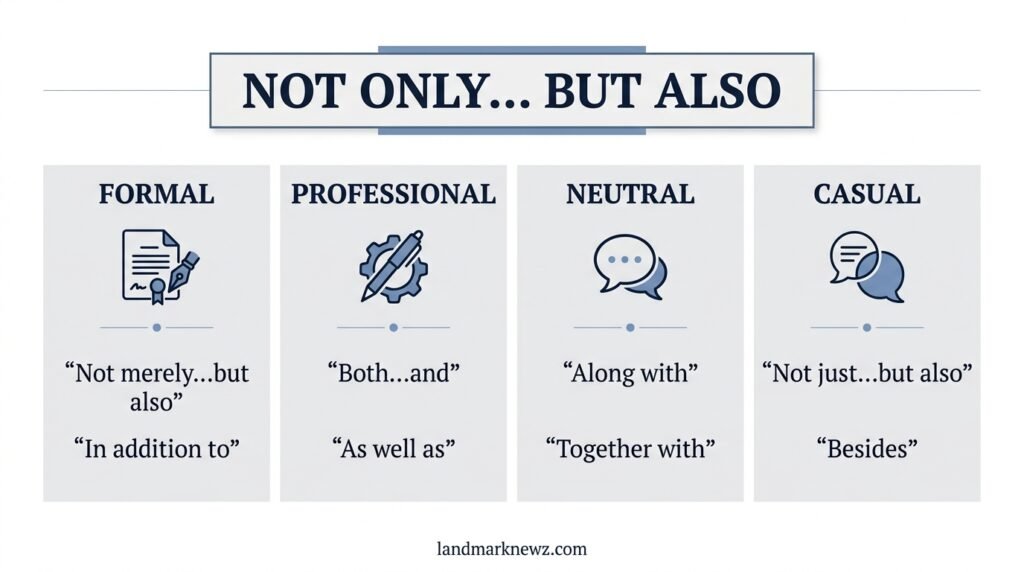
| Alternative | Best Used In | Tone |
| Both…and | Everyday and professional writing | Clear, balanced |
| As well as | Emails and general writing | Natural, polished |
| In addition to | Reports and business writing | Professional, formal |
| Along with | General and professional writing | Natural, neutral |
| Not merely…but also | Academic and formal writing | Formal, emphatic |
| As well as being | Descriptive writing | Smooth, polished |
| Together with | Reports and formal documents | Formal, professional |
| In addition | Essays, emails, reports | Professional, clear |
| Besides | Conversations and casual writing | Friendly, conversational |
| Not just…but also | Everyday and professional writing | Conversational, emphatic |
Common Mistakes
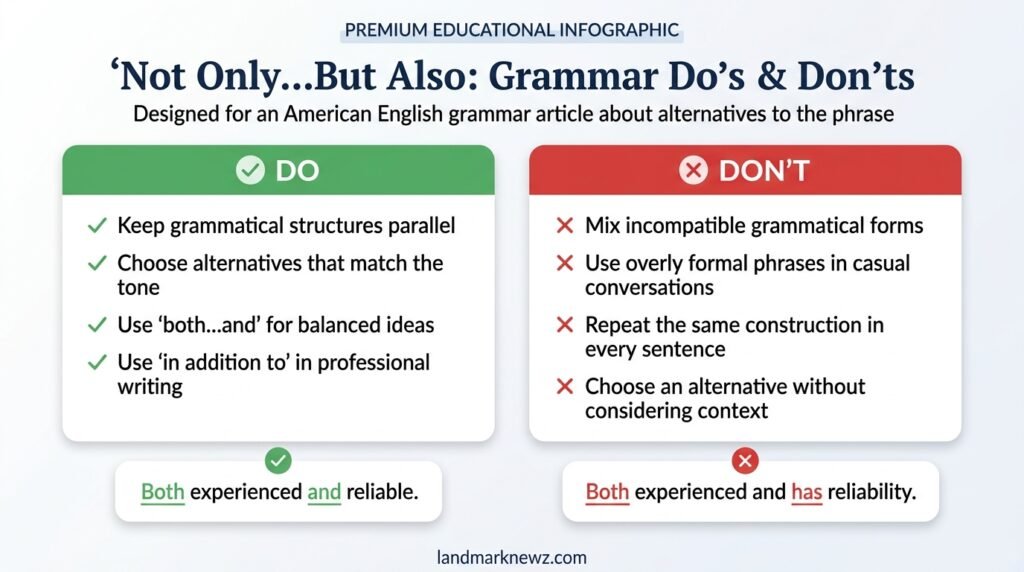
- Using casual phrases in formal writing
“Besides” may sound too conversational in a highly formal report. In those situations, “in addition to” may be a better fit. - Forgetting parallel structure
The two elements connected by “both…and” or “not only…but also” should normally have matching grammatical forms. For example, write “She enjoys reading and writing,” not “She enjoys reading and to write.” - Using overly formal language
“Not merely…but also” can sound unnecessarily formal in a casual conversation. Match the construction to your audience. - Repeating the same structure
Even a grammatically correct phrase can become monotonous if it appears repeatedly. Vary your sentence structures when several consecutive sentences make similar comparisons. - Ignoring context
These alternatives are not always perfectly interchangeable. “In addition” can introduce a separate sentence, while “both…and” normally connects two elements within the same grammatical structure.
Frequently Asked Questions
What is the best alternative to “not only but also”?
The best alternative depends on your sentence. “Both…and” is usually the clearest choice when two ideas have equal importance. “As well as” creates a smoother, less emphatic tone, while “not merely…but also” works well when you want a formal and strongly emphasized construction.
What is a professional way to say “not only but also”?
For professional writing, consider “in addition to,” “as well as,” “along with,” or “both…and.” For example, instead of “She is not only experienced but also reliable,” you could write, “She is both experienced and reliable.” The best option depends on the sentence structure and the level of emphasis you need.
Can I use “both and” instead of “not only but also”?
Yes. “Both…and” can replace “not only…but also” when you want to present two equally important ideas. For example, “The candidate is both qualified and dependable” communicates the same basic relationship as “The candidate is not only qualified but also dependable.”
Is “as well as” the same as “not only but also”?
They can communicate a similar idea, but they do not always create the same emphasis. “Not only…but also” highlights the addition of the second point, while “as well as” usually presents the second point more naturally and with less emphasis.
What is a formal alternative to “not only but also”?
“Not merely…but also” is a strong formal alternative. “In addition to” is another excellent choice for professional and academic writing. For example, “The study is not merely informative but also practical” gives the sentence a formal and emphatic tone.
What can I use instead of “not only…but also” in an essay?
For an essay, you can use “both…and,” “in addition to,” “as well as,” or “not merely…but also.” Choose based on the relationship between your ideas. “Both…and” is simple and direct, while “not merely…but also” creates stronger emphasis.
How do I avoid repeating “not only…but also”?
Change the sentence structure instead of replacing every occurrence with another fixed phrase. You can use “both…and,” “as well as,” “in addition to,” or even divide the information into two sentences with “in addition.” This creates more natural variety without forcing unnecessary synonyms.
Which alternative sounds most natural in everyday English?
“Both…and” and “as well as” are among the most natural choices. “Not just…but also” is also common when you want emphasis. For example, “The restaurant is not just affordable but also excellent” sounds natural in everyday American English.
Conclusion
There are many useful ways to say “not only…but also,” but the best choice depends on your sentence, audience, and desired tone. For simple and balanced writing, “both…and” is often the strongest option. “As well as” and “along with” provide smooth alternatives, while “in addition to” works especially well in professional and academic writing.
If you want stronger emphasis, “not merely…but also” is a polished formal choice, while “not just…but also” sounds more conversational. Most importantly, pay attention to grammar and parallel structure when connecting two ideas.
Choose the construction that sounds natural in context rather than replacing every occurrence mechanically. A good alternative should make your writing clearer, smoother, and more purposeful—not simply different.

About Dr. Priya Nair
Dr. Priya Nair is a passionate Writer & Blogger at LandMarkNewz.com, dedicated to creating informative, engaging, and easy-to-understand content for readers. With a strong interest in research, current trends, lifestyle, and everyday topics, she focuses on presenting useful information in a clear and reader-friendly way.
Through her writing, Priya aims to help readers discover valuable insights, understand complex topics more easily, and stay informed about subjects that matter to them. Her approach combines thoughtful research with a simple and engaging writing style.
At LandMarkNewz.com, she contributes original articles designed to inform, educate, and provide practical value to readers.