When you need to tell someone that they should cover the cost of their own food, “pay for your own meal” is clear and direct. However, it can sometimes sound blunt, especially when discussing money with friends, coworkers, guests, or people you do not know well.
Fortunately, English offers several alternatives that can make the message sound more natural. You might want to say “pay your share,” “cover your meal,” “pay separately,” or “take care of your own bill,” depending on the situation.
What Does “Another Way to Say Pay for Your Own Meal” Mean?
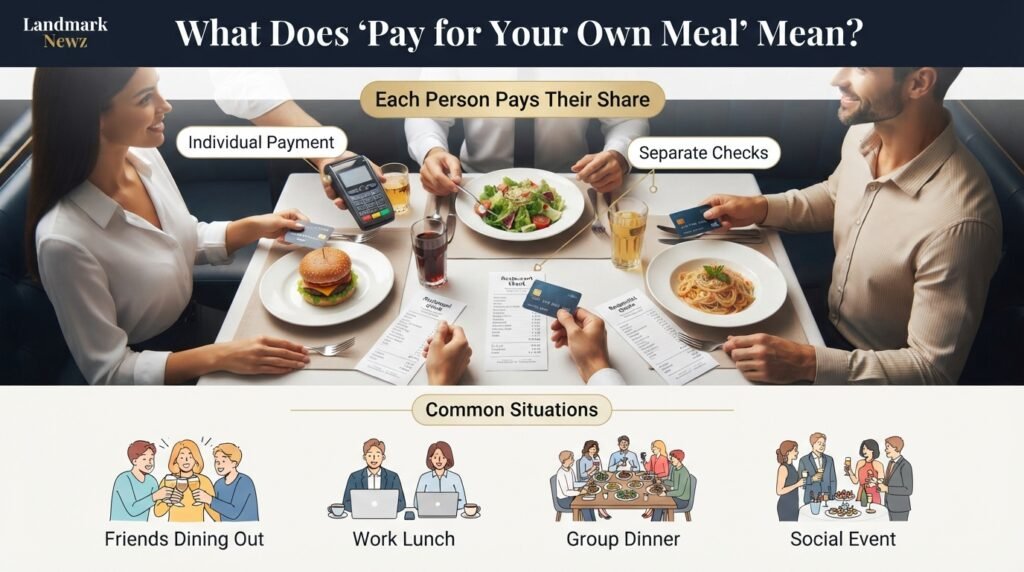
“Pay for your own meal” means that each person is responsible for paying the cost of the food and drinks they ordered rather than having one person pay for everyone.
The phrase commonly appears when friends are dining together, coworkers are ordering food, or a group wants to split a restaurant bill. It can also describe a self-pay arrangement, where everyone handles their individual expenses.
For example, if four friends eat dinner together and each person pays for what they ordered, you could say, “We’re going to pay for our own meals.”
The wording is easy to understand, but alternatives can help you communicate the same idea with a friendlier or more professional tone.
Why Use Other Ways to Say “Pay for Your Own Meal”?
Using different expressions gives you more control over your tone. Talking about money can feel sensitive, so the right wording can make your message sound clear without seeming rude.
Other expressions can help you:
- Avoid sounding too direct or demanding.
- Make a group payment arrangement clear.
- Sound more polite in social situations.
- Communicate naturally with friends or coworkers.
- Choose wording that fits casual or formal settings.
- Explain a separate-check arrangement without confusion.
The key is to choose an expression that matches the situation rather than simply replacing every use of the original phrase.
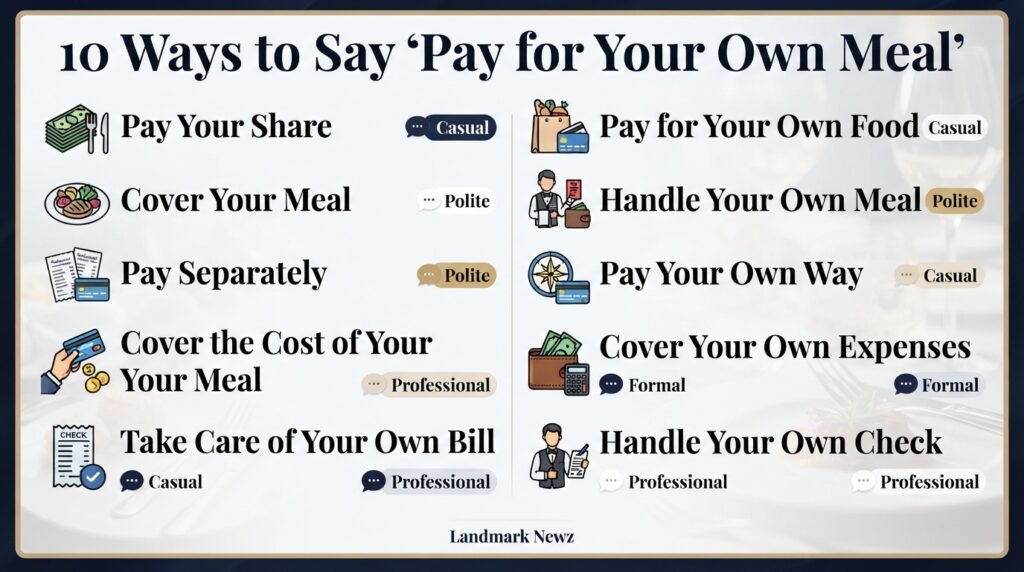
10 Best Other Ways to Say “Pay for Your Own Meal”
1. Pay Your Share
Meaning
“Pay your share” means that each person contributes the appropriate amount toward a shared expense. It is especially useful when a group is splitting a restaurant bill.
Best For
- Casual
- Friendly
- Polite
Example 1
“Everyone can pay their share when the check comes.”
Example 2
“We ordered different meals, so we’ll each pay our share.”
Quick Tip
Use this phrase when the expense is shared, especially if everyone is expected to contribute fairly.
2. Cover Your Meal
Meaning
“Cover your meal” means to pay the cost of the food you personally ordered. It sounds natural and slightly softer than directly saying “pay for your own meal.”
Best For
- Casual
- Friendly
- Polite
Example 1
“Don’t worry about treating me; I’ll cover my meal.”
Example 2
“We can all cover our meals and meet up afterward.”
Quick Tip
This is a good choice when speaking with friends or acquaintances in a relaxed setting.
3. Pay Separately
Meaning
“Pay separately” usually means that each person receives an individual check or pays for their own portion of the restaurant bill. It is concise and very common in American English.
Best For
- Casual
- Professional
- Polite
Example 1
“Let’s ask the server if we can pay separately.”
Example 2
“We’re all paying separately tonight, so there’s no need to split the check evenly.”
Quick Tip
Use this expression when talking about the payment process rather than emphasizing personal responsibility.
4. Cover the Cost of Your Meal
Meaning
“Cover the cost of your meal” is a polished way to explain that someone is responsible for paying for their own food. It works particularly well when you want to sound courteous and clear.
Best For
- Professional
- Formal
- Polite
Example 1
“Each attendee will need to cover the cost of their meal.”
Example 2
“Guests are welcome to join us, but they will cover the cost of their meals.”
Quick Tip
Choose this option for invitations, event information, or other situations where you want a professional tone.
5. Take Care of Your Own Bill
Meaning
“Take care of your own bill” means that each person handles their individual restaurant charges. The phrase can sound conversational while still being straightforward.
Best For
- Casual
- Friendly
- Polite
Example 1
“We’ll each take care of our own bill tonight.”
Example 2
“Since everyone ordered something different, we can take care of our own bills.”
Quick Tip
This works best when people already understand that the group is not sharing one combined expense.
6. Pay for Your Own Food
Meaning
“Pay for your own food” is a simple alternative that replaces “meal” with “food.” It has almost the same meaning and is easy for anyone to understand.
Best For
- Casual
- Friendly
- Direct
Example 1
“Everyone can pay for their own food at the counter.”
Example 2
“We’re keeping things simple, so everyone will pay for their own food.”
Quick Tip
Use this phrase when you want maximum clarity and do not need a particularly formal tone.
7. Handle Your Own Meal
Meaning
“Handle your own meal” suggests that each person is responsible for paying for their food. It can also imply responsibility for ordering or managing the meal, so context matters.
Best For
- Casual
- Professional
- Direct
Example 1
“Everyone will handle their own meal expenses.”
Example 2
“For this lunch, employees will handle their own meals.”
Quick Tip
Adding “expenses” makes the payment meaning clearer in professional settings.
8. Pay Your Own Way
Meaning
“Pay your own way” is a broader expression meaning that you are responsible for your own expenses. It can refer to meals, transportation, tickets, or other costs.
Best For
- Casual
- Friendly
- Direct
Example 1
“We’re meeting for dinner, and everyone can pay their own way.”
Example 2
“The group is going out after work, but everyone will pay their own way.”
Quick Tip
Use this phrase when the expenses may include more than just the meal.
9. Cover Your Own Expenses
Meaning
“Cover your own expenses” is more general and somewhat more formal. It clearly establishes that each person is financially responsible for their own costs.
Best For
- Professional
- Formal
- Polite
Example 1
“Participants should be prepared to cover their own expenses during the trip.”
Example 2
“Employees attending the optional dinner will cover their own expenses.”
Quick Tip
This phrase is ideal when discussing meals alongside other costs.
10. Handle Your Own Check
Meaning
“Handle your own check” communicates that each diner will take responsibility for their individual restaurant bill. It is especially relevant when discussing how a group will settle a check.
Best For
- Casual
- Friendly
- Polite
Example 1
“We’ll each handle our own check after dinner.”
Example 2
“Just let the server know that we’ll handle our own checks.”
Quick Tip
Use this phrase when you are specifically talking about individual restaurant checks.
Comparison Table
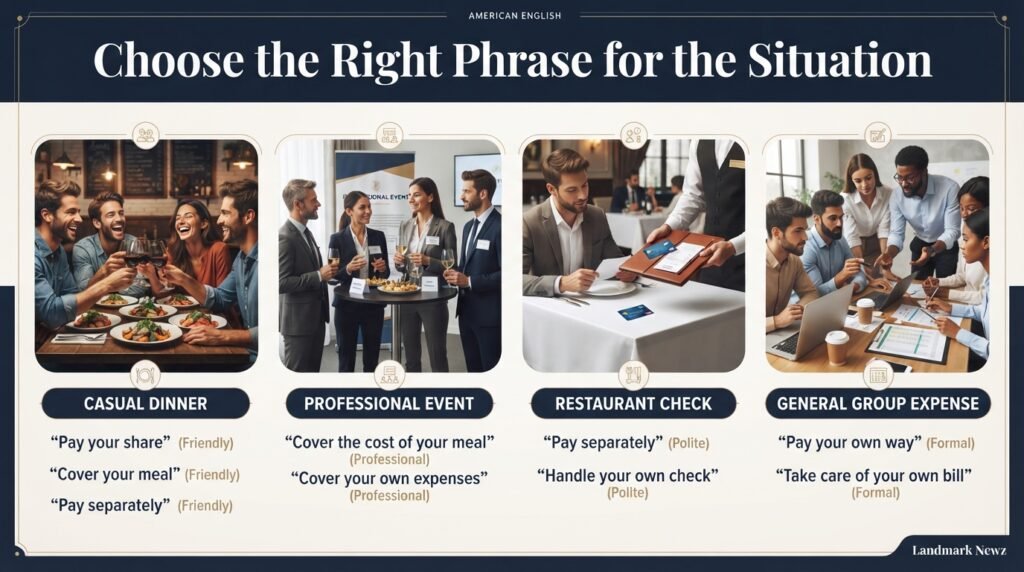
| Alternative | Best Used In | Tone |
| Pay your share | Group dinners | Friendly, polite |
| Cover your meal | Casual dining | Friendly, polite |
| Pay separately | Restaurants | Neutral, polite |
| Cover the cost of your meal | Events and invitations | Formal, professional |
| Take care of your own bill | Group dining | Casual, polite |
| Pay for your own food | Everyday conversation | Casual, direct |
| Handle your own meal | Work or casual settings | Neutral, direct |
| Pay your own way | General expenses | Casual, direct |
| Cover your own expenses | Business or events | Formal, professional |
| Handle your own check | Restaurant payments | Casual, polite |
Common Mistakes
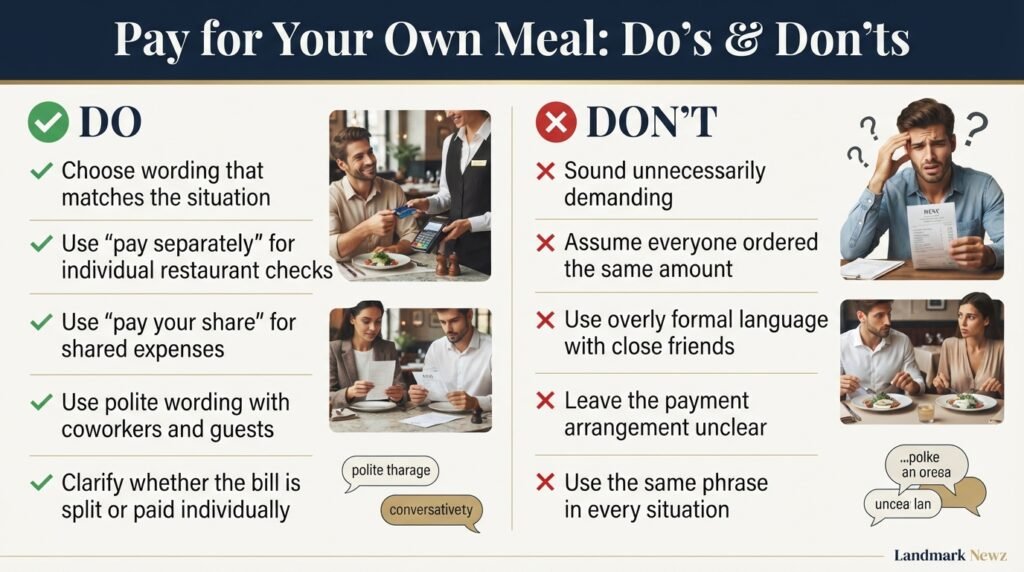
1. Using “Pay for Your Own Meal” When a Softer Phrase Fits
The original phrase is not incorrect, but it can sound blunt in some situations. If you are speaking to guests or coworkers, “cover the cost of your meal” may sound more considerate.
2. Assuming “Pay Your Share” Always Means an Equal Split
“Pay your share” can mean a fair portion rather than an identical amount. If everyone ordered different-priced meals, clarify whether people are paying individually or dividing the total equally.
3. Using Overly Formal Language With Friends
Phrases such as “cover your own expenses” may sound unnecessarily official during a casual dinner. “Pay separately” or “cover your meal” will usually feel more natural.
4. Forgetting to Clarify the Payment Arrangement
Simply saying that everyone should pay can leave people wondering whether the bill will be divided evenly or individually. State the arrangement clearly when money is involved.
5. Choosing a Phrase That Does Not Match the Situation
“Pay your own way” can cover many types of expenses, while “handle your own check” specifically points to a restaurant bill. Pick the expression that accurately describes what people need to pay for.
Frequently Asked Questions
What is another way to say “pay for your own meal”?
Common alternatives include “pay your share,” “cover your meal,” “pay separately,” “cover the cost of your meal,” and “take care of your own bill.” The best option depends on the situation. “Pay separately” is especially natural when explaining how a group will handle a restaurant check.
How do you politely say everyone pays for their own meal?
You can say, “Everyone can cover their own meal,” or “We’ll each pay for our own meals.” For a more polished message, try, “Each guest will be responsible for the cost of their meal.” These options make the arrangement clear without sounding unnecessarily harsh.
What is a polite way to say “pay your own way”?
“Pay your own way” is already a common expression, but “cover your own expenses” sounds more formal and professional. In a casual setting, you could say, “Everyone can take care of their own costs.” Choose the wording based on your relationship with the people involved.
Is “pay separately” the same as “pay for your own meal”?
They are closely related, but they are not always identical. “Pay separately” usually describes the payment method, such as getting separate checks. “Pay for your own meal” focuses on personal responsibility for the cost of what you ordered.
How do you say you are not paying for someone else’s meal?
You can say, “I’ll be paying for my own meal,” which sounds less confrontational than directly telling someone else to pay. Another option is, “Let’s each cover our own meals.” This frames the arrangement as a shared decision rather than a demand directed at one person.
What does “everyone pays their own way” mean at a restaurant?
It generally means that each person is responsible for their own expenses. At a restaurant, this often means diners pay for the food and drinks they ordered. However, the exact arrangement can vary, so it is helpful to clarify whether the restaurant will provide separate checks or divide the bill.
What is the best phrase for a professional event?
“Cover the cost of your meal” or “cover your own expenses” works well for professional events. These phrases sound neutral and respectful while clearly communicating that attendees are responsible for their own food costs. They are appropriate for event invitations, workplace communications, and registration information.
Is “take care of your own bill” rude?
Not necessarily. It is a common conversational expression, but its tone depends on how it is delivered and the relationship between the speakers. If you want a softer option, try “We’ll each pay separately” or “Everyone can cover their own meal.” These alternatives can sound less demanding.
Conclusion
There are many natural ways to say “pay for your own meal,” and the best choice depends on your audience and situation. For casual conversations, “cover your meal,” “pay your share,” and “pay separately” are simple and natural.
For professional settings, “cover the cost of your meal” or “cover your own expenses” provides a more polished tone. If you are specifically discussing restaurant checks, “handle your own check” makes the payment arrangement clear.
Remember that small wording choices can change how a message feels. When discussing money, aim for language that is direct enough to prevent confusion but polite enough to maintain a comfortable relationship. The right phrase makes the payment arrangement clear without making the conversation awkward. For more guidance, learn about choosing the right level of formality to match your wording to your audience and situation.

Language & Everyday Communication Specialist
Elena Voss is a language enthusiast and communication coach with over 9 years of experience helping people express themselves more naturally in English. She previously worked as an ESL instructor and corporate language trainer, guiding professionals and students on clearer everyday conversations, polite alternatives, and natural phrasing.
Elena specializes in practical synonym guides and “another way to say…” content that feels conversational rather than textbook. Her writing focuses on real-life situations — emails to friends, casual workplace chat, social media, and daily interactions. She believes the best language advice is simple, useful, and easy to remember.
When she’s not creating content for LandmarkNewz, Elena enjoys analyzing modern slang trends and testing new phrases in real conversations.