What Does “Another Way to Say a Lot Of” Mean?
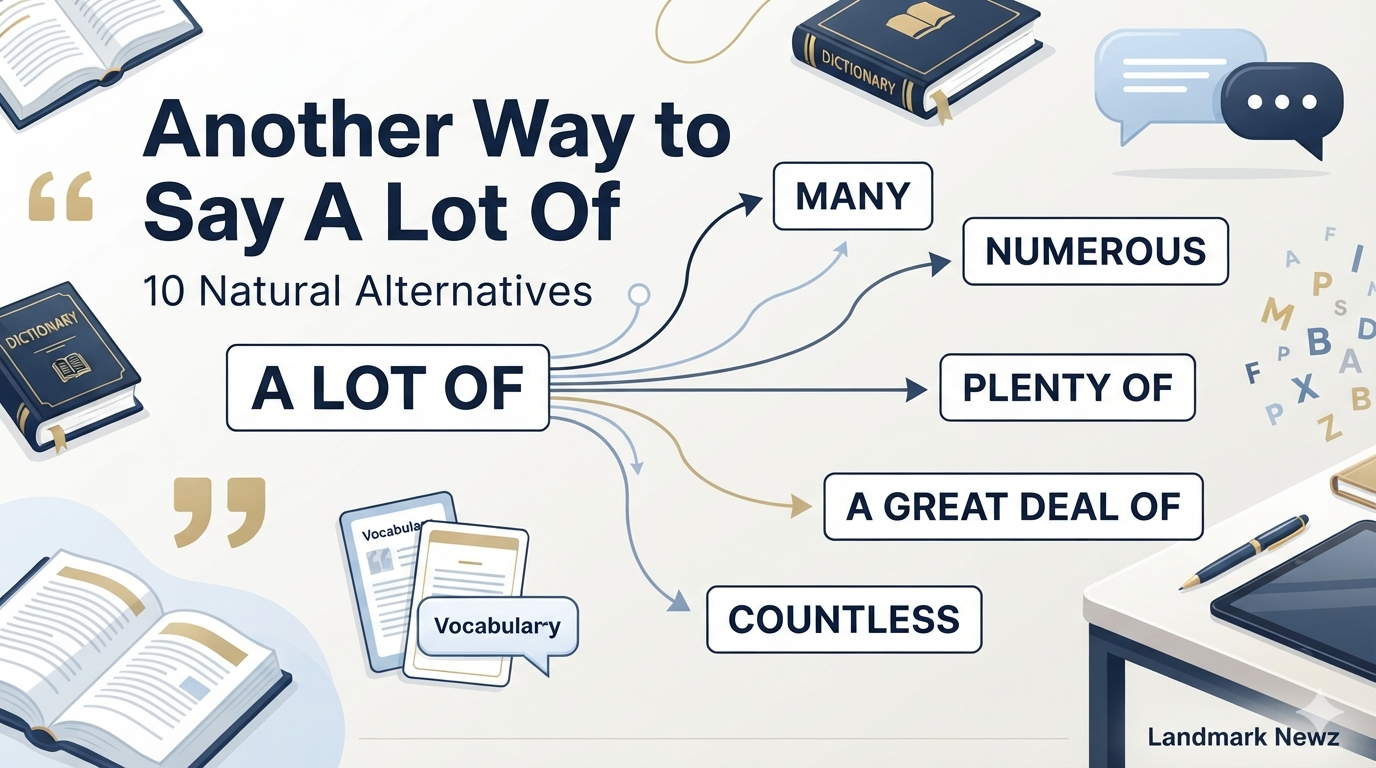
The phrase “another way to say a lot of” refers to alternative expressions that communicate a large quantity or number. People often search for these alternatives when they want to avoid repetition, improve their writing, or find wording that better fits a specific situation.
For example, instead of saying, “She has a lot of experience,” you could write, “She has extensive experience.” Similarly, “There are a lot of reasons” could become “There are many reasons.”
These alternatives appear frequently in essays, emails, resumes, business writing, academic work, conversations, and everyday messages.
Why Use Other Ways to Say “A Lot Of”?
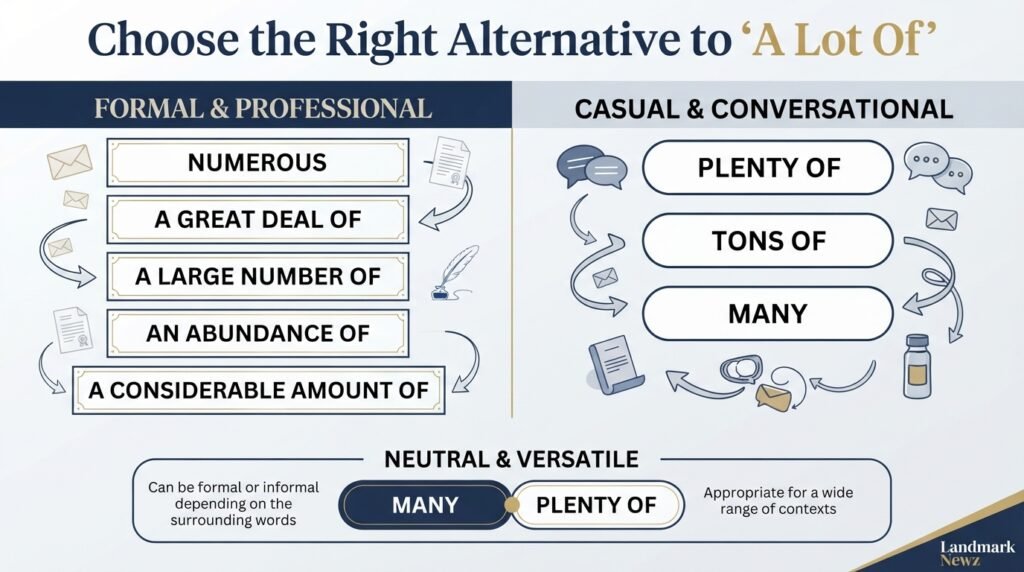
Using different expressions can make your writing more precise and natural. While “a lot of” is perfectly acceptable in everyday English, it may sound too informal or repetitive in some situations.
Consider another expression when you want to:
- Avoid repeating the same phrase.
- Make your writing more professional.
- Match formal or academic language.
- Sound more natural in conversation.
- Describe quantity more precisely.
- Make a sentence more engaging.
The key is not to replace “a lot of” automatically. Choose the alternative that best matches your meaning and audience.
10 Best Other Ways to Say “A Lot Of”
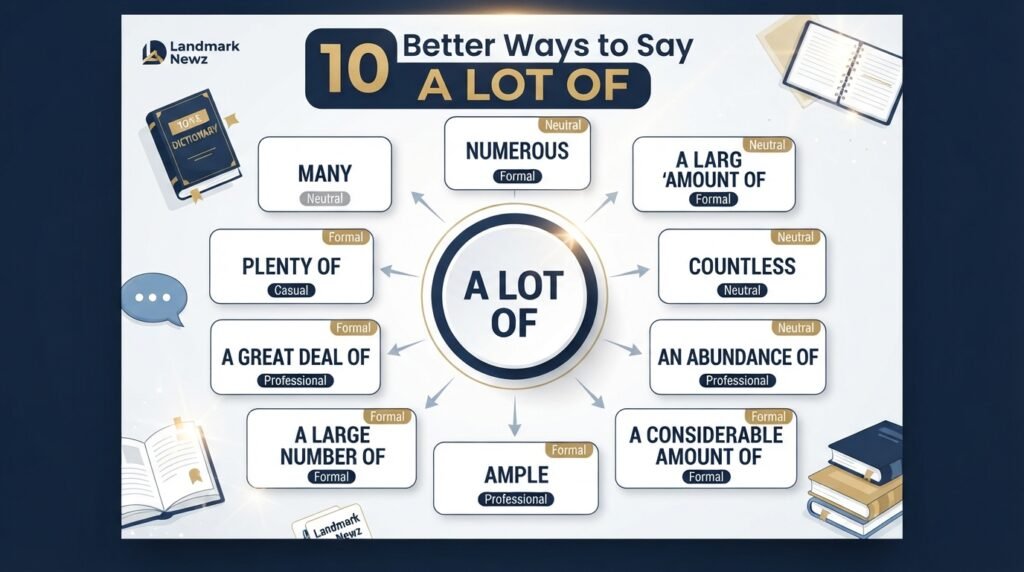
1. Many
Meaning
Many means a large number of people, things, or other countable nouns. It is one of the simplest and most versatile alternatives to “a lot of.”
Best For
- Professional
- Formal
- Casual
- Friendly
Example 1
Many customers prefer online shopping because it is convenient.
Example 2
We received many helpful suggestions during the meeting.
Quick Tip
Use many with plural countable nouns, such as “many books,” “many employees,” or “many opportunities.”
2. Numerous
Meaning
Numerous means a large number of something. It sounds slightly more formal than “many” and works especially well in professional, academic, and business writing.
Best For
- Professional
- Formal
Example 1
The company has received numerous applications for the position.
Example 2
Numerous studies have examined the effects of regular exercise.
Quick Tip
Use “numerous” when you want to emphasize quantity while maintaining a polished tone.
3. Plenty of
Meaning
Plenty of means more than enough or a large amount. It often has a positive or reassuring feeling, making it especially useful in everyday communication.
Best For
- Casual
- Friendly
- Warm
- Polite
Example 1
We have plenty of time to finish the project before Friday.
Example 2
There are plenty of restaurants to choose from in this neighborhood.
Quick Tip
Choose “plenty of” when you want to communicate abundance without sounding overly formal.
4. A Great Deal of
Meaning
A great deal of describes a large amount of something and is particularly useful with uncountable nouns. It has a more formal tone than “a lot of.”
Best For
- Formal
- Professional
- Polite
Example 1
The project required a great deal of careful planning.
Example 2
She has gained a great deal of knowledge through her experience.
Quick Tip
Use it with uncountable nouns such as time, effort, knowledge, attention, and work.
5. A Large Number of
Meaning
A large number of clearly communicates that something exists in high quantity. It is a straightforward choice for formal and informational writing.
Best For
- Professional
- Formal
Example 1
A large number of applicants submitted their resumes before the deadline.
Example 2
A large number of households now use smart home devices.
Quick Tip
Use this phrase with plural countable nouns when clarity matters more than conversational style.
6. Tons of
Meaning
Tons of means a very large amount or number. It is informal and conversational, so it works best when speaking with friends or writing relaxed content.
Best For
- Casual
- Friendly
Example 1
There are tons of great hiking trails around the city.
Example 2
I have tons of photos from our vacation.
Quick Tip
Avoid “tons of” in formal reports, academic papers, and professional applications unless the tone is intentionally conversational.
7. Countless
Meaning
Countless describes an extremely large number that is difficult or impossible to count. It can also emphasize the impressive scale of something.
Best For
- Formal
- Professional
- Warm
Example 1
She has helped countless families find affordable housing.
Example 2
Countless opportunities are available to people who develop strong communication skills.
Quick Tip
Use “countless” when the exact number is unknown or unimportant and you want to emphasize scale.
8. An Abundance of
Meaning
An abundance of means a plentiful or very large supply of something. It sounds polished and is often used in formal, descriptive, or professional writing.
Best For
- Formal
- Professional
Example 1
The region offers an abundance of natural beauty.
Example 2
The website provides an abundance of useful resources for new employees.
Quick Tip
Use this phrase when you want to emphasize that something is available in more than sufficient quantities.
9. Ample
Meaning
Ample means enough or more than enough. Unlike “a lot of,” it often focuses on sufficiency rather than simply describing a large quantity.
Best For
- Professional
- Formal
- Polite
Example 1
The team has ample time to review the proposal.
Example 2
The new facility provides ample space for additional equipment.
Quick Tip
Use “ample” when the quantity is not only large but also sufficient for a particular need.
10. A Considerable Amount of
Meaning
A considerable amount of describes a substantial quantity and gives a sentence a formal, measured tone. It is useful when you want to emphasize that something is significant.
Best For
- Professional
- Formal
Example 1
The renovation required a considerable amount of financial planning.
Example 2
He spent a considerable amount of time preparing for the presentation.
Quick Tip
Use this expression when you want to stress significance rather than simply say that something is plentiful.
Comparison Table
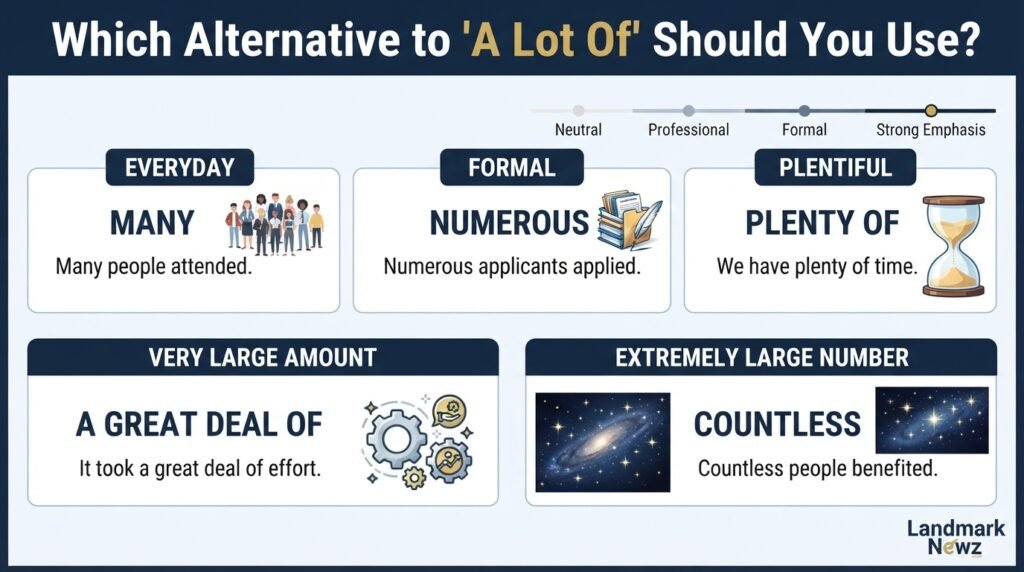
| Alternative | Best Used In | Tone |
| Many | Everyday and professional writing | Neutral |
| Numerous | Business and academic writing | Formal |
| Plenty of | Conversations and friendly writing | Casual |
| A great deal of | Professional and formal writing | Polished |
| A large number of | Reports and informational writing | Formal |
| Tons of | Casual conversations | Informal |
| Countless | Descriptive and professional writing | Strong |
| An abundance of | Formal and descriptive writing | Formal |
| Ample | Professional and practical contexts | Polished |
| A considerable amount of | Business and academic contexts | Formal |
Common Mistakes
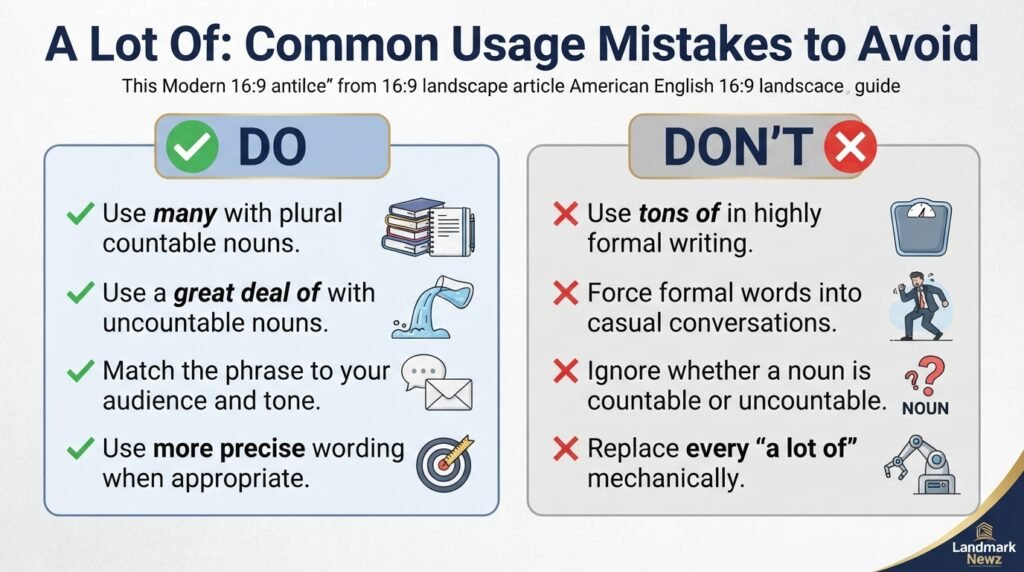
1. Using casual phrases in professional writing
Expressions such as “tons of” may sound too informal in a business email, resume, or academic paper. Choose “many,” “numerous,” or another professional alternative instead.
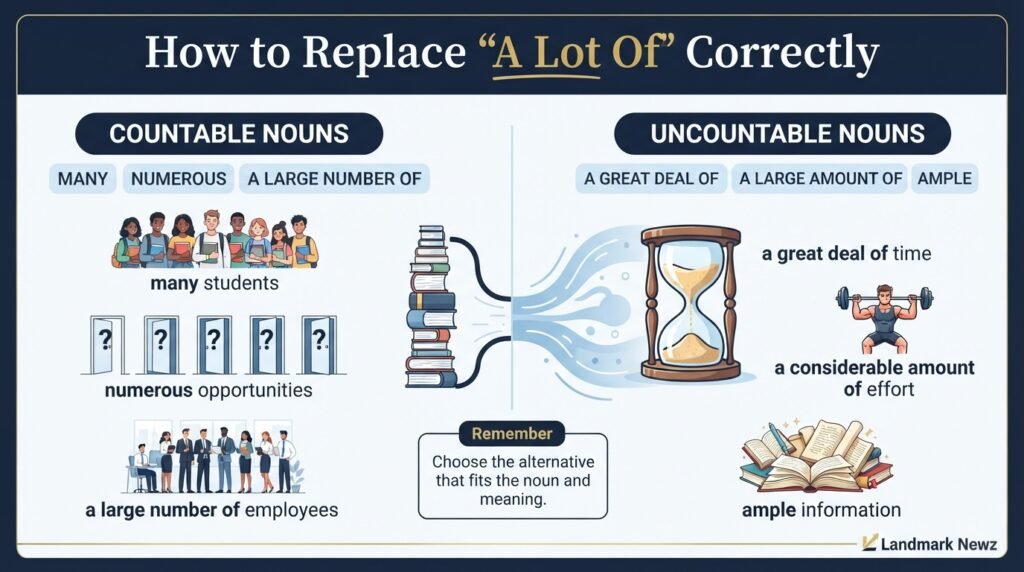
2. Choosing the wrong noun type
Some expressions work better with countable nouns, while others pair naturally with uncountable nouns. For example, “many employees” is correct, while “many information” is not.
3. Making every sentence overly formal
Replacing every instance of “a lot of” with “a considerable amount of” can make simple writing sound stiff. Use natural language when the situation is casual.
4. Ignoring the intended meaning
“A lot of” can simply mean a large quantity, while “ample” suggests more than enough and “countless” suggests an extremely large number. Consider the exact meaning before choosing an alternative.
5. Repeating one replacement
Switching from “a lot of” to “many” in every sentence does not solve repetition. Vary your wording naturally while keeping the meaning and tone consistent.
Frequently Asked Questions
What is a better word for “a lot of”?
There is no single best replacement because the right choice depends on context. Many works well with countable nouns, while a great deal of suits uncountable nouns in formal writing. In casual conversation, plenty of or tons of may sound more natural.
What is a formal way to say “a lot of”?
Formal alternatives include numerous, a great deal of, a large number of, an abundance of, and a considerable amount of. Choose based on the noun. For example, “numerous opportunities” sounds natural, while “a great deal of effort” is appropriate for an uncountable noun.
What is another way to say “a lot of” in an essay?
For essays, consider many, numerous, a large number of, a great deal of, or a considerable amount of. The best option depends on the sentence. Academic writing usually benefits from precise language instead of informal expressions such as “tons of.”
Can I use “many” instead of “a lot of”?
Yes. Many can replace “a lot of” when the noun is plural and countable. For example, “a lot of students attended” can become “many students attended.” However, “many” cannot normally replace “a lot of” before an uncountable noun such as “money” or “information.”
What is a casual way to say “a lot of”?
Common casual alternatives include tons of, loads of, and plenty of. “Tons of” is especially informal and conversational. For example, “There are tons of things to do this weekend” sounds natural among friends but may be too casual for a formal report.
What is another way to say “a lot of” on a resume?
On a resume, replace “a lot of” with specific, professional language whenever possible. Words such as numerous, extensive, significant, or substantial may work depending on the sentence. Even better, quantify your achievement when you can, such as “Managed 50+ customer accounts.”
Is “a great deal of” formal?
Yes. A great deal of has a relatively formal and polished tone. It commonly appears with uncountable nouns, including “time,” “effort,” “attention,” “experience,” and “research.” It is a useful choice for professional, academic, and formal writing.
Which alternative sounds the most natural?
Many is usually the safest neutral choice for countable nouns. Plenty of sounds natural in friendly conversation, while numerous works well in formal writing. The most natural alternative depends on your audience, the noun that follows it, and the overall tone of your sentence.
Conclusion
There are many useful alternatives to “a lot of,” but the best one depends on context. For everyday writing, many is simple and natural, while plenty of adds a friendly, conversational feel. In professional or academic writing, numerous, a large number of, and a great deal of can sound more polished.
If you want to emphasize an especially large quantity, countless or an abundance of may be stronger choices. When you mean more than enough, ample is often better because it communicates sufficiency as well as quantity.
The main goal is not to eliminate “a lot of” from your writing. Instead, choose the expression that conveys your exact meaning and matches your audience. Good word choice should make your writing clearer, more natural, and more precise. For additional guidance on choosing the right word, see Purdue OWL’s Diction guide.

Professional Writing & Workplace Communication Expert
Marcus Hale is a business communication specialist with 11 years of experience in corporate training and professional writing. He has worked with mid-sized companies and remote teams to improve clarity in emails, reports, performance reviews, and client-facing messages.
Marcus focuses on polished, professional alternatives that help readers sound confident without sounding stiff. His guides cover workplace phrases, resume language, leadership communication, and formal-to-natural transitions. He holds a background in business administration and technical writing, and has led workshops on effective professional English.
At LandmarkNewz, Marcus creates practical synonym lists and phrasing tips that professionals can apply immediately in emails, meetings, and career documents.